
What a Quality of Earnings Report Costs
Ryan Anoskey, CPA · 30 August 2026 · 11 min read
LIMESTONE Strategic Partners prices every quality of earnings report as one fixed fee, quoted in writing after a scoping call, for buyers and sellers of businesses earning $500K to $5M of EBITDA. The firm is in Carmel, Indiana.
Our fees are published: QoE Light from $10,000, Core from $15,000, Full from $25,000, and a Red-Flag Screen from $5,000 that is credited toward a full engagement. Light takes 10 to 15 business days, Core 10 to 20 and Full 15 to 25, counted from the last critical item on the request list. What moves the fee is the state of the books, the number of ledgers and how far back the work reaches, more than the size of the business.
Most of what you will pay for a quality of earnings report is decided before you call anybody: by the state of the books, the number of ledgers, and how far back the work has to reach. The firm you pick moves the fee less than any of those, and each of them has a price.
A searcher asked a question on a public forum. The thread had already run fifty-seven comments about quality of earnings reports. Then he asked the one that mattered. What level of review does a business that size actually need?
Silence.
I understand why. The honest answer starts with a range wide enough to be useless. Published prices for a lower-middle-market review run from $3,900 to $25,000 and above. That is not one market. It is four different products wearing one name.
So take the products first, then take your own deal. Most of your number is already set, and it was set by the seller. By how many bank accounts they opened, whether anybody ever closed a month, and whether a filed tax return ties to the books. None of that moves when you shop.
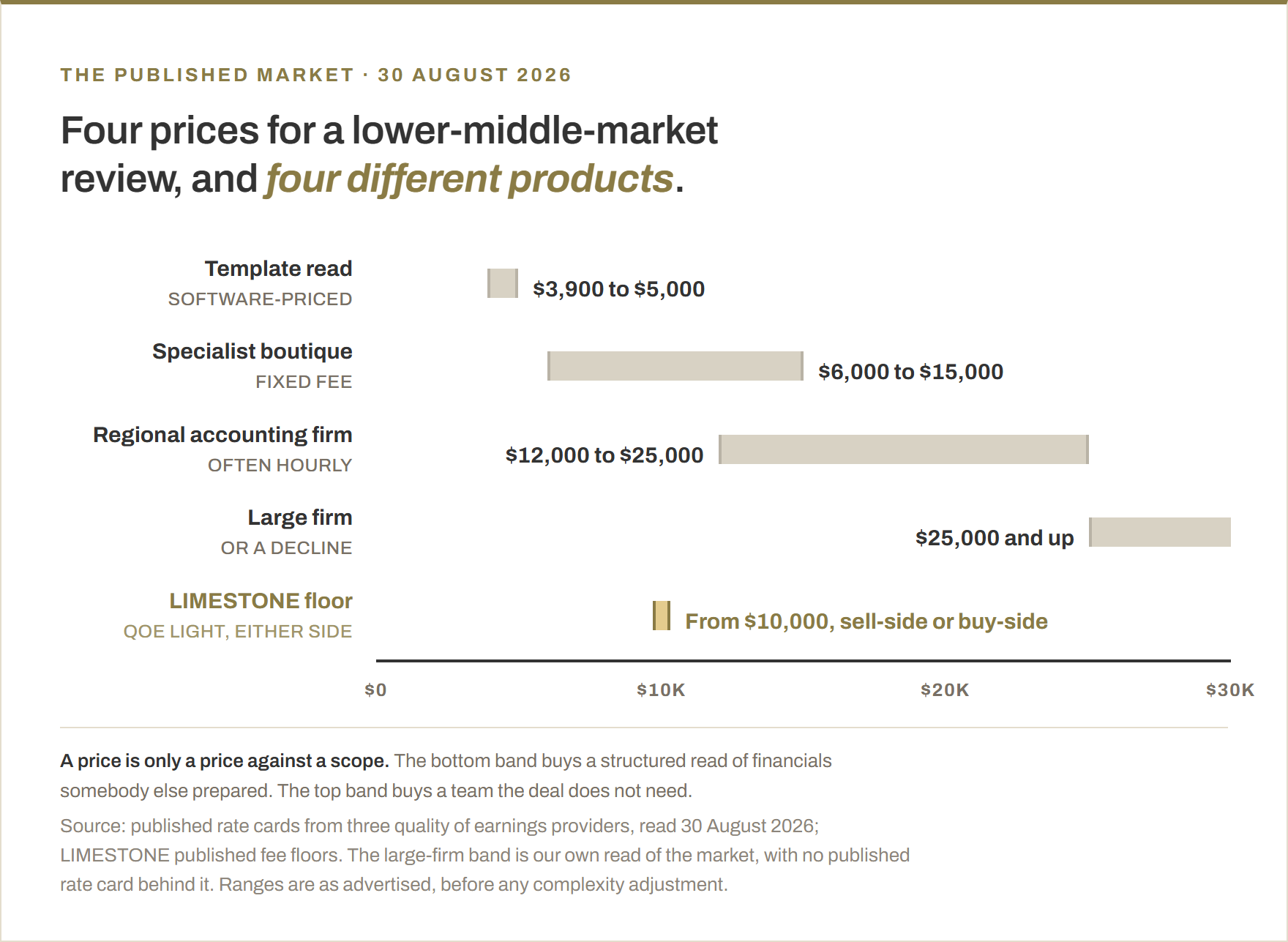
Our $10,000 Light floor sits in the specialist boutique band, where a fixed fee buys a tested review.
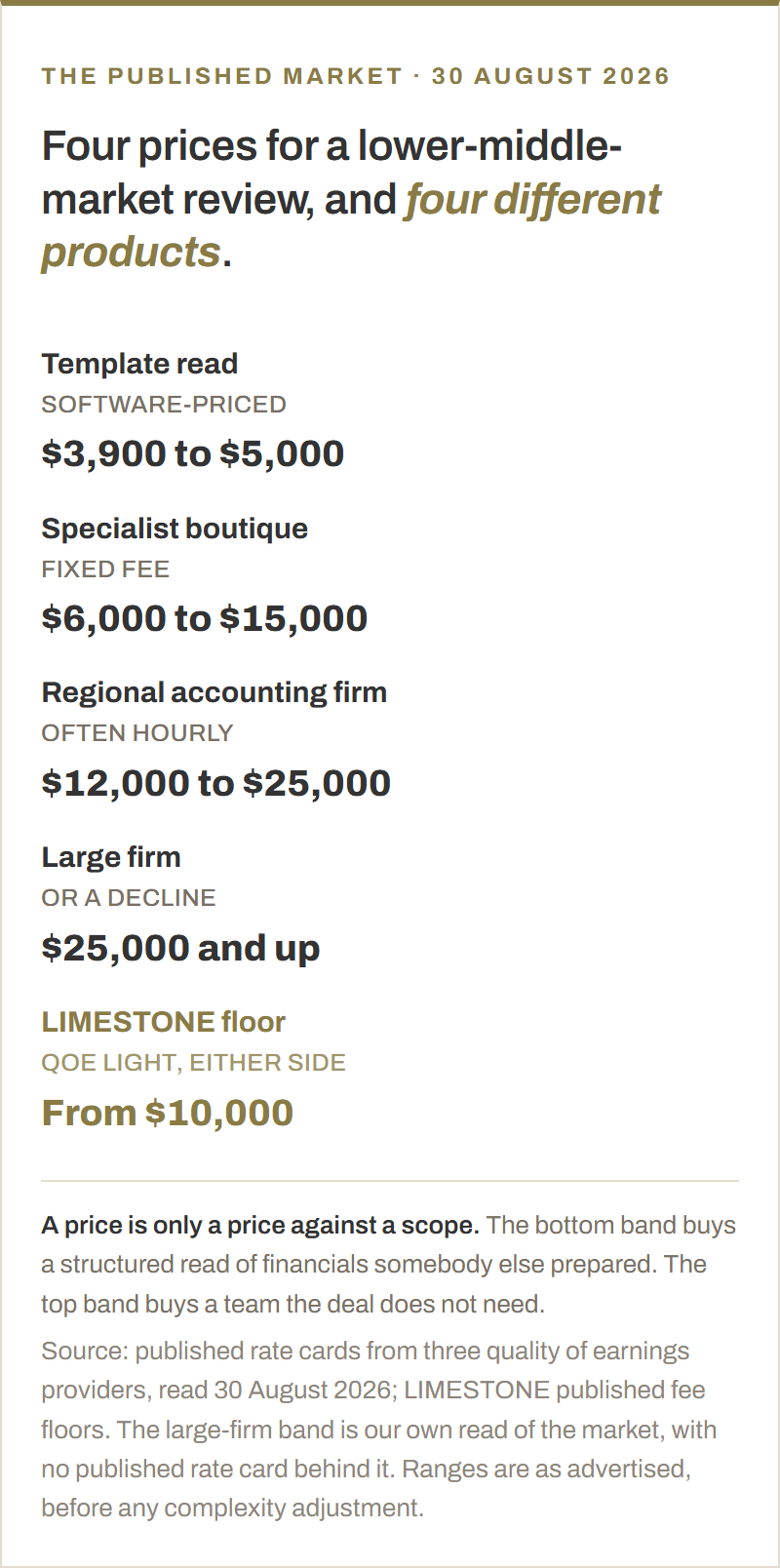
Our $10,000 Light floor sits in the specialist boutique band, where a fixed fee buys a tested review.
What the market charges, and for what
Four price points, and four genuinely different things being sold.
Under $5,000. Software-priced and template-driven. One provider calibrated to acquisitions between $300,000 and $5M publishes a $3,900 entry tier and a $5,000 comprehensive one. At that price you are buying a structured read of financials somebody else prepared. It has a real use, as a different product from a tested review.
$6,000 to $15,000. The specialist boutique band. Fixed fee, one practitioner in the file, two to three weeks. A volume provider publishes $6,997 for a standard review and $15,000 for a comprehensive one. The same provider sells a $349 screen of the offering memorandum and a $1,999 lite report, which sit below this band because they are not reviews.
$12,000 to $25,000. The regional accounting firm. One publishes $12,000 to $15,000 for a simple single-location business under $2.5M of revenue, $14,000 to $23,000 under $10M of enterprise value, and $25,000 and up above that. Hourly billing is common in this band, and so are overruns.
$25,000 and up. The large firms. On a lower-middle-market deal most of them decline the file outright, because it sits under the minimum their model needs to work. When one does take it, you are paying for a staffing model built for transactions many times the size.
Our Light floor sits inside the second band: Light reviews start at $10,000, sell-side or buy-side, with Core from $15,000 and Full from $25,000. Where a lender relies on the report, that reliance is a liability we take on and therefore price.
Size is not what makes it expensive
Ask most buyers what drives the fee and they say deal size. It is the wrong variable.
A business throwing off $5M of EBITDA from one location with ten people on the payroll is a straightforward file. A business throwing off $1M of EBITDA across thirty locations runs several times longer, and it is the smaller company.
Complexity is the variable. Size matters only because it usually drags complexity along with it, and on plenty of deals it does not.
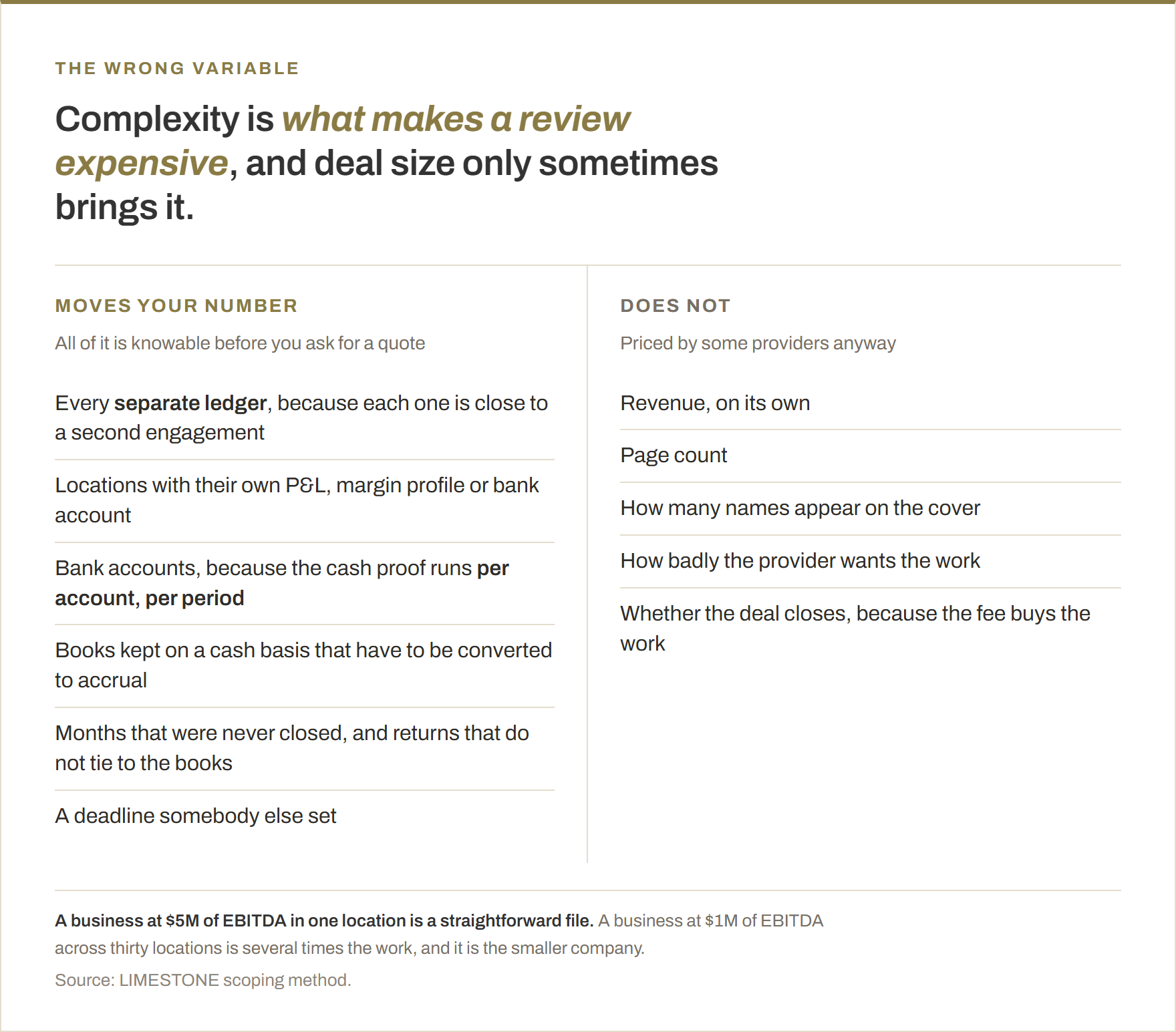
Six things move the fee, and every one of them is knowable before you ask for a quote.
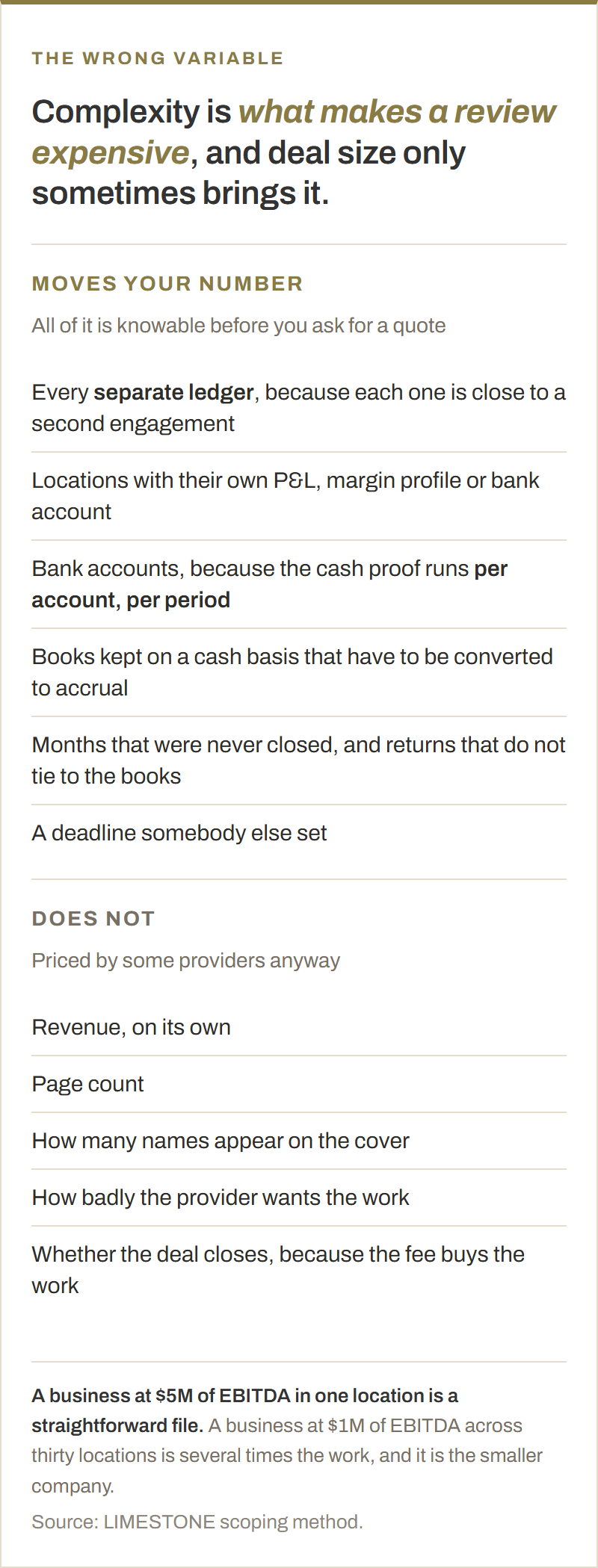
Six things move the fee, and every one of them is knowable before you ask for a quote.
The counts that set your price
We build a fee from counts. Every one of these can be established on a thirty-minute call or from the first trial balance. That is the point of them. Guessing here is where a fixed fee goes wrong, and it goes wrong in the provider’s favor or in yours, never neutrally.
Entities. Each separate ledger is close to a second engagement. Ask whether they consolidate, and whether the consolidation is real or a spreadsheet somebody maintains by hand.
Financial statement sets. Entities multiplied by periods. This is the number that actually drives the work and it is the one everybody forgets. Three entities across three years and a stub period is twelve sets.
Locations that need separate review. Not addresses. Locations with their own profit and loss, their own margin profile, their own bank account or manager, which a buyer is going to price separately. This single answer can double the analysis.
Bank accounts. The proof of cash runs per account, per period. Four accounts across three years is twelve reconciliations before anybody has formed an opinion about anything.
Accounting basis. Cash, accrual, or cash with adjustments bolted on at year end. After the cash proof, a conversion from cash accounting to accrual is the most time-consuming thing that can land on a fee. On contractor books it is the most common single reason a file is not reviewable as delivered, and the work runs from a handful of reclasses to rebuilding the books. That is why we price it separately instead of burying it in a scope. Folded into a fixed fee, it is the item most likely to force a renegotiation halfway through.
Periods. How far back the cash proof has to reach. A three-period reconstruction is the heaviest single item in any engagement. It gets quoted, never absorbed.
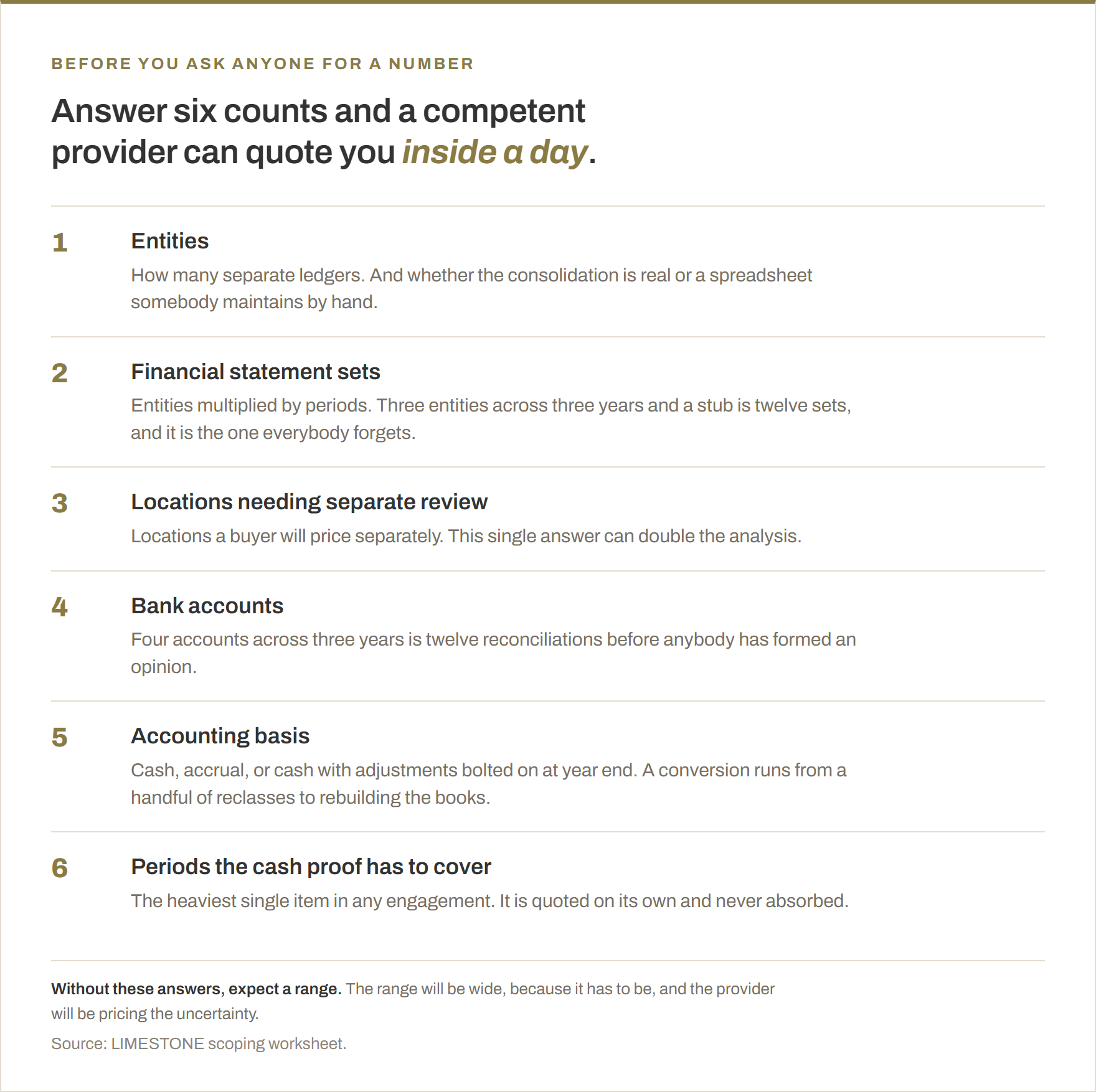
Answer these before you call anybody, and the quote stops being a guess.
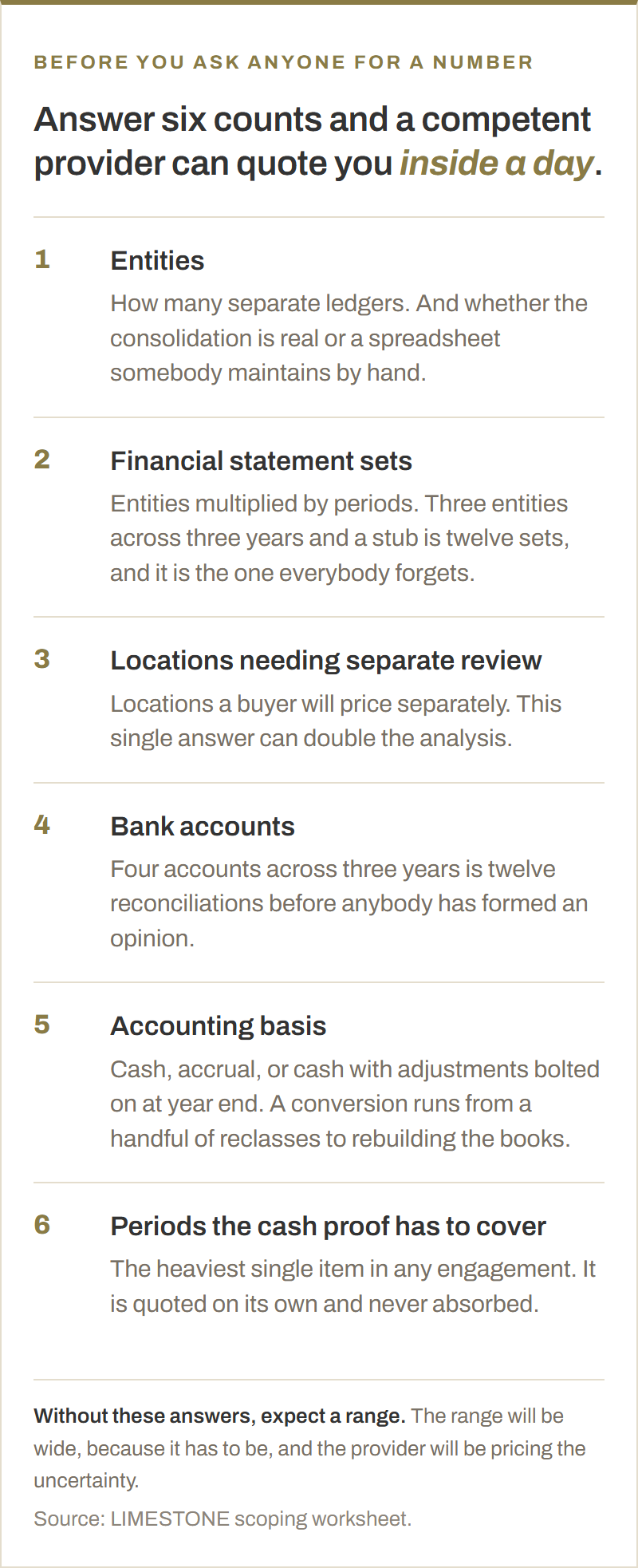
Answer these before you call anybody, and the quote stops being a guess.
Those counts produce a base. What happens to the base from there is arithmetic, and it is worth knowing the arithmetic before somebody applies it to you.
| What triggers an adjustment | What it does to the fee |
|---|---|
| More than one entity | +20% to +100%. A shared system with a real consolidation sits near the bottom. Fully separate ledgers and bank accounts is close to two engagements. |
| A location that needs its own review | +25% to +50% for each one. |
| Poor records | +30% to +50%. Beyond that the work is a cleanup, quoted on its own. |
| More than 300 active general ledger accounts | +10% to +20%, for mapping and the add-back scan. |
| A regulated or complex industry | +20% to +40%. |
| Delivery inside ten business days | +$3,500. |
| A cash proof period beyond the scope | Quoted on its own. Never absorbed. |
| Converting cash-basis books to accrual | Quoted on its own, because the work runs from a few reclasses to rebuilding the books. |
Two things about that table. The adjusters compound, so a multi-entity file on poor books in a hurry is a materially different engagement from a clean one. And past a point they stop applying at all: if the records are worse than poor, the right purchase is a cleanup first, quoted on its own, and then a review that costs less because the books are straight.
What the SBA report costs
From 1 October 2026, an SBA lender must have an independent quality of earnings on any 7(a) initial acquisition or business expansion where the business purchase price is $3M or more. The lender can engage it, or rely on one the buyer commissioned once one of its approved vendors has reviewed it; a report prepared by or for the seller never counts. I have written separately on who orders the QoE on an SBA deal, because that part surprises people.
I have not been able to find anyone who has published what one of these costs. So here is ours.
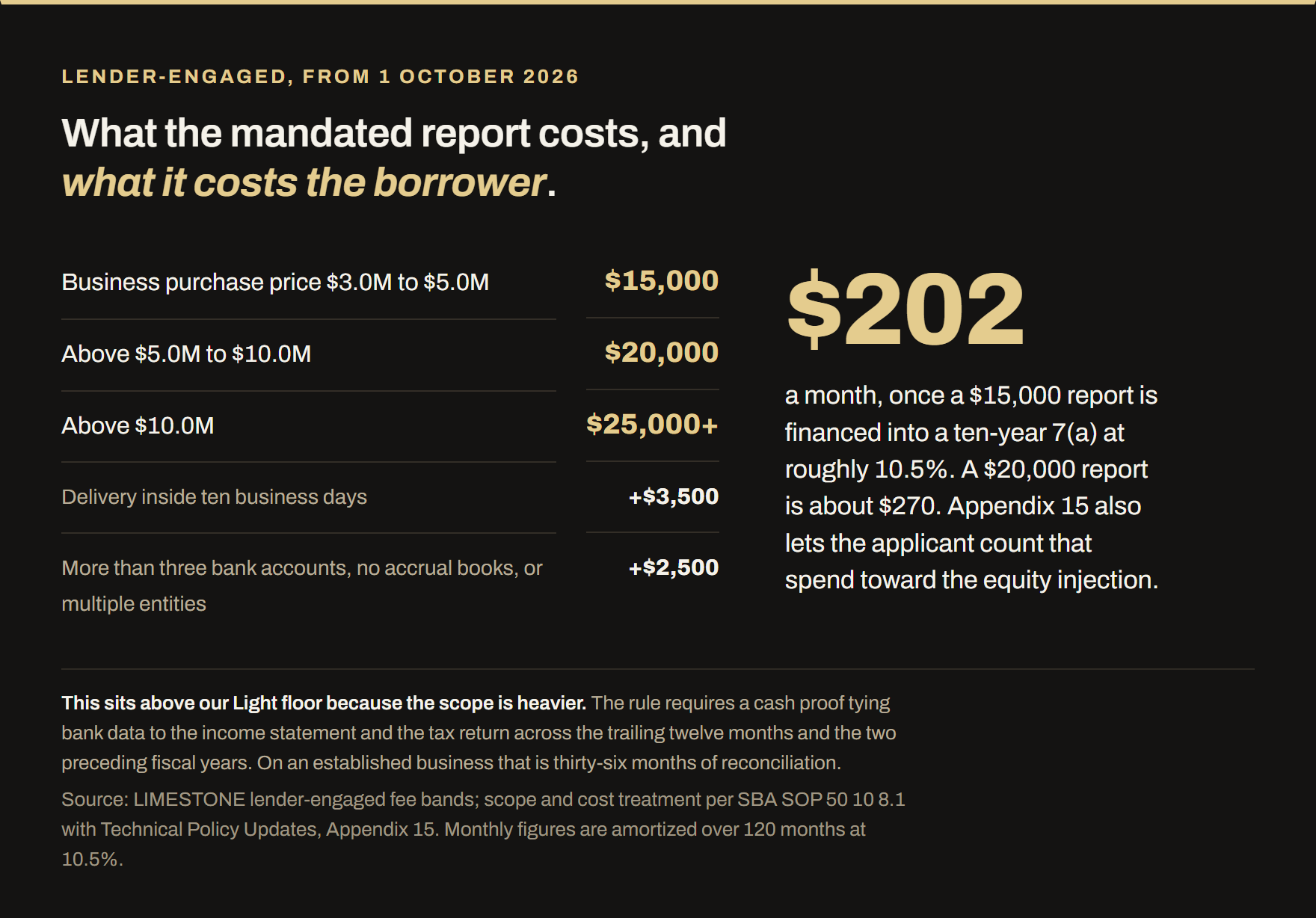
Financed into the loan, the mandated report costs the borrower about two hundred dollars a month.
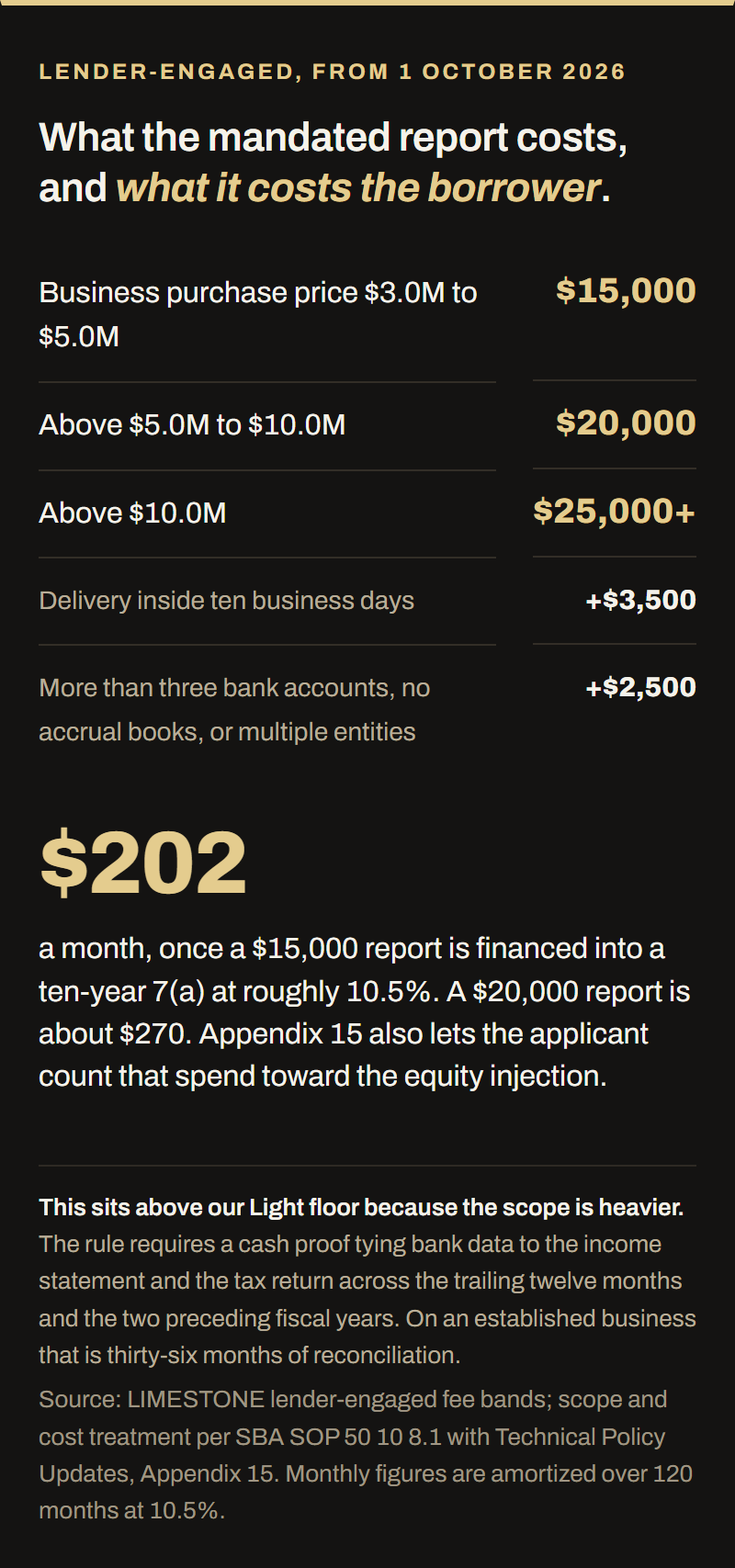
Financed into the loan, the mandated report costs the borrower about two hundred dollars a month.
That sits above our Light floor and it should, because the mandated scope is heavier. It requires a cash proof reconciling bank data to the income statement and to the tax return, on a trailing twelve-month basis and across the last two fiscal years, reduced where the business has operated for less than two years. On an established business that is thirty-six months of bank reconciliation, and it is the largest single driver of effort in the file.
Now the number that matters to a borrower. A $15,000 report financed into a ten-year 7(a) at roughly 10.5% costs about $202 a month. A $20,000 report costs about $270. Appendix 15 also permits the cost to be passed through to the borrower, and permits what the applicant spends on the report to count toward the equity injection.
So the fee is real, and it is not the thing that decides the deal.
One warning that price will not solve. A report you commissioned counts toward the rule only after one of the lender’s approved vendors has reviewed it, however much it cost and however good it is. If you are buying a business above the threshold and you have already paid for a review, ask your lender whether it will put your report through that review before you pay for anything else.
When you should not buy one
Four situations where the answer is no, or not yet.
When the threshold does not actually reach you. The $3M test is the business purchase price and it strips out owner-occupied commercial real estate. A $3.6M deal carrying $900,000 of building is a $2.7M business purchase price, and it triggers nothing. The threshold is also measured before buyer equity and seller debt, so you cannot structure your way under it, and you should not assume you are over it either. Check the number before you budget for a mandated report you do not need.
When you are still deciding whether to keep going. Pre-LOI the question is usually go or no-go. A Red-Flag Screen answers it in five business days, starts at $5,000, and we credit it against the full engagement if the deal proceeds. Buying the full review to answer a screening question is the most common way people overspend here.
When you are buying it for a higher multiple. GF Data looked at 360 transactions completed since the third quarter of 2024 and found the valuation benefit of a sell-side review in deals above $50M of enterprise value; smaller deals did not see a valuation lift at all. So if somebody is selling you a sell-side review on the promise of a better multiple on a $4M business, the data does not say that. Buy it for speed, for certainty, and to stop a retrade in week six of diligence. Those are worth real money, and at this size they are the whole argument.
When the books need a cleanup first. If nobody has reconciled a bank account in two years, a quality of earnings is the wrong first purchase. Straighten the books, then buy the review. It will be a better review and it will cost less. Taken on as it stands, that engagement ends in one of two places: a change order, or a thinner review than you paid for.
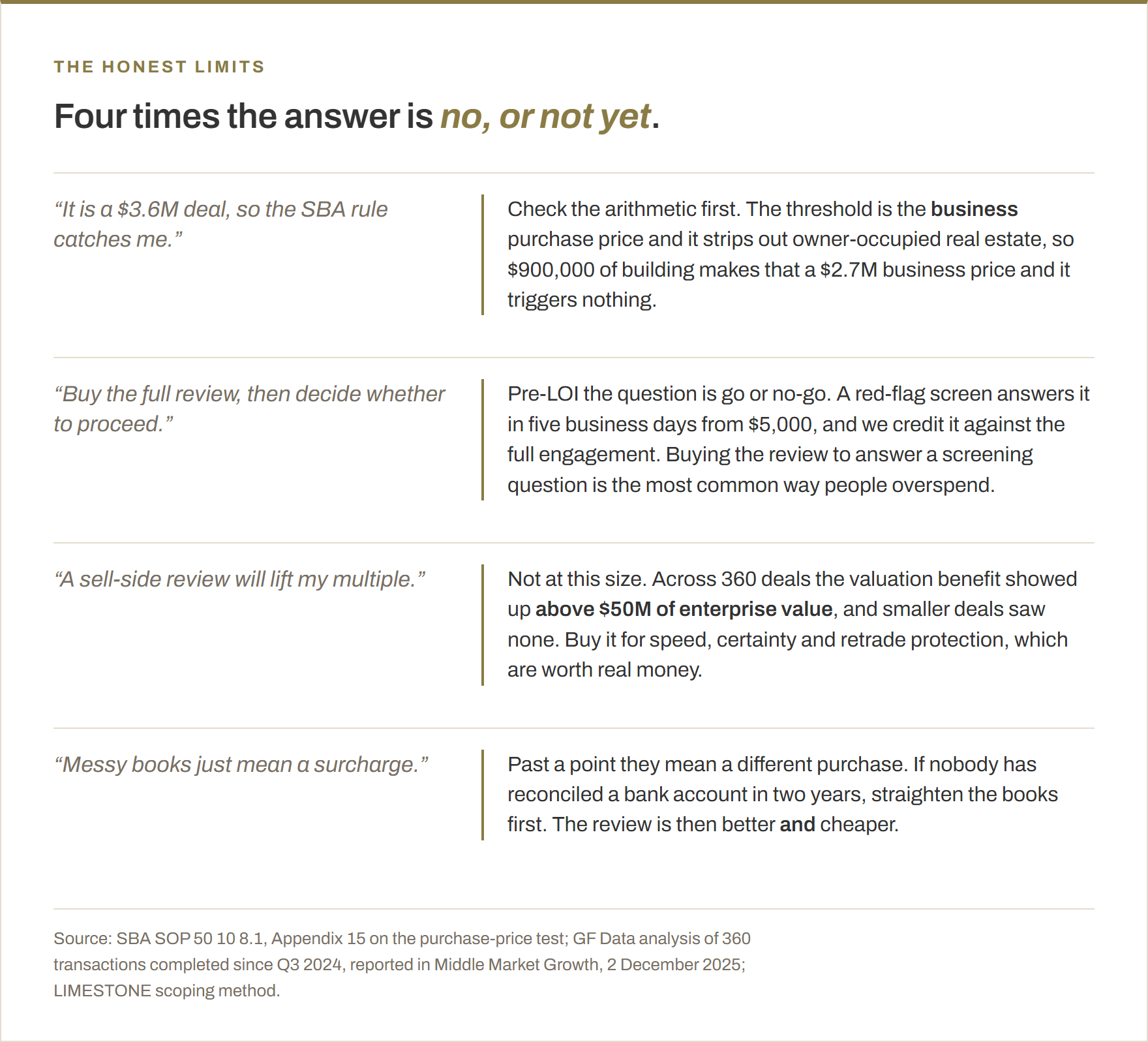
Each of these is a situation where we tell people not to buy the review.
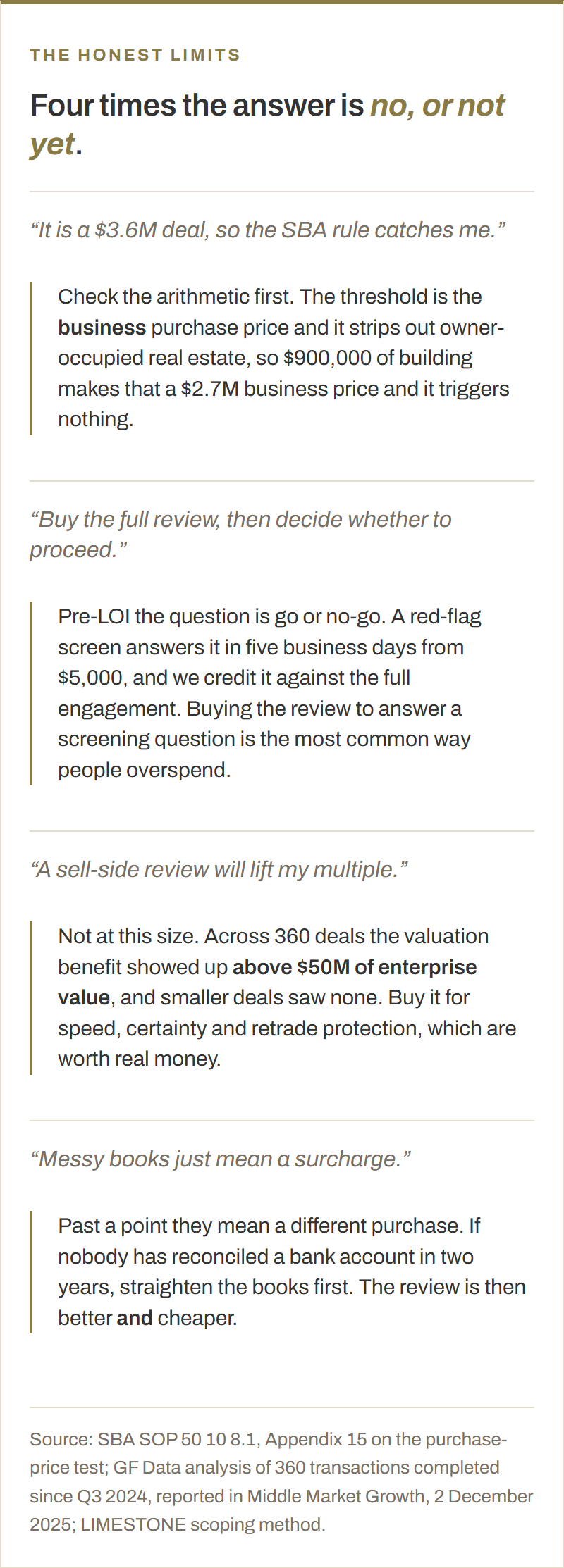
Each of these is a situation where we tell people not to buy the review.
What the floor buys
A price only means something against a scope, so here is what the $10,000 Light floor actually buys.
Included at the floorPriced separatelyNormalized seller’s discretionary earnings and adjusted EBITDA, with the bridge between themConverting cash-basis books to accrualThe waterfall from the filed tax return through to adjusted EBITDA, every reconciling item shownCash proof periods beyond the scopeA tested add-back schedule, including the items we rejectedTax diligenceProof of cash, bank to bookOperational and commercial diligencePayroll tie, register to the profit and lossA named reliance letter for a third partyOwner compensation set to a market rateCleanup beyond a light passRevenue trend and top-ten customer concentrationA written verdict on whether the earnings holdThe report, the exhibit book, and the Excel model every number traces back to
One point on report length, because it gets used as a proxy for value and it is a bad one. A thirty-page report and a fifteen-page report on the same $4M business usually differ by fifteen pages of boilerplate. What you are paying for is the testing behind the exhibits and the willingness to write down what failed the test. Some accounting firms will pitch you a $25,000 engagement that includes a set of analyses the deal does not require. The right scope gives you everything you need and nothing you do not, and a provider who cannot tell you which is which has not scoped your deal.
What automation changes, and what it does not
Something is shifting underneath this work, and it belongs in an article about price.
Roughly half of a quality of earnings engagement is mechanical. Pulling a general ledger, mapping a chart of accounts, tying a payroll register to the profit and loss, reconciling bank statements to book. It is careful work and it is not judgment. Direct connections into accounting systems and structured extraction are already taking time out of that half, and we are building toward it. We use AI in the work today and we are upfront about what for: it collects and it summarizes, and the opinion stays with the partner who reaches it.
The other half does not compress. Whether an add-back is real, provable and defensible is a judgment. Whether a credit committee accepts it is a second judgment, and that one is not written down anywhere for a model to read. A firm puts its name on the report. Somebody sits in the room when a buyer asks why an adjustment was rejected.
So expect the mechanical half of the fee to come down over time. I do not expect the judgment half to. On lender-engaged work the new rule has made independence and accountability the actual product, and neither of those is a processing task.
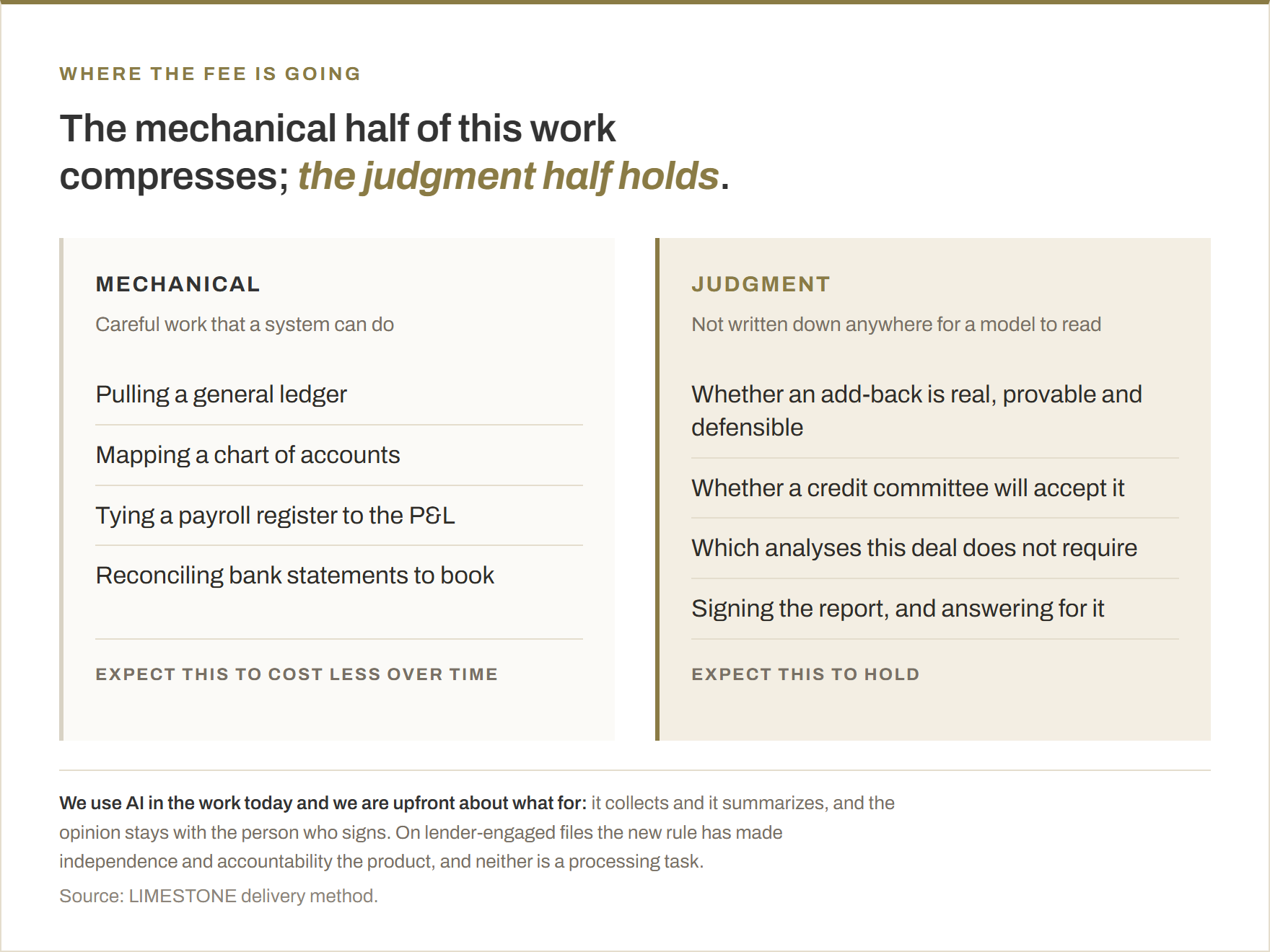
The judgment half of the fee holds while the mechanical half automates.
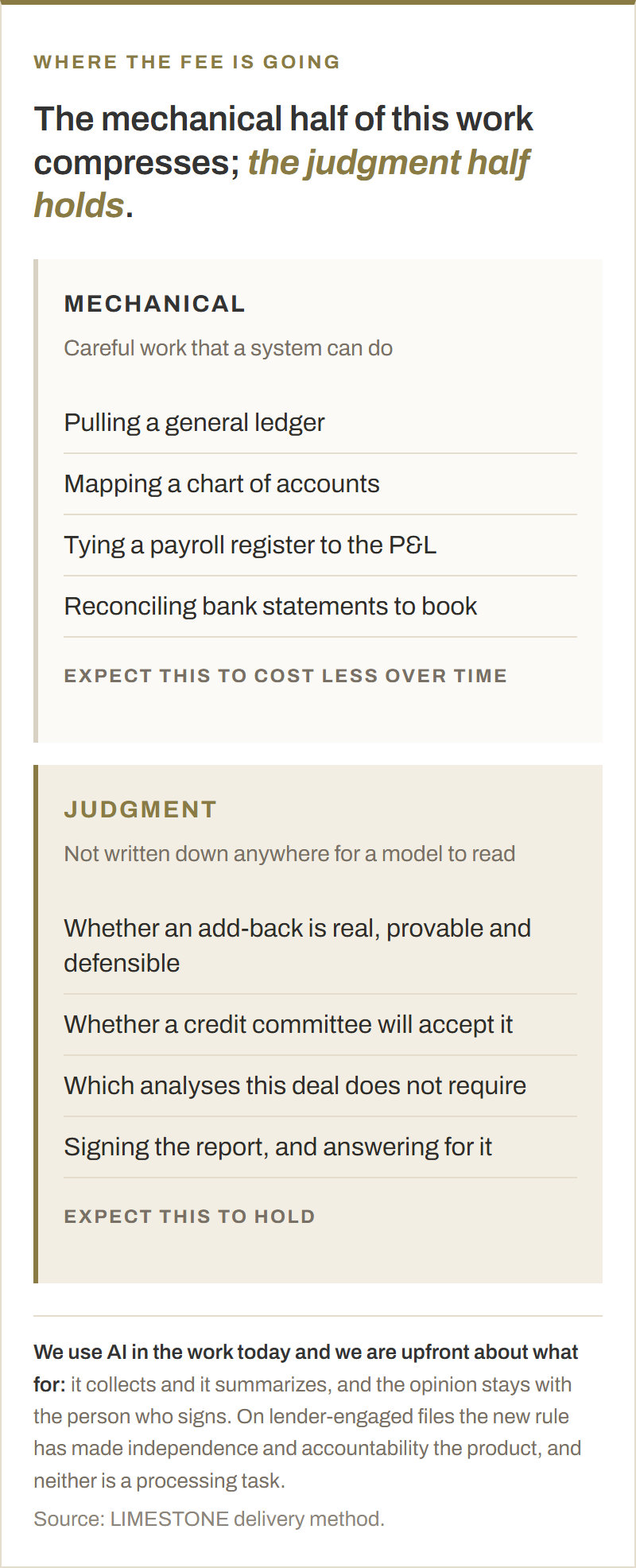
The judgment half of the fee holds while the mechanical half automates.
Questions we get
Does it cost more when a lender relies on the report? Sometimes. Light starts at $10,000 on either side, and the fee moves with the counts above. When a lender will rely on the report we carry a liability for that, and a reliance letter to a named lender is priced separately. Information friction matters too: on a sell-side file the client controls the data room, and on a buy-side file you are waiting on somebody with other priorities.
Is a fixed fee always better than hourly? For this work, yes, and not because hourly firms are doing something wrong. A fixed fee puts the risk of a messy file on the provider, which is where it belongs, because the provider is the one who is supposed to be able to read a trial balance and predict the work. It also removes the incentive to take longer.
Will a cheaper report still be accepted by my lender? Lenders set their own requirements, so no honest firm can promise you that. They look at who engaged the firm, whether the preparer is credentialed and independent, and whether the earnings figure is supported well enough to underwrite from. On an SBA deal at $3M or more, a report you commissioned also needs a review by one of the lender’s approved vendors.
How fast can you tell me my number? Usually within a business day of a short call. We answer the counts above, quote one fixed fee, and put the scope in writing before anything starts.
Want the number for your deal? Tell us the shape of it. The entities, the locations, the bank accounts, the basis, and how far back the work has to reach. We come back with one fixed fee and a written scope. If you are earlier than that, the three worth reading are what a buyer’s quality of earnings review checks, what a lender needs to see, and what a quality of earnings report will not tell you.
Ryan Anoskey is a CPA and a partner at LIMESTONE Strategic Partners. He has run more than 100 quality of earnings engagements, buy-side and sell-side, across manufacturing, healthcare, contracting and multi-site roll-ups.
Sources: published rate cards from three quality of earnings providers, reviewed 30 August 2026, with the large-firm band our own read of the market and no published figure behind it; GF Data analysis of 360 transactions completed since Q3 2024, reported in Middle Market Growth, 2 December 2025; SBA SOP 50 10 8.1, Appendix 15 (issued 14 August 2026, with technical policy updates published 25 September 2026, effective 1 October 2026) on the purchase-price threshold, the mandated cash proof, and the treatment of diligence costs; LIMESTONE scoping method and published fee floors.