
The QoE You Already Paid For May Not Count
Ryan Anoskey, CPA · 30 August 2026 · 10 min read
LIMESTONE Strategic Partners prepares quality of earnings reports that SBA 7(a) lenders can order directly, from Carmel, Indiana, on acquisitions of businesses earning $500K to $5M of EBITDA.
The lender orders it. From 1 October 2026 a 7(a) lender must have a quality of earnings report on any initial acquisition or business expansion at a $3 million business purchase price, obtained by the lender. Since SBA’s 25 September update a report the buyer paid for can count once the lender’s own vendor has reviewed it; the SOP text still describes only that review, so ask your lender what it will accept before you commission anything.
From 1 October 2026, an SBA lender must have a quality of earnings report on any 7(a) Initial Acquisition or Business Expansion at a business purchase price of $3 million or more. Since SBA’s 25 September update, a report you commissioned can count, once one of the lender’s approved vendors has reviewed it. A report prepared for the seller never can.
If you are buying a business at $3 million or more with a 7(a) loan, and you have already paid for your own quality of earnings report, there is a paragraph in the new SBA rules you should read before you budget the rest of the deal.
It says your lender cannot rely on that report until one of the lender’s own vendors has reviewed it.
That rule takes effect on 1 October 2026, and it decides whether you pay for one report and a review, or for two reports.
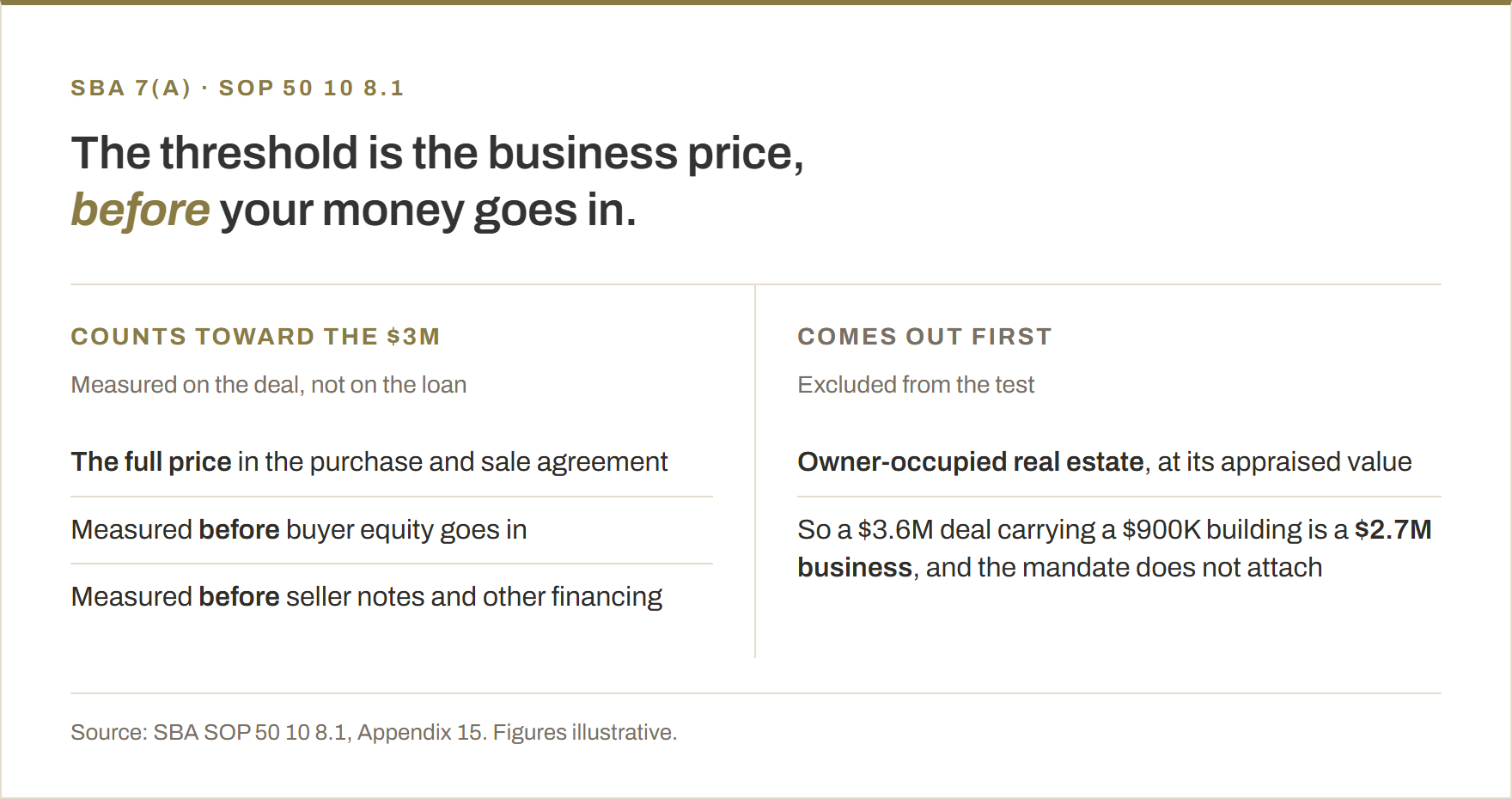
The building comes out first, at its appraised value, so a deal that looks like it is over the line can land under it.
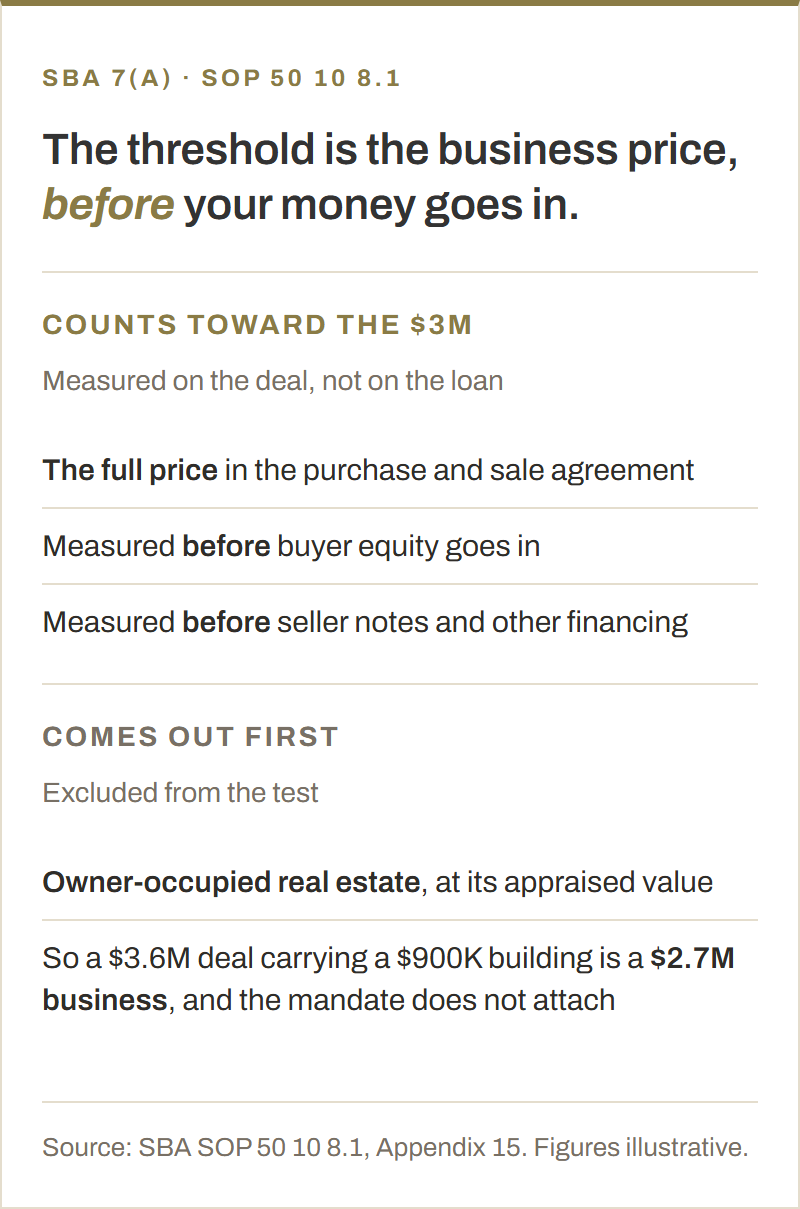
The building comes out first, at its appraised value, so a deal that looks like it is over the line can land under it.
What the rule says
SOP 50 10 8.1 was issued on 14 August 2026 under Information Notice 5000-880695, and SBA published technical updates to it on 25 September under Information Notice 5000-882227. The updated text applies to applications SBA receives on or after 1 October 2026.
The operative sentence is short:
“For Business Expansion and Initial Acquisition transactions where the Purchase Price as defined in Paragraph A.1 is equal to or greater than $3 million, the Lender must also obtain a Quality of Earnings (QoE) in addition to the required Business Valuation.”
The Lender must obtain it. Who commissions it is a separate question, and the update answers that one.
Then the independence clause, which is the one that catches people:
“The QoE must be performed by an independent, experienced financial professional and must be conducted for the benefit of the Lender. As the QoE report is part of the financial due diligence of the transaction, the report must not be prepared by or for the seller.”
Until 25 September that sentence also named the borrower. It now names only the seller, and the update adds the route for everyone else: the lender “may elect to have that report reviewed by one of their approved vendors,” the findings of that review go in the loan file with the original report, and “the Lender may not rely upon a QoE report prepared by another party without a review being performed by one of their vendors.” Searcher, strategic buyer, family office, the route is the same, and the lender decides whether to take it.
Three details worth having straight, because they change who this applies to.
The $3 million is the business price, measured before your money. The SOP: “The $3 million threshold is determined before the application of buyer equity, seller debt, or other financing sources.” So a $3.4 million business bought with $1 million down is a $3.4 million deal for this test.
Real estate comes out first. “The Business Purchase Price excludes all owner-occupied commercial real estate assets being acquired in the transaction.” Where property is part of the deal, the lender removes the appraised value of the real estate from the purchase and sale agreement price, and tests what is left. A $3.6 million deal with $900,000 of building in it is a $2.7 million business, and the mandate does not attach.
Owner buyouts are exempt. The SOP excludes Owner Buyout and ESOP and Cooperative transactions, and it says why: “the existing owner(s) retain operational knowledge of the business and the transaction does not result in a change to the management or operating structure.” The rule is aimed at the information gap between a departing seller and a buyer who has never run the business. An owner buying out a partner does not have that gap. The update widened the exemption in two places: an employee of 24 months or more can now buy a single owner out entirely as an Owner Buyout, and a deal built around an owner-occupied special purpose property, such as a hotel or storage facility that cannot be separated from the business, needs no quality of earnings report at any price.
Who may prepare it
| Who commissioned the report | Satisfies the mandate? | What it is still good for |
|---|---|---|
| The lender | Yes. The lender’s own engagement, conducted for its benefit. | Everything below, plus the debt service coverage calculation. |
| The buyer, before or after the LOI | With a review. One of the lender’s approved vendors reviews it, and the review goes in the file with it. | Price negotiation, walking away, structuring the offer, briefing your own lender, and, after that review, the lender’s file. |
| The seller, sell-side | No. Prepared for the seller, and prepared to present the business. | Getting your data room straight and finding what a buyer will flag before a buyer does. |
| The seller’s broker or M&A advisor | No. Prepared for the seller’s side of the deal. | Positioning the deal. |
| The buyer’s own CPA | Unsettled. The SOP never defines independent, and SBA’s spoken standard bars any affiliation with an advisory firm on either side. The lender’s vendor review decides. | Tax and structuring work, which is a different job. |
The rule is about independence. The lender is about to lend against an earnings figure with SBA’s guarantee behind it, and it wants that figure produced, or at least checked, by someone with no stake in the deal closing.
What the text says, and what SBA said out loud
In August a version was circulating that a buyer-ordered report would be accepted if the lender’s vendor-management firm reviewed it. The phrase was not in the rulebook then, and it is not now: “vendor management” appears nowhere in SOP 50 10 8.1, before or after the update. The substance arrived on 25 September anyway, in plainer words.
Then SBA answered the question directly, on the record.
On 26 August 2026 the Office of Capital Access ran a training session on Appendix 15, the second of three held that week. It is public, on SBA’s own channel, and the presenter noted almost five thousand people were on the call. On buyer-commissioned reports, SBA said this:
“So say you have a buyer who engages as part of some of their initial diligence their own independent QoE. We’re not prohibiting the lender from using that report as part of their diligence. However, it has to be reviewed by one of their approved vendors and it can be incorporated into their report. So whether that’s a reliance letter.”
And that SBA intended to write it down: “There’s some flexibility that we’ll be adding and clarifying in the tech update.”
On 25 September the review went into the rulebook. SBA’s notice announcing the update says a report already prepared for the buyer “may be used if accompanied by a reliance letter or secondary review by a different firm,” but the SOP text describes only the vendor review, and it still uses the term reliance letter eleven times, every one of them about environmental reports under Appendix 5. The SOP is what binds your lender, so plan on the review.
The practical position is narrow. Your report reaches the lender’s file only if that lender is willing to put it through a vendor it approves, and the SOP leaves that choice to the lender. Ask before you commission anything else.
One more thing from the same session, because it cuts harder than the written rule does. On independence, SBA said the provider “cannot be affiliated in any way with any advisory firm on either buy side or sell side or any agent involved,” and that this means “not just the division handling the transaction, it is any affiliation whatsoever.” The written rule asks who the report was prepared for. The spoken rule asks who you are connected to at all.
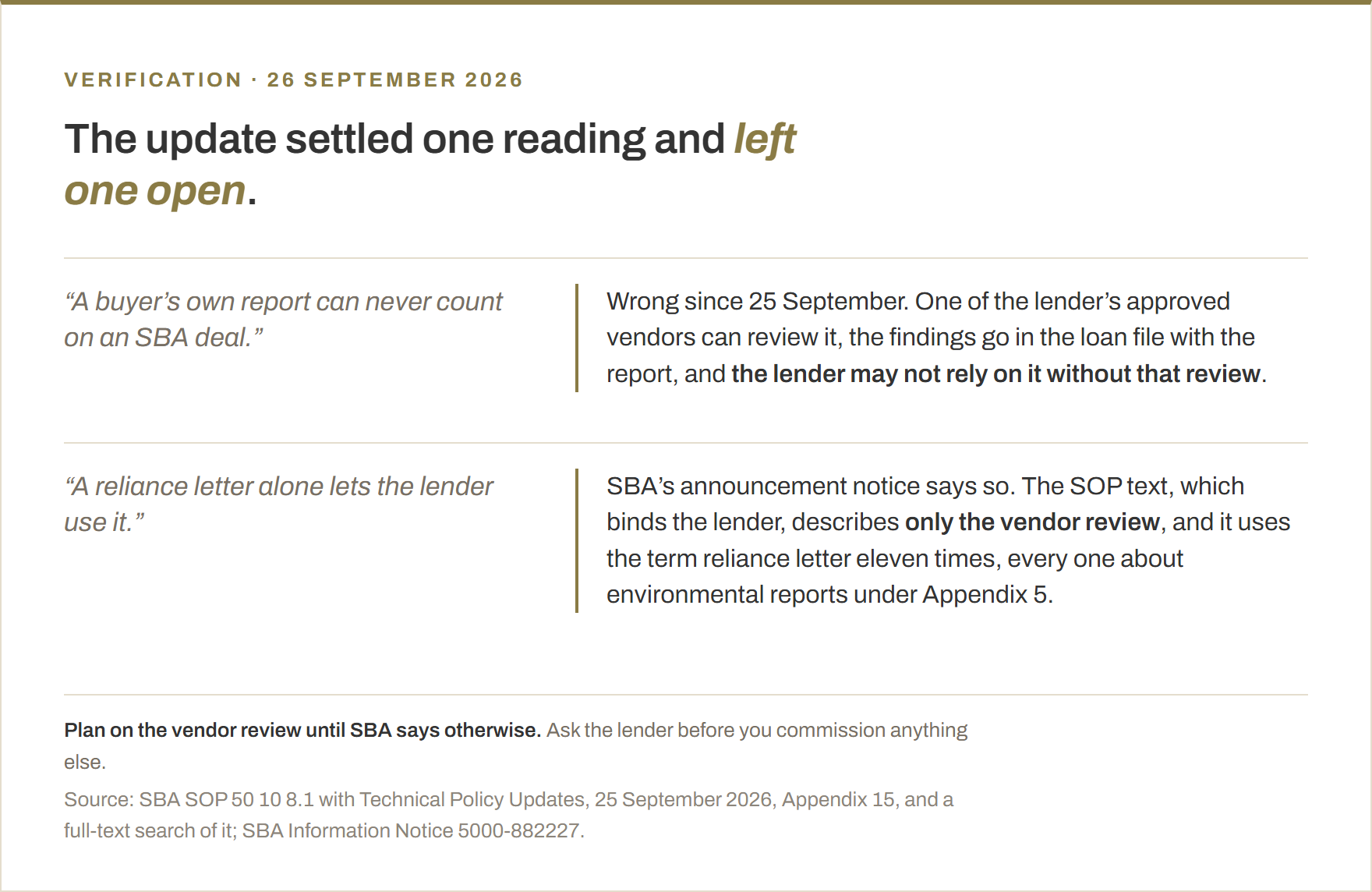
The update settled whether a buyer’s report can count, and left open whether a reliance letter is enough.
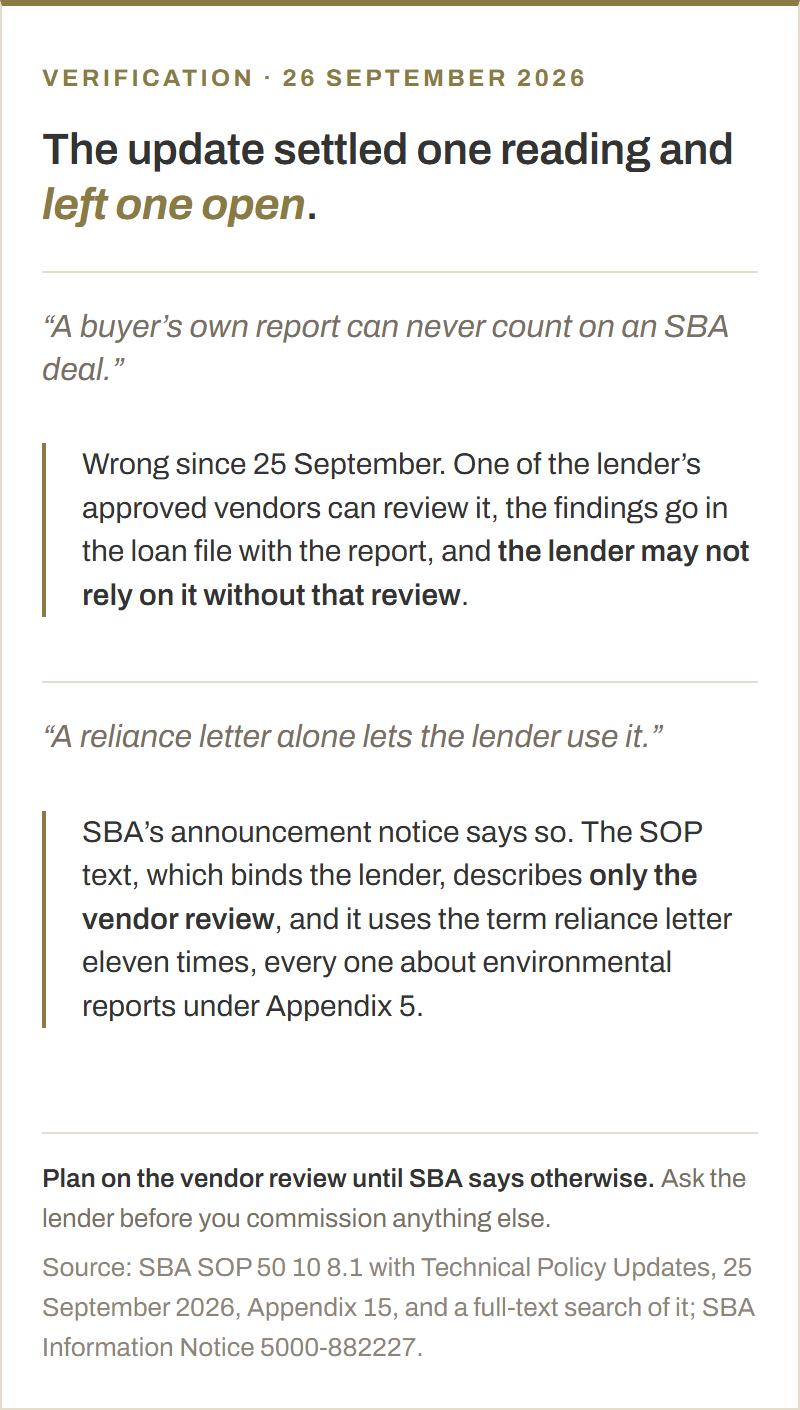
The update settled whether a buyer’s report can count, and left open whether a reliance letter is enough.
What a buyer-ordered report is still worth
Your report was doing a different job from the lender’s, and it still is.
A buy-side QoE exists to stop you overpaying and to tell you whether to walk. It answers questions the lender’s report will not even ask, because the lender is underwriting a loan and you are buying a company. Customer concentration that makes you nervous. A key employee with no contract. Whether the owner’s relationships walk out the door with him. A lender cares about those only insofar as they move coverage. You care because you run the place on Monday.
The lender-ordered report has one narrow job: produce an earnings figure the bank can underwrite. The SOP is explicit that the lender “must use the report’s findings to calculate the Debt Service Coverage,” and that “if that Debt Service Coverage does not support the business valuation and proposed debt structure, the loan amount must be reduced accordingly.”
Your number and the bank’s number answer different questions, for different people, at different risk.
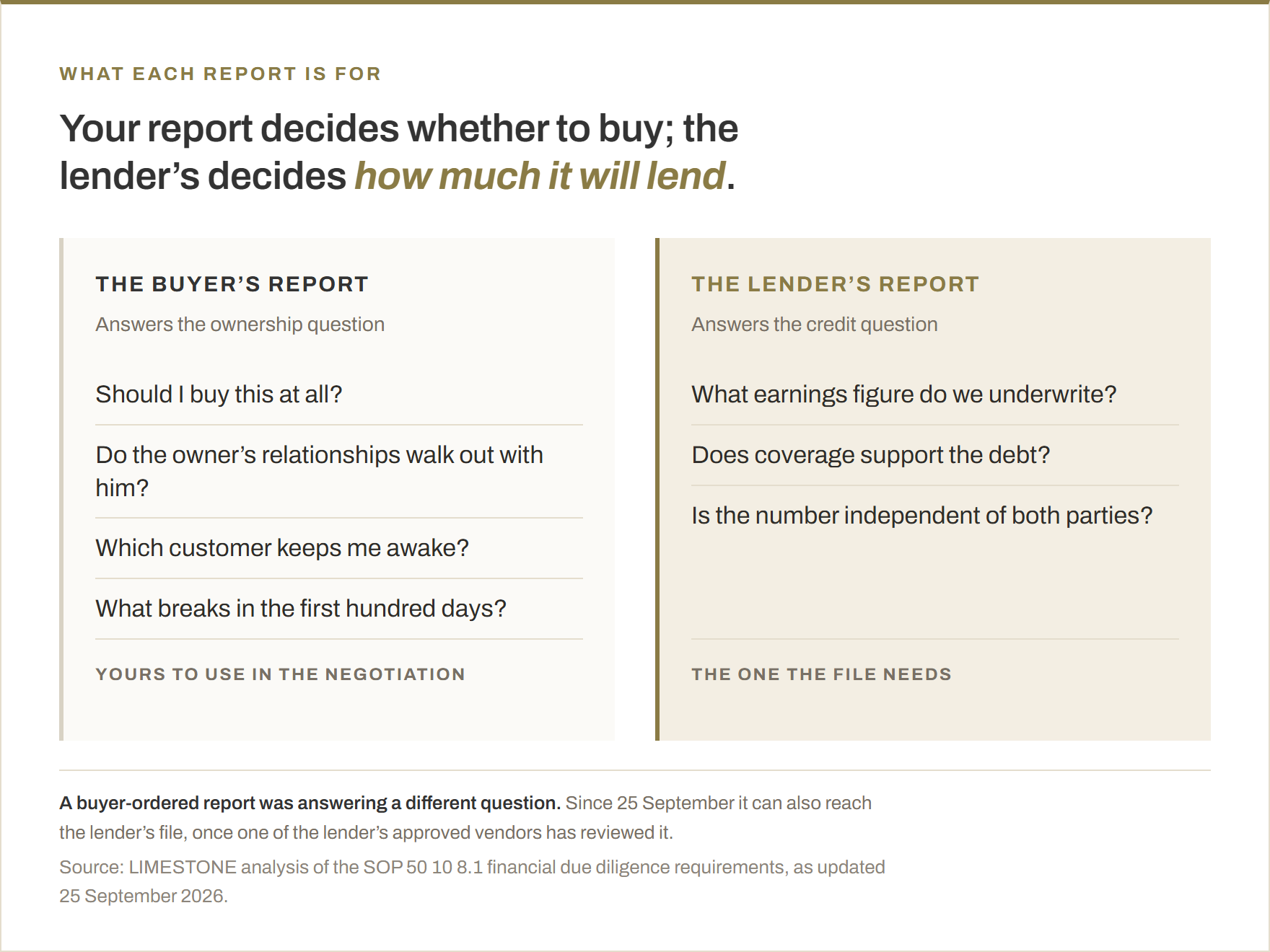
A buyer-ordered report answers the ownership question, and after a vendor review it can serve the lender’s file as well.
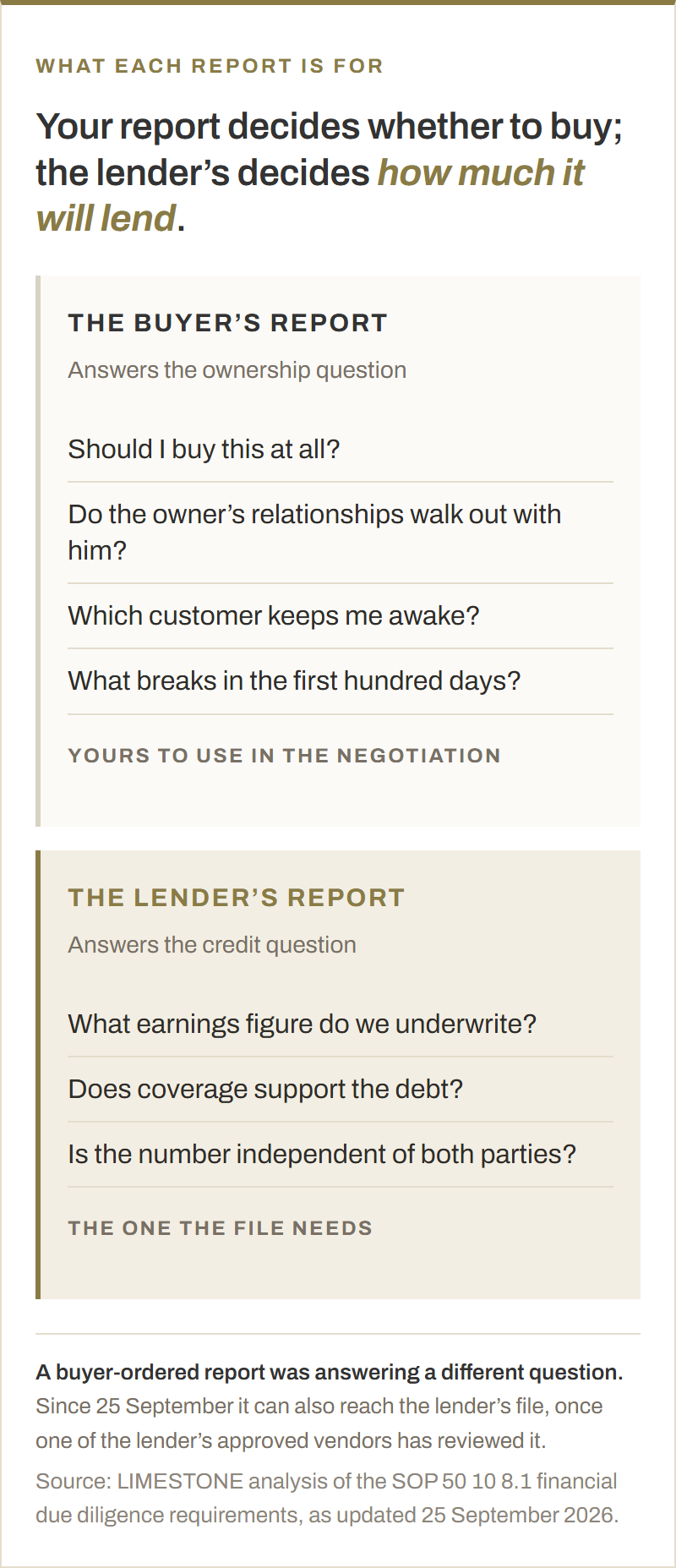
A buyer-ordered report answers the ownership question, and after a vendor review it can serve the lender’s file as well.
The QoE now sits inside the equity math as well as the coverage math. The SOP allows additional limited equity sources “when additional funds are required to supplement the purchase when the sales price exceeds the value supported by the Business Valuation and Quality of Earnings report,” and requires those funds to be on full standby. A report that lands below the price shrinks the loan and can force more money into the deal, either your own cash or a limited source such as more seller debt, which then sits on full standby for the term.
What happens when two reports disagree
On one roll-up we ran the sell-side work while a national firm ran the buy-side on the same practices. The two numbers landed close together. That is the good outcome, and it is not the only one available.
When two competent firms do land apart, the cause is almost never arithmetic. It is scope and standard of proof: one firm accepts an add-back on management’s explanation, the other requires the invoice. One normalizes owner compensation to a survey; the other to what the replacement was actually paid. Both are defensible. They produce different EBITDA.
Which is the practical argument for getting your buy-side work and the lender’s report onto the same evidentiary footing early. When our number and the bank’s number are built from the same documents and the same standard of proof, the gap closes to something explainable. When they are not, you spend the last two weeks before closing reconciling two spreadsheets instead of planning the first hundred days.
The add-back we strike most often is not the country club membership or the truck. It is the one-time consulting fee that appears in all three years. Nobody is lying. They just never had a reason to look.
When to order, and who picks
Order early, because the lender cannot finish underwriting without the report, which puts it on the closing critical path.
The rule in three numbers, both routes to the lender’s file and our fee for the lender-ordered report are on the SBA quality of earnings page.
Who selects the provider depends on who engages it. When the lender engages the report for its own benefit, the choice is the lender’s, and most will take a recommendation, particularly if the firm has been through their approval process. When you commission your own before you approach the lender, you choose, and the lender decides whether to put your report through one of its vendors. If you have a provider you trust, say so early. Ask the lender what its credit team requires and whether it keeps a panel. That conversation costs nothing now and a great deal in the week before closing.
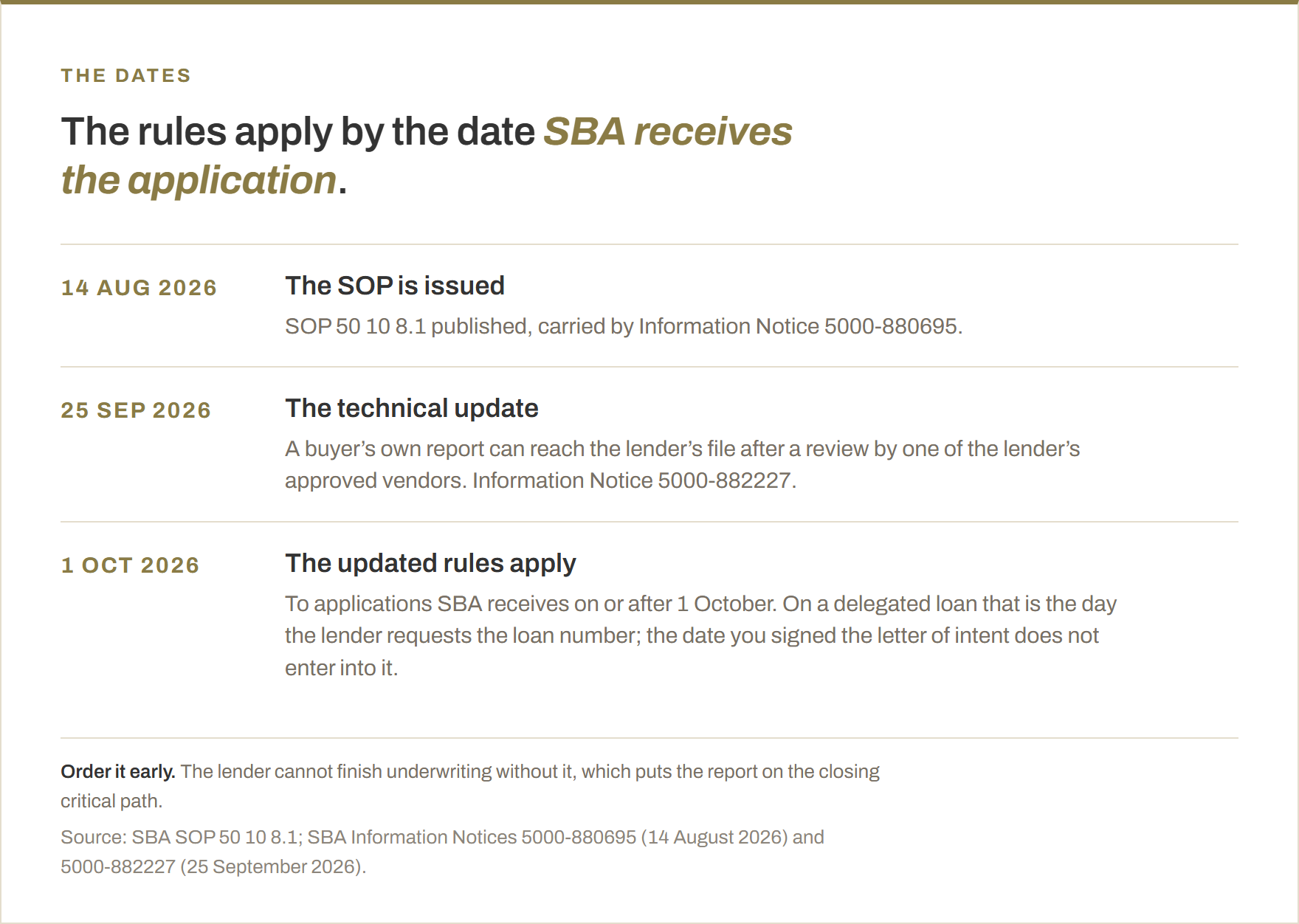
On a delegated loan, the day the lender requests the SBA loan number decides which rulebook applies.
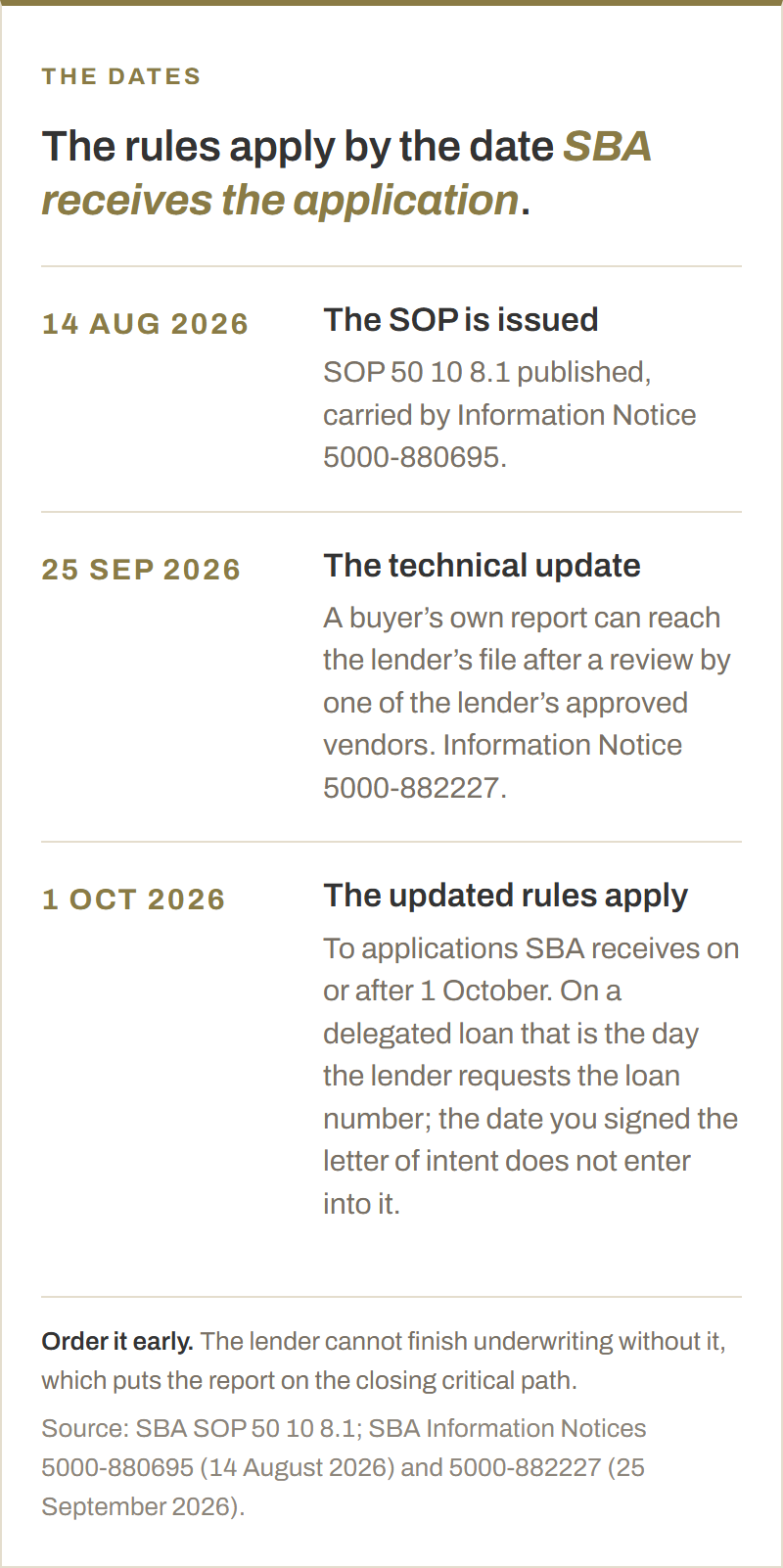
On a delegated loan, the day the lender requests the SBA loan number decides which rulebook applies.
What could still change
Updated 27 September 2026 for SBA’s technical update of 25 September. The first version was current as of 30 August 2026. We review this quarterly and date every change.
Three things are still unsettled.
Whether a reliance letter is enough on its own. SBA’s notice says a report prepared for the buyer can be used with “a reliance letter or secondary review by a different firm.” The SOP text describes only the review by one of the lender’s vendors. Until SBA reconciles the two, a lender is entitled to follow the SOP.
How individual credit teams apply it. The SOP sets a floor. Banks build their own overlays, and some will be stricter about scope, provider approval and independence than the text requires. The rule you read and the rule your bank enforces may be different documents.
Whether SBA issues further notices. The SOP was published on 14 August and revised on 25 September, six days before it takes effect, and lender feedback is still arriving.
If you are working a deal that reaches SBA after 1 October, the safe assumption is the SOP text as written: a report you commissioned counts only after one of the lender’s vendors has reviewed it, however thorough it was.
Those are the open questions on this one rule. For everything else Appendix 15 changes, category by category, see what the SOP leaves out.
Questions we get
I already paid for a QoE. Do I have to buy another one? Not necessarily. If your deal is an Initial Acquisition or Business Expansion, the business purchase price is $3 million or more, and SBA receives the application on or after 1 October, the lender must have a report conducted for its benefit. Since the 25 September update the SOP lets the lender use yours, once one of its approved vendors has reviewed it and the review is in the file. Ask your lender whether it will do that before you commission anything else.
Does my sell-side report count? No. A sell-side report is prepared for the seller, which is the specific thing the SOP excludes. It is still worth having. It shortens the buyer’s work and it tells you what will be found before someone else finds it.
Who picks the provider, me or the bank? The bank, when it engages the report for its own benefit, and most will consider a recommendation. If you commission your own first, you pick, and the bank decides whether to have one of its approved vendors review it. Ask early whether it keeps an approved list.
What if the purchase price is just under $3 million? Then the mandate does not attach, and financial due diligence is still required on every change of ownership transaction. Remember that the threshold is measured before your equity and any seller note, and that owner-occupied real estate comes out at appraised value first. Deals land on the wrong side of $3 million more often than people expect.
When should the report be ordered? As early as the lender will allow. It feeds the debt service coverage calculation, so underwriting cannot finish without it, and on a tight timeline it is the item that moves the closing date.
Working out how to apply this? If you are a lender deciding what to require, or a buyer with a report in hand and a lender who has not seen it yet, we will get on a call and go through scope. No charge and no pitch. You can read a complete sample report first, no form and no email required: the Light report.
Ryan Anoskey is a CPA and a partner at LIMESTONE Strategic Partners. He has run more than 100 quality of earnings engagements, buy-side and sell-side, across manufacturing, healthcare, contracting and multi-site roll-ups.
Sources: SBA SOP 50 10 8.1, Appendix 15 (issued 14 August 2026, with technical policy updates published 25 September 2026, effective 1 October 2026); SBA Information Notices 5000-880695 and 5000-882227. Rule claims in this article were checked against the full updated SOP text and against SBA’s Appendix 15 training session of 26 August 2026.