
The Indiana Statehouse in Indianapolis at dusk, built of Indiana limestone

SBA 7(a) acquisitions

The quality of earnings an SBA 7(a) lender can rely on.

For buyers whose business purchase price reaches $3 million, and for the lender on their file. From 1 October 2026 the lender needs a quality of earnings report it can rely on before closing, and since the 25 September update it may use the buyer’s own report once one of its approved vendors has reviewed it. We prepare the report for the lender, or review the one you already hold, on a fixed fee, in 15 business days.

The rule

The rule attaches at $3 million, applies from 1 October 2026, and runs coverage on the report’s earnings.

$3 million

Business purchase price

Measured before buyer equity and seller debt, with owner-occupied real estate taken out at its appraised value. Below it, no quality of earnings is required and the lender still owes financial due diligence.

1 Oct 2026

Effective date

SOP 50 10 8.1, Appendix 15, covers Initial Acquisitions and Business Expansions. Owner buyouts, ESOP and cooperative transactions, and an owner-occupied special purpose property at any price sit outside the rule.

1.25x

Debt service coverage

An Initial Acquisition must clear 1.25x on the report’s adjusted earnings; a Business Expansion clears 1.15x. If coverage does not support the price and the structure, the loan amount comes down and equity fills the gap.

Both routes to the lender’s file

SOP 50 10 8.1 · Appendix 15

Step 1

Is the deal an Initial Acquisition or a Business Expansion?

Yes, continue
If no

Owner buyout, ESOP or cooperative transaction, or an owner-occupied special purpose property: no quality of earnings is required. Financial due diligence still is.

Step 2

Is the business purchase price $3 million or more?Real estate out at appraised value; before equity and seller debt.

Yes, continue
If no

The rule does not attach. The lender still owes financial due diligence, and the buyer chooses the review.

Step 3

Who commissioned the report?

The lender

Route 1. The lender’s own engagement, conducted for its benefit. Coverage runs on the report’s earnings.

The buyer

Route 2. Usable once one of the lender’s approved vendors has reviewed it. The review sits in the file beside the report.

The seller

Cannot be the lender’s report. It never reaches the file.

Where we sit

Route 1: the lender engages us and the report is addressed to the lender. Route 2: we review another firm’s report and give the lender written findings for its file.

Source: SOP 50 10 8.1, Appendix 15, Para. C.1, text of 25 September 2026.

Both routes

The lender orders the report, or one of its vendors reviews yours.
Until 25 September the SOP barred a report prepared for the borrower as well as the seller. The technical update narrowed that bar to the seller and opened a second route: a report the buyer commissioned can be used once one of the lender’s approved vendors has reviewed it, with the review kept in the loan file beside the report. A report prepared for the seller still cannot be the lender’s report. Ask your lender which route it will take before you commission anything, because the answer decides who engages us and whom the report is addressed to.

What the lender receives

One report, built to Appendix 15, addressed to the lender.

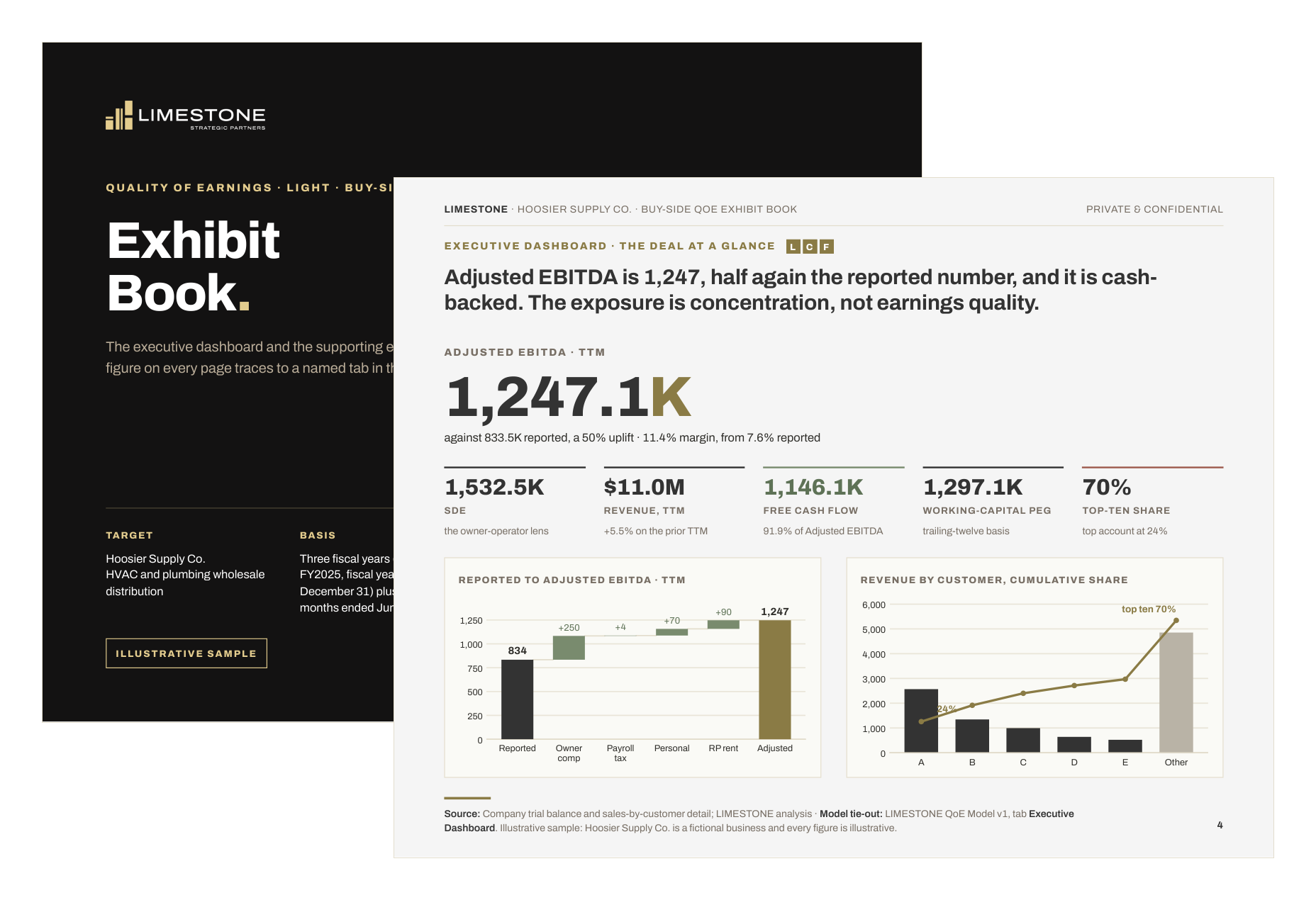
The report reconciles the accountant-prepared statements, the tax returns, the internal statements and the IRS transcripts to one adjusted earnings figure. It carries the Cash Proof over the trailing twelve months and the last two fiscal years, documents every add-back with the items we rejected shown, and closes with a one-page summary that walks adjusted earnings to debt service coverage.

Ryan Anoskey, CPA, leads the engagement and Jared Luegers, CFA, performs the documented second review. LIMESTONE issues and signs the report, and we hold one role on a transaction.

Fee by business purchase price

Fixed · quoted in writing

$3.0M to $5.0M$15,000
Above $5.0M to $10.0M$20,000
Above $10.0M$25,000 and up

Adjustments

Delivery inside 10 business days+$3,500
Complex fileSeveral entities, cash-heavy books or intercompany activity+$2,500
Review of a report another firm preparedRoute 2: written findings for the lender’s fileQuoted at scoping

Standard delivery is 15 business days from Day 1. The fee does not depend on the findings or on whether the loan closes.

Fee and turnaround

One fixed fee by business purchase price, 15 business days from Day 1.

The fee is quoted to the lender in writing after a scoping call and passed through to the borrower as a diligence expense. Under delegated authority the SBA loan number cannot issue until the report is engaged and an engagement letter is in place, so Day 1 matters: it is the later of cleared payment and the last critical item on our request list. Lenders onboarding LIMESTONE as a vendor can write to us, and the vendor packet goes out by email within a business day.

Questions

Three questions that come up on every SBA file.

The longer answers are in who orders the QoE on an SBA deal, what the SOP leaves out and what a deal under $3 million needs. Everything else about the report itself is on the Quality of Earnings page.

Who can prepare a quality of earnings report for an SBA 7(a) loan?

The SOP asks for an independent, experienced financial professional working for the benefit of the lender, and bars a report prepared by or for the seller. It names no credential and no provider list. On its 26 August training call SBA set the bar higher: no affiliation with an advisory firm on either side of the deal or any agent involved. At LIMESTONE a CPA leads every engagement, LIMESTONE issues and signs the report, and we hold one role on a transaction.

What if the purchase price is just under $3 million?

The rule does not attach, and the lender still owes financial due diligence on every change of ownership. Check the measurement first: the threshold is the business purchase price before your equity and any seller note, with owner-occupied real estate removed at its appraised value. A $3.6 million deal carrying a $900,000 building is a $2.7 million business; a $3.4 million business bought with $1 million down is a $3.4 million deal.

What happens if the report comes back below the agreed price?

The lender must run coverage on the report’s earnings, and if coverage does not support the valuation and the proposed structure, the loan amount must be reduced. The difference comes in as additional equity, from the buyer or from a limited source such as more seller debt, and any limited source that fills it goes on full standby for the term of the loan.

Get started

Engage the report early.

Bring the deal as it stands. If you are a buyer with a report in hand and a lender who has not seen it, we will go through scope with you at no charge. If you are a lender writing your quality of earnings procedure, put us on your hardest file first. Or write to either of us below, and the call starts at the numbers.