
What a quality of earnings report won’t tell you
Jared Luegers, CFA · 14 August 2026 · 10 min read
LIMESTONE Strategic Partners delivers the operational read alongside the quality of earnings, with an operator and a CPA on every buy-side report, for businesses earning $500K to $5M of EBITDA.
A quality of earnings report proves the profit was real last year. It does not tell a buyer whether the earnings survive the day the owner leaves, whether the top customer stays, or who runs the floor. That is the operational read, and we deliver it with the numbers: an operator’s read of owner dependence and a kill list of the findings that would end the deal, with the five critical seats and customer reference calls when Operational & Market Diligence is in scope.
A clean report proves the profit was real last year. It can’t prove it survives the day you take over. The gap between the two, and how to read it before you wire the money.
A buyer I know closed on a good services business, about two and a half million in revenue. Clean books. A quality of earnings report that tied out to the penny. Real profit, roughly what the seller said it was. He wired the money and felt smart doing it.
Six months later the biggest customer left. Turned out that account was loyal to the owner who had just cashed out. Close to forty percent of the revenue walked out the door with a handshake, and none of it showed up as a problem in diligence. The report was right about the profit, and the profit left with the customer.
A quality of earnings report tells you the profit was real last year. It cannot tell you whether that profit survives the day you take over. Those are two different questions. A QoE answers the first one well. I’m biased, it’s work we do, but I’d want one on any deal I was serious about. It was just never built to answer the second question, and on a small acquisition that second one is what bankrupts people. If you’re buying a business, you need to know exactly where the report stops and where you’re on your own.
I’ve sat on both sides of this. I came up in finance reading numbers for a living, then spent years operating businesses and watched buyers price some of them. The numbers matter. But a number is the result of a business.
What a quality of earnings report actually checks
A QoE is a buyer’s financial review with one job: figure out what the business really earns, stripped of the owner’s personal noise. A good one checks five things.
- The tax return. A disciplined review doesn’t take the seller’s slick P&L at face value. It rebuilds the earnings from the books and ties them back to the filed return, the one number the seller signed.
- The add-backs. Every adjustment the seller made to dress up profit, tested one by one.
- Proof of cash. Reconciling reported revenue to what actually hit the bank, month by month. Bank statements are far harder to dress up than a P&L, though not impossible, which is exactly why you tie the story back to them.
- The payroll. The register, the books, and the quarterly filings all have to agree.
- Revenue durability. How much of this repeats, versus how much was one good year.
Get those five right and you know what the business earned. That’s real work, and it’s worth paying for. Ryan walks the same ground from the reviewer’s side, grouped as four questions: what a buyer’s quality of earnings review checks. But all five look backward, and they look at paper.
What a quality of earnings report won’t tell you
This is where buyers get hurt, and it isn’t a knock on the report. The report is clean, so they stop looking. And a good report will flag a lot of what follows. What it can’t do is resolve it, because resolving it means calling the customers and walking the shop floor, and that’s not the engagement. A cheap checkbox review skips even the flagging. Either way, this part is on you.

A clean report closes the left column. The right column is still open on the day you take over.

A clean report closes the left column. The right column is still open on the day you take over.
Proof of cash proves the money existed. A cash proof ties the totals. By itself it won’t catch a marketing cost buried in payroll, or an owner expense parked in cost of goods. The totals reconcile and the margins can still be wrong. Sorting the classifications is a separate test, and it’s worth insisting on.
Concentration is an earnings-quality question. The report shows you one customer is thirty percent of revenue. It can’t tell you whether that revenue survives one phone call, or whether the relationship belongs to the seller personally. And the part that burns buyers after close: you can create concentration by winning. Land a big new account and that one relationship is suddenly a third of the business, a risk you built yourself by succeeding. You can also buy back a customer’s loyalty by cutting price, so a clean retention number can hide a margin you’re about to give away. Tie durability to gross margin and to whether the relationship actually transfers, or you’re guessing.
It can’t tell you if the business runs without the seller. On a small deal this is where the money is. A good report will flag that the business leans on the owner. What it can’t do is find out whether the top customers trust anyone but the seller. If the seller is the top salesperson, the master estimator, and the only name the big accounts know, you bought a job with the seller’s face on it. “I’ll introduce you after we sign” is not a transition plan. Neither is a personal license or certification that leaves with the seller: in a lot of trades, the day the seller walks you can’t legally pull a permit, and the sale memo never mentions it.
A pile of add-backs on a business starving itself is a trap. If the profit number everyone quotes looks great because the seller quit spending on trucks, equipment, and maintenance, you’re buying deferred bills. The report normalizes earnings, meaning it adjusts them to a clean, typical year. It doesn’t tell you the roof is done in two years.
Working capital can quietly become your problem on day one. A QoE will show you the working-capital swing, the cash the business needs tied up in receivables and inventory just to run, and how it moves with the season. What it won’t do is stop you from glossing over what that swing means for your own pocket. The peg, the working capital the seller must deliver at close, is usually set off a trailing average. Ask which months are in that average: a peg built on the slow season is set low, and you fund the busy-season build yourself. On an SBA loan the true-up is available: since SBA’s 25 September update, a working capital adjustment in the purchase agreement is not treated as a rebate, so cash that comes back to you can stay in the business. Set it low without a true-up and the gap comes out of your cash before you’ve made a single decision.
And the report won’t get you financed. This one surprises people. On an SBA-sized deal, your lender underwrites the tax returns and the debt service, whether the profit covers the loan payments, and on an initial acquisition or business expansion at a business purchase price of $3 million or more it has to use a quality of earnings, which can be yours only if it elects to have one of its approved vendors review it. A clean report can sit right on top of a deal the bank still won’t fund. That’s a separate question, and you have to ask it out loud early.
None of that lives in the workpapers, and neither does the market around the business. Historical earnings can be well supported while future demand stays uncertain, and recurring revenue, pricing or margins can erode after close even when every record reconciles. All of it is the difference between a buyer who sleeps and a buyer who’s up at 2 a.m.

Each of these arrives as a flag for you to resolve. The report has done its job; the judgment is still yours.

Each of these arrives as a flag for you to resolve. The report has done its job; the judgment is still yours.
Every add-back is a claim to prove
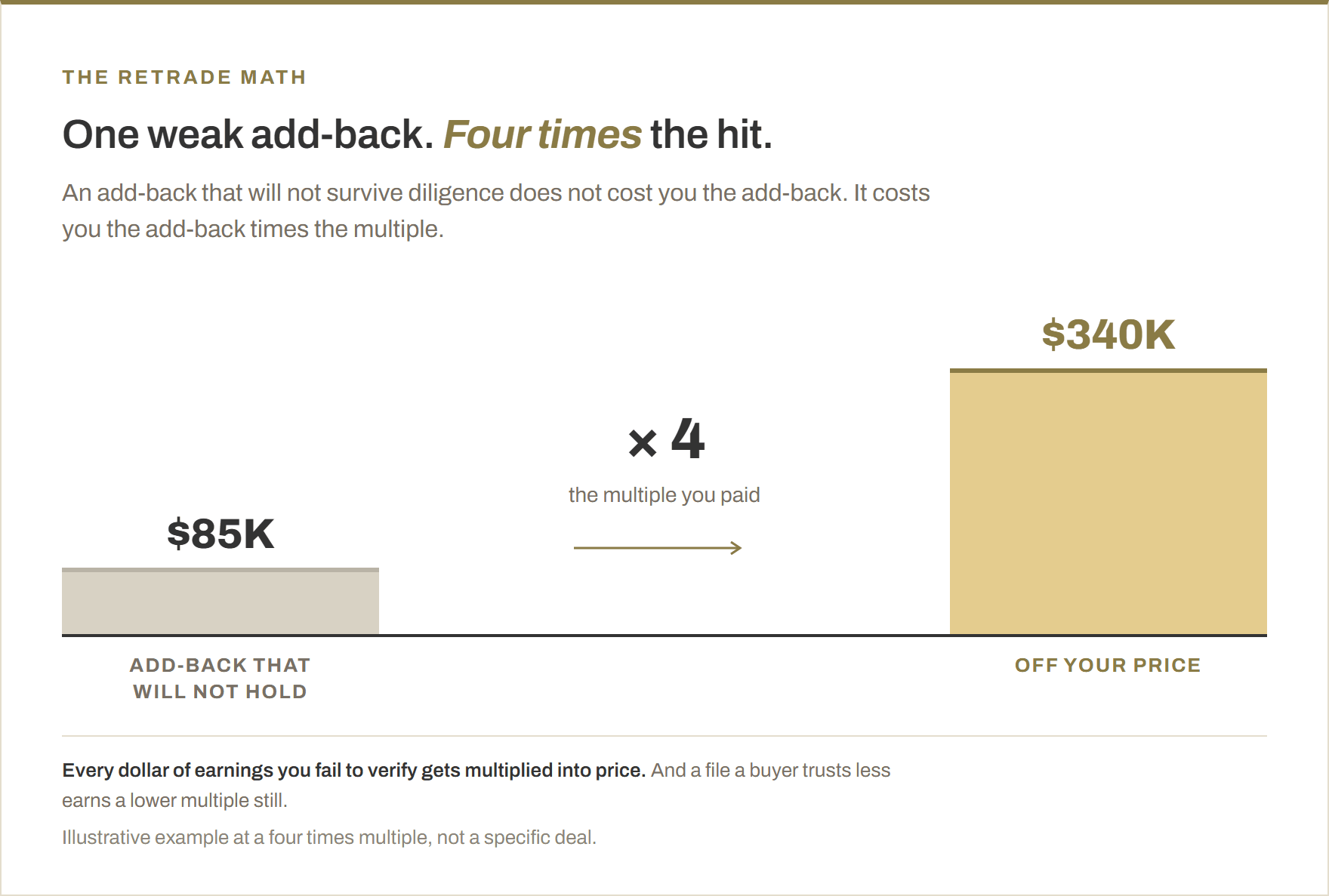
The number is small enough that sellers wave it through in the data room, and large enough to reprice the deal at closing.
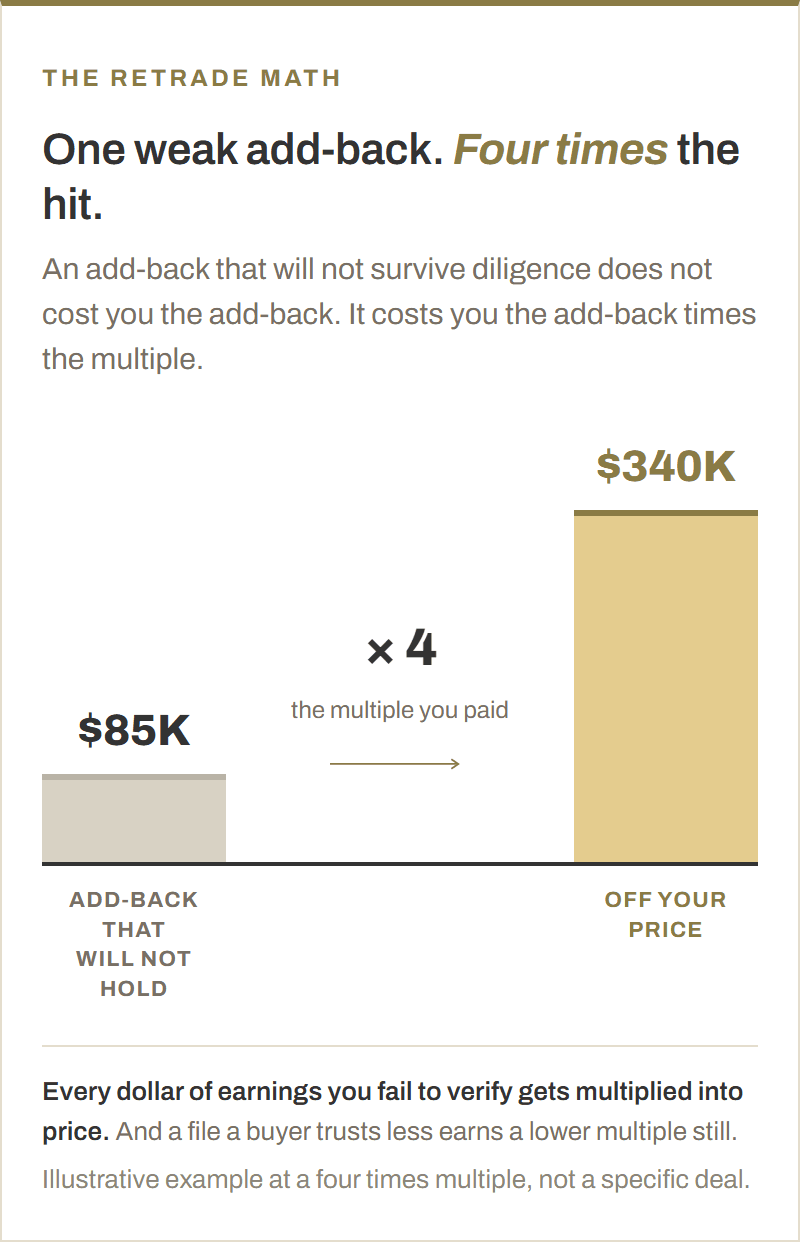
The number is small enough that sellers wave it through in the data room, and large enough to reprice the deal at closing.
Add-backs are where the real money moves, so they get their own rule. On a deal this size you’re usually buying seller’s discretionary earnings, SDE, and the single biggest line in it is what the owner paid himself. Every add-back on top of that is a claim the seller is making, and the burden of proof is the seller’s. Make each one pass a three-part test: a source document, a plain reason it won’t happen again, and a benchmark that it’s above market. No receipt, no reason, no benchmark, it comes out of the price.
The math isn’t small. A small business is often priced at around four times its earnings, so every dollar you let the seller add back is worth about four dollars in price. Strip one unsupported eighty-five-thousand-dollar add-back and the price just dropped over three hundred thousand. The brightest light is owner pay. The test is what a hired manager costs to do the job at market, and that number goes back into the earnings whether the seller likes it or not. When the add-back schedule runs longer than the profit, that length is itself the tell.
My partner Ryan, a CPA who’s run more than a hundred of these over his career, on both sides of the table, puts it simply: an add-back has to make the number honest. If you can’t hand him the receipt and a reason it won’t repeat, it comes out. He goes deeper on the financial mechanics in his own writing on add-backs. I’m here for the part that isn’t on the spreadsheet.
What a quality of earnings report costs, and what it’s worth
For a small acquisition, a focused review runs a few weeks and a fixed fee that scales with how messy the books and the deal are. It’s usually a low single-digit slice of the purchase price, less than a month of the loan payments you’re about to sign up for. Ryan has written up our published fees, what the market actually charges and what sets the fee: what a quality of earnings report costs.
Now the trade. A buyer I traded notes with skipped the review on a clean-looking deal, around four and a half million, and later found close to two hundred thousand a year in recurring costs the seller had been quietly capitalizing, treating everyday expenses as one-time investments so they never hit the profit line. At the multiple he paid, that mispriced the business by the better part of a million, discovered six months too late. The fee would have been a rounding error against it. The way searchers put it on the deal forums: a quality of earnings report is insurance, and the one time you skip it is the one time you needed it.
Buy the report, then keep going. A good QoE is the strongest read you can buy on the numbers, and you want it. It just isn’t a fraud guarantee, and on its own it doesn’t call your customers or walk your floor.
How much diligence is enough? Build a kill list
You can’t diligence everything, and trying to is its own mistake. Sellers drop buyers who show up with a fifty-page internet checklist. So steal this, whether you ever hire anyone or not.
Before you spend a dollar on a review or a lawyer, write your kill list: the specific, measurable things that would end this deal. “Any single customer over thirty percent.” “Real cash flow more than twenty percent under the memo.” “Can’t run day one without the seller.” “The profit doesn’t cover the loan payments.” Rank them by how badly they’d hurt, chase the worst one first, and the moment one trips, you stop and you walk.

Write this list before diligence starts. Written afterward, it turns into a justification for the deal you already want to do.

Write this list before diligence starts. Written afterward, it turns into a justification for the deal you already want to do.
You don’t need certainty to sign the letter of intent. You need enough conviction that paying for diligence is worth it. The letter gives you permission to go find the thing that kills the deal. Good diligence verifies what you already believe.
The part after the wire
Doing the deal is the easy part. Running it, and not breaking the thing you just paid for, is the hard part, and it starts the morning after the wire clears. The report firm is gone by then. The first payroll, the employees testing you, the customers deciding whether they trust you, that’s all yours.
That’s the gap LIMESTONE works in. We check the profit before you wire, in plain English, and we don’t vanish at close. Concretely, when Operational & Market Diligence is in scope, we call the top ten customers before close and read whether the relationships transfer, and we build the retention plan for the people who actually hold the place together, so day one has a plan. The report proves the earnings existed. The handoff is what proves they keep coming. And that operator’s read comes standard with us. Even a straightforward quality of earnings review comes with our honest take on whether the business actually runs, alongside the financial work, because a buyer wants both. That take works from the information agreed for the review, and market research and downside analysis are scoped on their own. It’s the reason people send us the numbers in the first place.
Before you wire
So before you wire the money, run both reads. Get the quality of earnings; you need it. Then do the operator read on top of it: call the top customers, find out whether the place runs without the seller, and price what it would cost to replace him.
The report tells you the profit was real. After that, the only question that matters is whether it’s still yours a year from now. That’s the read to do, whoever ends up doing it. Do that, and you’re already ahead of most of the people wiring money this year. The first hundred days after the wire are their own problem, and I wrote that one up separately: what an operating partner actually does after the close.
Jared Luegers is the founder and managing partner of LIMESTONE Strategic Partners and a CFA charterholder. He led strategic initiatives at a portfolio company through its $190 million sale, helped acquire a small Indiana operating business, and led strategic initiatives at a $9B Indiana RIA. He is the founder of OWN Indiana.
