
What a Lender Needs to See Before They Will Fund
Ryan Anoskey, CPA · 30 August 2026 · 8 min read
LIMESTONE Strategic Partners builds lender-ready financial packages and quality of earnings reports for owners and buyers of businesses earning $500K to $5M of EBITDA, from Carmel, Indiana.
A lender underwrites off one number, debt service coverage, and from 1 October 2026 an SBA 7(a) lender takes that number from a quality of earnings report on any $3 million acquisition. A lender-ready package reconciles the income statement to the tax returns and the bank statements, documents every add-back with proof, and states the working capital the business needs to run. The lender still decides.
From 1 October 2026, an SBA lender on a 7(a) initial acquisition or business expansion at a $3 million business purchase price underwrites off a quality of earnings report, its own or yours once its vendor has reviewed it. That report sets the add-backs, the add-backs set the coverage ratio, and the coverage ratio sets how much of the price comes out of your pocket instead of the bank’s.
Most packages that stall in underwriting are not weak businesses. They are ordinary businesses whose numbers cannot be tied to anything.
A credit team is not reading your income statement to decide whether you built something good. They are reading it to decide whether the earnings are real enough to lend against. Those are different questions, and the second one is answered with documents.
Here is what that looks like in practice, using SBA’s own arithmetic.
The number the lender is solving for
Everything in a 7(a) acquisition file runs through debt service coverage: the cash the business throws off, divided by the payments on the debt it will carry after closing. Under SOP 50 10 8.1 the floor depends on which kind of change of ownership you are doing. An Initial Acquisition, which SBA expects to be most transactions, has to clear 1.25 to 1. So do Owner Buyouts, ESOPs and cooperatives. Business Expansion stays at 1.15, deliberately, to leave room for an operator buying a turnaround.
What changes on 1 October is who decides the numerator. SBA was direct about it in its own training on the new appendix:
“QoEs drive the add-backs for the debt service coverage. So when a QoE is in place, that is the debt service and the add-backs that will be used. All add-backs must be justified by the lender and there needs to be a rational basis as to why we’re adjusting cash flow.”
So the report is not a formality that arrives late and confirms what the broker said. It produces the earnings figure the loan is sized on.
SBA walked lenders through two versions of the same deal. In the first, the report trims some adjustments and adjusted EBITDA still lands at $800,000. The buyer can support a loan of roughly $4.25 million, coverage comes in at 1.34, and no additional equity is required. In the second, the report disallows $140,000 of what the seller claimed, and adjusted EBITDA lands at $700,000 instead. The maximum loan drops to about $3.72 million, and the buyer has to find another $254,000 to close.
Same business. Same price. The only thing that moved was how much of the add-back schedule survived contact with the documents.
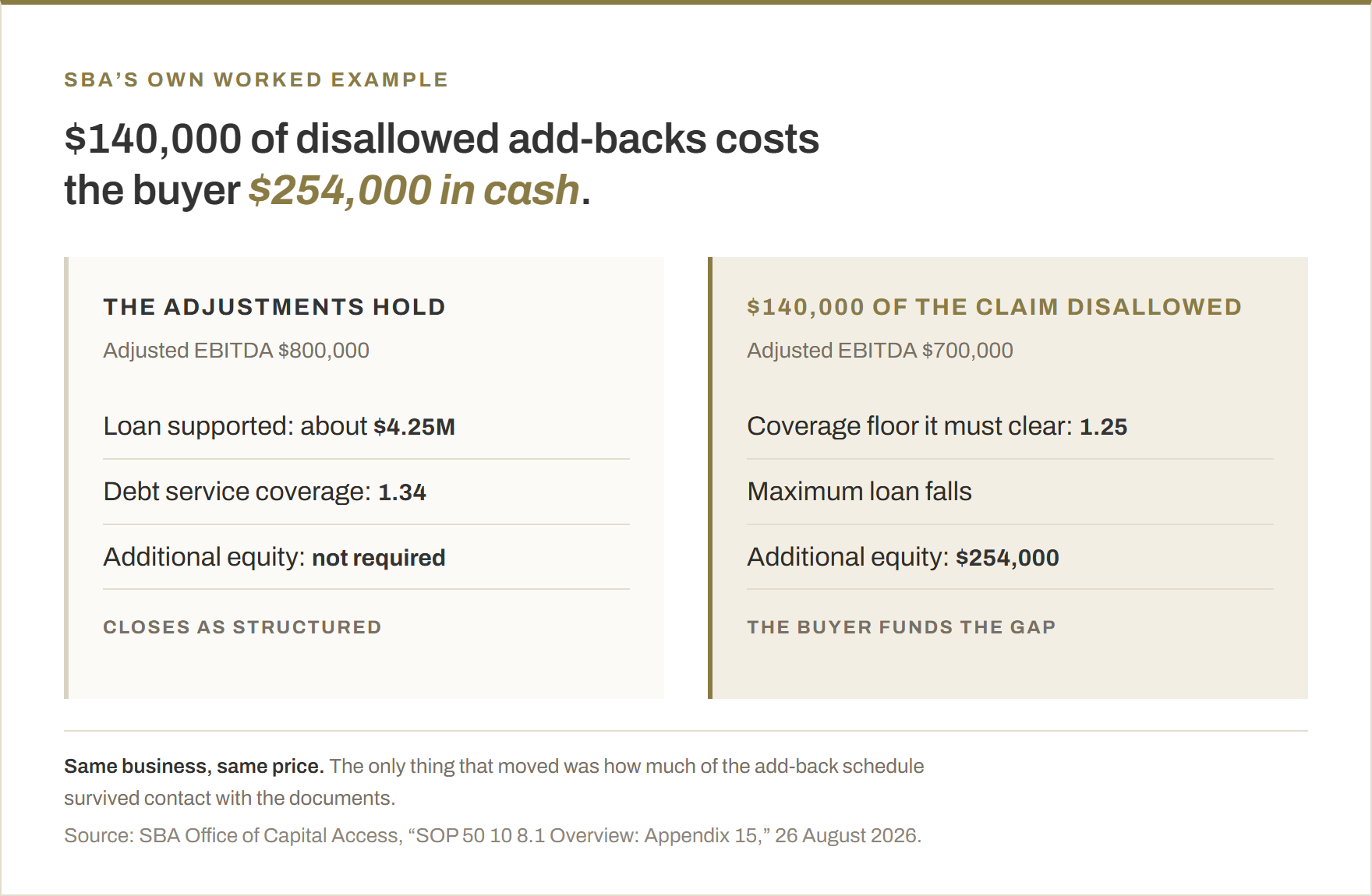
The add-back schedule is where the price is decided. This is what it costs to lose an argument you cannot document.
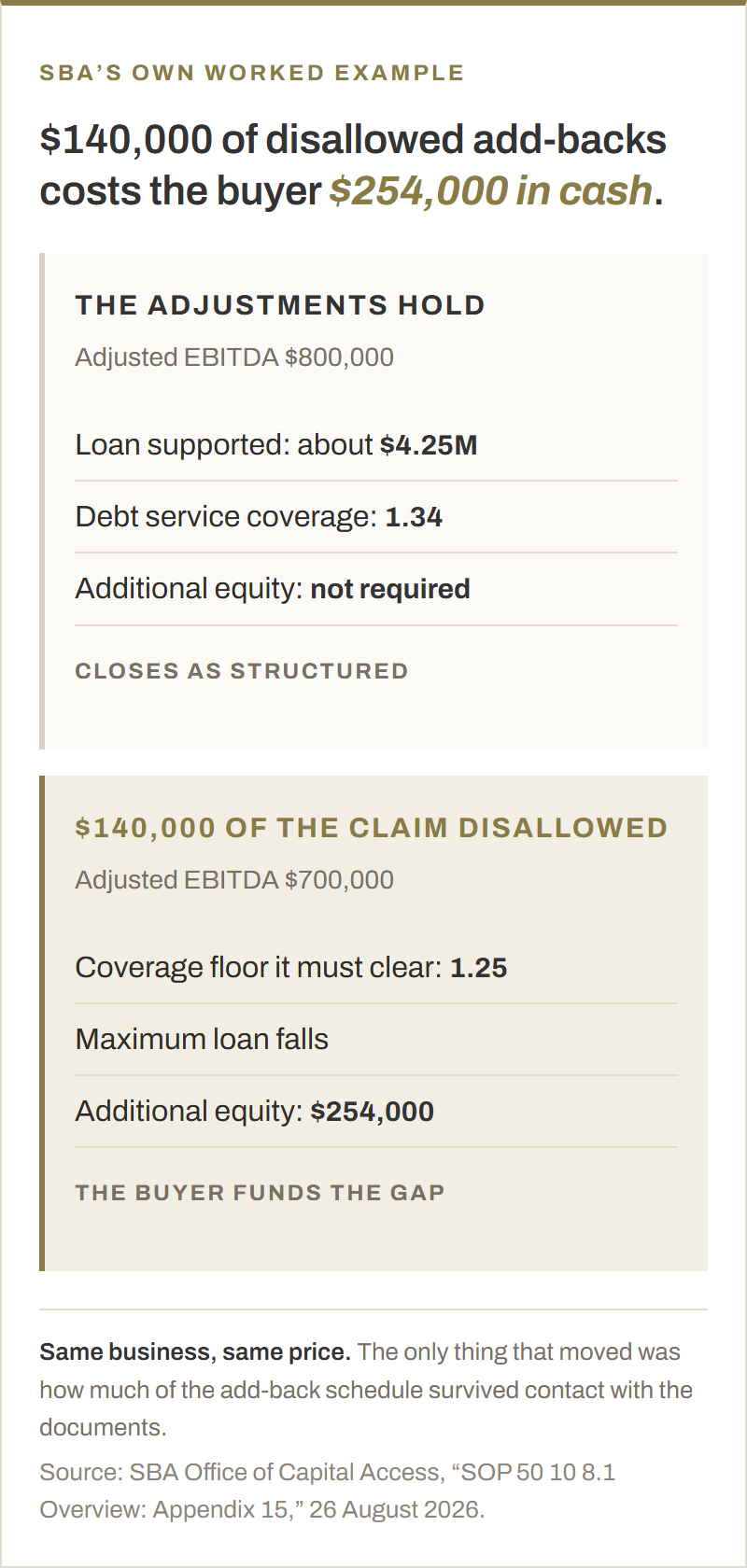
The add-back schedule is where the price is decided. This is what it costs to lose an argument you cannot document.
Where the numbers stop tying
When we run this work, disagreements almost never show up as arithmetic errors. They show up as four versions of the same year that do not reconcile, and nobody in the building has ever put them side by side.
| When this disagrees with this | What it usually means |
|---|---|
| The tax return shows less income than the internal statements | Tax positions and elections, not a different business. |
| The internal statements show more than the accountant-prepared set | Accruals that were never booked. This one usually moves the number. |
| The IRS transcript disagrees with the return in hand | An amended return nobody mentioned, or the wrong year supplied. |
| The bank deposits do not tie to reported revenue | Timing, or income that was never operating revenue. The cash proof separates the two. |
The second row is the one that usually moves the number. Accruals that were never booked are not fraud and not incompetence. They are what happens when a small company closes its books for a tax return once a year and runs on a bookkeeping service the rest of the time.
Nothing here is exotic. It is just invisible until somebody lines the four up.
The income statement is a claim until it reconciles to the bank
The single most useful procedure at this deal size is also the one most often skipped. A proof of cash ties reported revenue and expense to what actually moved through the accounts.
Books at a business this size are usually unaudited, often kept by an inexpensive bookkeeping service, and sometimes on a cash basis. That is not a red flag by itself. It does mean the income statement is a claim rather than a record until somebody reconciles it to the bank statements.
SBA now names the cash proof as the anchor of the report, and describes the scope as two fiscal years plus a trailing twelve months, reconciling the income statement to collections, with the look-back reduced where the business has operated for less than two years.
Worth saying plainly, because providers oversell this: a proof of cash proves the totals reconcile. It does not prove every item was classified correctly. Anyone who tells you a cash proof settles the classification question has not run one.
The three gates every adjustment has to pass
An add-back schedule is an argument. These are the three tests we apply before an adjustment goes on ours, and they are close to what a credit committee applies to yours.
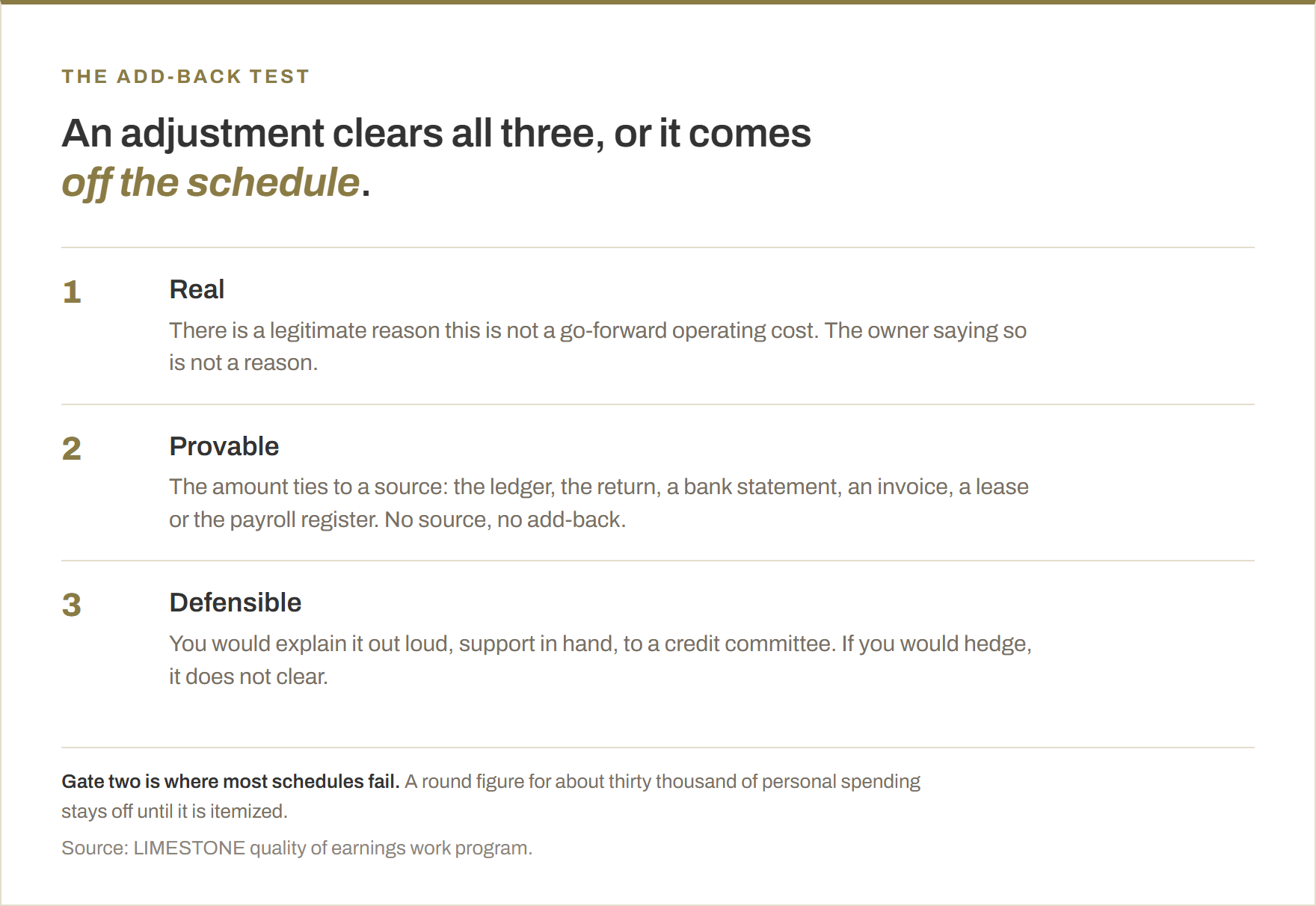
Two of the three are judgment. The middle one is just filing.
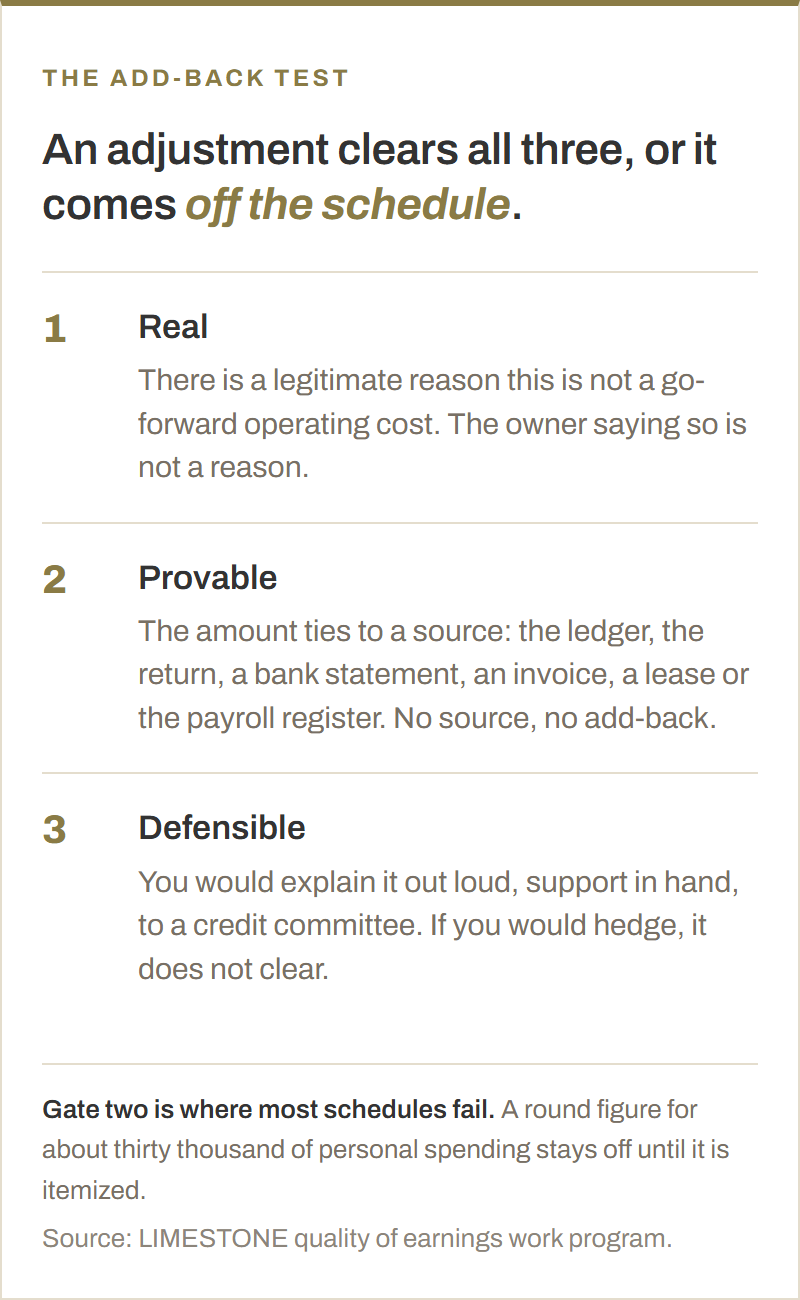
Two of the three are judgment. The middle one is just filing.
Gate two is where most schedules fail. A round figure for “about thirty thousand of personal spending” stays off until it is itemized. No source, no add-back.
What we decline, and what a lender will decline: undocumented cash income, full owner compensation added back inside an EBITDA figure that already assumes a hired manager, recurring costs relabeled as one-time, and pro-forma growth presented as history.
That last one has a tell. Look for the same “one-time” item in consecutive years.
A schedule that stacks only favorable adjustments is discounted by whoever reads it next. Showing what you rejected, and why, is what makes the ones you kept hold up.
What a lender-ready package actually contains
This is the list. It is longer than most sellers expect and it is not negotiable, because every item exists to tie one number to another.
| What to have ready | What it ties |
|---|---|
| Three years of business tax returns, the accountant’s copy | The filed baseline. Include the book-to-tax detail and the full depreciation schedules. |
| Monthly P&Ls and balance sheets, 36 months | Trend and seasonality, and the periods where margin actually moved. |
| 24 to 36 months of bank statements | The proof of cash. Reported revenue against what cleared. |
| General ledger, full detail | Where an adjustment actually lives. |
| AR and AP aging | Collectability, and whether revenue was recognized before it was earned. |
| Payroll register and W-2s | Owner compensation, family members on payroll, and the replacement salary question. |
| Fixed-asset register | Depreciation, and capital spending recorded as expense. |
| Revenue by customer, three years | Concentration. We test any customer above 15 to 20 percent of revenue. |
| Debt schedules | The service the new loan sits on top of. |
| Leases and customer contracts | Change-of-control and anti-assignment clauses, which can end a deal on their own. |
The detail people miss is the accountant’s copy of the tax return, with the book-to-tax reconciliation and the full depreciation schedules. The client copy will not answer the questions underwriting asks.
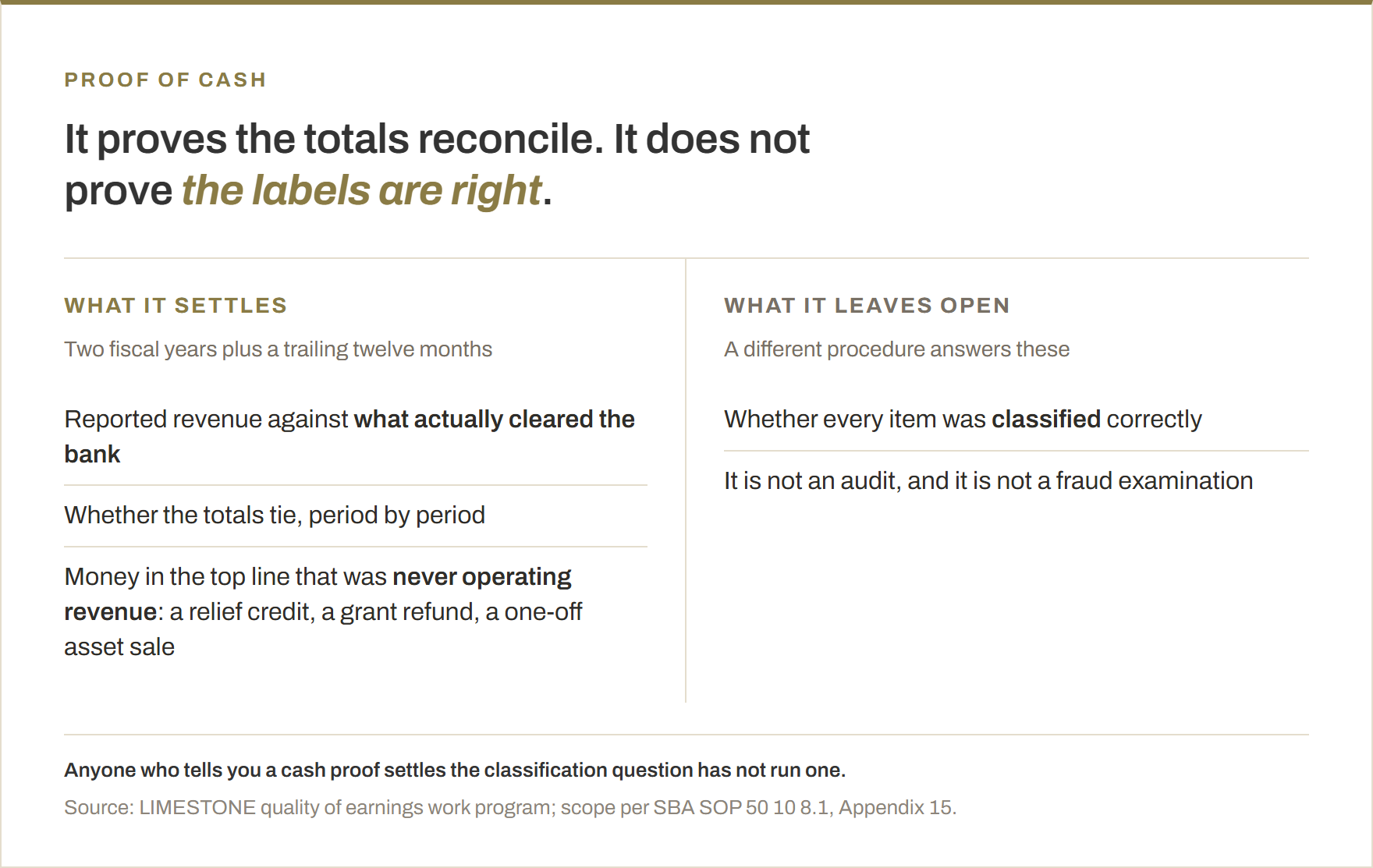
A proof of cash ties the reported totals to the bank; whether each line carries the right label is tested separately.
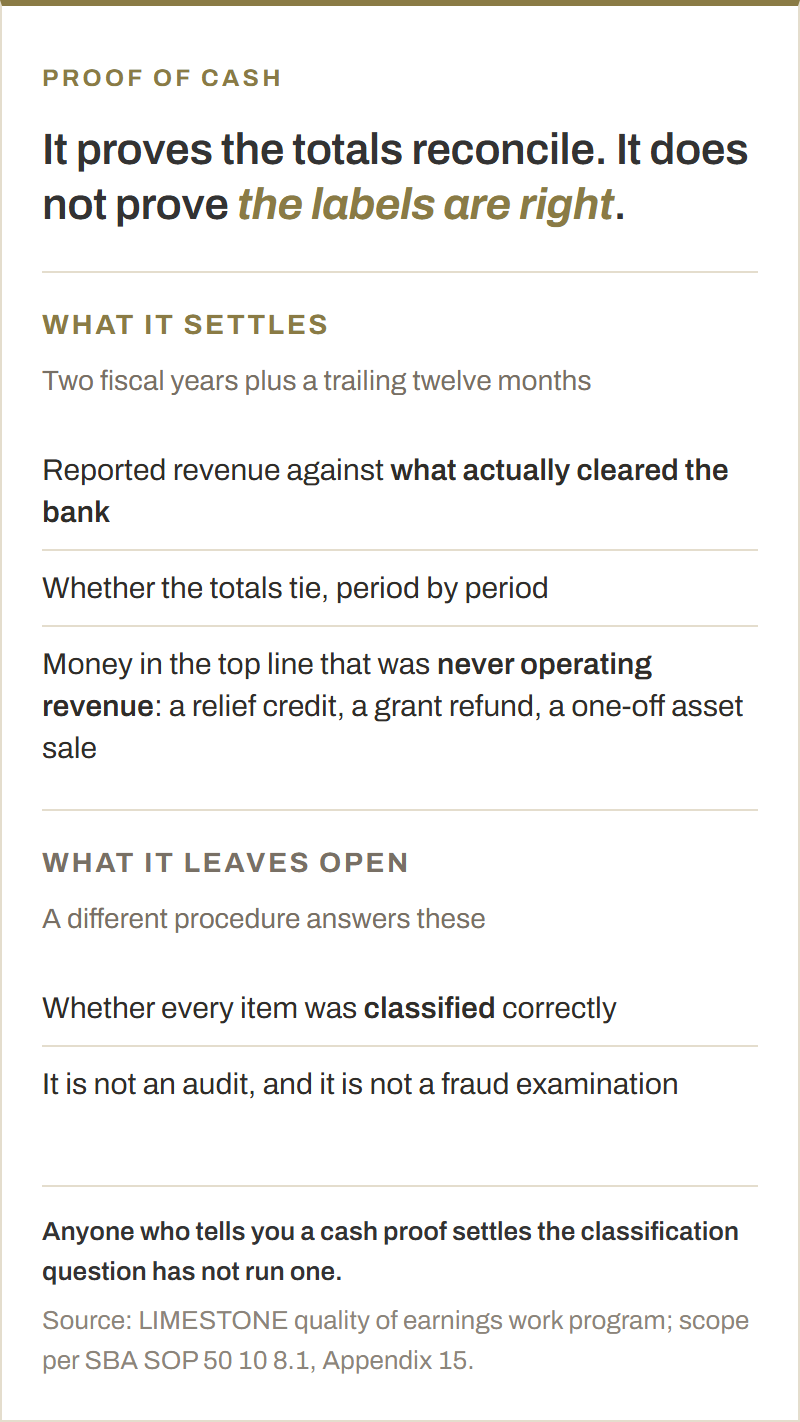
A proof of cash ties the reported totals to the bank; whether each line carries the right label is tested separately.
What SBA took away, and why it matters to you
Projections no longer clear approval, except on an owner-occupied special purpose property. They remain part of the package, but the deal has to work on historical, adjusted cash flow. SBA explained the reasoning without much padding:
“I want you to think about the business as an asset and as a purchase of a stream of cash flow. If what you’re buying, even with adjustments, cannot clear the threshold, what asset did you actually buy? You bought a company, it can’t pay its debts, at least not with a sufficient margin of error.”
The second change is quieter and hits harder. Mixed-use loans are gone for change of ownership, so a deal carrying real estate is either two loans or one blended amortization, unless it is built around an owner-occupied special purpose property, which may carry one loan of up to 25 years. SBA showed lenders what that does to a real file: a company that clears at 1.15 on a twenty-five year amortization lands at 0.75 when the amortization tightens to ten years.
Same company, same cash flow, and nowhere close to qualifying.
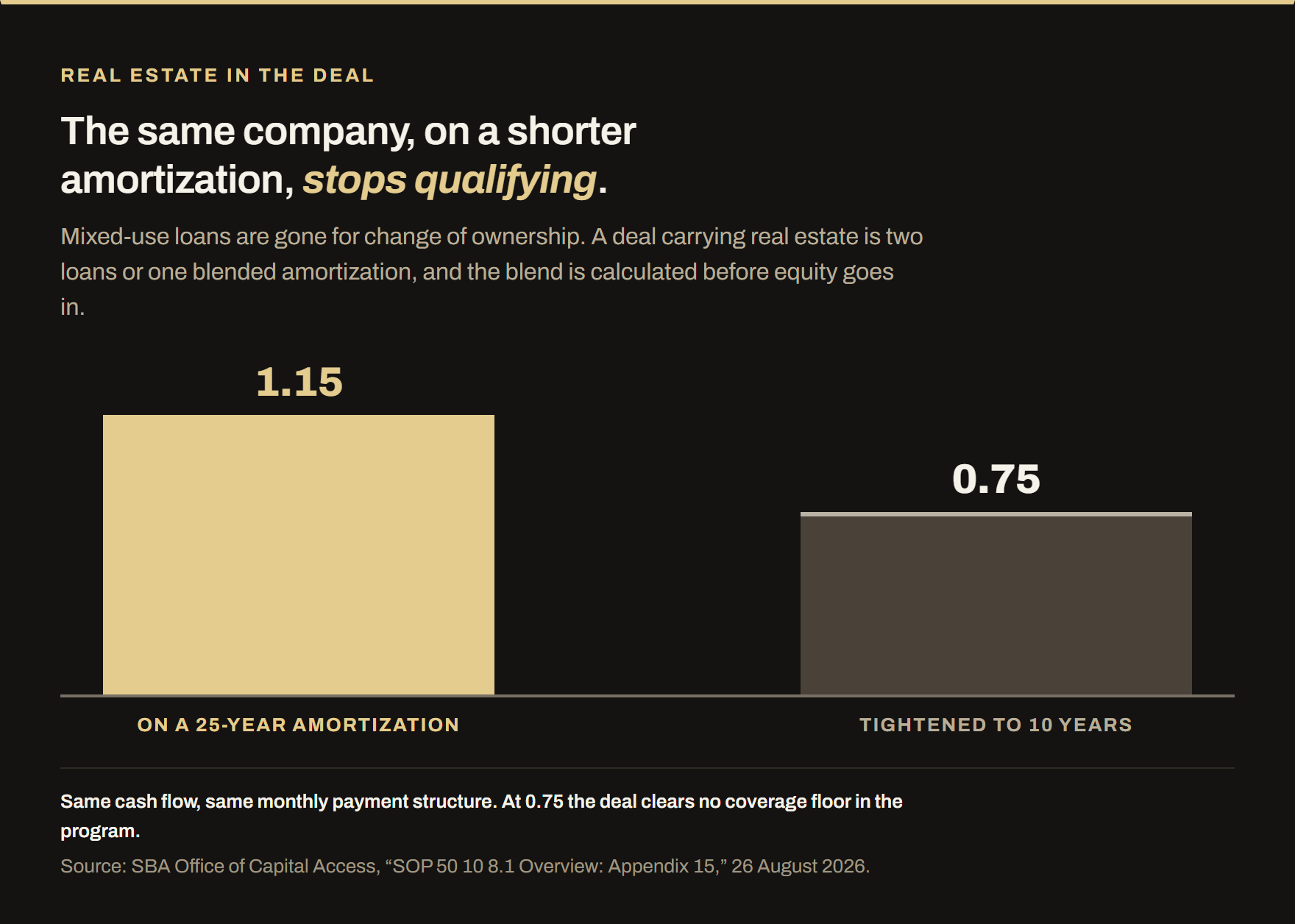
A deal with real estate in it becomes a different credit once the amortization shortens.
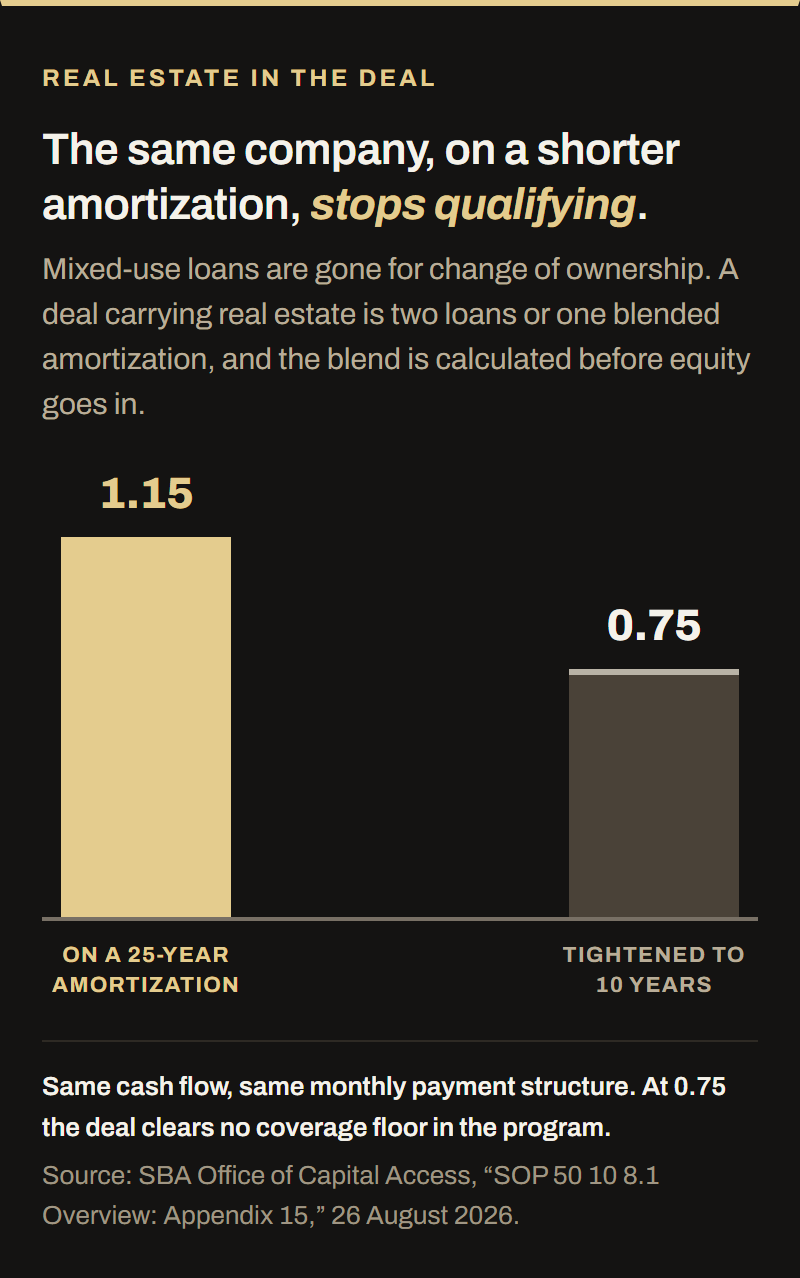
A deal with real estate in it becomes a different credit once the amortization shortens.
There is a lever in the other direction, and most buyers do not know it exists. Liens on receivables and inventory are now required, but a lender can move that collateral onto a line of credit in exchange for between 20 and 50 percent of day one availability. In SBA’s worked example on a $4.2 million acquisition, replacing $200,000 of permanent working capital in the term loan with a line of credit, and shifting $300,000 of day one availability onto that line, took coverage from 1.34 to 1.52.
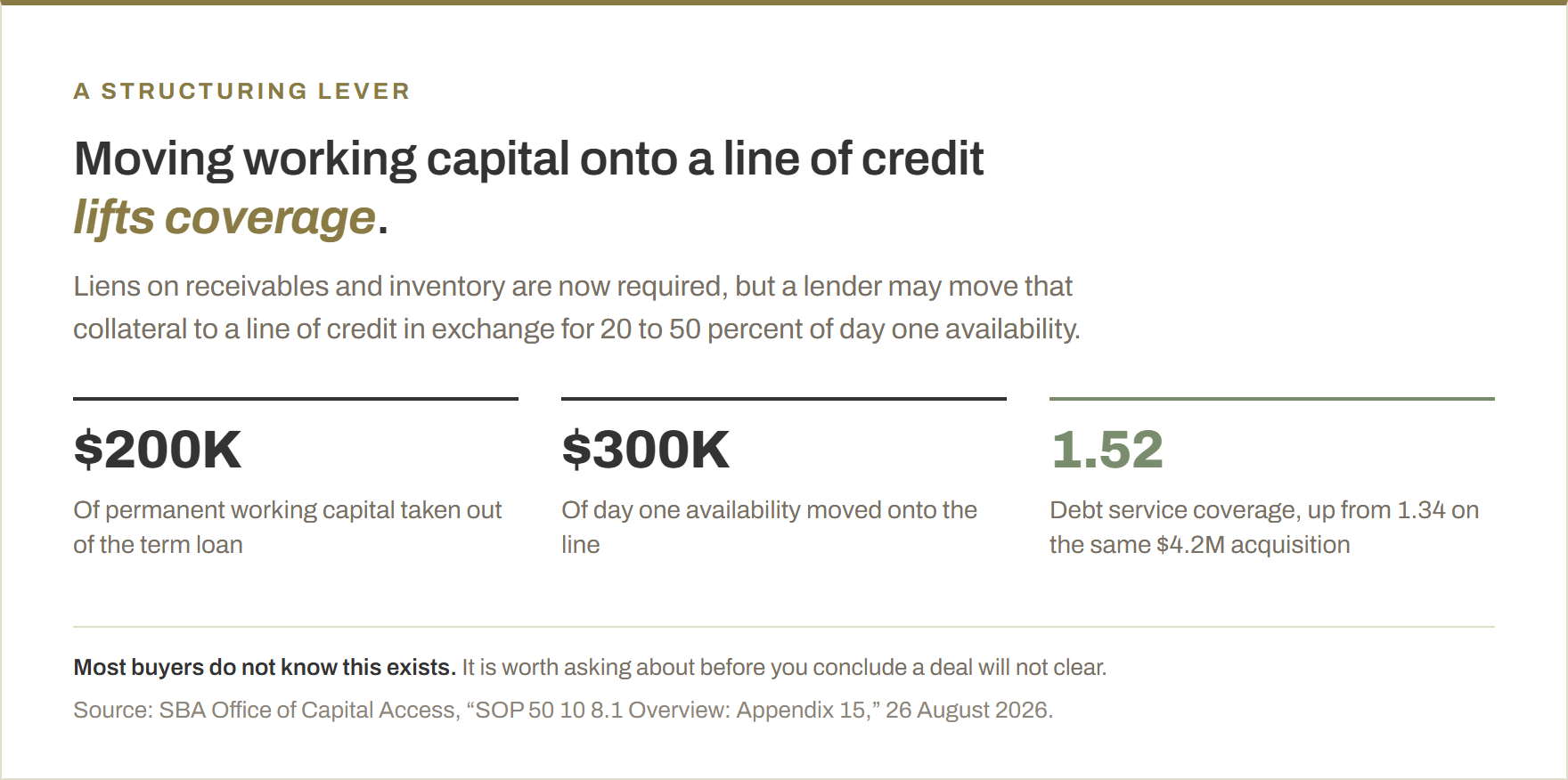
Moving working capital onto a line of credit lifts debt service coverage.
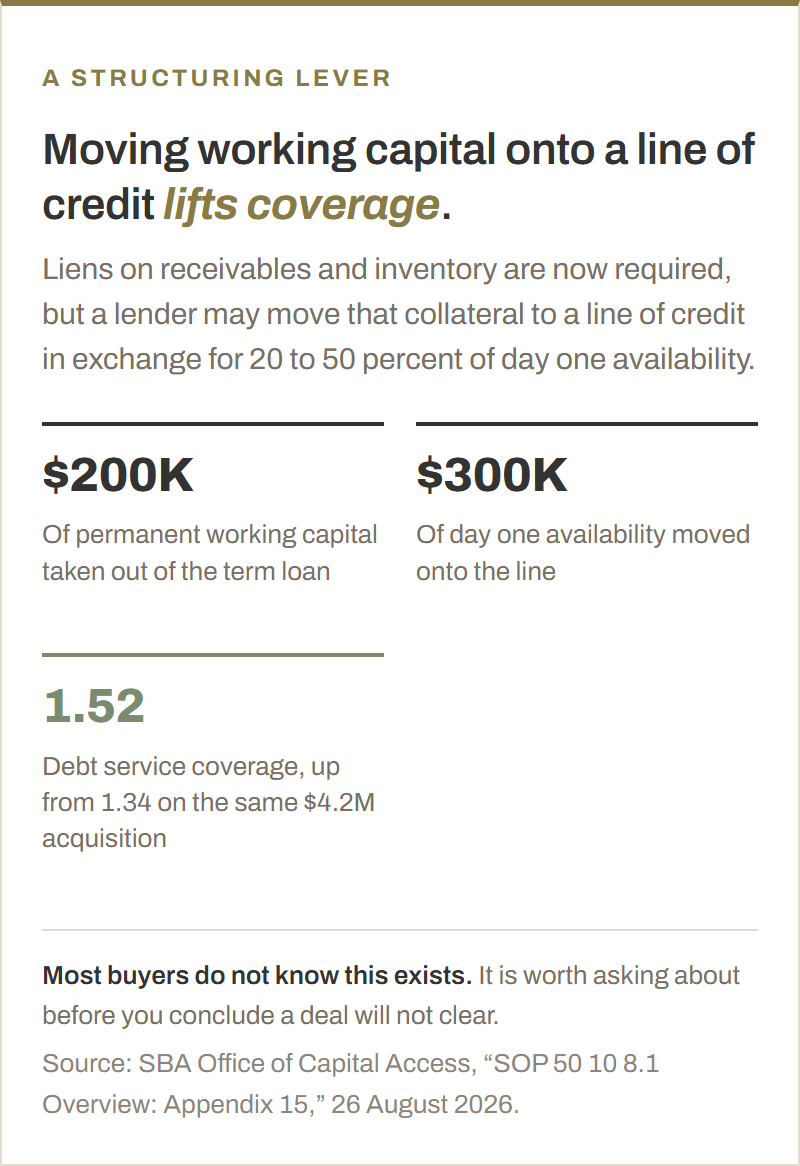
Moving working capital onto a line of credit lifts debt service coverage.
Those are two of several changes landing at once. For the others, category by category, see what the SOP leaves out.
What to do about it, in order
Start the reconciliation before you start the conversation. If the four versions of your last three years do not agree, that is a bookkeeping project, not a diligence project, and it is far cheaper to fix now than in the week before closing.
Pull the accountant’s copies of the returns, not the client copies. Ask for the M-1 detail.
Write the add-back schedule with a source next to every line. If you cannot name the document, take the line off. You will be a more credible negotiator with a shorter schedule that holds.
Then ask the lender two questions: what does your credit team require in the package, and do you keep a panel of approved providers. Both are free to ask now and expensive to discover in October.
Questions we hear
My books are on a cash basis. Is that a problem? It is a conversion project, not a disqualifier, and it is one of the more time-consuming pieces of the work. Revenue and the cost that produced it land in different periods on a cash basis, so margin appears to move when only timing did. Plan for it rather than discovering it.
The seller says the add-backs are legitimate. Why does the bank disagree? Usually it does not disagree about the item. It disagrees about the proof behind it. A lender will typically accept adjustments that can be verified as one-time or genuinely owner-related, and decline the ones resting on an explanation. The burden sits with whoever wants the higher multiple.
How far below the broker’s number do these usually land? There is no honest average, and we will not quote you one before reading your file. What is predictable is the direction and the mechanism: replacement salary at market rather than what the owner paid himself, personal expenses split rather than added back whole, and one-time items tested against the two years either side.
How long does this take? The work itself is weeks, not months. What sets the timeline is how fast the documents arrive. Files that stall are almost always waiting on a seller, not on an analyst.
Do I need this if my deal is under $3 million? The mandate does not attach, and financial due diligence is still required on every change of ownership. The threshold is measured before your equity and any seller note, and owner-occupied real estate comes out at appraised value first, so check the arithmetic before you assume you are under it. We wrote up how that test works in who orders the QoE on an SBA deal.
Want a read on your own package? If you are assembling one now, or you are a lender deciding what to require, we will go through the document list and the add-back schedule with you on a call. No charge and no pitch. You can read a full sample report first, no form and no email required: the Light report.
Ryan Anoskey is a CPA and a partner at LIMESTONE Strategic Partners. He has run more than 100 quality of earnings engagements, buy-side and sell-side, across manufacturing, healthcare, contracting and multi-site roll-ups.
Sources: SBA SOP 50 10 8.1, Appendix 15 (issued 14 August 2026, with technical policy updates published 25 September 2026, effective 1 October 2026); SBA Office of Capital Access training, “SOP 50 10 8.1 Overview: Appendix 15, Changes of Ownership Transactions,” 26 August 2026. Quoted figures are SBA’s own worked examples from that session.