
Deal Diligence · Sell-Side & Buy-Side
Quality of Earnings done by operators.
LIMESTONE Strategic Partners, in Carmel, Indiana, runs Quality of Earnings reviews for deals of roughly $500K to $5M of EBITDA, buy-side, sell-side and lender-ordered for SBA 7(a) acquisitions, on one fixed fee: proof of cash, every add-back tested and the rejected ones shown, and the working capital peg, in 10 to 25 business days. Are the earnings real, and do they survive the handoff? On the sell side, know your number before a buyer prices it. On the buy side, know what you are buying before you wire.
three numbers
A third of banker-led sales never close, and a gap in price is the reason cited most often.
100+
Quality of earnings reviews
Ryan, a CPA, has run more than a hundred of these, buy-side and sell-side. Whatever a buyer’s reviewer will do to your numbers, he’s already done it to someone else’s.
32%
Of banker-led sales never close
The median share of banker-led sale engagements that ended without a closed deal, in Pepperdine’s 2026 Private Capital Markets Report. The gap between the buyer’s price and the seller’s expectation was the cause cited most often.
11–20%
The usual price gap on a failed sale
When a banker-led sale failed, the gap between the buyer’s price and the seller’s asking price most often ran 11 to 20 percent, in the same Pepperdine survey.

Why Operators
The report and the exhibit book prove what happened. We also advise on what to do next.
Most reviews at this deal size come back as a checklist. A buyer reads one and still doesn’t know if the earnings are real, or what to do if they aren’t. LIMESTONE goes further, because we have run businesses ourselves: we can tell you which problems are fixable, which ones move the price, and which ones kill the deal.
The add-back we strike most often is the one-time consulting fee that turns up in all three years. Nobody is lying; they just never had a reason to look.
That’s the pairing you hire: the CPA who has been the buyer’s reviewer, and the operator who supported operations through a $190 million sale. Ryan leads the work and proves the numbers. Jared judges whether they hold once the owner steps back.
The Buyer’s-Eye Read
What a buyer actually checks, and what we find first.
Proof of cash
LIMESTONE ties every dollar you claim you made to the bank account. Bank statements are the hardest thing in a deal to dress up, and the proof of cash is the first test a serious buyer runs.
The add-back test: real, provable, defensible
Every add-back has to clear three gates. Real: it isn’t a true go-forward cost, it’s non-recurring, personal, or restated to a market rate. Provable: a statement or contract backs it. Defensible: you can explain it to a skeptical buyer out loud. Fail one, it comes off. No source, no add-back.
Revenue quality & concentration
Recurring versus one-off, and who your top customers really are. Concentration is one of the first things a buyer discounts for. We test any customer above 15 to 20% of revenue. SBA’s only number is a lending rule: a customer’s receivables above 20% of the total come out of the borrowing base.
Net working capital peg
The quiet deal-killer, and the gas you’re expected to leave in the tank at close. LIMESTONE sets and defends the peg before you sign, so the true-up ninety days later lands as arithmetic, not as a surprise.
WHAT IT COVERS
What a QoE answers, and what it doesn’t.

IF YOU’RE BUYING
Everything you know about this business came from the person selling it.
The memo, the add-back schedule, the explanation for why last year was soft: all of it was assembled by someone with a reason to make it look good. That’s not an accusation, it’s the structure of the transaction. LIMESTONE reads the numbers the way a skeptical lender would, and we tell you what we find while there’s still time to use it: what’s real, what’s padded, what working capital will actually cost you on day one, and whether the earnings walk out the door with the owner. If a lender is relying on the report, we build it to that standard.
And if you’re buying with an SBA loan, you’re guaranteeing that debt personally. That makes this the cheapest protection in the whole deal.

IF YOU’RE SELLING
Run the exam on yourself before the buyer does.
A sell-side review is the trial run for the buyer’s diligence. LIMESTONE stages your data room, pressure-tests the numbers, and surfaces what a buyer would flag while there’s still time to fix it and while the cards are still in your hand. The two deal-killers are time and surprise, and both are removable. A document you can turn around in a day signals a real business. Weeks signals something else.

THE SECOND QUESTION
The seller’s numbers are history. Whether they hold for a new owner is a different question.
Where a financial scope stops, ours can keep going: owner dependency, concentration tested rather than tabulated, bench depth, and on buy-side deals, where the seller allows contact, reference calls to the customers themselves. Where they don’t, that restriction is itself a finding. The Quality of Earnings answers the first question, are the earnings real. This answers the second, do they survive the handoff.
The Multiple Math
The math does the arguing.
How It Works
Before the LOI. During diligence. After the close.
01
Before the LOI
A fast Red-Flag Screen flags the deal-breakers before you spend on a full QoE. Screening several deals at once, or getting ready to list? Start here.
02
During diligence
The full Quality of Earnings, plus the operational review and the customer calls. Buy-side or sell-side.
03
After close
How We Quote
One number, before you commit. No meter.
LIMESTONE scopes on a short call and comes back with one fixed fee, usually within a business day. It goes in writing before work starts and does not move unless you ask. Anything outside it is priced and approved first, never absorbed quietly.
On a deal this size we will usually come in under a national or large regional firm, and the partners who scope the work are the ones who do it.
Not ready for a full review? Plenty of what we see does not need one: an offer on the table, a CIM you are reading, a straight answer on whether a deal is worth chasing. Tell us the question and we will quote one number.
What You Receive
Three core deliverables: the conclusion, the evidence, the math.
The Report. The written conclusion, section by section, in prose. It states what we found and what it means, and it is the only one that carries our conclusions.
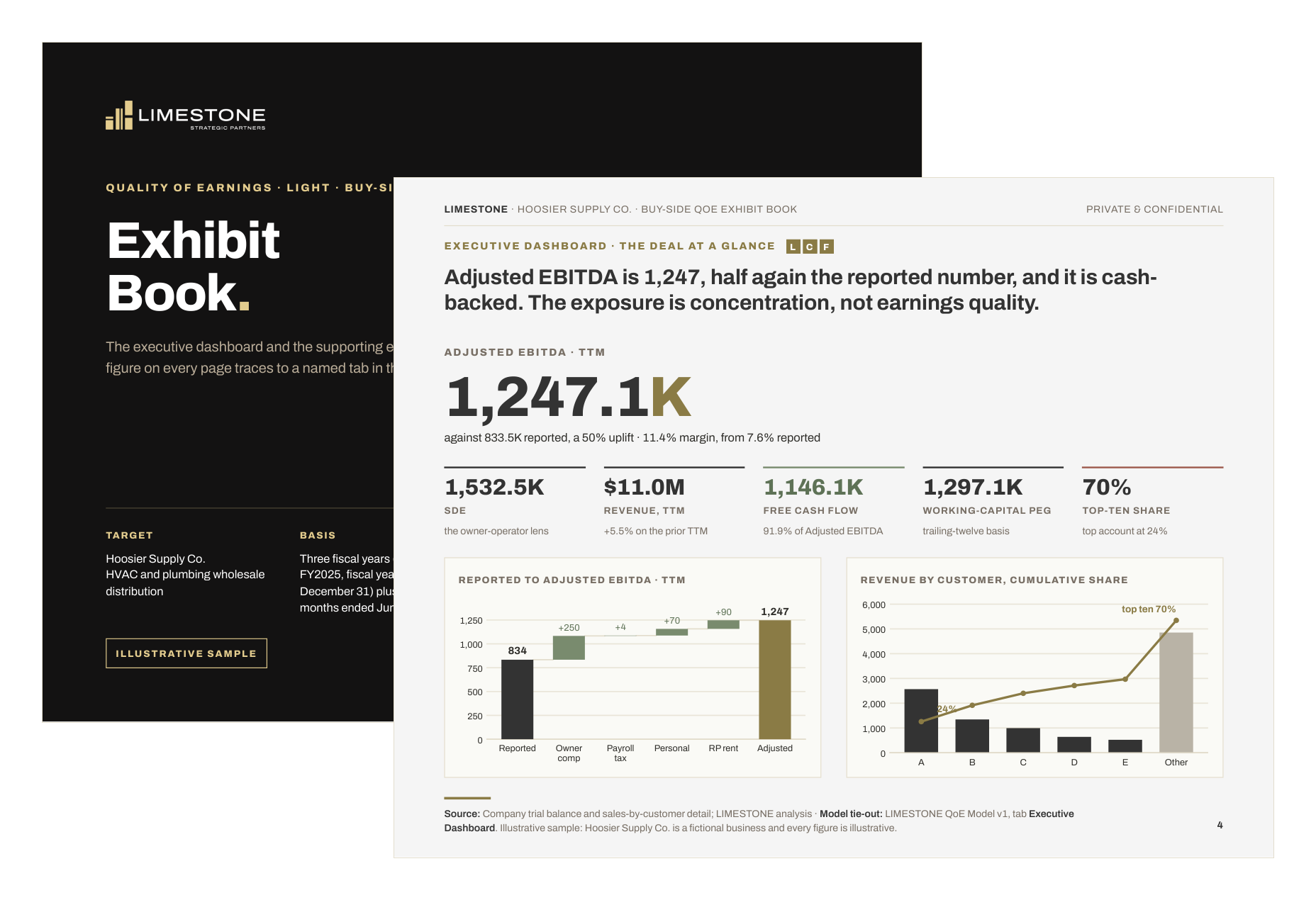
The Exhibit Book. The evidence: an executive dashboard, then one exhibit per page in the same order as the report. Every page names the tab in the workbook its figures came from.
The Workbook. The cleaned Excel file the whole package is built from, so you or your advisor can audit any number back to its source.
How We Communicate
You will never wonder where this stands.
A written update every week, and a call whenever it needs one. You see the draft before anyone else does. We call you the day before the readout, so nothing in it is a surprise. If a finding affects price, you hear it by phone before any draft, with the evidence and its size. What you do with it is your call.
How We Use AI
The systems do the retyping. The judgment is ours.
AI takes the repetition out of the routine work, and Crunchafi lands three years of a target’s ledger standardized in days rather than a week of re-keying. That time goes into the analysis and the calls. The opinion stays human, and you own your data.
Scope
Most deals at this size land on Core.
See The Actual Work
Read a whole report before you hire anyone. Including us.
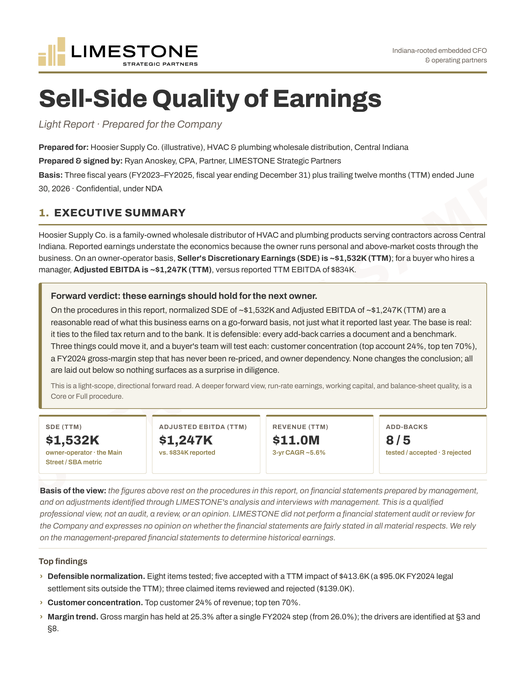
The Light report. Sell-side.
The walk from the tax return to Adjusted EBITDA, the add-back register with the rejected items shown, the proof of cash, and the verdict on whether the earnings hold. Enough to judge whether the work is any good.
Opens in your browser. No form, no email required.
The Full-scope report. Buy-side.
The complete report, exhibits and all. We send this one by email so we know where it went. The company name and location are fictional; the analysis, the exhibits and the standard are exactly what a client receives.
The exhibit book. Every finding has a page.
Each page carries a title that states the conclusion, a read line saying what it means rather than what it shows, and a source line naming the model tab behind the figures. Twenty-six arithmetic checks have to pass before the book will build.
We do not put the exhibit book or the model online. We walk both on a call, and we want to hear about the business or the deal you are looking at.
get started