
What the SOP Leaves Out, and SBA Said Anyway
Ryan Anoskey, CPA · 30 August 2026 · 14 min read
LIMESTONE Strategic Partners is a Carmel, Indiana diligence firm that prepares lender-ordered quality of earnings reports for SBA 7(a) acquisitions of businesses earning roughly $500K to $5M of EBITDA.
From 1 October 2026, SOP 50 10 8.1 requires the lender to obtain a quality of earnings report on any 7(a) initial acquisition or business expansion at a business purchase price of $3 million or more, and to use its earnings in the debt service coverage test. A report the buyer commissioned can reach the lender’s file once one of the lender’s own vendors has reviewed it. Our report reconciles the tax returns to the books and the books to the bank, tests every add-back through three gates and shows the ones we rejected, and sets the working capital peg: a fixed fee, delivered in 10 to 25 business days.
SOP 50 10 8.1 runs to close to 150,000 words, and SBA revised it on 25 September, six days before it takes effect. The paragraph that decides whether your deal needs a quality of earnings report now answers the question most buyers were asking, whether a report they paid for can count, and leaves one piece open.
On 26 August, SBA’s Office of Capital Access spent an hour walking lenders through Appendix 15, the section that governs every 7(a) change of ownership from 1 October. The presenter mentioned that almost five thousand people were on the call.
He said three things in that hour that were not in the rulebook. On 25 September SBA wrote one of them in, the route by which a report you already paid for can reach your bank’s file. The other two are still only in the recording.
A quality of earnings report is not an audit. It is a short, independent read of whether the earnings a seller reports are real and repeatable, built by tying the books to the tax returns and to what actually landed in the bank. From 1 October, on deals of a certain size, your lender has to have one.
So take the written rule first, then the places it stops, then what SBA added out loud.
The date that decides which rulebook applies
SOP 50 10 8.1 replaces 50 10 8 and takes effect on 1 October 2026. The notice SBA issued with the 25 September update ties it to the application, applying 8.1 to “all applications received by SBA on or after” 1 October, while lenders “must continue to use SOP 50 10 8 for 7(a) and 504 applications submitted through September 30, 2026.”
On a delegated loan, SBA receives the application when your lender requests the loan number, so the date of that request is the one that decides, however long the file sat in underwriting before it. A non-delegated file works differently. One your lender sent to SBA’s loan processing center by 30 September stays on 50 10 8 under the notice, and if its number issues in October, ask your lender which rulebook it is being read under.
If your lender has not sent the file to SBA yet, assume 8.1. It is the cheaper assumption to be wrong about.
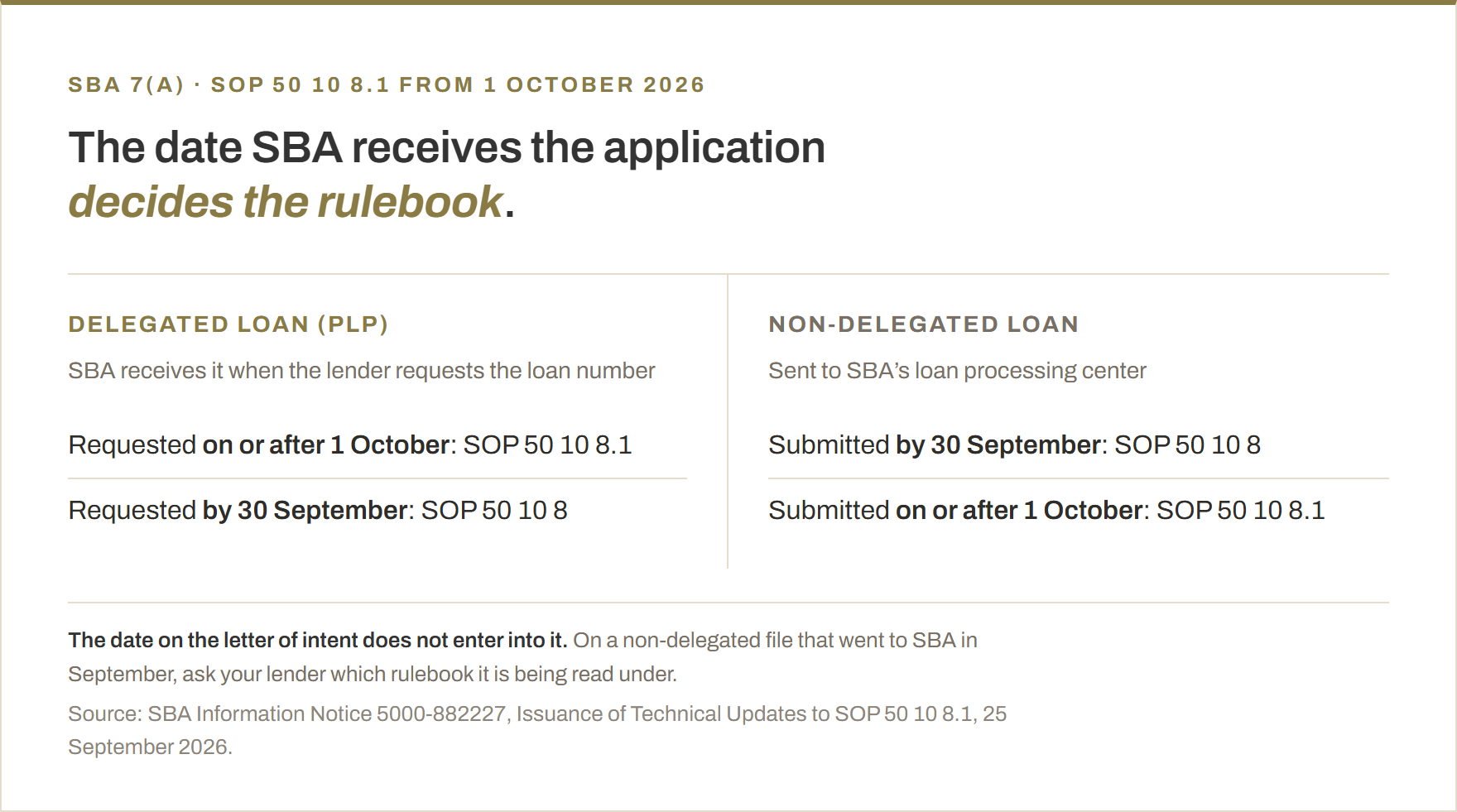
On a delegated loan, the date the lender requests the SBA loan number decides which rulebook applies.
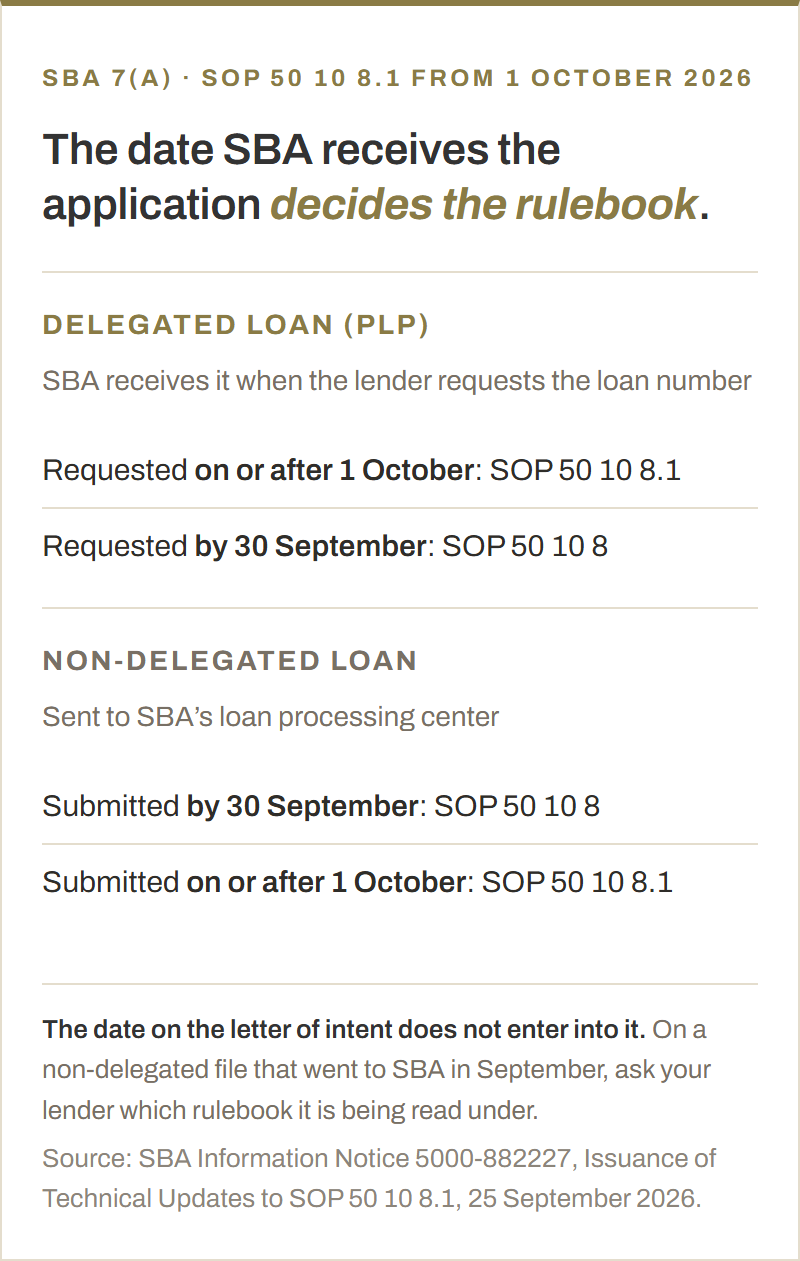
On a delegated loan, the date the lender requests the SBA loan number decides which rulebook applies.
What the text requires, category by category
Appendix 15 does something the old SOP did not. It sorts every change of ownership into four boxes, and then makes almost every other rule depend on which box you are in.
“Change of ownership transactions fall into four categories: Initial Acquisition, Business Expansion, Owner Buyout (Existing and Partial Change), and ESOP and Cooperative.”
The category is not something you elect. Initial Acquisition is the default, and the burden runs the other way:
“Initial Acquisition is the default category for 7(a) changes of ownership. For a change of ownership transaction to qualify as a Business Expansion, Owner Buyout, or ESOP & Cooperative, the Lender must document how the Applicant satisfies the requirement in their credit memorandum.”
SBA said the same thing on the call in plainer words: “You begin with initial acquisition. You move into the other categories based on the nature of that transaction.”
Four things fork off that decision. Whether you need a quality of earnings report at all. The coverage floor you are measured against. Whether the ten percent down payment can be reduced. And one qualifier per category, which is where deals fall back into the default box.
One measurement note before the table, because it decides who is even in scope. The $3M is the business purchase price: owner-occupied real estate comes out first at its appraised value, and the test runs before your equity and any seller note go in. A $3.6M deal carrying a $900,000 building is a $2.7M business and the mandate does not attach. A $3.4M business bought with $1M down is still a $3.4M deal. Files land on the wrong side of that line more often than people expect.
| Transaction type | What underwriting requires | The qualifier that trips people |
|---|---|---|
| Initial Acquisition | QoE required at $3M and up. Coverage floor 1.25x. Equity 10%, and it cannot be reduced. | The default category, including a buyer who has worked in the business for less than 24 months. Any deal that fails another category’s test lands here. |
| Business Expansion | QoE required at $3M and up. Coverage floor 1.15x. Equity 10%, reducible or removable on liquidity, provided net worth is not negative at the last fiscal year-end. | Two full fiscal years under current ownership, and the target in the same four-digit NAICS Industry Group. |
| Owner Buyout | No QoE required. Coverage floor 1.25x. Equity 10%, on the same reduction terms as a Business Expansion. | A buyer employed there less than 24 months must stay under half the equity and must not become the largest shareholder, counting interests held through entities. An employee of 24 months or more may buy a single owner out in full. |
| ESOP and cooperative | No QoE required. Coverage floor 1.25x. Equity 10%, and no injection at all where the plan or cooperative buys 51% or more. | The plan, trust or cooperative has to acquire a controlling interest. |
Two rows in that table are where the surprises live.
Business Expansion is harder to qualify for than it reads. It takes two full fiscal years under current ownership, a longer test than twenty-four months for anyone who bought mid-year, and the target has to sit in the same four-digit NAICS Industry Group. SBA was blunt about who that rule is aimed at: a buyer who acquires in January, again in July and again in December is not running three expansions. Those later deals are initial acquisitions wearing a different label, and they carry the 1.25 floor and the unwaivable ten percent.
Owner Buyout has a shareholder test that catches partial deals. Someone who has not worked in the business for at least 24 months may acquire less than half the equity, and may not become the largest direct or indirect shareholder. Interests held through a holding company, a trust or a partnership are aggregated in. Fail that and the deal is underwritten to the Initial Acquisition standards, “specifically the minimum DSC, minimum equity injection and Quality of Earnings requirements,” though the seller may still stay on as an owner and employee. Which means a quality of earnings report if the price clears $3M, and a down payment nobody can waive. The 25 September update also opened the category the other way: an employee of 24 months or more may now buy a single owner out entirely and stay an Owner Buyout, with no quality of earnings requirement at any price.
One number in the table looks worse than it is. The coverage floor on an initial acquisition moved from 1.15 to 1.25, and SBA’s own view of that is worth knowing: “Frankly, most lenders are already above that point.” The floor was raised to match what credit teams were doing anyway.
Three more items that do not fit a table. A business valuation is required on all four categories, by one of five named accreditations and prepared for the lender, though at a business purchase price of $350,000 or less the lender may value the business itself unless buyer and seller are closely related. 7(a) Small loans, which the August text kept out of changes of ownership, may now finance one, as may SBA Express loans, on the same coverage floors. And a deal built around an owner-occupied special purpose property, such as a hotel or a storage facility that cannot be separated from the business running it, needs no quality of earnings report at any price.
Three places the quality of earnings rule stops
The whole requirement runs to about 470 words since the update, and it asks for four things. The lender obtains the report on Initial Acquisitions and Business Expansions at a business purchase price of $3M or more. The report must be independent and conducted for the lender’s benefit, and it “must not be prepared by or for the seller,” a narrower bar than August’s, which also named the borrower. And it must carry a cash proof over the trailing twelve months and the last two fiscal years, reduced where the business has operated for less than two years.
Then it stops, and it stops in three places that matter.
It does not say whether a reliance letter is enough. Since 25 September the lender may have a report you commissioned “reviewed by one of their approved vendors,” with the findings of that review in the loan file beside your report, and “the Lender may not rely upon a QoE report prepared by another party without a review being performed by one of their vendors.” SBA’s notice announcing the update says the report can be used “if accompanied by a reliance letter or secondary review by a different firm.” The SOP text carries only the review, and the SOP is what binds your lender, so plan on the review.
It does not define independent. The report must be performed by “an independent, experienced financial professional.” That is the whole standard. Now set it against the business valuation two paragraphs earlier. That one names five accreditations. It requires the individual to be independent of the loan production function. It bars anyone carrying “the appearance of a conflict of interest.” Same appendix, same page, and one paragraph is specific while the other is not.
It does not say how much testing is enough. The SOP lists what the report must reconcile: accountant-prepared statements, tax returns, internal statements and IRS transcript data, into one adjusted earnings figure. It requires the cash proof. It says the report must assess customer concentration and contract continuity. It never says what depth of evidence satisfies any of that, which is why two firms can look at the same file and quote thousands apart. What actually moves that number is a separate piece: what a quality of earnings report costs.
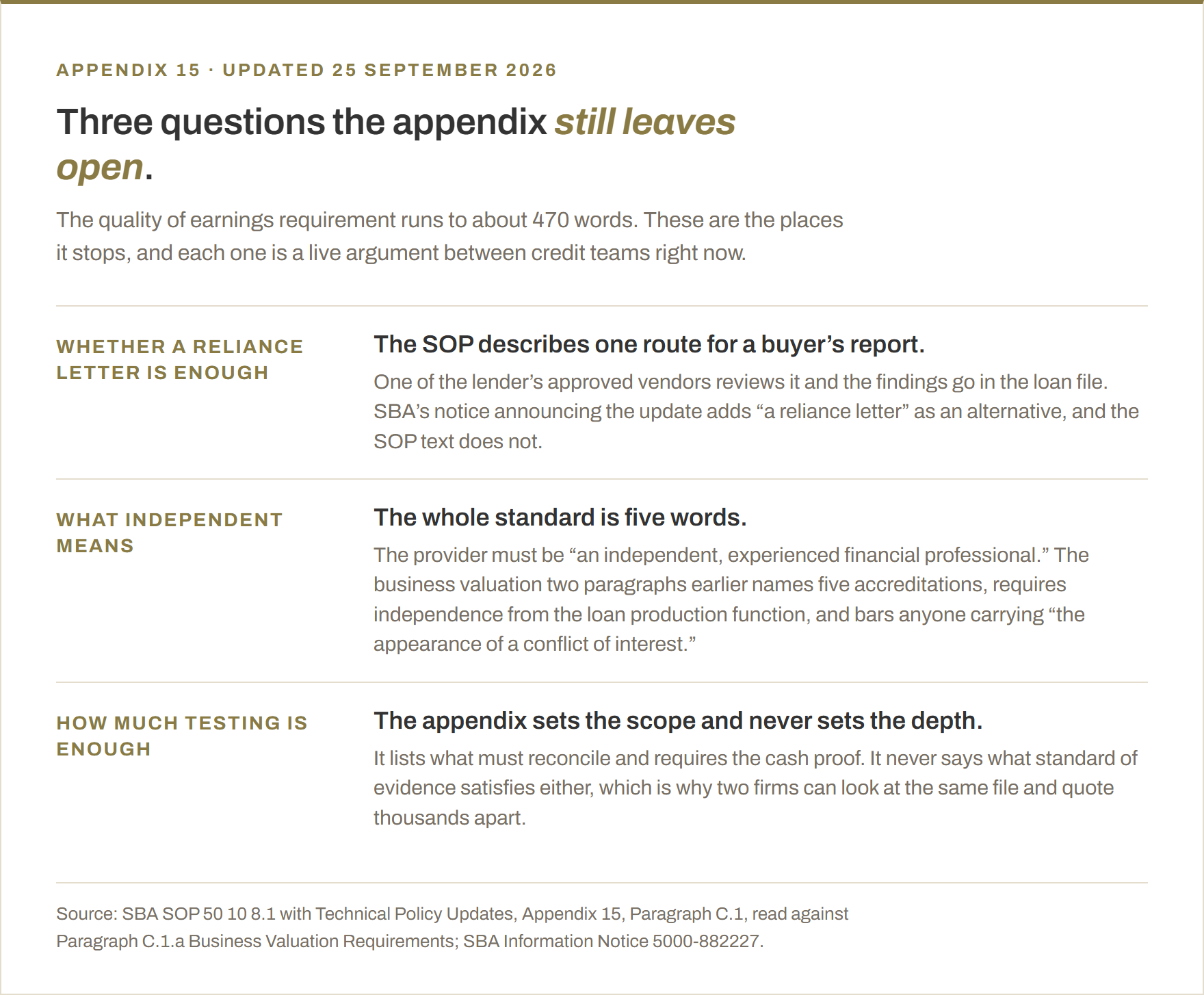
After the update, the appendix still leaves the reliance letter, the meaning of independent and the depth of testing to the lender.
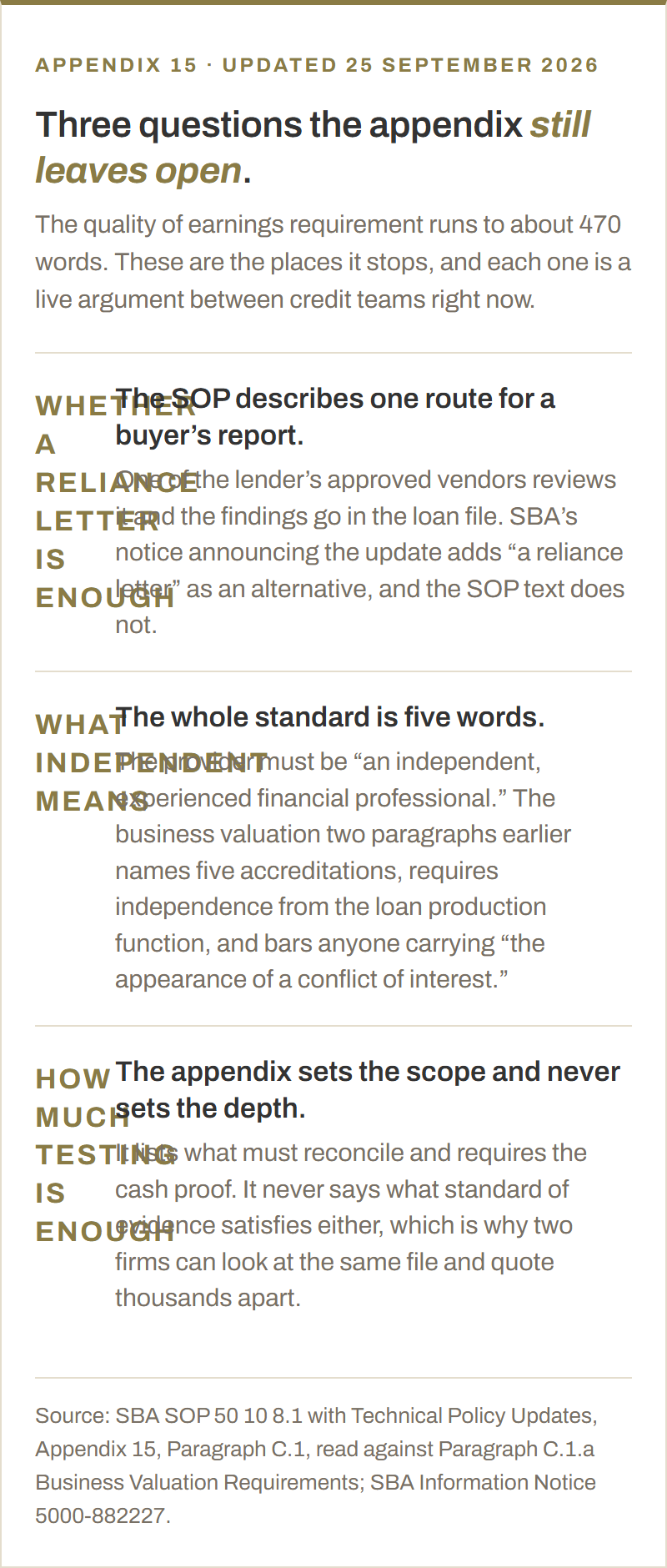
After the update, the appendix still leaves the reliance letter, the meaning of independent and the depth of testing to the lender.
What SBA said out loud
The training session was the second of three that week and it sits on SBA’s own channel, linked from the lender training page. The quotations below are his words with the stumbles and false starts taken out, and nothing else changed.
On who engages the work, SBA was firm, and the reason it gave turns on how many parties have an interest in the deal:
“This is not a box checking exercise. It needs to be engaged early. It is engaged by the lender.”
Then, unprompted, the carve-out that in August was not written down anywhere:
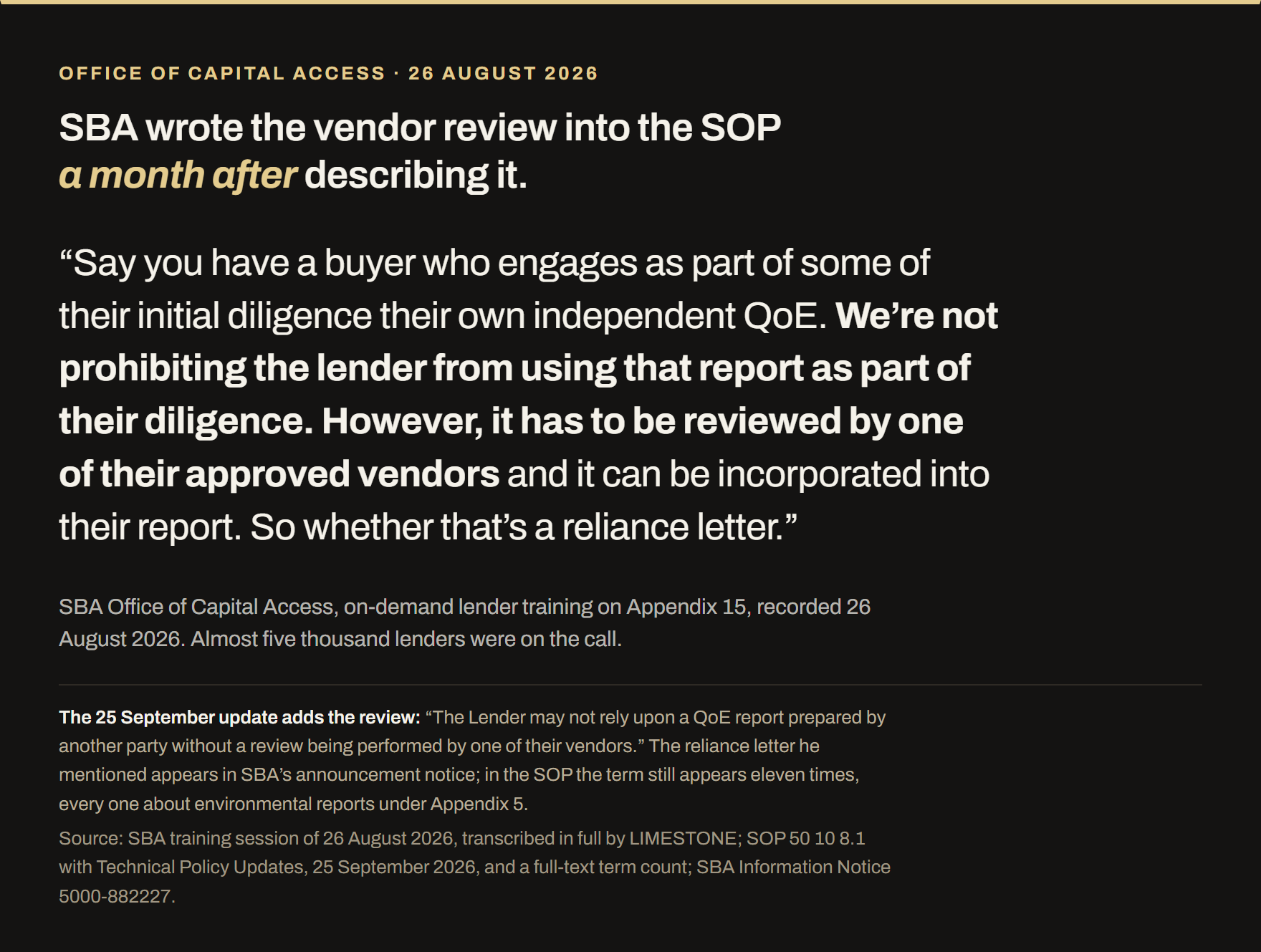
SBA wrote the vendor review into the SOP on 25 September, a month after describing it on the training call.
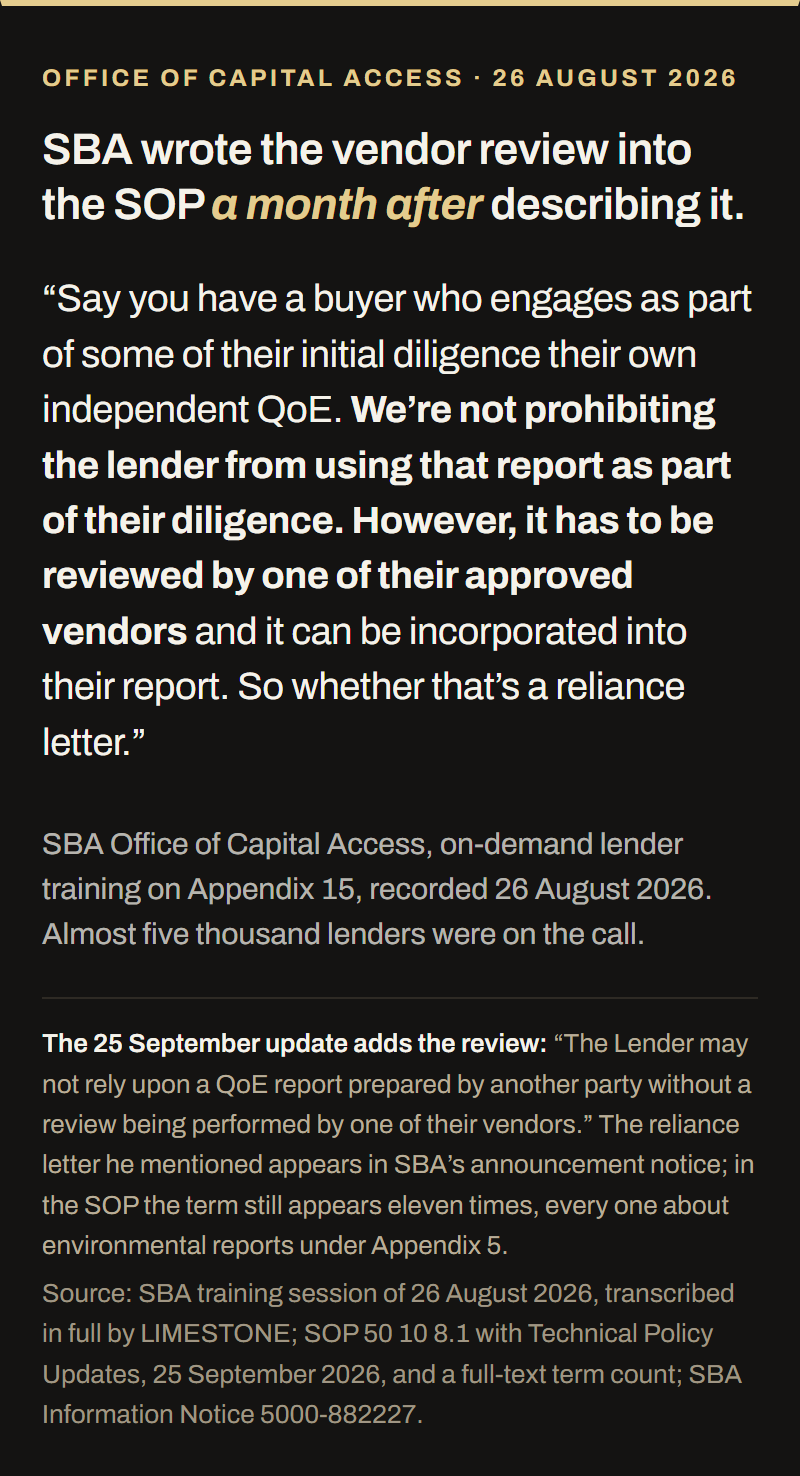
SBA wrote the vendor review into the SOP on 25 September, a month after describing it on the training call.
In August the appendix and the training did not say the same thing. The text barred a report prepared for the borrower, and SBA described a route by which one reaches the file anyway, through a vendor the lender approves, carried across by reliance letter. The 25 September update closed most of that gap. The bar now covers only the seller, and the vendor review is in the text. The reliance letter is still outside it. The SOP uses the term eleven times, and every one of them concerns environmental reports under a different appendix.
Then the independence standard, which cuts the other way and cuts harder:
“It cannot be affiliated in any way with any advisory firm on either buy side or sell side or any agent involved. And I mean that’s not just the division handling the transaction. It is any affiliation whatsoever. It has to be truly independent.”
The written rule asks who the report was prepared for. The spoken rule asks who the preparer is connected to at all, and it does not accept a wall between divisions as an answer. That is a real constraint on the large firms who advise both sides of the market, and it is worth being honest that it constrains us too. LIMESTONE cannot take the lender’s seat on a deal where we advise either party, and we would not want the report if we could.
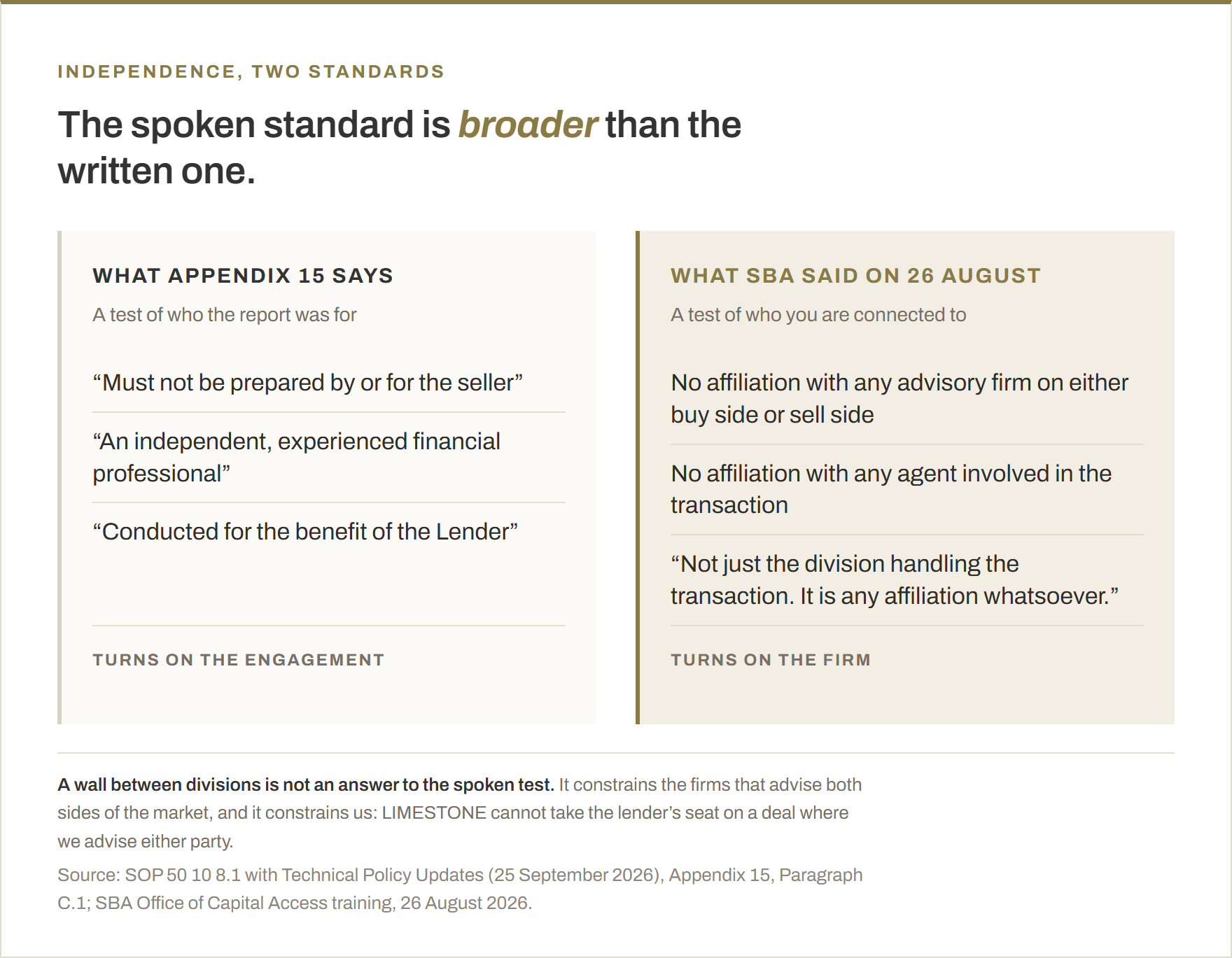
A wall between divisions does not answer the standard SBA described out loud.
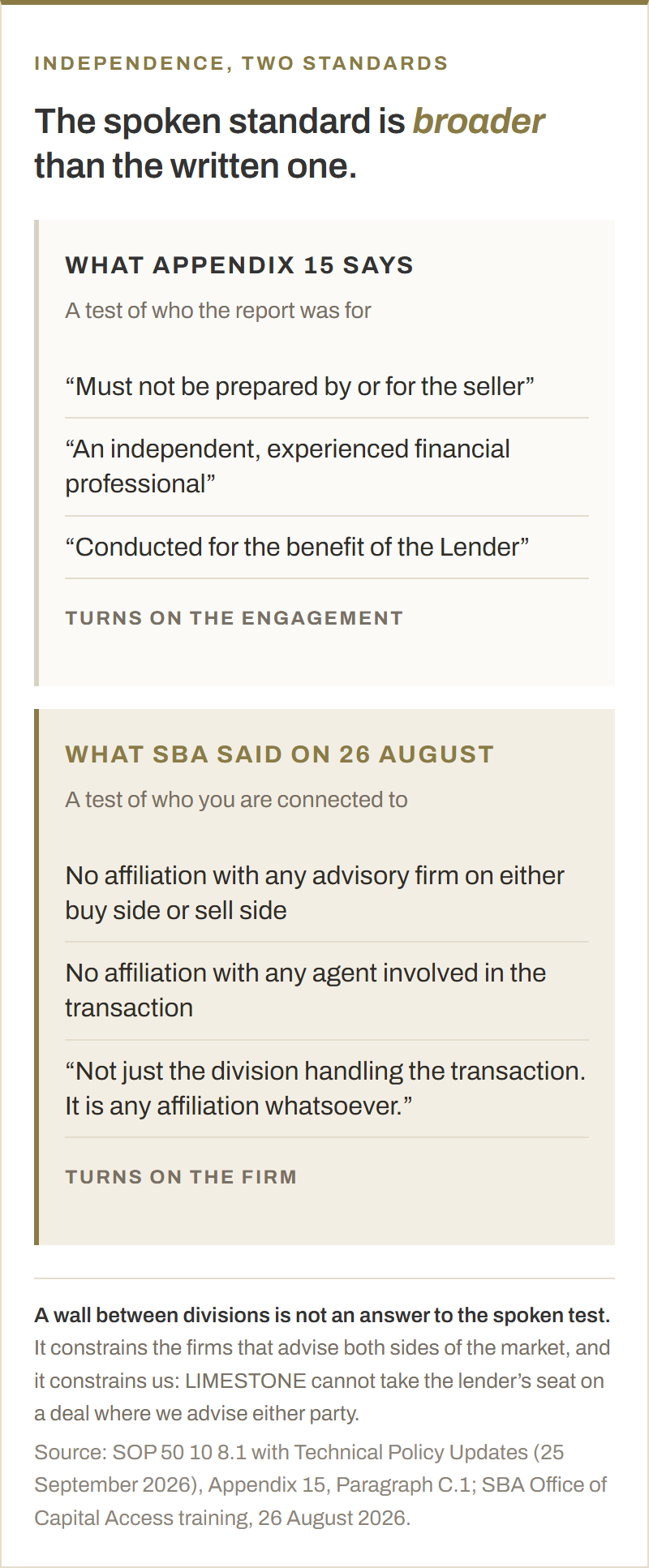
A wall between divisions does not answer the standard SBA described out loud.
On scope, SBA gave a description and then deliberately left the ceiling open:
“I would describe it as having somewhat of a medium scope focus, the cash proof probably being the one item in here. There’s definitely more work within a QoE that can be performed and I’ll leave it to the QoE providers to comment on that.”
My read, and I will own it as a read: that is a floor. Two fiscal years plus a trailing twelve, reconciling the income statement to what actually landed in the bank, is enough to underwrite a loan against. It is not enough to buy a company on. A lender wants to know the earnings figure is real. You want to know which customer keeps you awake and whether the owner’s relationships walk out the door with him, and the mandated scope does not reach either question. That gap is why LIMESTONE scopes a buy-side report differently from a lender-engaged one, even on the same company.
One more piece of the session that saves buyers money and almost nobody has picked up: the fee is not a sunk cost. “Any money spent related to the QoE, that is an out-of-pocket expense and it can count toward the applicant’s equity.” The SOP agrees: “Any funds expended by the Applicant on the report can count toward the equity injection.” On a deal requiring $300,000 down, a $15,000 report is $15,000 you were putting in anyway. The update added a separate line to the same appendix saying fees for “advisory services” are not equity, so confirm with your lender that it reads the report fee under the first line.
What the 25 September update settled
SBA said in August that it would write the route down: “There’s some flexibility that we’ll be adding and clarifying in the tech update.” The technical update published on 25 September and did most of what that sentence promised. A report the buyer commissioned can now reach the lender’s file, provided one of the lender’s approved vendors reviews it and the review sits in the file beside the report.
Both routes the update leaves open, and what we deliver on each, are set out on the SBA quality of earnings page.
The notice and the SOP still differ on one point. SBA’s notice announcing the update says the report can be used with “a reliance letter or secondary review by a different firm,” and lenders are already repeating that sentence. The SOP text says only that the lender may not rely on the report without a review by one of its vendors. A credit team working from the SOP is entitled to insist on the review, and I would plan on it until SBA says otherwise.
The practical position is narrower than either reading. Your report reaches the file only if your lender is willing to put it through a vendor it approves, and the SOP leaves that choice to the lender. That question is free to ask and expensive to skip.
Updated 27 September 2026 for SBA’s technical update of 25 September and Information Notice 5000-882227. The first version of this page was current as of 30 August 2026. We will update it again when SBA clarifies the reliance letter or issues a further notice, and we will date that change as well.
What we would do before ordering a report
Five things, in order, and the first two cost nothing.
Ask your lender which category they will code the deal as. It is an entry in the SBA Loan System and it has to be justified in the credit memorandum, so there is a right answer and someone has to write it down. It sets your coverage floor and your down payment.
Ask whether they keep an approved vendor list, and whether one of those vendors will review a report you already hold. Two questions, one email. If the answer is no, you know the budget early enough to plan for a second report.
If you already have a report, do not commission a second one before you have asked. This is the most common way to spend $15,000 you did not need to spend.
Budget the fee as part of your equity. The SOP lets it count toward the injection, alongside the valuation; confirm your lender reads it that way.
Assume the engagement letter has to be signed before your loan number issues. Under delegated authority the reports can finish after the number and before closing, so long as they are in process. The engagement itself cannot wait. The appendix requires that the vendor “must have been retained, and an engagement letter must be in place” when the number is issued. So choosing the provider sits on the closing critical path. That is not where most buyers have it.
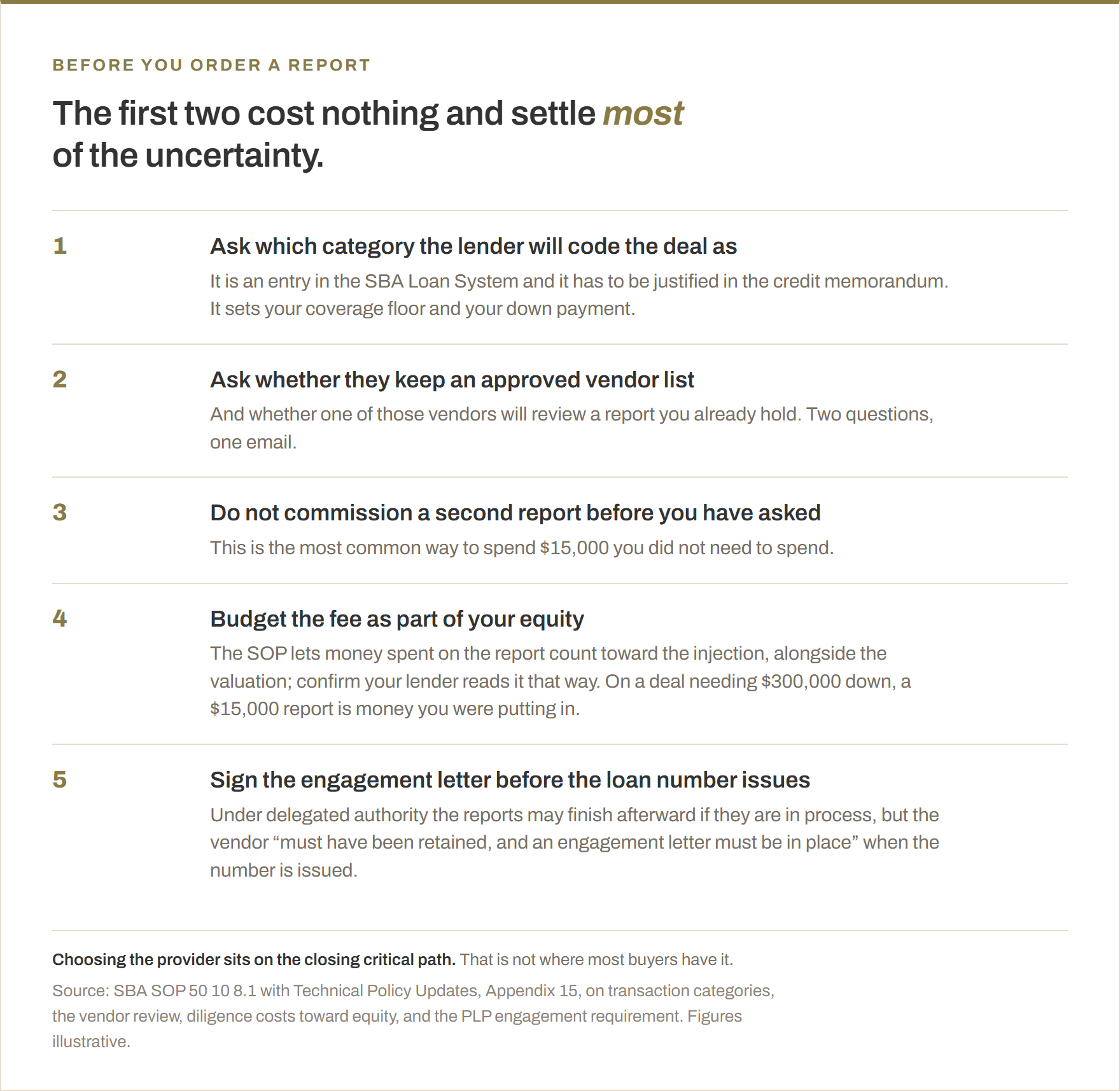
Choosing the provider now sits on the closing critical path.
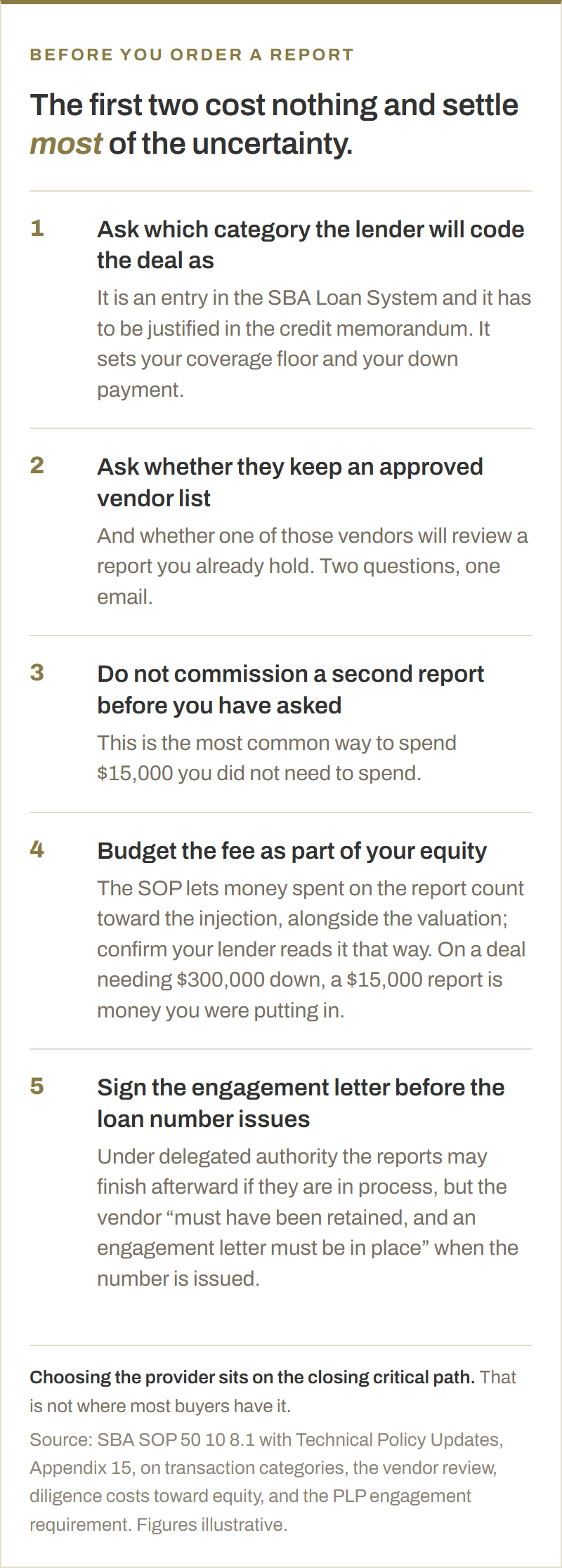
Choosing the provider now sits on the closing critical path.
Questions we hear
My application is already in. Am I under the old rules or the new ones?
It depends on when SBA received it. SBA’s notice keeps SOP 50 10 8 for applications submitted to SBA through 30 September and applies 8.1 to those received on or after 1 October. On a delegated loan SBA receives the application when your lender requests the loan number, so a number requested in October puts you under 8.1 however long the file sat in underwriting. If your lender sent a non-delegated application to SBA in September, ask which rulebook it is being read under.
I already own a company and I’m buying a second one. Is that an expansion?
Only if your existing business has operated for two full fiscal years under your ownership and the target sits in the same four-digit NAICS Industry Group. Two full fiscal years can run past thirty months if you bought in June. Miss either test and it is an initial acquisition: 1.25 coverage, ten percent down that cannot be reduced, and a quality of earnings report if the business price clears $3M.
SBA’s notice and the SOP say different things about a reliance letter. Which does my bank follow?
The SOP, and then its own credit policy on top. The SOP binds the lender, and on this point it describes only a review by one of the lender’s vendors; the reliance letter appears in the notice that announced the update. A conservative credit team is entitled to insist on the review, so ask your lender directly; its answer is the only one that binds.
What happens if the report comes back below the price I agreed to?
The loan shrinks and the difference lands on you. The appendix is direct about it: if the coverage does not support the valuation and the proposed debt structure, “the loan amount must be reduced accordingly,” and the gap has to be filled with additional equity, which the SOP lets you add, from your own cash or a limited source, to bring the debt down until coverage clears. Where that extra money comes from a limited source such as more seller debt, it goes on full standby for the term; where it comes from you, it is cash you were planning to operate with.
Working out where your deal lands? Send us the shape of it: purchase price, whether real estate is in the transaction, whether you already own an operating company, and whether anyone buying in works there today. LIMESTONE will tell you which category it falls in, whether the report is required, and which coverage floor you are being measured against. Fifteen minutes, no charge, and nothing to sign. If you would rather read first, the Light sample report is on the quality of earnings page with no form and no email required.
Two companion pieces go deeper than this one does. On whose report counts and why the independence clause catches people, read who orders the QoE on an SBA deal. On what actually lands in front of a credit committee, read what a lender needs to see before they will fund.
Ryan Anoskey is a CPA and a partner at LIMESTONE Strategic Partners. He has run more than 100 quality of earnings engagements, buy-side and sell-side, across manufacturing, healthcare, contracting and multi-site roll-ups.
Sources: SBA SOP 50 10 8.1, Appendix 15, 7(a) Changes of Ownership (issued 14 August 2026, with technical policy updates published 25 September 2026, effective 1 October 2026), quoted from the published documents; SBA Information Notice 5000-882227, Issuance of Technical Updates to SOP 50 10 8.1 (25 September 2026); SBA Office of Capital Access, “SOP 50 10 8.1 Overview: Appendix 15, Changes of Ownership Transactions,” on-demand lender training recorded 26 August 2026, transcribed in full by LIMESTONE. Every rule statement in this article was checked against the SOP text itself.