
You were told you need a CFO. You may need a controller instead.
Jared Luegers, CFA · 18 September 2026 · 11 min read
LIMESTONE Strategic Partners takes the CFO seat and the operating partner seat inside owner-led businesses earning $500K to $5M of EBITDA, embedded and part-time, from Carmel, Indiana.
If the books are late or wrong, you need a controller. If the numbers are right and the business cannot see three months ahead, you need a CFO. If the plan is clear and everything still runs through you, the missing seat is an operating partner. Revenue is the wrong trigger for any of the three; hire for the job that needs doing.
Which title you hire matters less than the job that needs doing. If the books are late or wrong, you need a controller. If the numbers are right and the business cannot see three months ahead, you need a CFO. If the plan is clear and everything still runs through you, the missing seat may not be finance at all.
Somebody told you to get a CFO. A banker, a partner, an advisor at a lunch. You typed the comparison into a search bar and got a dozen pages that agree with each other and end the same way, with the firm that wrote the page offering to be your fractional CFO.
I run a firm that sells that seat, so read the next sentence with that in mind. Many of the owners who ask us for a CFO need a controller first, and we do not do that work. We do not keep the books and we do not run the close. We sign it off on the fifth business day and we use it, and when the problem is the books we say so and introduce you to a firm that does that work well.
Those pages confuse people because the market has blended five different things into one word. One is the role you need (a controller or a CFO). Another is the mandate, whether something in the business has to change. Then the delivery model (fractional, interim, full-time). How deep the seat sits inside your management team, for which the word now is embedded. And a second seat that is not finance at all. Sort what is broken first and the title takes care of itself.
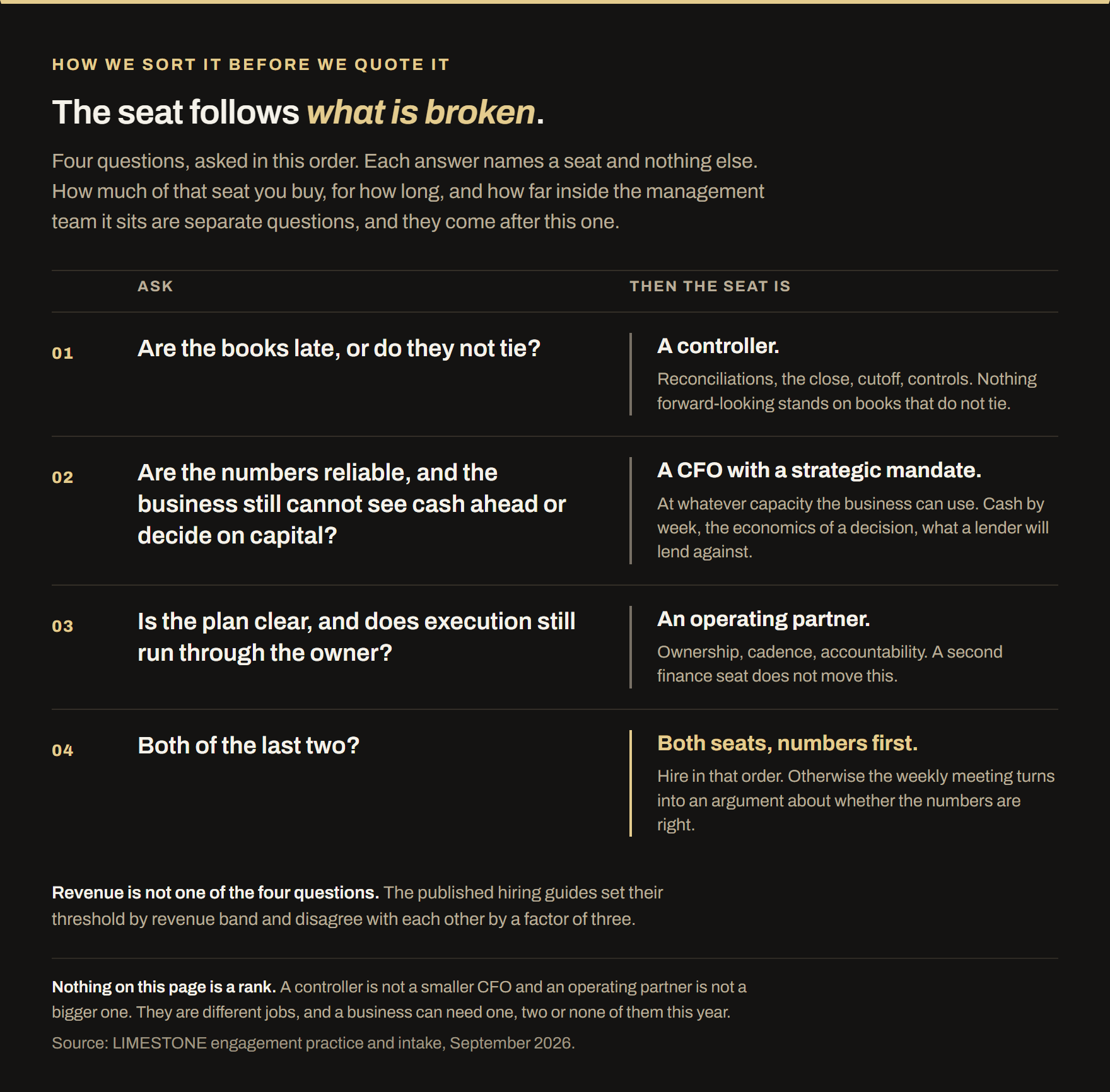
Four questions answered in order, where the first yes is the seat the business is missing.
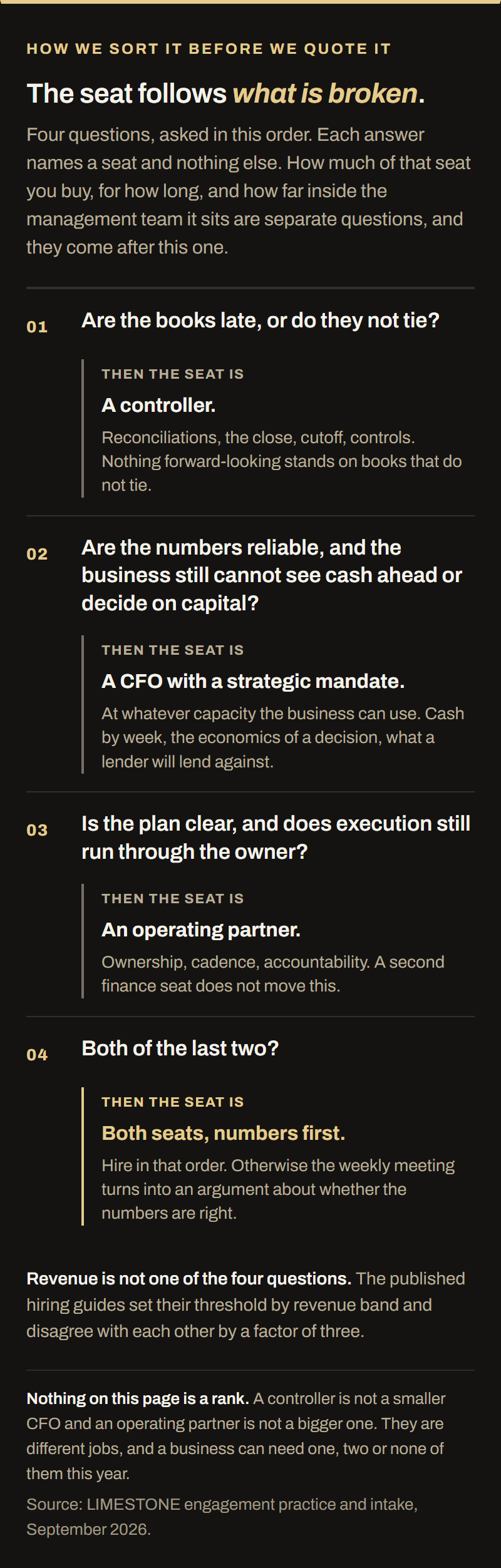
Four questions answered in order, where the first yes is the seat the business is missing.
When do you need a controller?
When the numbers cannot be trusted. It sounds obvious, and it is the diagnosis owners miss more often than any other, because the symptom rarely looks like accounting. It looks like a forecast that never matches what happened, or a bank that asks for a statement and gets it three weeks later.
A controller makes the numbers reliable. Reconciliations tie, the close lands on the same business day every month, revenue is booked when it is earned rather than when the contract is signed, and the balance sheet balances without anyone having to explain it. It is the past, done properly, and nothing forward-looking can be built without it.
We usually hear this one secondhand. An advisor has already told the owner they are “not ready for a fractional CFO yet,” the line lands as a judgment on the business rather than a note about order, and the owner wants to argue with it. The complaint underneath is plenty of lagging indicators and no leading ones, which is a CFO complaint word for word. The advisor was still right. A leading indicator cannot be built on books that do not tie, so the first hire is the person who makes them tie.
Our own monthly close shows where that person’s work ends and the CFO’s begins.
| Task | Owner | Business day |
|---|---|---|
| Bank and card reconciliations; AR and AP cutoff and aging | Controller | 2 |
| Accruals and prepaids; payroll and benefits | Controller | 3 |
| Depreciation; inventory and cost-of-sales true-up | Controller | 4 |
| Revenue recognition review | CFO | 4 |
| Variance against plan, with the reason for each | CFO | 5 |
| Reporting package and scoreboard refresh | CFO | 5 |
| 13-week cash refresh | CFO | 5 |
| Sign-off and distribution | CFO | 5 |
Everything the controller owns on that list is skilled work. A controller who lands a clean close by the fourth business day every month is worth more to an owner than a CFO reading unreliable numbers on the tenth.
When do you actually need a CFO?
When the numbers are reliable and the business still cannot decide. A CFO turns reliable numbers into forward-looking decisions. How much cash the business will have in week nine. Whether the second location pays back in two years or four. What a lender will lend against, and which of three growth moves the balance sheet can actually carry.
What we take are the situations where something has to change. A turnaround. A business that has outgrown the finance function it started with. A raise or a refinancing. An owner a few years from a sale who needs the numbers to hold up when a buyer’s team reads them. Some CFO engagements are scoped to accounting and reporting, and there is nothing wrong with that scope. Ours are scoped to a change. That is a difference I would defend across a table.
My clearest example of the line between the two seats is a services business we work with that gets paid when the work completes. It had roughly $6 million of signed work open, and about $750,000 of it had turned into cash over the previous 90 days. Its owner wanted to borrow against the book. Doing exactly what underwriters do, the bank would count only the slice that turns to cash inside 90 days, which was a fraction of the $6 million. Nothing about that was an accounting problem; the books said what they said. What was missing was laying the signed work out by when it converts, writing the underwriter a plain memo on the collection history, and putting a longer-term SBA structure on the table beside the line of credit so the owner had two doors instead of one. It is CFO judgment, and no controller is hired to do it.
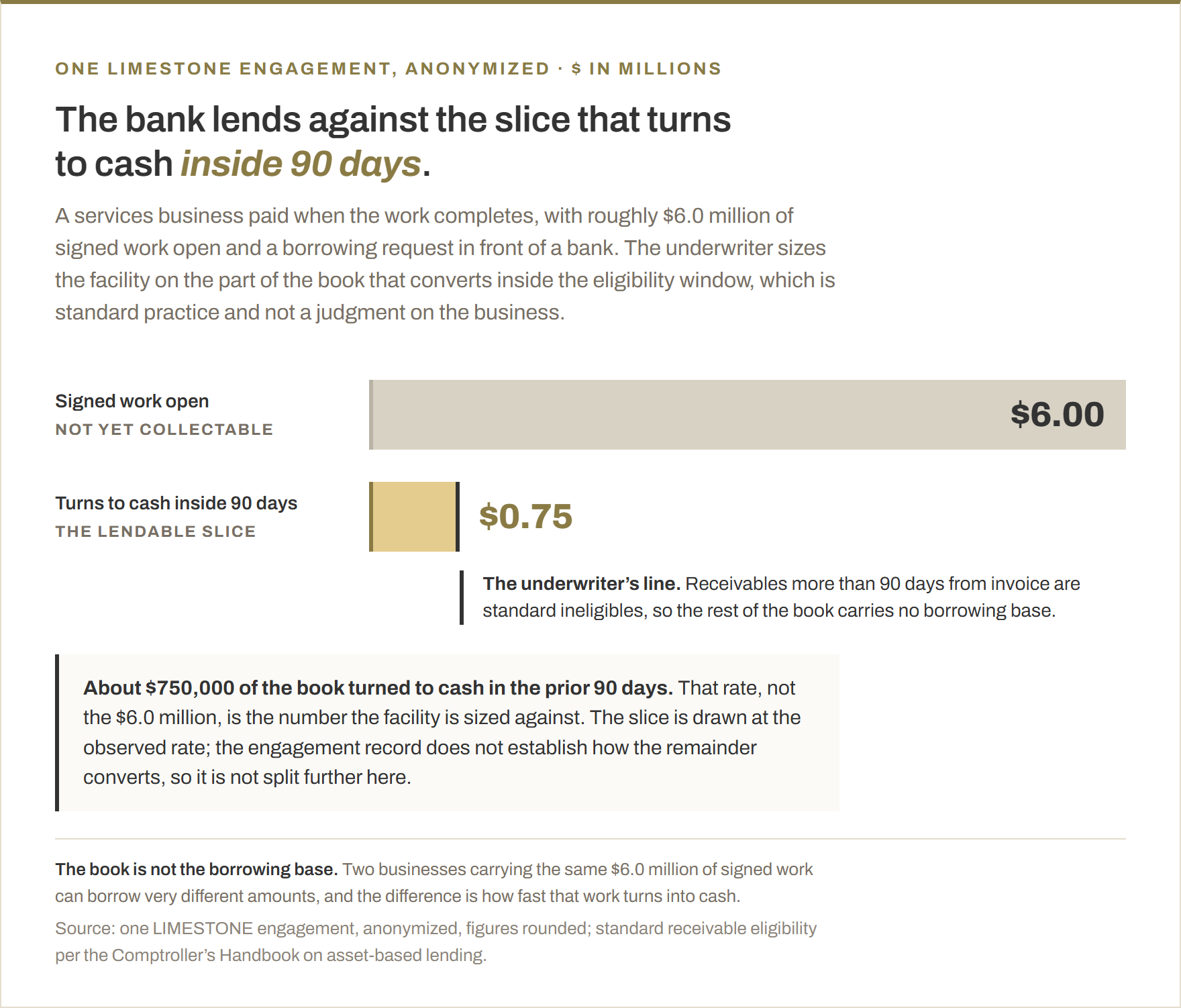
Roughly $6.0 million of signed work, and the $750,000 of it a lender will actually count.
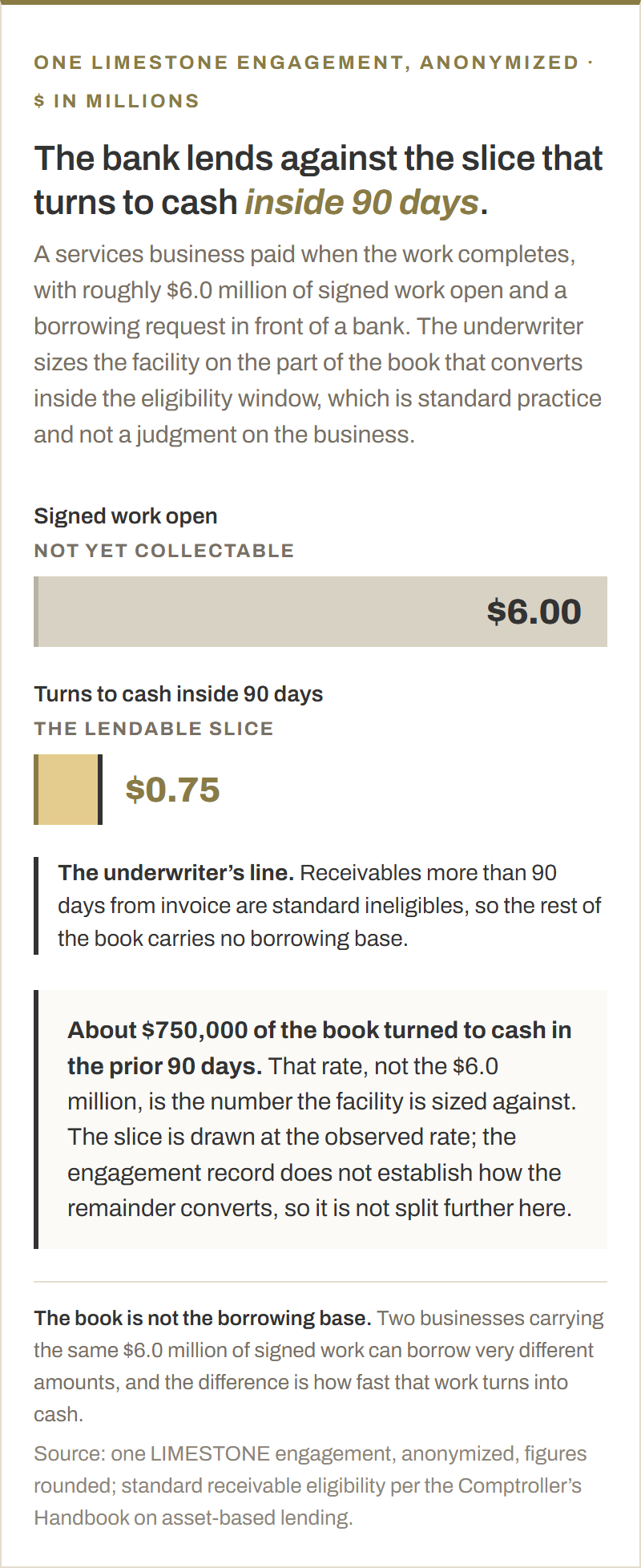
Roughly $6.0 million of signed work, and the $750,000 of it a lender will actually count.
What the seat has to connect
This job has changed, and the change is what separates the seat from a senior accountant. Financial statements tell you what happened. The seat’s job now is to tie them to the operating data so the owner can decide what happens next. Margin by customer and by line, pipeline conversion, labor as a share of revenue, days sales outstanding, cash by week rather than by month.
In our engagements that means a scoreboard of 10 to 15 numbers, each with one accountable owner and a target, refreshed every week, and a 13-week cash view rolled forward every Monday against the actual bank balance. The cash summary leads with the lowest point in the thirteen weeks, the week it lands, and the runway behind it. For a business on 30-day terms the targets look like a close by the fifth business day, DSO under 40 days and no customer above 20% of revenue; on 60-day terms two of those move. A number that misses becomes an agenda item in the weekly leadership meeting the same week, with a name beside it.
What do fractional, interim and embedded actually mean?
Three words that describe how the seat is delivered, and none of them says anything about whether the CFO is any good.
Fractional describes capacity, meaning continuous CFO leadership that is not forty hours a week. A business with a few million dollars of EBITDA rarely needs a full-time CFO and rarely wants to pay for one, so it buys the seat a day or two a week. A fractional CFO can be as strategic as any full-time one, and plenty are.
Interim describes duration and situation. It is a temporary seat that covers a discontinuity, whether a departure, a crisis, a restructuring or a transaction. Usually full-time, usually three to twelve months, at whatever capacity the discontinuity needs. Our first 90 days in a turnaround run at that intensity and then step down, which is one form of the same thing.
Embedded describes who owns the cadence. The word is getting inflated (national fractional-CFO firms now put it in their headlines), so it needs defining by what it means in practice. For us it means the Friday report and the weekly leadership meeting run under our name whether or not a partner is in the room that week, the scoreboard is ours to keep current, and when the lender has a question they call us. Reporting on a business from outside once a month is a legitimate service. It is not embedded.
Strategic describes the mandate, and it is the only one of the four words that says anything about the work itself. LIMESTONE’s CFO seat is fractional in capacity, strategic in mandate and embedded in the management team, and I would rather say those three things plainly than let one word carry all of them.
| The word | What it actually describes | What it says about the work |
|---|---|---|
| Fractional | Capacity: how many hours of the seat you buy | Nothing |
| Interim | Duration: a temporary seat covering a discontinuity | Nothing |
| Embedded | Integration: who owns the weekly cadence | Nothing |
| Strategic | Mandate: the seat exists because something has to change | Everything |
Why revenue is the wrong trigger
On sequence, the usual advice is right. A controller comes before a CFO, because a decision built on unreliable numbers is a guess with a spreadsheet attached. Where it goes wrong is the trigger. Nearly every guide sets it by revenue, and the bands do not agree with each other. One puts the controller under $3 million and the CFO from $3 million to $15 million. Another puts the first controller around $5 million, a CFO at $10 million to $20 million and a full-time hire at $50 million. A third runs under $10 million, $10 million to $50 million, and above. When the guides disagree by a factor of three, the variable they are using is the wrong one.
Two businesses at $8 million of revenue can need different seats entirely. One is stable, run on a good controller’s numbers, and needs nothing new this year. The other is six months from a refinancing with a lender who wants a 13-week cash view and a covenant forecast before the meeting. Revenue tells you nothing about which one you are. What is broken does.
When is the missing seat not finance?
Sometimes the numbers are reliable, the forecast is good, the decision has been made, and nothing happens. A plan exists and nobody runs it, every priority still routes through the owner, and the weekly meeting, where there is one, discusses and does not decide. That is not a finance problem, and a second CFO will not fix it.
The work belongs to an operating partner. A CFO asks what the data says and what will happen to cash; an operating partner asks who owns this and what changes on Monday morning. Private equity has kept the two seats apart for years, for the same reason a larger company has both a CFO and a COO, and the skills overlap far less than the titles suggest.
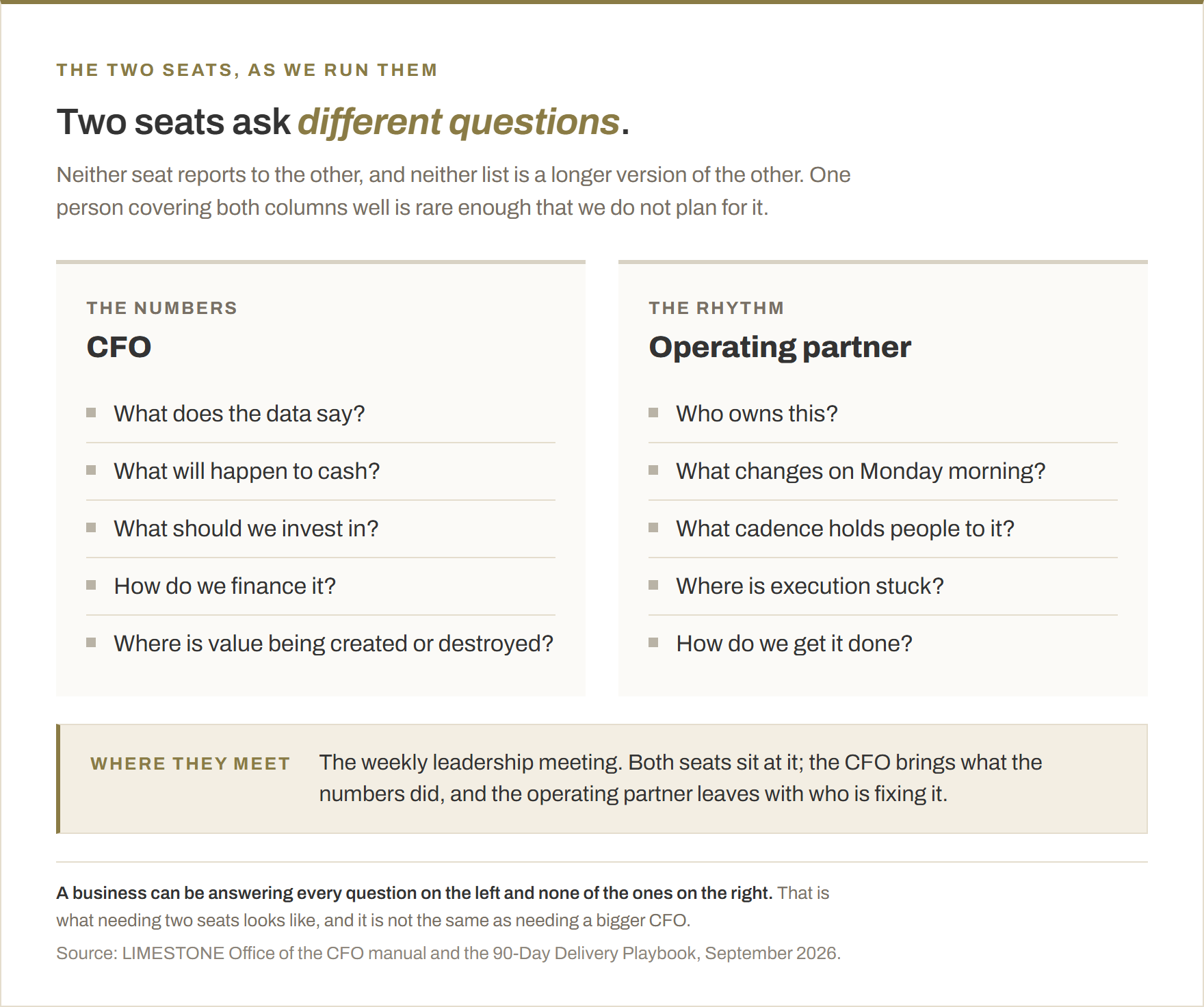
The CFO’s five questions and the operating partner’s five, and the one meeting where both sets get answered.
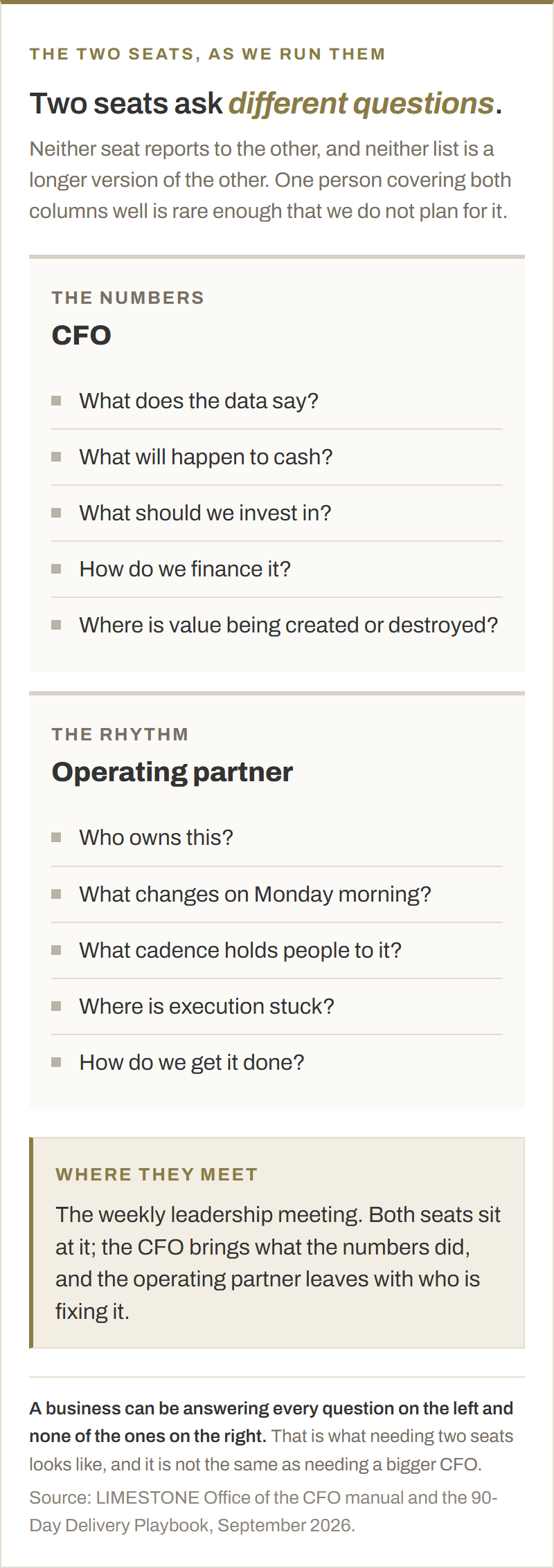
The CFO’s five questions and the operating partner’s five, and the one meeting where both sets get answered.
LIMESTONE separates the two seats on purpose. Ryan Anoskey holds the CFO seat, I hold the operating partner seat, and they are priced separately so an owner who needs one is not paying for two; the numbers are on our CFO and operating partner page. Ryan has led more than 100 quality of earnings reviews, buy-side and sell-side, and that matters here because he reads an owner’s numbers the way the buyer or the lender will read them, before they do.
Some businesses are missing both seats. It happens in a turnaround, in a business scaling past the systems it started with, in a large raise, and in the two years before a sale, when the books and the org chart both have to survive a stranger’s review. When both are missing, the numbers come first, because execution measured against numbers nobody trusts is theater. What the operating seat does in its first hundred days is its own article, and it is the proof for this one. Read what an operating partner actually does after the close.
Questions we hear
I was told I’m not ready for a fractional CFO yet. Am I?
Probably not, and it is not an insult. If your close takes more than ten business days, your bank reconciliations are behind, or your balance sheet carries entries nobody can explain, the next hire is a controller. A CFO on top of that spends the first three months doing controller work at a CFO’s price. Get the books to tie first; the CFO conversation gets shorter and cheaper when you do.
Isn’t this my CPA’s job?
Your CPA keeps the reporting, tax and compliance right, and a good one is worth keeping close. What a CPA firm is not built to do is sit in your weekly leadership meeting, roll a 13-week cash forecast every Monday, or negotiate with your lender. Different jobs, and we work alongside yours.
My books are a mess, so which one do I need?
Owners use one word for three different cleanups. Wrong books are controller work, and we will introduce you to someone. Books that are right and tell you nothing (no margin by line, no leading indicator, no cash view) are the CFO seat. Books that are right while the earnings will not survive a buyer’s review are a different exercise again. Two other pieces cover it: how to get your business ready to sell and what a lender needs to see.
Need the books fixed? Tell us what you have and we will point you to a controller or bookkeeping firm we have worked beside. No charge, and we take no fee for the introduction. Something has to change? If it is a turnaround, a raise, a sale a few years out, or a business outgrowing its finance function, book a call. Both partners are on it, and we will tell you straight whether it is one seat, both, or neither.
Jared Luegers, CFA, is the founder and managing partner of LIMESTONE Strategic Partners. He supported operations through a $190 million strategic sale, worked in the FP&A and corporate development seat at an energy platform that acquired Shell’s Danish refinery business, and now sits in the operating partner seat with lower-middle-market owners in Indiana.
Sources: the LIMESTONE Office of the CFO manual and monthly close checklist; one LIMESTONE engagement, anonymized and with figures rounded; published controller and CFO hiring guides, revenue bands as of September 2026; the Comptroller’s Handbook on asset-based lending, on receivable eligibility.
