
Getting your dental practice ready to sell: what a buyer’s quality of earnings checks and what raises the price
Ryan Anoskey, CPA · 20 October 2026 · 16 min read
LIMESTONE Strategic Partners does exit readiness and quality of earnings work for dentists who plan to sell, so the owner sees what a buyer’s review will find before the buyer does. Ryan Anoskey, CPA, leads the numbers. The firm is in Carmel, Indiana. Indiana-rooted, and we serve buyers and owners nationwide.
A dental practice sells on its earnings, and both kinds of buyer, another dentist or a DSO, test the books first. Documented add-backs, collections near 98 percent of adjusted production, overhead in line with similar practices, and a practice that runs without its owner each raise the price, and most of that work takes about two years.
Two dental practices with the same collections can sell for very different prices, and most of the difference is work the owner can still do. This is that work in the order I’d do it, starting with the review a buyer will run on your practice, run for you two years early.
Two general practices can sit across the street from each other, both collecting around $900,000 a year, and one earns $60,000 before the owner is paid while the other earns $400,000. I’ve seen it more than once. Ask either dentist what the practice is worth and you’ll probably hear the same rule of thumb, a percentage of collections, which prices them the same. A buyer starts from the $60,000 and the $400,000.
Most of that gap comes from things an owner can change: production that was never collected, overhead that hasn’t been properly benchmarked, personal spending run through the practice, QuickBooks that don’t align to reality, and patients who come back for the owner personally. I’m writing this for the dentist who is two to five years from selling and hasn’t talked to a buyer yet.
Where I learned what a buyer checks
My dad is a dentist. The regional CPA firm in Indianapolis that valued his practice, while I was still auditing in Evansville, later hired me onto its valuation team. My deal work there was mostly health care, with distribution, engineering and manufacturing mixed in, and dentistry ran through all of it.
We were the standing quality of earnings provider to a dental service organization (DSO) in the Indianapolis area as it formed. The group was buying practices and selling itself to private equity in the same transaction, so we worked buy-side and sell-side on the same practices at the same time, then ran the reviews on its add-ons. We also prepared the earnings a group of dental brokers marketed to buyers, and in a busy year we valued around a hundred practices. The work for that group is part of how I helped build the firm’s transaction advisory practice.
In all I’ve prepared more than one hundred quality of earnings reviews, on both sides of the table. Some were hard to watch: a good practice, loyal patients, and books that cost the dentist part of their price over problems that would have taken six to twelve months to clean up.
How does a DSO price a practice differently from a dentist buyer?
A dentist buyer plans to work in the practice, so they price the earnings before any doctor is paid, limited by what the practice can carry after the loan payment. Plenty of banks with dental lending teams will finance most or all of that price without an SBA loan. A DSO takes a normalized doctor wage out first, puts a multiple on what’s left, and often pays part of the price in equity in the group, called rollover. DSOs tend to call it an affiliation or a partnership, and it carries a non-compete like any other sale.
| $ in thousands | Dentist buyer | DSO |
|---|---|---|
| Collections | 1,500 | 1,500 |
| Overhead before any doctor pay (63%) | (945) | (945) |
| Doctor pay the buyer assumes | No doctor pay; the buyer works the chair | (300), at 30% of the 1,000 that dentist collects |
| Earnings the buyer prices | 555 | 255 |
| Price | 1,100, which is 73% of collections | 1,275, at 5.0x |
| Paid in cash at close | 1,100 | 956, with 319 in rollover equity |
| Seller’s income after close | Ends after a short transition | 300 a year as an employed dentist, often for five years |
Exhibit 1
The DSO pays $175,000 more, and the seller takes $144,000 less in cash at close. Illustrative practice in round numbers, with rollover at 25 percent of the DSO price. Source: LIMESTONE.
The dentist buyer’s number looks low until you run their loan. At $1.1 million over ten years the payment is about $157,000 a year, and the buyer still has to pay themselves as the dentist; after a market doctor wage of $300,000, the earnings cover the payment about 1.6 times. The 5.0 multiple is in line with what small practices trade at in 2026, and larger groups trade well above it.
The dentist buyer has changed too. The ADA’s Health Policy Institute found that dentists now buy later in their careers, with more of them starting out at a DSO, so the buyer for a solo practice is more often ten or fifteen years out of school, and finding them takes time.
What does a buyer’s quality of earnings check in a dental practice?
A buyer’s review starts with a document request: three years of tax returns and monthly financials, every bank statement, payroll, the fee schedule and PPO contracts, the lease, and the practice management reports. Your software reports production at your own fee schedule, the PPO write-offs bring it down to adjusted production, and what reaches the bank is collections. The reviewer ties collections to the deposits and the deposits to the books, month by month. When all three agree, I stop worrying about revenue. When they don’t, the review goes there next.
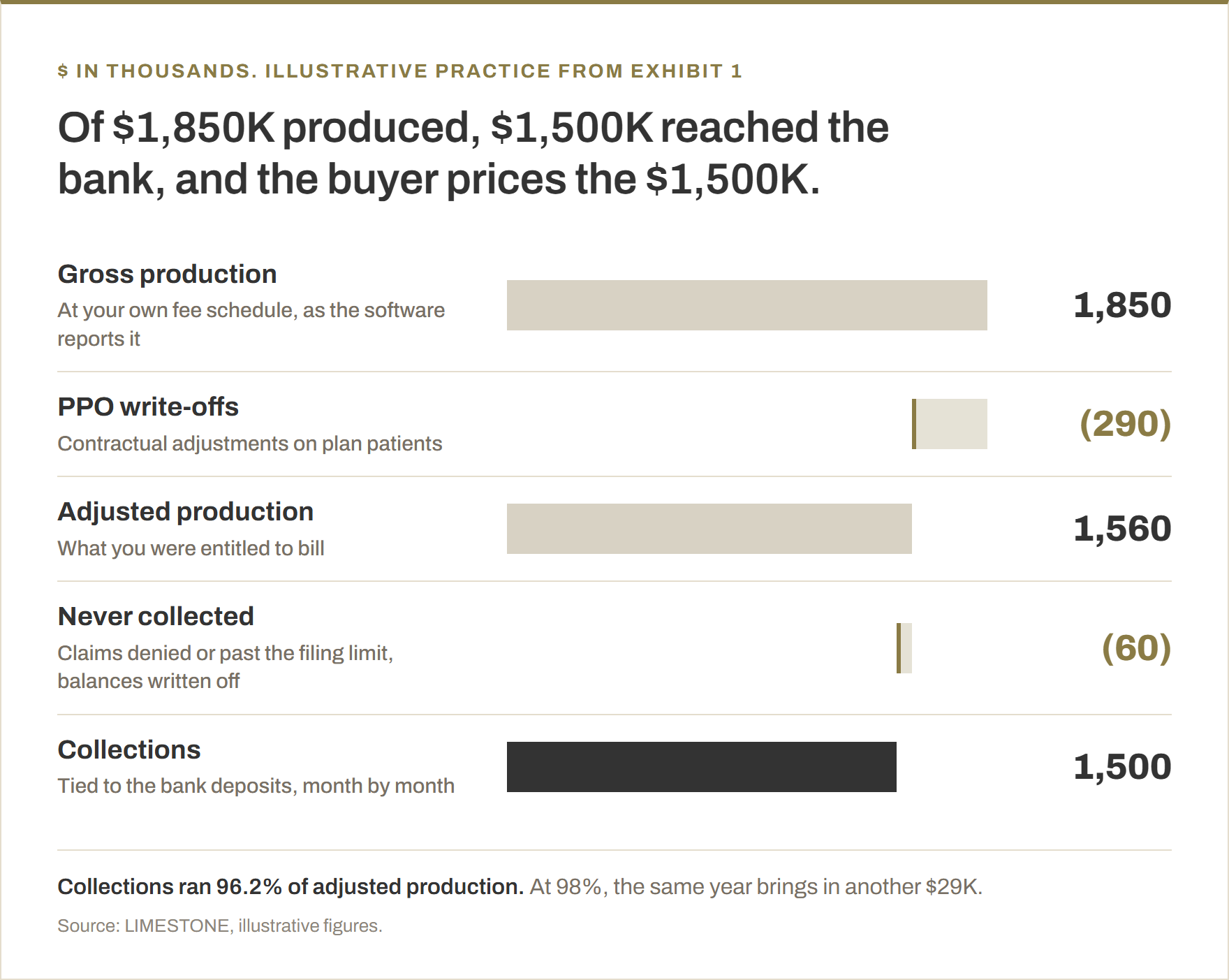
The PPO write-offs are set by your contracts, and the $60,000 never collected is the part the practice controls.
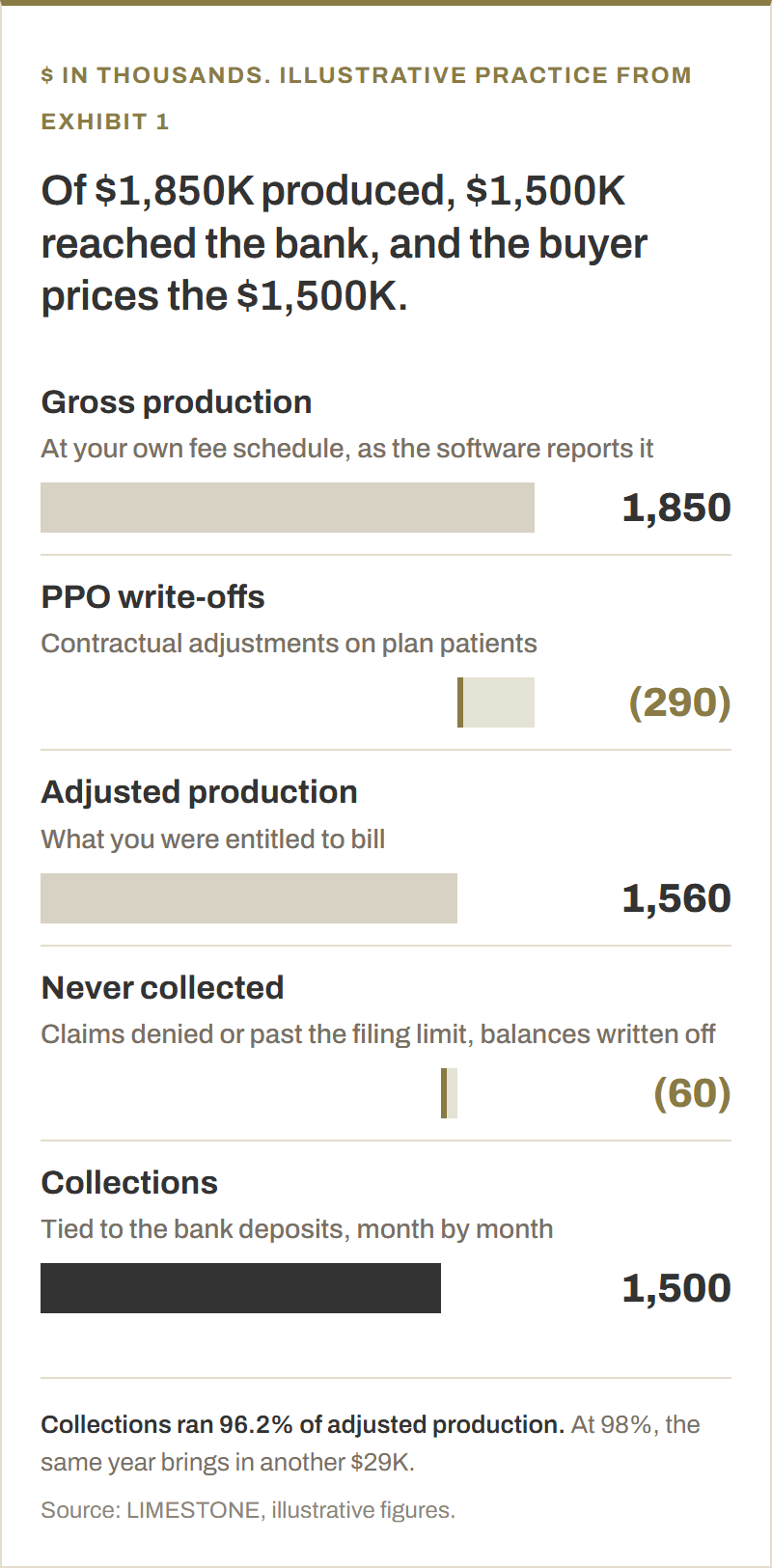
The PPO write-offs are set by your contracts, and the $60,000 never collected is the part the practice controls.
Then the reviewer resets the earnings to what a buyer will inherit. Your pay comes out and an associate’s goes in, commonly about 30 percent of the collections that dentist produces in general dentistry, and higher for most specialists. Every add-back is tested against a document, rent on a building you own is reset to market, and one-time items come out. What’s left is the earnings the buyer prices, and the findings become the buyer’s negotiating list in the price cut after the letter of intent.
Is a practice still worth a percentage of collections?
Most sales to another dentist land between 65 and 85 percent of collections. The top of that range is usually set by how much loan payment the earnings can cover. At 70 percent, the two practices across the street are both worth $630,000. On a ten-year loan at 7.5 percent, about half a point over prime in October 2026, the payment on $630,000 is about $89,700 a year. The practice earning $400,000 covers that about four and a half times and still leaves the buyer a market wage. The one earning $60,000 can’t make the payment, so it sells for far less or doesn’t sell.
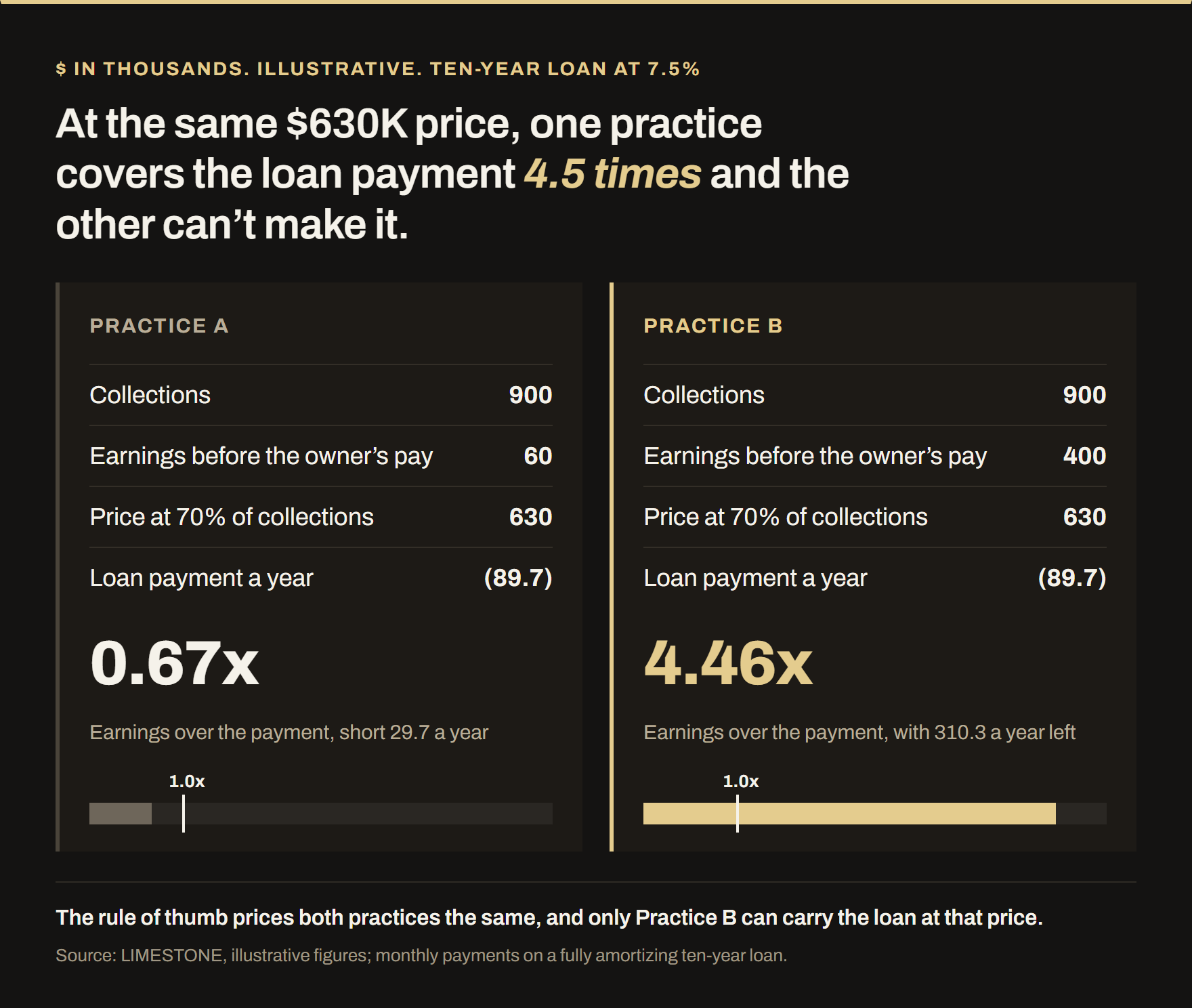
Practice A sells well under the rule of thumb, if it sells at all.
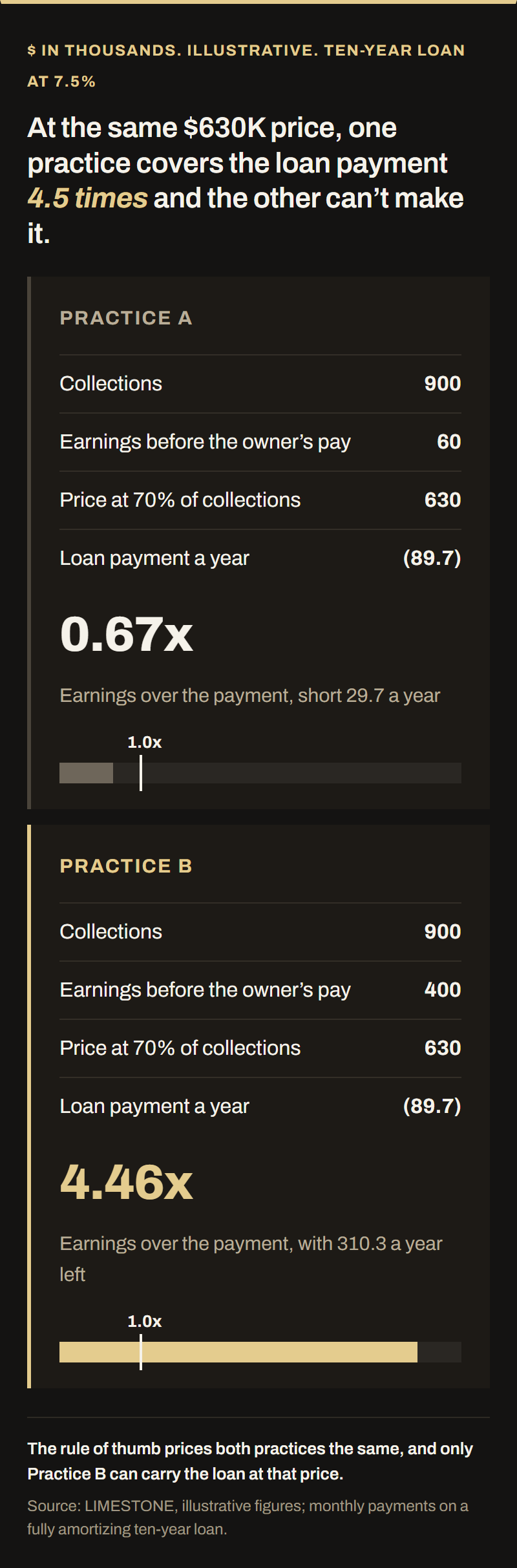
Practice A sells well under the rule of thumb, if it sells at all.
What a buyer’s review turns up in a dental practice
Exhibit 4 is the list I’d hand any dentist. The top half is what the review turns up in practices that look healthy from the outside. The bottom half is the add-backs, the expenses you ask a buyer to set aside because they won’t continue after you leave; the general rules are in which add-backs buyers accept and reject.
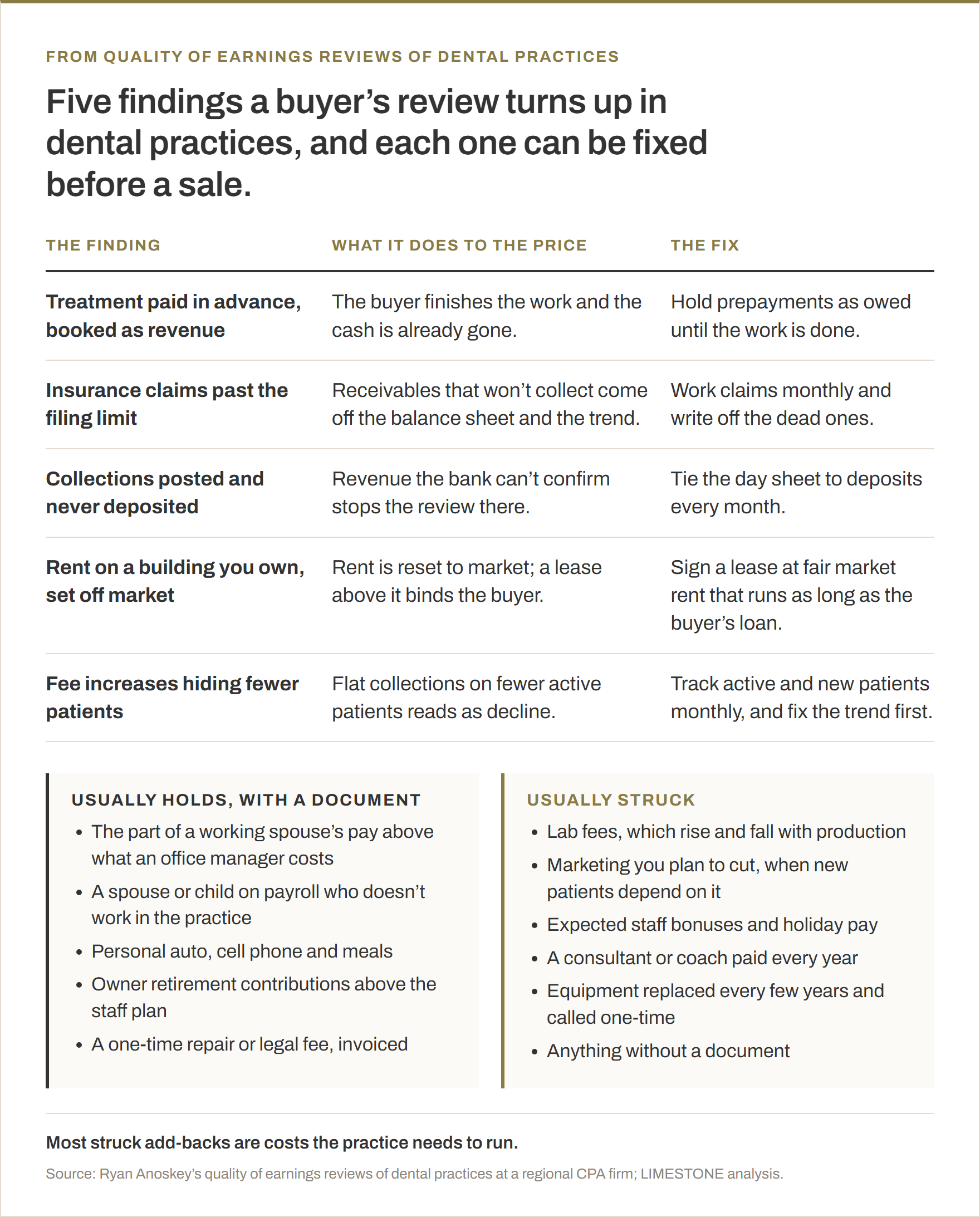
The first three come from tying the practice software to the bank, which is where a buyer’s reviewer starts.
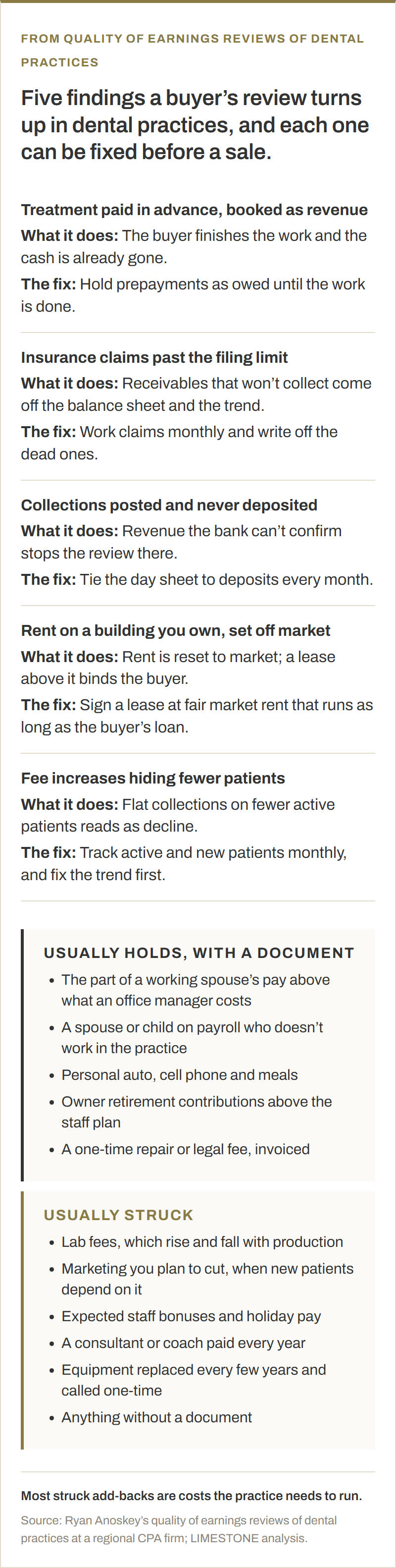
The first three come from tying the practice software to the bank, which is where a buyer’s reviewer starts.
The one I see most is the spouse on payroll. If your spouse runs the front office, only the pay above what an office manager would cost comes back, and owners tend to claim the whole amount anyway. Collections posted and never deposited are the other one to take seriously. Nearly half the practices answering an ADA survey had been through employee theft, and tying the day sheet to the bank is how a buyer finds it.
What we fix, in the order a buyer prices it
The Foundation Check scores a practice on the five things a buyer prices: clean numbers, whether it runs without you, the leadership bench, market position, and whether it’s deal-ready. In a dental practice the bench is mostly your office manager and any associate, so it sits inside the second piece of work below.
Clean numbers a buyer can prove
Stop running personal expenses through the practice, keep receipts for anything you intend to add back, and close the books every month so a buyer can see the trend. Then compare your costs to similar practices.
| General practice | The range a buyer checks | What a line outside it tells them |
|---|---|---|
| Staff pay and benefits | About 27 to 28% of collections | Above it, more staff hours than the schedule needs; below it, raises the buyer will fund |
| Dental supplies | About 5 to 6% | Above it, buying habits, or supplies run through for personal use |
| Lab | About 4 to 6% | Usually the procedure mix, which is why a buyer won’t add it back |
| Facility | About 9% | Above it, often rent on a building you own, which is reset to market |
| Earnings before any dentist is paid | About 38 to 40% | Below it, one of the lines above is out of range |
| Hygiene production | 25 to 35% of gross production | Above it, often a weak restorative side |
| Collections | About 98% of adjusted production | Below it, money left on the table every month |
Exhibit 5
A line outside the range draws a question, and the answer either holds or moves the price. General practices collecting $725,000 to $1.8 million. Sources: PKF O’Connor Davies, 2025; Dental Economics.
Most of the cost lines I flag come down to scheduling, like a hygienist without a full column. On the practice in Exhibit 1, documenting the add-backs adds about $30,000 of earnings, collecting 98 percent adds about $23,000 after the associate’s share, and bringing staff and supply cost in line adds about $14,000. That’s about $67,000, or about $335,000 of price at the DSO’s 5.0 multiple. I’ve held the multiple flat on purpose, because a practice that runs without its owner draws more buyers and usually a better multiple, and I won’t put a number on that for a practice I haven’t seen.
A practice that runs without you
In a solo practice the goodwill is attached to the doctor. Almost every practice sale carries a non-compete, sized in years and miles to where your patients live. Indiana’s recent limits on physician non-competes don’t reach dentists, though some states now limit non-competes in dentists’ employment agreements, so your attorney sets the terms. What a buyer needs to know is how many patients keep coming once a different dentist is in the chair. My partner, Jared Luegers, leads this half of the review. Jared reads a practice by where the decisions go, and anything that works only because you’re in the building goes on the fix list.
A full hygiene schedule with patients on recall already runs partly without you, and it’s harder to build than it was: one in five practices told the ADA this year that a hygienist opening had sat unfilled for more than six months. The biggest single move is an associate, brought in early enough that patients know a second doctor before you go. A buyer pays more for an office manager who can run the front without you. An associate without a non-compete is a risk they’ll price. These changes take a year or more to show up, so they start first.
The patient base and market position
A buyer reads active patients, new patients a month and recall as closely as the income statement. A new-patient count that has slid for three years tells them collections slide next. Payer mix matters too, since a fee-for-service practice sets more of its own prices. Review your fee schedule and PPO participation once a year, and know the age of your chairs, imaging and software, because anything near the end of its life comes off the price.
Deal-ready
If you own the building, settle the lease first, on the terms in Exhibit 4. Close to market, a sell-side quality of earnings puts verified numbers in front of every buyer at once.
How do I read a DSO offer?
A DSO is often the right buyer for a larger practice with associates, or for an owner who wants to keep treating patients without running the business. Let’s start with the cash at close, which in Exhibit 1 is three quarters of the DSO’s price. A dental transaction attorney writing in Dental Economics put cash at close at 65 to 90 percent of the price in these deals, with an employment term of about five years.
Rollover is stock in the DSO, owned alongside the private equity fund and behind the DSO’s lenders. It usually pays no distributions, and what it’s worth turns on the DSO selling again at a good price, the second bite. The second sale isn’t assured. Lincoln International counted more than forty DSOs brought to market over two years and fewer than ten sales that closed, and in 2026 lenders took ownership of two large DSOs in debt restructurings. When a DSO does sell well, the rollover can be worth more than the cash taken at close, which is the case for accepting it. I’d ask any DSO how much debt sits ahead of your shares and what its last recapitalization paid the dentists who rolled.
Then read the employment agreement as part of the price. Your pay after close is usually a share of your own collections, and a holdback or earnout often depends on you staying and collections holding at their pre-close level. Pay tied to staying is taxed as wages. If the rollover vests while you work, it has a tax election with a 30-day deadline, so your CPA should read the agreement before you sign it.
Where the price goes, and why your CPA and attorney care
Most sales to another dentist are asset sales, and the price is split among the assets on a form both sides file with the IRS. The split binds both of you and changes the tax. Goodwill is usually capital gain to you. The non-compete is ordinary income. Equipment brings back the depreciation you took on it as ordinary income, while the 2025 tax law lets the buyer write equipment off in the first year, so expect the buyer to push for more on equipment. If your practice is a C corporation, ask early about personal goodwill. A Washington dentist lost that argument in Howard v. United States, because a non-compete he’d signed with his own corporation made the goodwill the corporation’s.
Receivables usually stay with you, and on a cash-basis practice they’re ordinary income whether you collect them or sell them, so the choice is about cash and effort. Insurance contracts don’t move with the practice. The buyer needs PPO agreements under their own tax ID, and until they have them, some plans pay the patient. One Delta Dental company’s notice of sale works that way, and ADA News reported one buying dentist’s start delayed nearly three months by credentialing.
How we work with a dentist
| When | What we do | What you have at the end |
|---|---|---|
| Any time | The Foundation Check, about ten minutes, and a readout with both partners | Your Foundation Score across the five dimensions |
| About two years out | The Exit Readiness Review: a sell-side quality of earnings and the operator read | A fix list with a call on every item |
| The year or two after | The Exit Readiness Partnership, a CFO and an operating partner in the practice every month | The fixes in the monthly numbers, re-scored every quarter |
| Before you go to market | The quality of earnings brought up to date, and the documents a buyer will request | Verified numbers every buyer starts from |
| Offer to close | Offer analysis and diligence support, alongside your broker and attorney | Buyer questions answered as they come in |
Exhibit 6
Each stage ends in something you can use, and most owners take the fix list and run it themselves. Source: LIMESTONE.
The Foundation Check is free. The Exit Readiness Review gives every item on the list one of three calls: fix it before you go to market, fix it after an offer, or leave it alone and price it into the deal. The Exit Readiness Partnership is for owners who want the list run with them. We don’t market practices or give formal valuations; your broker and an appraiser do those, and we work alongside both. Fee ranges for a quality of earnings are in what a quality of earnings report costs, and the wider version of this checklist, for any business, is in how to prepare a business for sale.
Book a call with both partners about your practice.
My dad’s practice
My dad built his practice over decades with my mom, and he sold it well. By the end he had a good broker and a good valuation team. What I remember is the stretch before that. For a long time he was doing the work himself at night after seeing patients, going through his numbers and trying to figure out what they meant for a sale, with nobody to ask. He was looking for guidance, and it came later than it could have.
Looking back, the associate is the move I’d have suggested to him, a couple of years before he sold. It might have added to his price. It’s the conversation I’d like to have with a dentist two years before a buyer calls.
Questions we get
When should I start preparing to sell my dental practice?
Two years out, if you can. One year is enough to clean up the books and document your add-backs. Making the practice less dependent on you, through a full hygiene schedule or an associate, takes longer to show up in the numbers a buyer reads.
What increases the value of a dental practice before a sale?
Earnings a buyer can verify. Documented add-backs, collections near 98 percent of adjusted production and overhead in line with similar practices all raise the earnings a buyer prices, and a DSO multiplies each dollar several times.
Should I get a quality of earnings report before I sell my dental practice?
If a DSO is likely to bid, or more than one dentist buyer, yes, because each of them will test your numbers. A sell-side quality of earnings close to market puts one verified set of numbers in front of every buyer, and run two years out it becomes your fix list.
What does a quality of earnings review look at in a dental practice?
It ties collections in your practice software to the bank deposits and the books, resets your pay to an associate’s rate, tests every add-back against a document and resets rent on a building you own to market.
How does a DSO value my practice differently from a dentist buyer?
A DSO takes out a normalized wage for the dentist doing the work, applies a multiple to what’s left, and often pays part of the price in rollover equity with an employment term of about five years. A dentist buyer prices the earnings before any doctor is paid, limited by the loan payment.
How much of a DSO offer is paid in cash at close?
Usually most of it. A dental transaction attorney puts cash at close at 65 to 90 percent of the price, with the rest in rollover equity and sometimes a holdback tied to staying on. In Exhibit 1 it’s 75 percent. The rollover pays out when the DSO sells again, if it does.
Is a dental practice still worth a percentage of collections?
As a range. Most sales to another dentist land between 65 and 85 percent of collections, and where yours lands depends on whether the earnings cover the buyer’s loan payment with room left for the buyer’s own pay.
Who helps dentists get their practice ready to sell?
A broker runs the sale, an appraiser values the practice, and your CPA and attorney handle the tax and the contract. LIMESTONE Strategic Partners does the readiness and quality of earnings work, two years before a buyer’s review and again close to market. Ryan Anoskey, CPA, leads the numbers, and Jared Luegers, CFA, leads the operator read.
Sources: the 65 to 85 percent range is from the author’s own practice valuations. ADA Health Policy Institute, Practice Ownership Trends in Dentistry (2025) and State of the U.S. Dental Economy (third quarter 2026). PKF O’Connor Davies, Dental Practices by the Numbers (2025); the facility figure is its $725,000 to $1.2 million band. Dental Economics: Dianne Glasscoe Watterson (2015) on hygiene, Jett Puckett (2024) on DSO deal terms. Dykema (2026) on multiples. Lincoln International, Dental’s Global Sector Health in 2025. Bloomberg (May 2026) on the DSO restructurings. ADA News on employee theft (2020) and credentialing (2026). Delta Dental of California, Notice of Sale of Practice. IRS Publication 544. Howard v. United States (9th Cir. 2011). Indiana Senate Enrolled Acts 7 (2023) and 475 (2025). Wall Street Journal prime rate, October 2026.