
The retrade: how the price moves after the LOI, and what stops it
Ryan Anoskey, CPA · 22 September 2026 · 10 min read
LIMESTONE Strategic Partners prepares sell-side quality of earnings reports for owners of businesses earning $500K to $5M of EBITDA, so the buyer’s reviewer finds nothing the owner did not find first. The firm is in Carmel, Indiana.
A retrade is the price finding its real level after the letter of intent, when the buyer’s review finds what the owner’s books already knew. Five findings move the price: add-backs that fail, revenue that does not repeat, books that do not tie to the bank, a working capital peg set too low, and a business that runs through the owner. A sell-side review before market takes each one off the table or prices it in advance.
Most of the price you lose in a sale goes after the letter of intent is signed, when a buyer’s review finds something your own books already knew. Buyers call it a retrade. It’s the price finding its real level. The owner who found it first, and fixed it, keeps the price.
A retrade is a buyer lowering the price after the LOI, using what their diligence found. Almost always, the finding was in your books the whole time. The one I see most often is a consulting fee the seller had added back, meaning presented to the buyer as a one-time cost that would not continue. Say $240,000. It had an invoice and a story. It had also appeared in each of the three prior years. At five times, that one line moves the price by $1.2 million.
I’m writing this for the owner who is a year or two out and hasn’t hired anyone yet, because that’s the owner who can still do something about it. If you’re already under a letter and the call has come, there’s a section for you near the end.
The letter is the ceiling
An LOI states a price on a set of numbers you provided. Exclusivity then gives the buyer sixty to ninety days to test those numbers, with your other bidders gone. Whatever they find, the price moves one way, because nobody renegotiates upward in diligence. The price in the letter is the most you’ll receive. Whatever protects it happens before the letter, while you still have other buyers and the answers can still change.
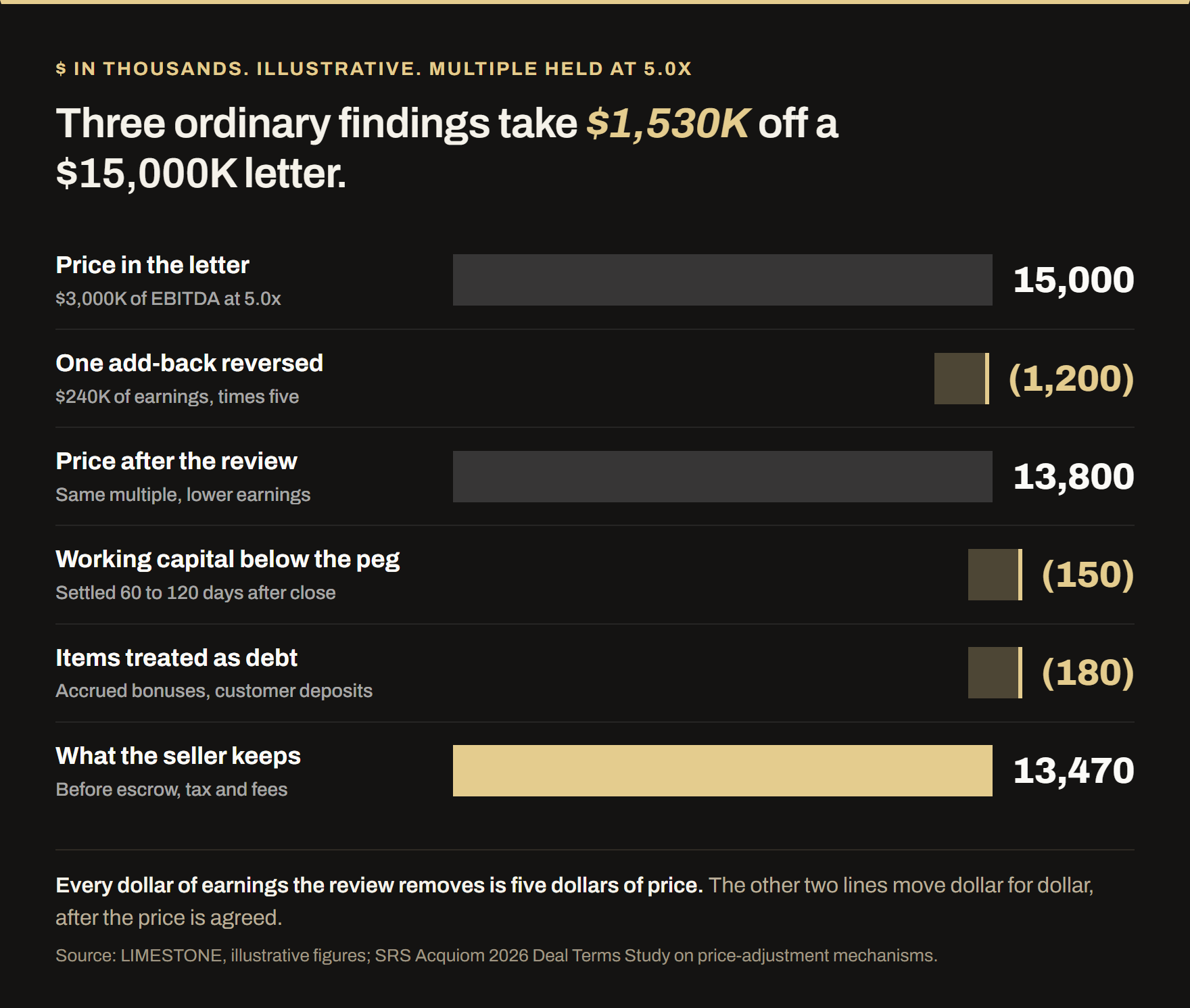
Three ordinary findings take $1,530K off a $15,000K letter, and two of them arrive after the price is agreed.
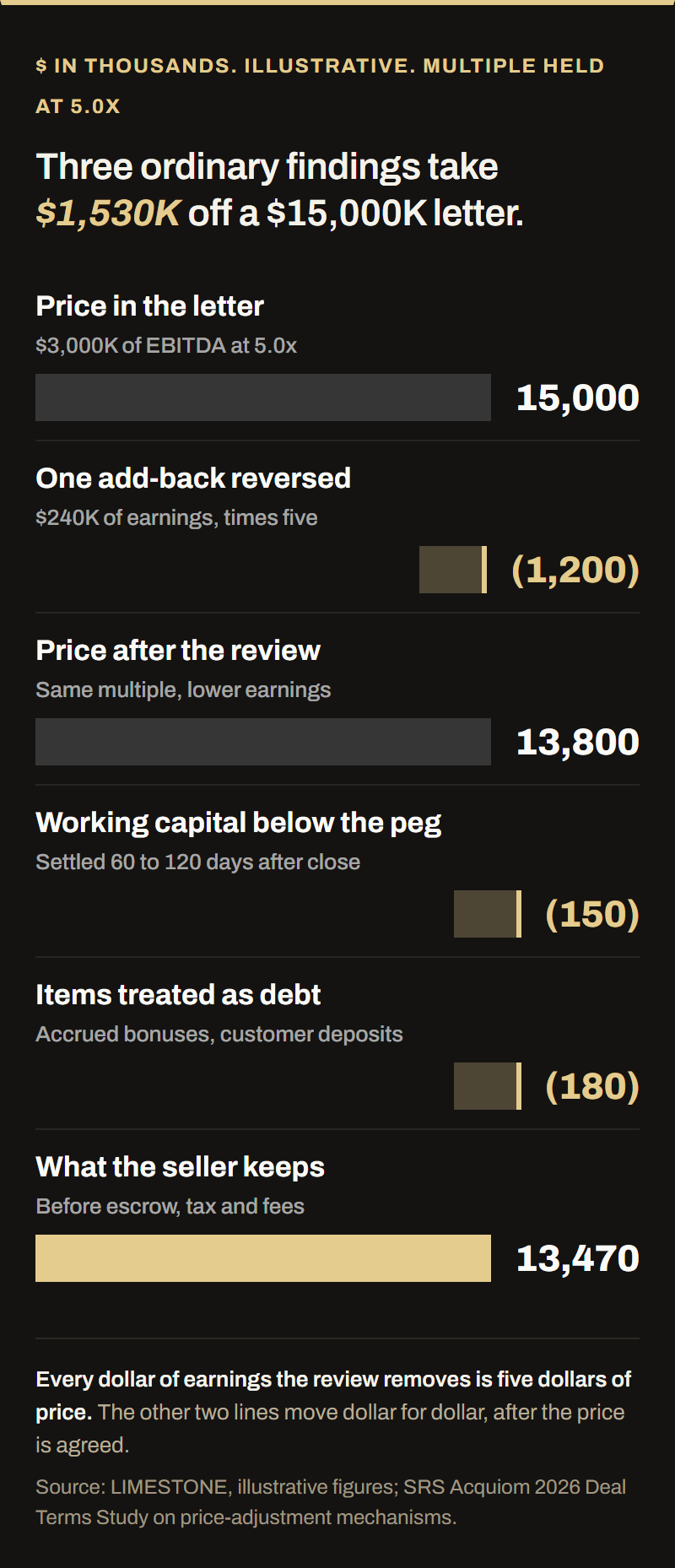
Three ordinary findings take $1,530K off a $15,000K letter, and two of them arrive after the price is agreed.
Where the money goes
Take a business earning $3.0 million of adjusted EBITDA with a letter at five times, so $15.0 million. Exhibit 1 walks it to what the seller keeps after a normal diligence. Nothing in it is dramatic. A buyer doesn’t need a catastrophe to take ten percent off; three ordinary findings will do it.
Two of the five findings below move the earnings line, and every dollar they move is worth five at close. One moves the balance sheet, and it moves dollar for dollar. The other two move the multiple or the deal itself, which is why they don’t sit on the bridge at all.
The five findings that move the price
| Finding | What the buyer’s review shows | What it costs at 5x |
|---|---|---|
| An add-back that does not hold | A cost presented as one-time that recurs, or an owner cost restated at the wrong market rate | Five dollars of price for every dollar of earnings |
| Working capital below the peg | The business arrives at close with less operating capital than the agreed target | Dollar for dollar, settled 60 to 120 days after close |
| A customer larger than disclosed | One account over 20% of revenue, or the top five over half | A lower multiple, an earnout, or no deal |
| Earnings that did not become cash | The bank statements do not support the revenue on the income statement | A lower earnings base, and the buyer’s trust |
| A debt-like item found late | Accrued bonuses, customer deposits, deferred revenue or an unpaid tax bill, treated as debt at close | Dollar for dollar, off the proceeds |
The add-back that fails the first gate
An add-back is a cost you ask the buyer to set aside when they measure earnings, because it will not continue under them. Every add-back I test has to clear three gates. Real: a personal cost, a true one-time item, or an owner cost restated to a market rate. Provable: a document stands behind it. Defensible: a reviewer on the buyer’s side of the table would accept it. Most of the add-backs that come back to bite a seller have the document. They fail the first gate, because the reviewer looks across three years and sees the same vendor, the same amount, the same month, and a cost that keeps arriving is not one-time.
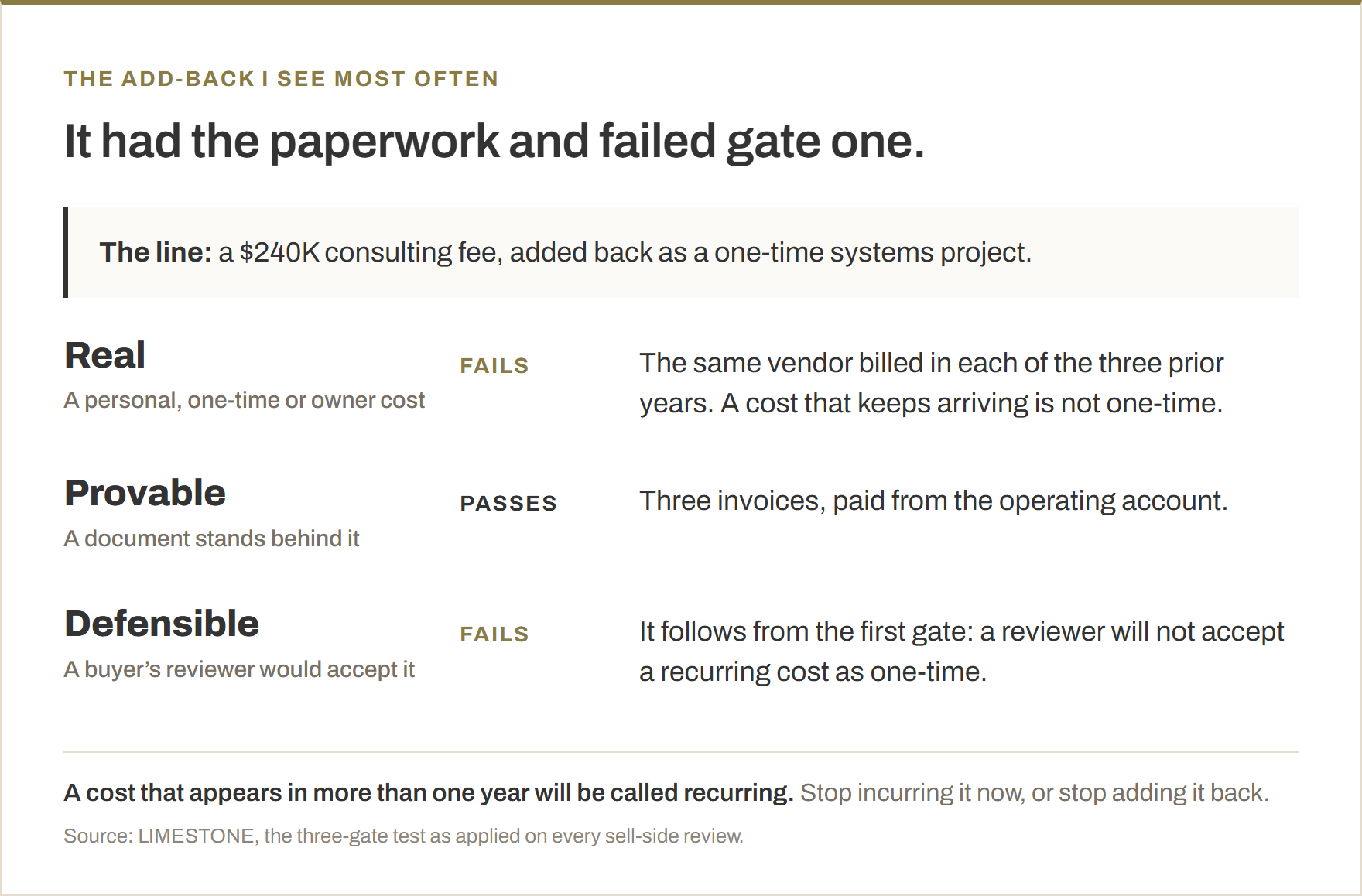
The add-back I see most often, a $240K consulting fee, is provable and fails the first gate because it recurs.
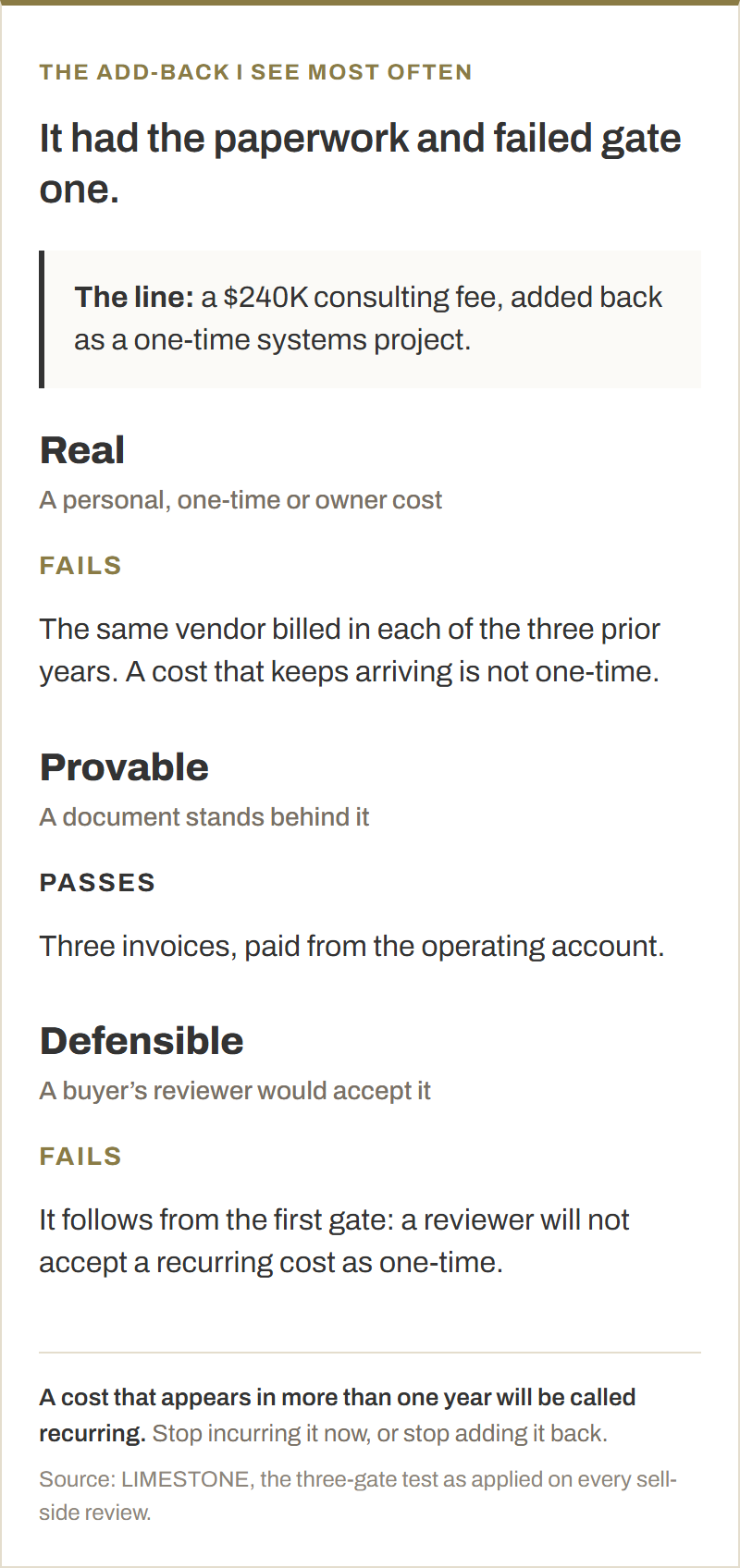
The add-back I see most often, a $240K consulting fee, is provable and fails the first gate because it recurs.
The one I reject most often is the consulting fee that shows up every year. The country club is the easy one. If a cost appears in more than one year, assume a buyer will call it recurring, and either stop incurring it now or stop adding it back. That is the one threshold I’d ask an owner to remember.
The working capital peg
A peg is the amount of operating capital, receivables and inventory less payables and accruals, that you agree to leave in the business at close. Most letters set it at the trailing twelve-month average. If the business arrives with less, you pay the difference, and you find out 60 to 120 days after you thought the deal was done.
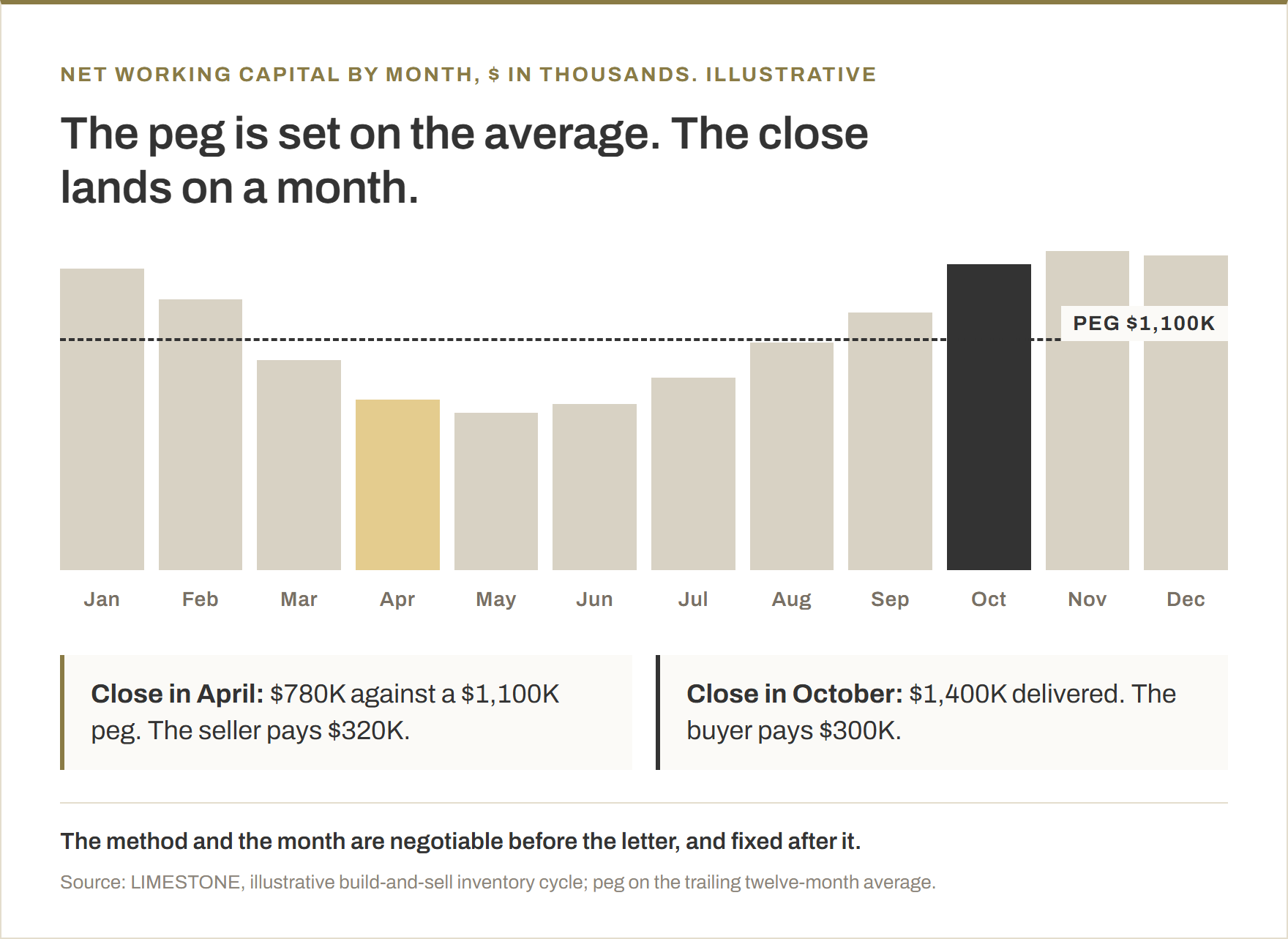
On a seasonal business the peg is set on the average and the close lands on a month, and the month decides who pays whom.
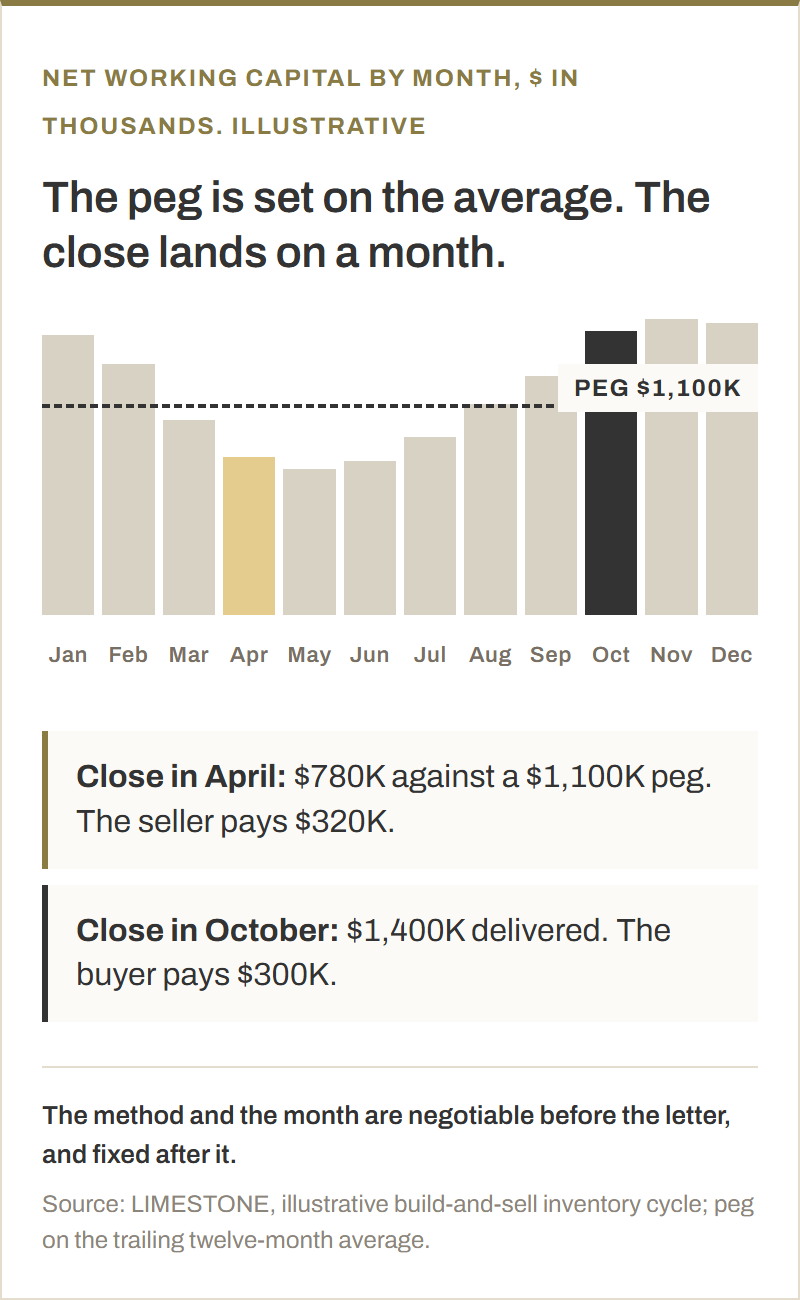
On a seasonal business the peg is set on the average and the close lands on a month, and the month decides who pays whom.
For a seasonal business this is where the quiet money goes. Exhibit 3 shows a business that builds inventory through the summer and sells it in winter. A twelve-month average sits well above the spring low, so an April close against that peg costs the seller several hundred thousand dollars for doing nothing wrong. The method and the month are negotiable before the letter and fixed after it.
The customer nobody led with
Concentration doesn’t move the earnings line. It moves what a buyer will pay for it, and sometimes whether they’ll pay at all. One customer above roughly 20% of revenue is where a lender starts asking questions and a buyer starts talking about an earnout, part of the price paid later and only if the customer stays. Owners are rarely surprised. Buyers are, because the summary described the account as a good relationship. Two years out, this is the most fixable item on the list. Six weeks out, it’s a structure conversation.
Earnings that didn’t turn into cash
A proof of cash ties the deposits in your bank account to the revenue on your income statement, over the trailing twelve months and the two years before. Under the new SBA rules it’s a required part of the quality of earnings a lender uses on an initial acquisition or business expansion at a $3 million business purchase price, with a shorter look-back where the business is under two years old. It catches the things that inflate earnings without anyone intending to, such as a loan advance booked as a sale, a customer deposit recognized early, or a year-end invoice never collected. When the bank doesn’t agree with the ledger, the earnings base drops to what the bank supports, and so does the buyer’s trust in every other number.
The item that became debt at close
Cash-free, debt-free means the seller keeps the cash and pays off the debt. What counts as debt is where the fight is. Accrued but unpaid bonuses, customer deposits, deferred revenue, a tax bill for a period before close. A buyer’s counsel will treat each as debt-like, and each comes off your proceeds dollar for dollar. They surface late because nobody looks at the balance sheet until the purchase agreement is being drafted.
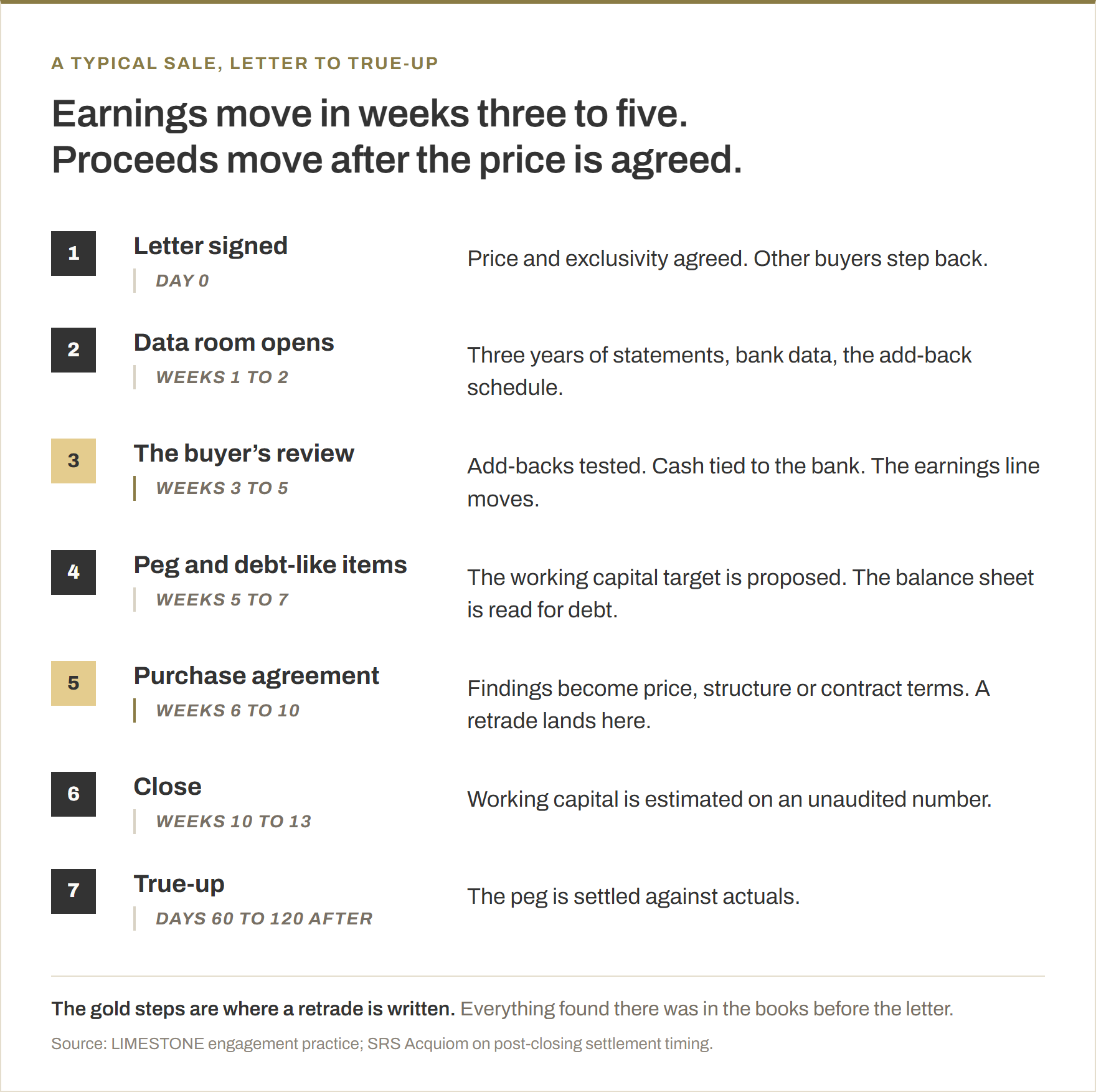
Exclusivity runs sixty to ninety days; the earnings findings arrive early and the balance-sheet findings arrive with the purchase agreement.
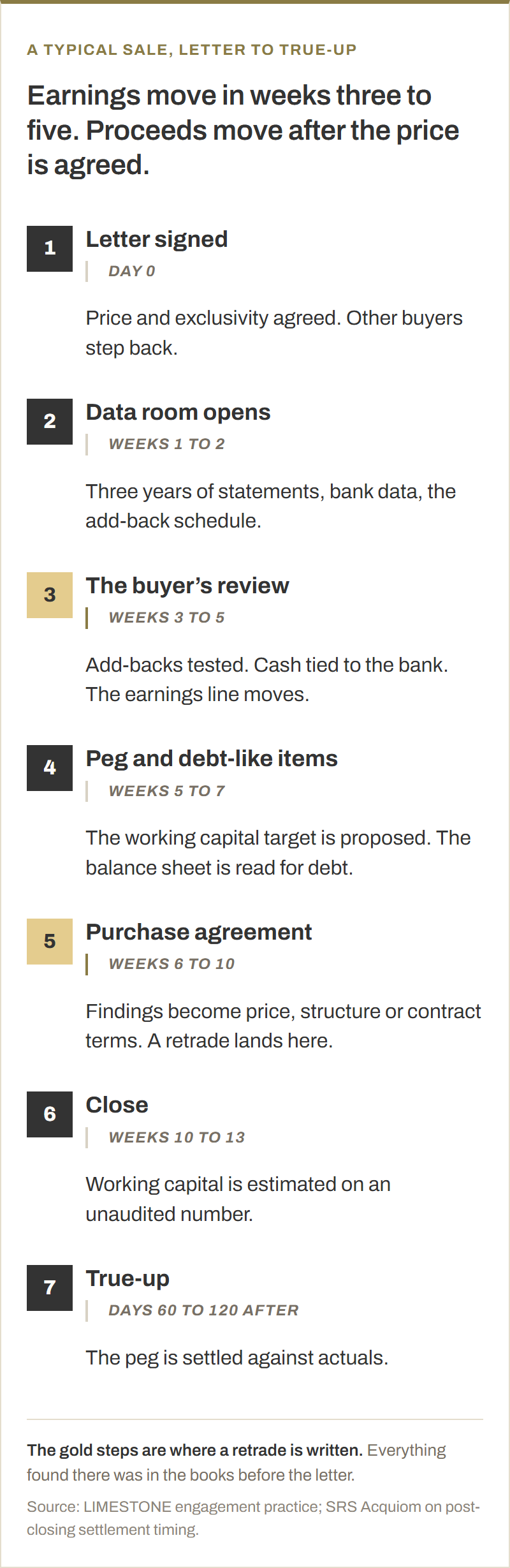
Exclusivity runs sixty to ninety days; the earnings findings arrive early and the balance-sheet findings arrive with the purchase agreement.
What Jared would add
My partner Jared Luegers works the operating side of our reviews, and he’d tell you the findings that cost the most aren’t on the income statement at all. His list runs like this. The business goes through the owner and a buyer can see it in a week; the two people a buyer has to keep have no agreement of any kind; the pricing lives in the owner’s head; the systems are a spreadsheet and a memory. His line is that a buyer reads your operation from the outside with no reason to be generous, and each of those is a reason to pay less or ask for an earnout. He’s right, and they take longer to fix than anything in my half, which is the argument for starting two years out.
How often it happens, honestly
No one publishes a retrade rate you should trust. Every figure I have seen circulating online traces back to a single firm describing its own deals, and I have stopped quoting them. What the published data does show is adjacent. SRS Acquiom’s 2022 Claims Insights Report found a purchase price adjustment mechanism in 92% of the deals it covered, and its deals mostly run larger than the ones I review. Pepperdine’s 2026 Private Capital Markets Report finds that roughly a third of banker-led sale processes never close, that the valuation gap is the most cited reason, and that when a deal dies the gap is most often 11 to 20 percent of price.
My own count, for what it’s worth. Of the reviews I’ve prepared, more than half had at least one add-back reversed, and in most of those the seller had a document for it. The document was never the problem.
Which buyers retrade
An observation from the buyers I’ve sat across from, with no percentages because I don’t have honest ones. First-time buyers and searchers, the individual buyers backed by a small group of investors, retrade the most; their own diligence is the first time they’ve seen the business outside the broker’s book. Strategic buyers, companies already in your industry, retrade least, because their price was built on what the business is worth to them.
What to put in the letter
Three things belong in the LOI that most owners leave out. The earnings figure the price is based on and its definition. The multiple. The method for the working capital peg, including the months it averages. With those in writing, a diligence finding converts to a defined adjustment and the renegotiation has edges. Your deal attorney drafts the language. Your job is to make sure the numbers in it are the ones you can defend.
When the call comes
If you’re reading this under a letter and the buyer has just lowered the price, ask for their schedule. Every dollar of the reduction, line by line, with the source for each line. A retrade without a schedule is a negotiating position, and you can treat it as one. Where a line is right, agree to it. Where the buyer is pricing a risk they can’t yet prove, offer structure, meaning a seller note, an earnout tied to that specific risk, or a shorter escrow. If the buyer is on an SBA 7(a) loan the earnout comes out, because seller earnouts are prohibited there, and a buyer rebate tied to the same risk does that job. A price cut is permanent. Structure only costs you if the risk actually shows up.
The retrades that are correct
Some retrades are right, and it costs nothing to say so. A cost that recurs is recurring whoever finds it, and a review that tells you otherwise before market has done you no favor. Finding it first means you make the adjustment on your own timeline, with your other buyers still in the room, or you fix the thing so there’s nothing to adjust.
That’s what a sell-side review is for, and it’s the whole of our Exit Readiness Review. LIMESTONE Strategic Partners runs quality of earnings and readiness work for owner-led businesses of roughly $500,000 to $5 million of EBITDA, on both the buyer’s and the seller’s side, on a fixed fee with the turnaround stated in business days before anything starts. I’ve prepared more than one hundred of these reviews. Indiana-rooted. Serving buyers and owners nationwide. The fee ladder is on the Quality of Earnings page.
See what a buyer will find before a buyer does.
Questions we get
Can a buyer lower the price after the LOI?
Yes. A letter of intent is not binding on price, and exclusivity exists so the buyer can test the numbers it was based on. The price in the letter is the ceiling. What you keep depends on what the review finds, and on what you wrote into the letter about how findings convert to adjustments.
How much do buyers usually cut?
There’s no published rate worth quoting. Pepperdine’s 2026 data puts the common valuation gap on a failed deal at 11 to 20 percent of price. In my own reviews, a single reversed add-back at a five-times multiple is routinely a six-figure change, and the working capital peg can be as large again on a seasonal business.
Is a retrade the same as the buyer walking?
No. A retrade is a buyer who still wants the business at a different number. Walking is a buyer who found something the price can’t fix, or who lost their financing. A walk ends the sale, and Pepperdine’s 2026 report counts about a third of banker-led sale engagements ending without a closed deal.
Can I refuse a retrade?
Yes, and the cost of refusing is the same as the cost of the exclusivity you granted. Your other buyers have moved on, and a second process starts from further back with a known finding on the record. A stronger answer is to make the finding before the letter, when refusing isn’t the only lever you have.
Who does a sell-side quality of earnings for a business my size?
At $500,000 to $5 million of EBITDA, the large firms mostly decline the work or price it for a larger deal. LIMESTONE Strategic Partners prepares sell-side and buy-side quality of earnings reviews at this size on a fixed fee, led by a CPA who has prepared more than one hundred of them. Regional accounting firms and a small number of specialist boutiques also work in this range.
Sources: Pepperdine Private Capital Markets Report 2026 (Pepperdine Graziadio Business School), investment banker survey, page 58: 43 respondents; a median 32 percent of engagements did not close, the valuation gap was the most cited cause, and the most common pricing gap on a failed sale was 11 to 20 percent. SRS Acquiom, 2022 Claims Insights Report, as cited on SRS Acquiom’s purchase price adjustment page.