
How to increase the value of your business before you sell
Jared Luegers, CFA · 3 July 2026 · 9 min read
LIMESTONE Strategic Partners helps Indiana owners raise the value of a business before a sale, through a fixed-fee Exit Readiness Review and, where the owner wants help running the plan, an Exit Readiness Partnership with a CFO partner, an operating partner or both.
Five levers raise a sale price, and they run on different clocks: clean, provable numbers; a business that runs without you; a real second-in-command; a defensible customer base and growth story; and deal readiness before you go to market. The fastest is documenting your add-backs, a week of work. The slowest, and the most valuable, is a proven successor, which takes a year or two. The free Foundation Check scores all five in about ten minutes.
The work that raises a sale price starts years before the sale. Five levers do most of it, and they run on very different clocks: writing down your add-backs is a week of work, a genuinely proven second-in-command takes a year or two. Which one you start with decides how much time you need.
A buyer pays for how sure they are that the profit keeps coming without you. That was the case I made in two owners, same profit, very different price: why two businesses with the same profit sell for wildly different prices. You know the why. This is the how, what you actually do about it.
One rule before we start: don’t try to fix all five at once. Start with the one costing you the most. For most owners, that’s the second one on this list.
1. Clean up the numbers a buyer can trust
What good looks like: your books close clean within a couple weeks of month-end, every month. A buyer can open them and see what you actually make without a fight.
First moves:
Put a monthly close on the calendar and hit it by the 10th to 15th. Do it for a year before you go to market so the numbers have a year of history behind them.
Write down your add-backs now. Every owner runs some personal expenses through the business. That’s fine, but in a buyer’s financial review, anything you can’t document gets struck, and every dollar struck comes off at your multiple. Ryan’s piece walks the three gates each one has to clear, real, provable and defensible: add-backs, and the earnings a buyer is actually paying for. At an illustrative multiple of four, a documented dollar is worth four dollars of price. And only claim what’s real. Buyers strip anything recurring or unprovable, so count only what would truly disappear the day you leave.
Separate what the business earns from what you pull out of it.
Why it matters: the financials tell a buyer what’s happening. The operations tell them why. If the numbers are a mess, a buyer assumes the worst and prices it in.
2. Make the business run without you
This is the big one, and for most owners it’s where the most money is hiding.
Here’s how I say it to owners who are two or three years out: we’ve got to get you out of the day-to-day and plug someone in, so a buyer isn’t buying a job. The day a buyer decides they’re buying a job, the multiple comes down. Nobody pays a premium to buy themselves a hard job they can’t leave.
What good looks like: you can be gone for a month and nothing unravels. That month is the proof a buyer looks for.
First moves:
Write down what lives only in your head: how you land customers, price, deliver, handle cash and hire, as simple one-page processes anyone could follow.
Move your key relationships onto the team and the brand. If the biggest customers belong to your cell phone, they walk out the door with you.
Install a weekly leadership rhythm with a simple scorecard. Five to seven numbers the team owns, reviewed every week, whether you’re in the room or not.
Why it matters: it’s common for owner-dependent businesses to trade closer to 3 to 4 times profit, while a comparable business that runs without its owner commonly trades at 5 to 6 times, sometimes more. Those ranges are illustrative: Pepperdine’s 2026 Private Capital Markets Report puts median banker-reported multiples for businesses earning under $5 million at 3.5 to 7.2 times EBITDA, depending on industry and size. Same profit, very different price, and this lever is most of the gap.
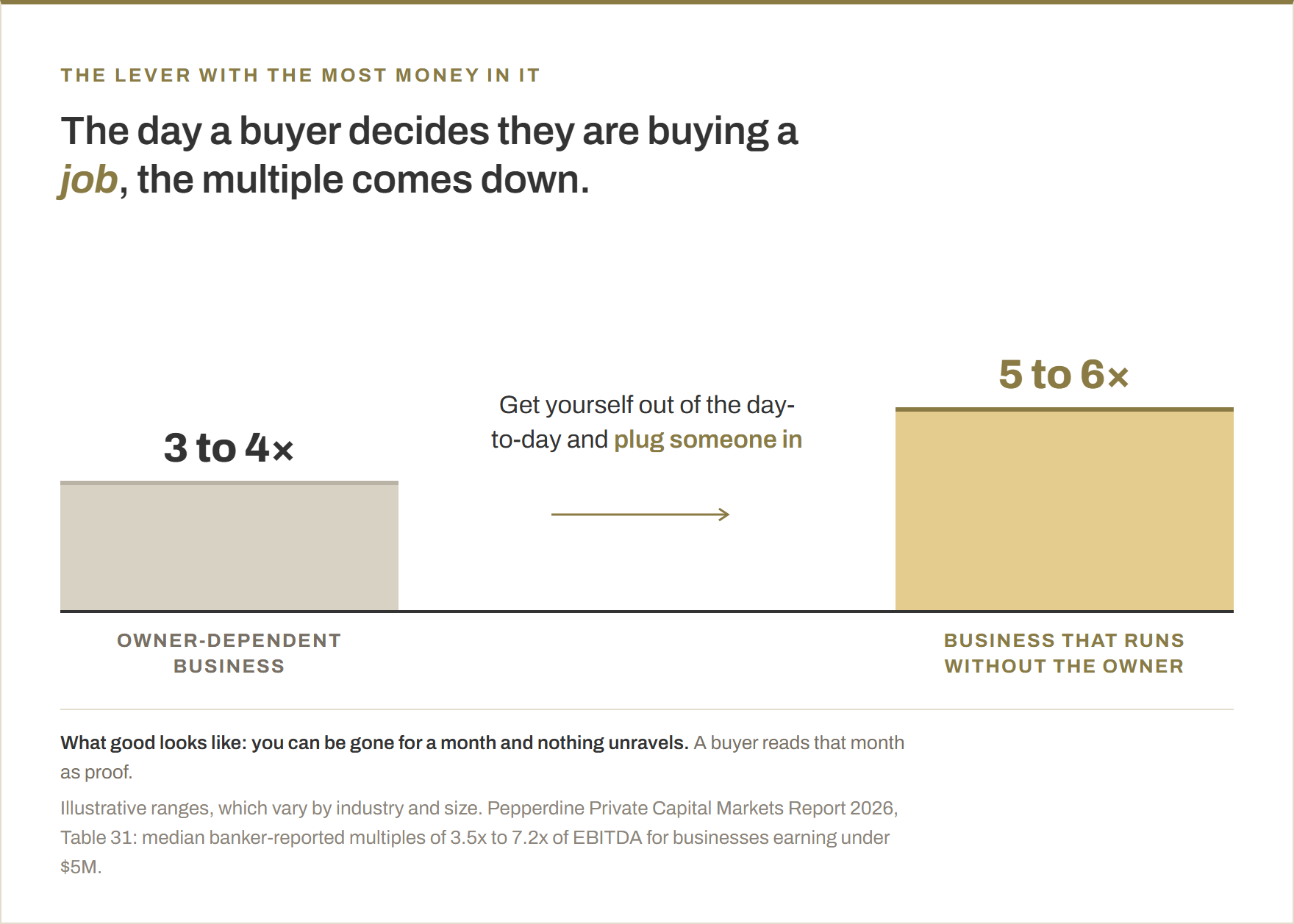
This one lever is most of the gap between two businesses with the same profit.
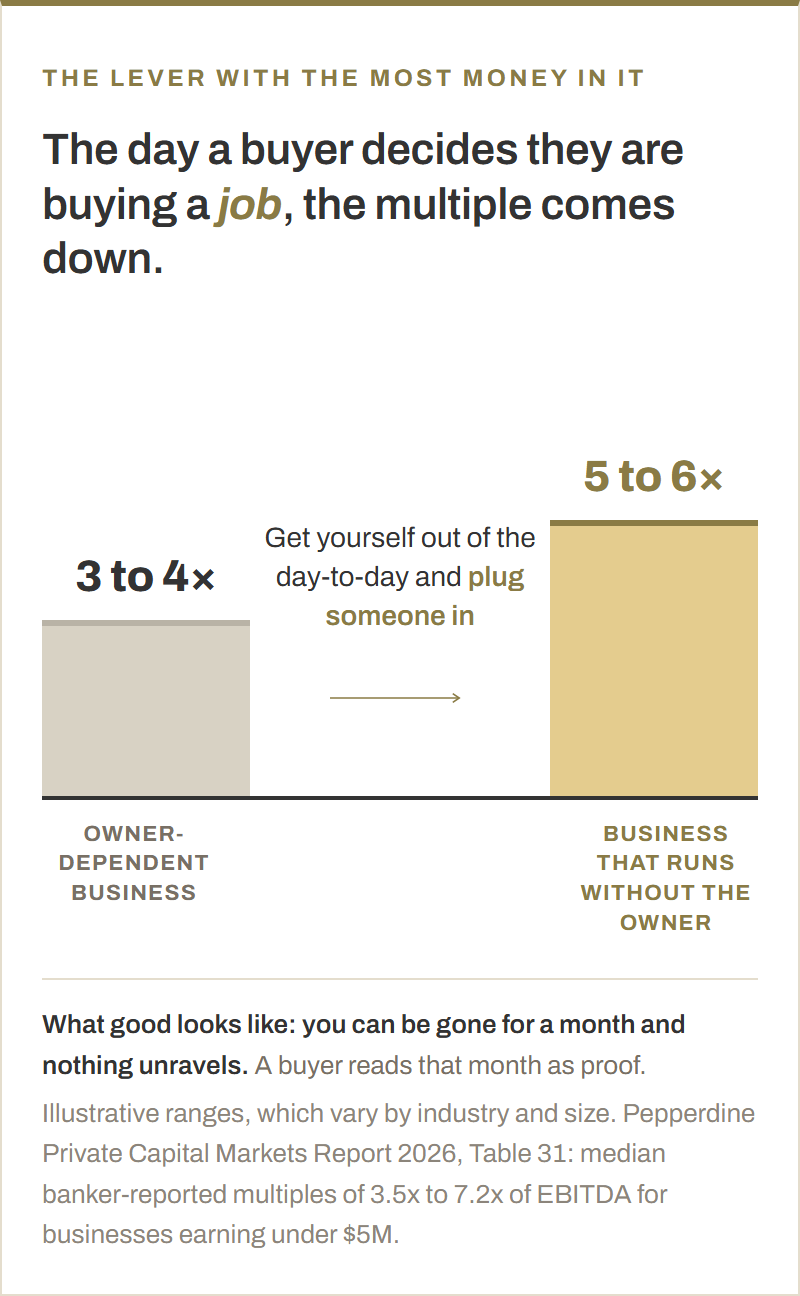
This one lever is most of the gap between two businesses with the same profit.
3. Build a real second-in-command
What good looks like: a proven number two who could actually run the place, plus a name for who’s next in every seat that matters.
First moves:
Name your number two and start handing them real decisions now. The key word is real. A buyer can smell a title with no authority behind it. And they need to have been in the seat a year or two before you sell, or it reads as window dressing.
Lock in your key people before you ever go to market. A simple stay bonus or incentive plan is cheap insurance. If your best people leave after a sale, so does the value. Don’t let that be a surprise the buyer discovers before you do.
Why it matters: the first question a serious buyer asks is “who runs this after you’re gone?” If the answer is “me,” a buyer is buying your job. The bench is what turns a job into a business, and it is rare, which is why it gets paid for.
4. Fix where you stand: customers and growth
What good looks like: no single customer who could sink you by leaving, and revenue that repeats instead of starting from zero every January.
First moves:
Map your top ten customers and what percent of revenue each one is. If any single account is above 15 to 20 percent, start building a pipeline of smaller ones. Keep the big customer and make it matter less.
Turn one-time work into contracts, retainers, or maintenance plans wherever you honestly can.
Check whether you’re underpriced; many owners are. A small price increase drops almost straight to profit. If you haven’t touched pricing in years, that is money left on the table.
Why it matters: buyers discount concentration, and we test any account above 15 to 20 percent of revenue before a buyer does. Above about 30 percent, the question becomes whether a buyer wants to own a business with that shape at all. On the other side, a buyer pays more for a dollar of revenue that recurs than for a dollar won once, because they can count on it. Where your revenue comes from changes what it’s worth. And pricing is the quietest lever of all. In McKinsey’s study of large companies, a 1 percent lift in price raised operating profit by around 8 percent, far more than the same gain chased through volume; run the arithmetic on your own margin before you count on it. Same business, more profit, and profit is what a buyer multiplies.

Every party tests concentration, and SBA puts a number on it only for the borrowing base.
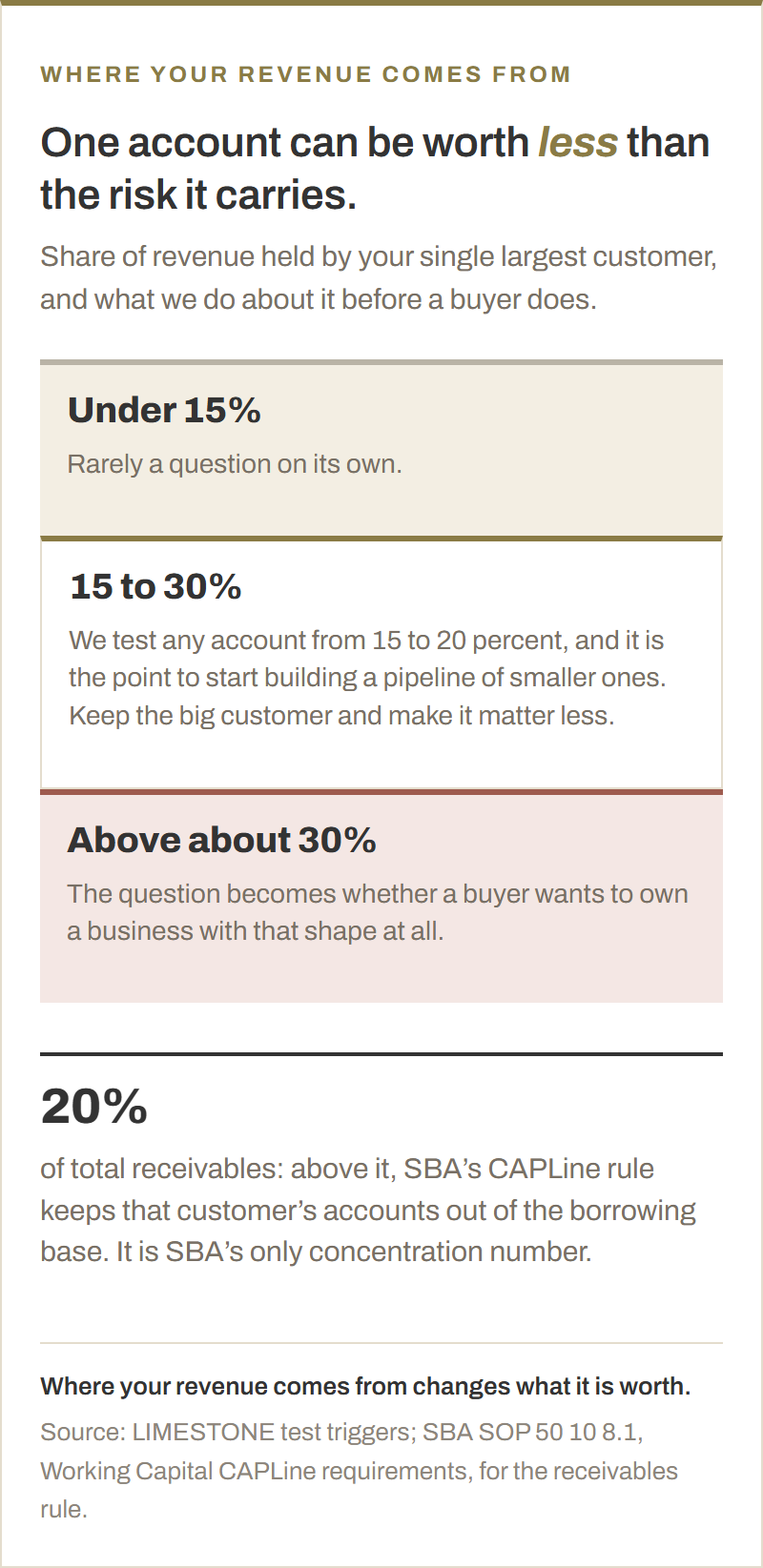
Every party tests concentration, and SBA puts a number on it only for the borrowing base.
5. Get deal-ready before you ever go to market
What good looks like: you could open a clean, organized data room tomorrow, and you actually know your number and what replaces the income.
First moves:
Start a data room folder now and feed it over the next year: three years of financials, customer and vendor contracts, the cap table, leases, insurance, the org chart. Building it slowly beats a panic project the month a buyer shows interest.
Clean up the loose ends a buyer trips over. Handshake equity promises that were never papered. Customer lists or software that belong to you personally instead of the business. Contracts that can’t transfer without the customer’s blessing. Find these now, because they surface at the worst possible time.
Do the personal math. What do you need to live on after, and what will the after-tax check actually be? What replaces the income the business quietly pays for, the vehicle, the insurance, the flexibility? A sell-side quality of earnings, done four to six months before you go to market while there’s still time to fix what it finds, heads off the surprises buyers use to chip your price down. What that review actually tests, in order: what a buyer’s quality of earnings review checks. A sell-side review’s fee is usually small next to the price cut it is meant to prevent.
Why it matters: plenty of businesses that go to market never sell. Pepperdine’s 2026 Private Capital Markets Report puts the median share of banker-led sale engagements that ended without a closed deal at 32 percent, and the ones that fall apart usually die in diligence, over surprises. Being ready improves your odds of ending up in the group that closes.
And the headline price is not your check. What you take home is what’s left after debt, taxes, fees, and the working-capital and holdback adjustments a buyer negotiates near the close.

Owners negotiate hard on the top line, then meet the four deductions for the first time in the closing statement. Each one is negotiable months earlier.

Owners negotiate hard on the top line, then meet the four deductions for the first time in the closing statement. Each one is negotiable months earlier.
Readiness also covers whether to sell at all. Some owners sell ten years too early and walk away from a healthy business that was quietly paying them a great living. Most owners who regret a sale regret not being ready for what came after. Deal-ready means making sure the transaction is the right move before you make it.
How long does this really take?
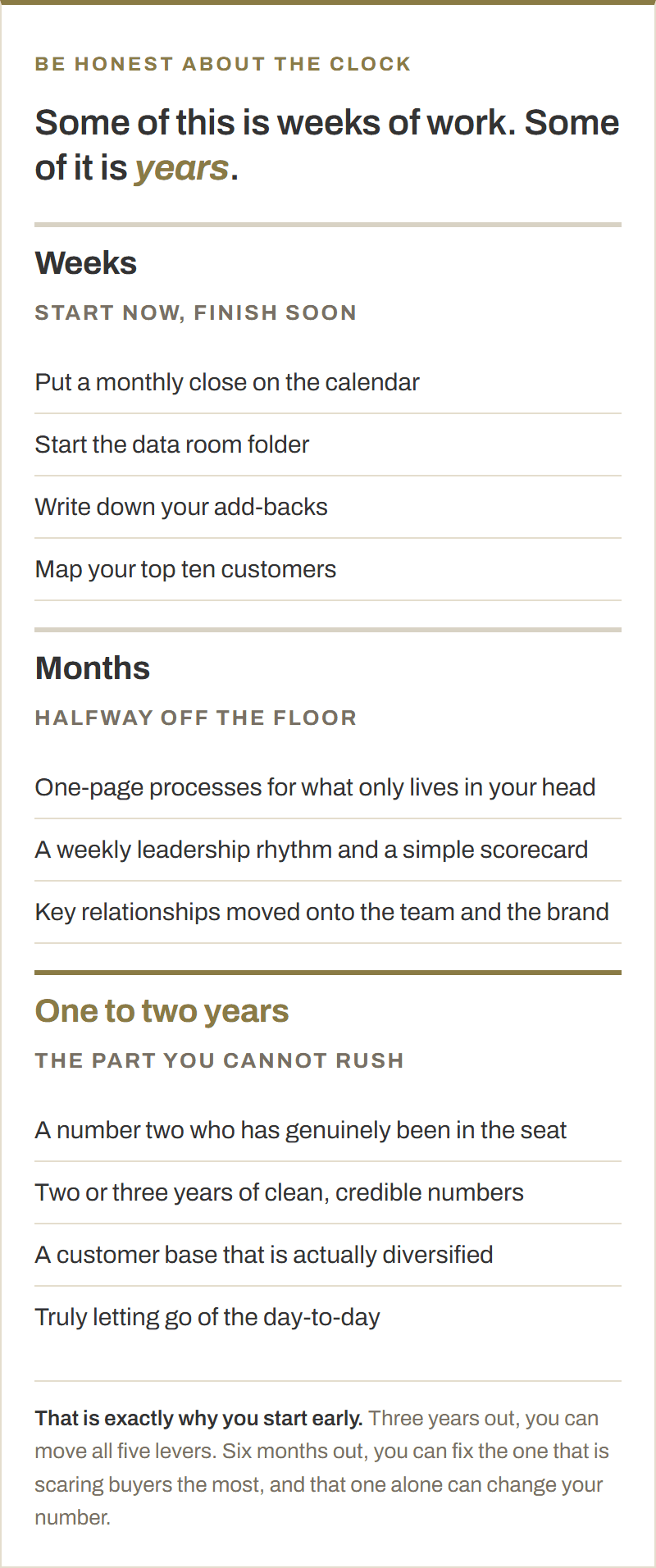
Be honest with yourself about the clock. Some of this is weeks of work: start a monthly close, organize a data room, write down your add-backs. Some of it is years: a number two who’s genuinely proven, two or three years of clean numbers, a customer base that’s actually diversified. Getting yourself out of the day-to-day is usually a one to two year job on its own, months to get halfway off, a year or more to truly let go.
That’s exactly why you start early. If you’re three years out, you can move all five of these. If you’re six months out, you can’t fix everything, but you can fix the one that’s scaring buyers the most, and that one alone can change your number. The longer field guide on what a buyer prices, and in what order, is how to get your business ready to sell.
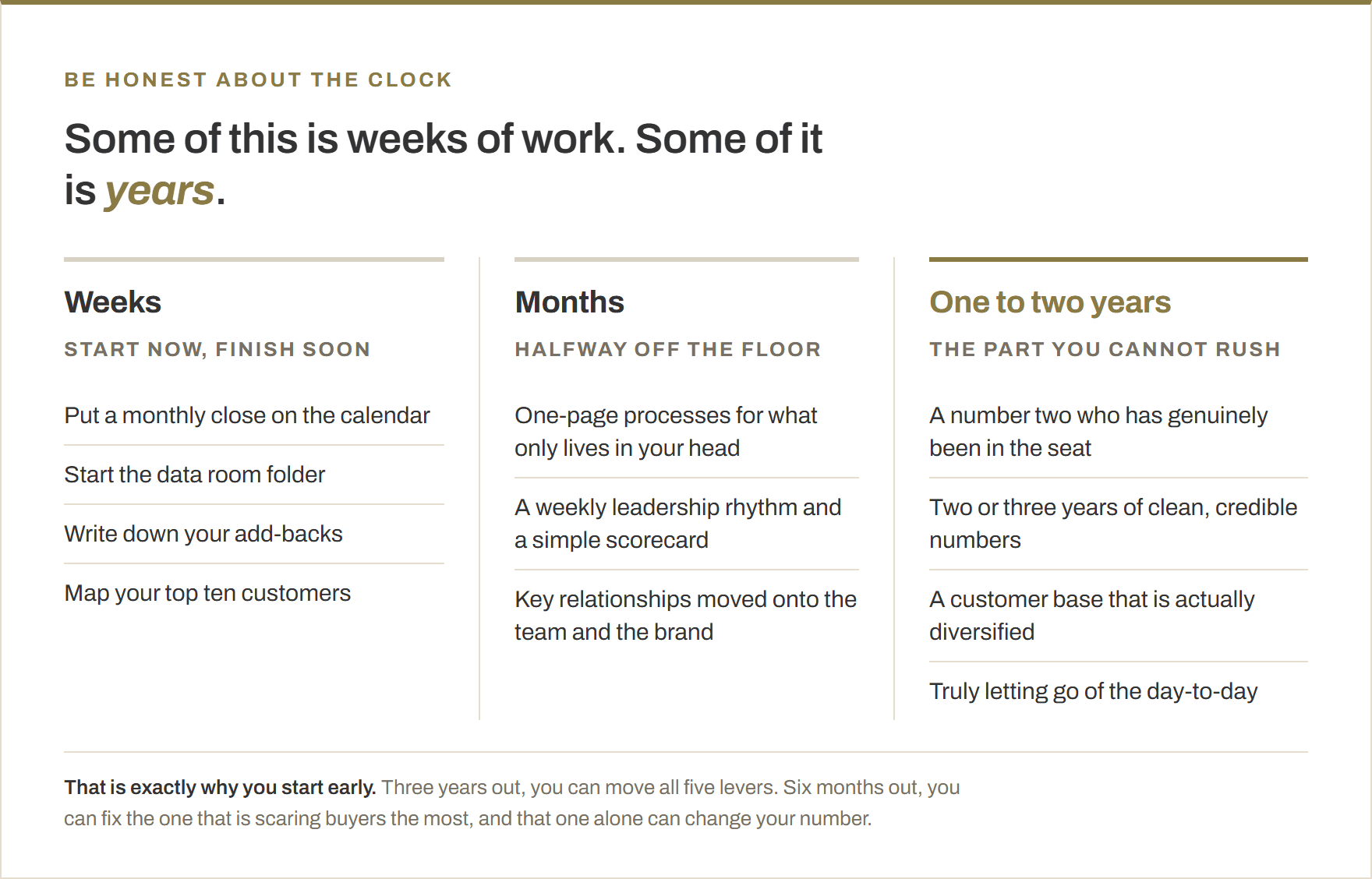
The levers that move the number most are the ones that cannot be rushed.
The levers that move the number most are the ones that cannot be rushed.
And if you own a business in Indiana, the clock is worth taking seriously. Many owners here are nearing retirement, and a lot of them will look to sell in the same handful of years. When that many come to market at once, the ready ones tend to get their pick of buyers. The rest compete on price.
The work pays off before a sale too
Every lever on this list makes your business better right now, whether you ever sell or not. A business that runs without you means fewer 11pm calls and a vacation that’s actually a vacation. Clean numbers mean you know where you make your money. Diversified customers mean you sleep at night.
The same work that makes a business worth more to a buyer in three years is what makes it run better and stress you less this quarter.
Where to start
Don’t guess which lever is costing you the most. A great CPA keeps your books right and your taxes handled, and that’s essential. It’s also a different question from what a buyer would pay for the business, or which gap is holding your value back most.
An Exit Readiness Review identifies the work. Your own management team can carry it out, or you can engage LIMESTONE in a defined Exit Readiness Partnership with a CFO partner, an operating partner or both.
The free Foundation Check, on LIMESTONE’s website, takes about ten minutes. It reads your business across these five things and shows you the one to fix first. If we can’t help you, we’ll tell you that straight, and point you to who can.
Jared Luegers is the founder and managing partner of LIMESTONE Strategic Partners and a CFA charterholder. He led strategic initiatives at a portfolio company through its $190 million sale, helped acquire a small Indiana operating business, and led strategic initiatives at a $9B Indiana RIA. He is the founder of OWN Indiana.
Sources: Pepperdine Private Capital Markets Report 2026 (Pepperdine Graziadio Business School), investment banker survey, page 58: 43 respondents; a median 32 percent of engagements did not close, the valuation gap was the most cited cause, and the most common pricing gap on a failed sale was 11 to 20 percent. Pepperdine Private Capital Markets Report 2026, Table 31, page 65: median deal multiples by EBITDA size and industry. Michael V. Marn, Eric V. Roegner and Craig C. Zawada, “The power of pricing,” McKinsey Quarterly, 2003, on the Global 1200.
