Bought, Not Sold: What a Buyer Prices Before They Pay
Jared Luegers, CFA · 30 August 2026 · 19 min read
LIMESTONE Strategic Partners works with Indiana owners two to five years from a sale, through a fixed-fee Exit Readiness Review and, where the owner wants it, an embedded CFO and operating partner seat.
A buyer prices five things: the profit you can prove, whether the business runs without you, the team that stays, where you stand with customers and the market, and whether the deal can close cleanly. Each is buildable, and each runs on its own clock, from a week of writing down add-backs to a year or two of proving a second-in-command.
Most owners get help once the offer is on the table. By then the price is mostly set. It was decided years earlier, by how clean the books are, by whether the business runs without you, and by who stays when you leave. This is the web edition of our first Field Guide, and it walks through what a buyer actually prices.
You built this. You probably cannot picture the day you hand it over, and that is normal.
This guide is not about talking you into a sale. It is about making sure that when a sale comes, on your timeline or on life’s, your business is the one that gets bought, on your terms, rather than sold, on the buyer’s.
It covers two of the three things that have to be ready: the business, and the numbers. The third, your own money and your life after, belongs with your wealth advisor and estate counsel. We name it, then hand it off.
One question is worth asking before you read any further. If you, or your key person, were gone Monday, what would the next 90 days look like? Whatever breaks in your answer is where your value quietly leaks. It is the best question we know for finding the first thing to fix.
Why this decade, and not the next one
Half of Indiana’s business owners are 55 or older. Those businesses change hands this decade whether or not their owners have planned for it, and most have not.

Half of Indiana’s owners are 55 or older. These businesses change hands this decade, ready or not.

Half of Indiana’s owners are 55 or older. These businesses change hands this decade, ready or not.
When a lot of businesses come to market at once, buyers get to choose. They pay up for the ones that are clean, independent and easy to underwrite, and they walk away from, or grind down, the ones that are not.
The difference between those two outcomes is who holds the upper hand. A ready business creates competition, and several interested buyers is the only thing that reliably pushes price up and pulls terms your way. An unready one takes whatever the single buyer willing to wade through the mess decides it is worth.
The numbers on the other side of that are not encouraging. Pepperdine’s 2026 Private Capital Markets Report found that about a third of banker-led sale engagements end without a closed deal, and the gap between what the buyer would pay and what the seller expected is the reason cited most often. Where a sale did fail, that gap most often ran 11 to 20 percent of the asking price.
None of the work ahead requires a buyer in the room. That is the case for starting early: you do it from a position of strength, while the business is running well, rather than under the pressure of a deal already in motion.
The five things a buyer prices
We score readiness on five dimensions. Read them in order, because they build on each other. Clean numbers make everything else provable. A business that runs without you, backed by a real bench, is what lets a buyer picture the future without you in it. A durable market is what makes them believe the earnings last. Transaction readiness is what keeps all of it from unraveling once diligence starts.
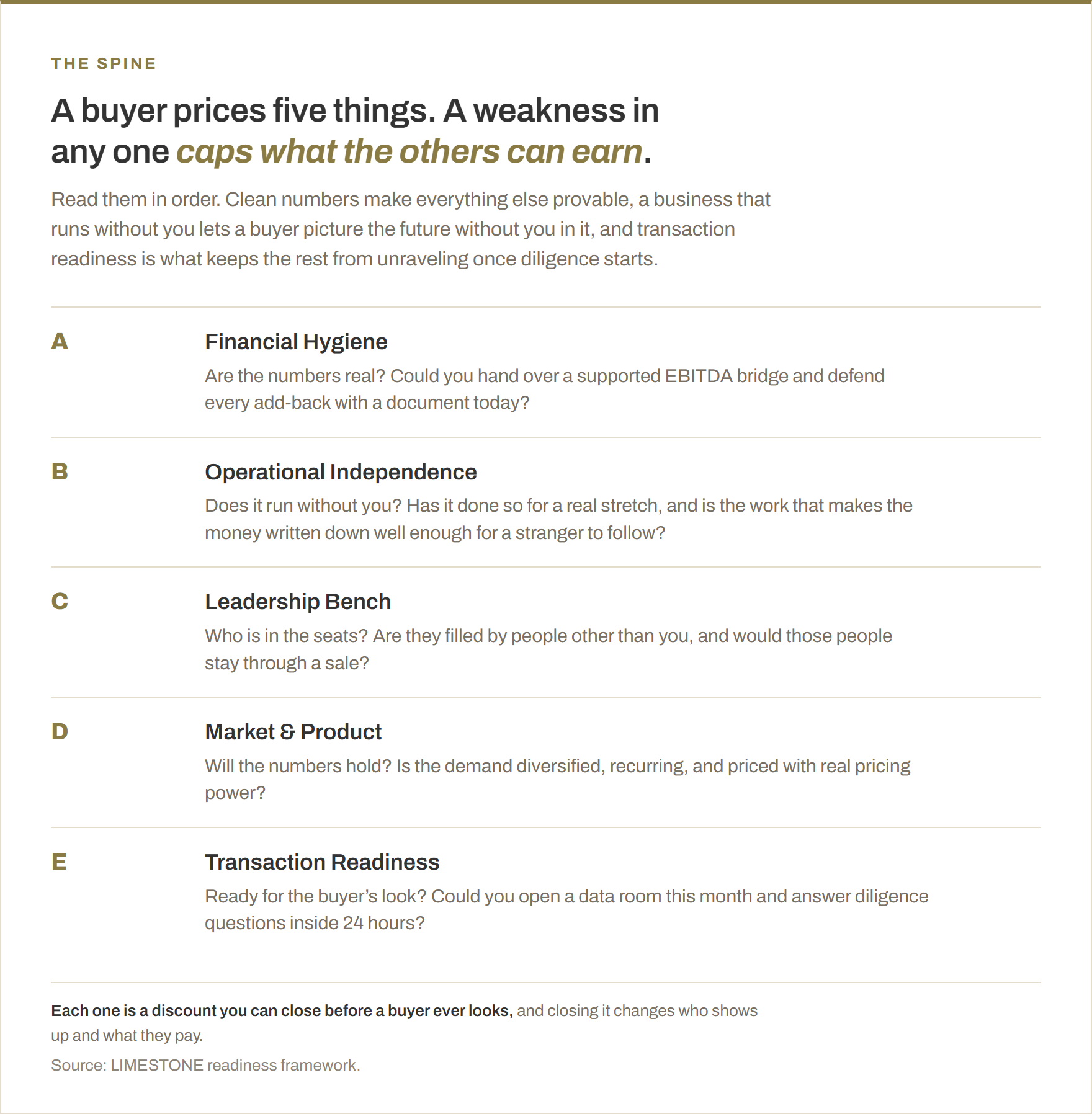
A weakness in any one caps the price the other four can earn.
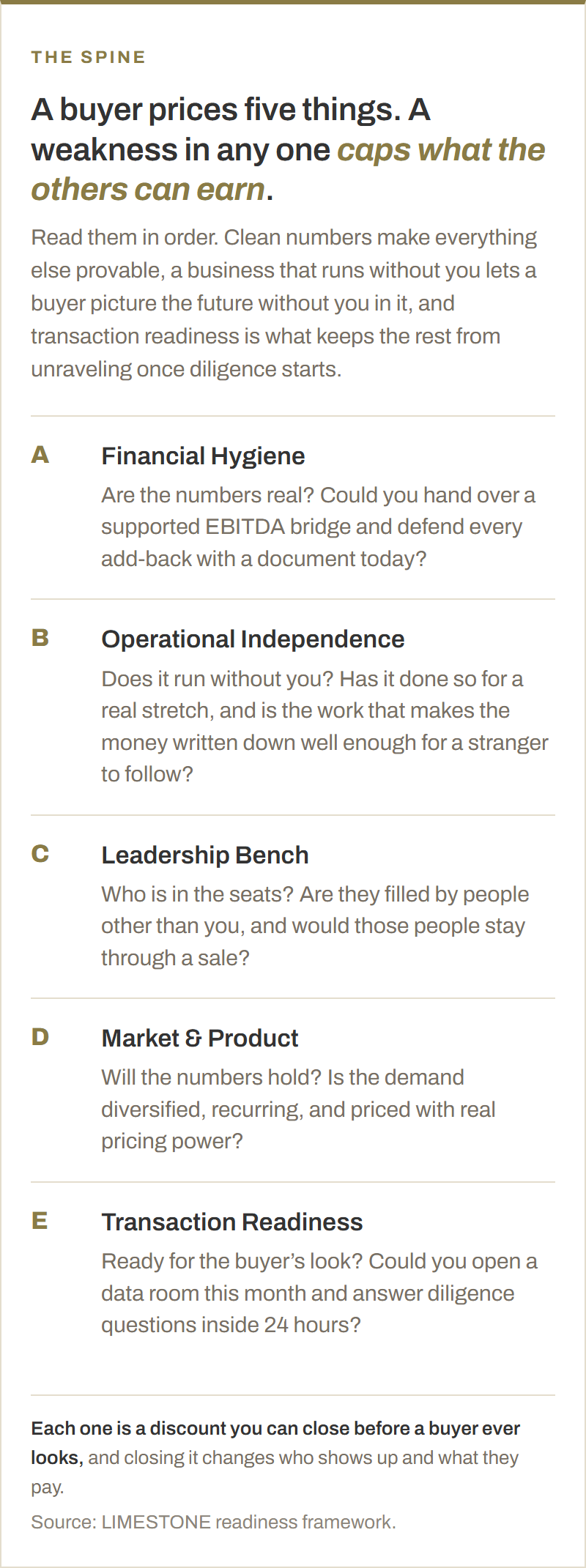
A weakness in any one caps the price the other four can earn.
A weakness in any one caps the price the others can earn. That is why the self-assessment at the end asks you to find your weakest dimension rather than your average.
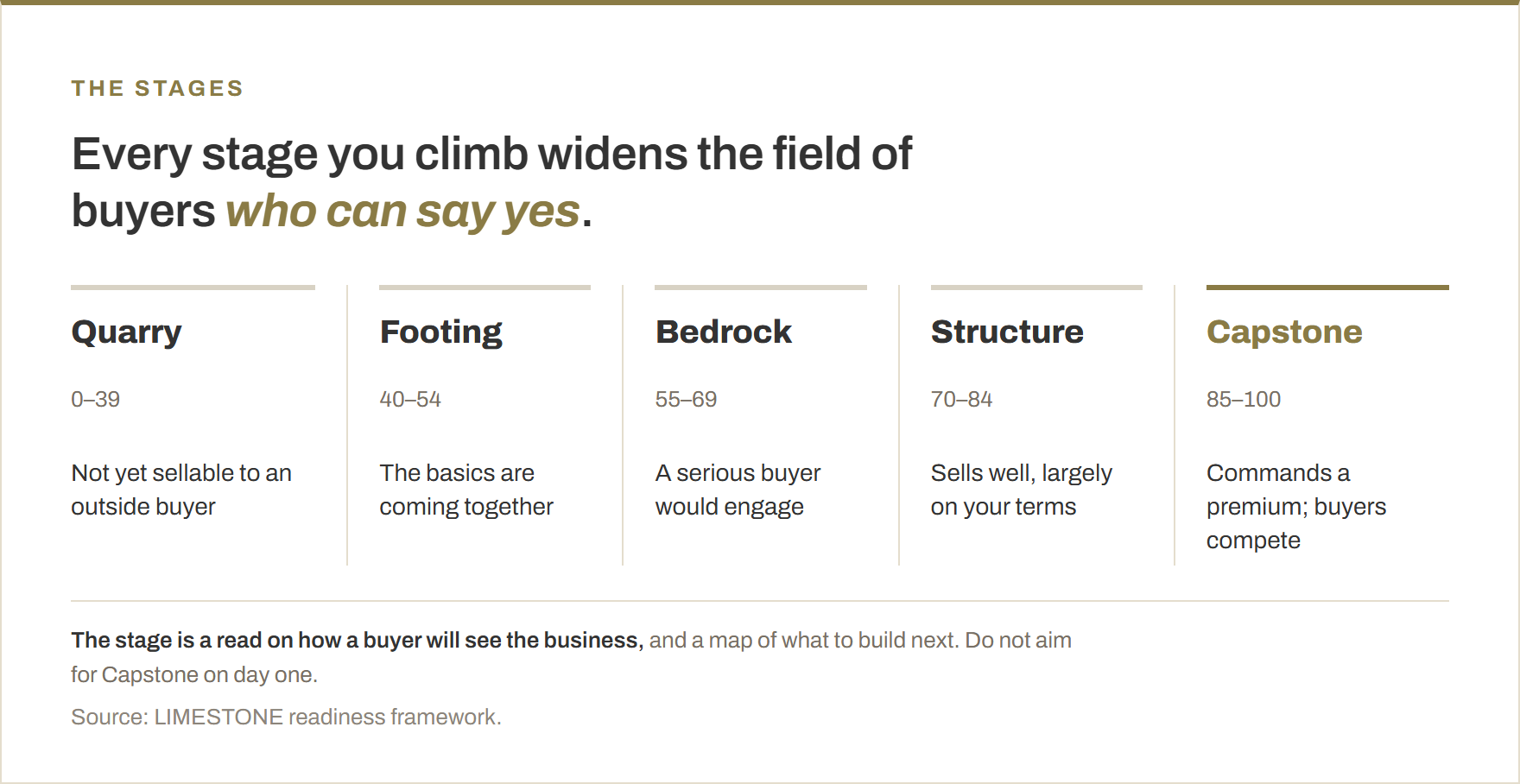
The stage is a read on how a buyer will see the business, and a map of what to build next.
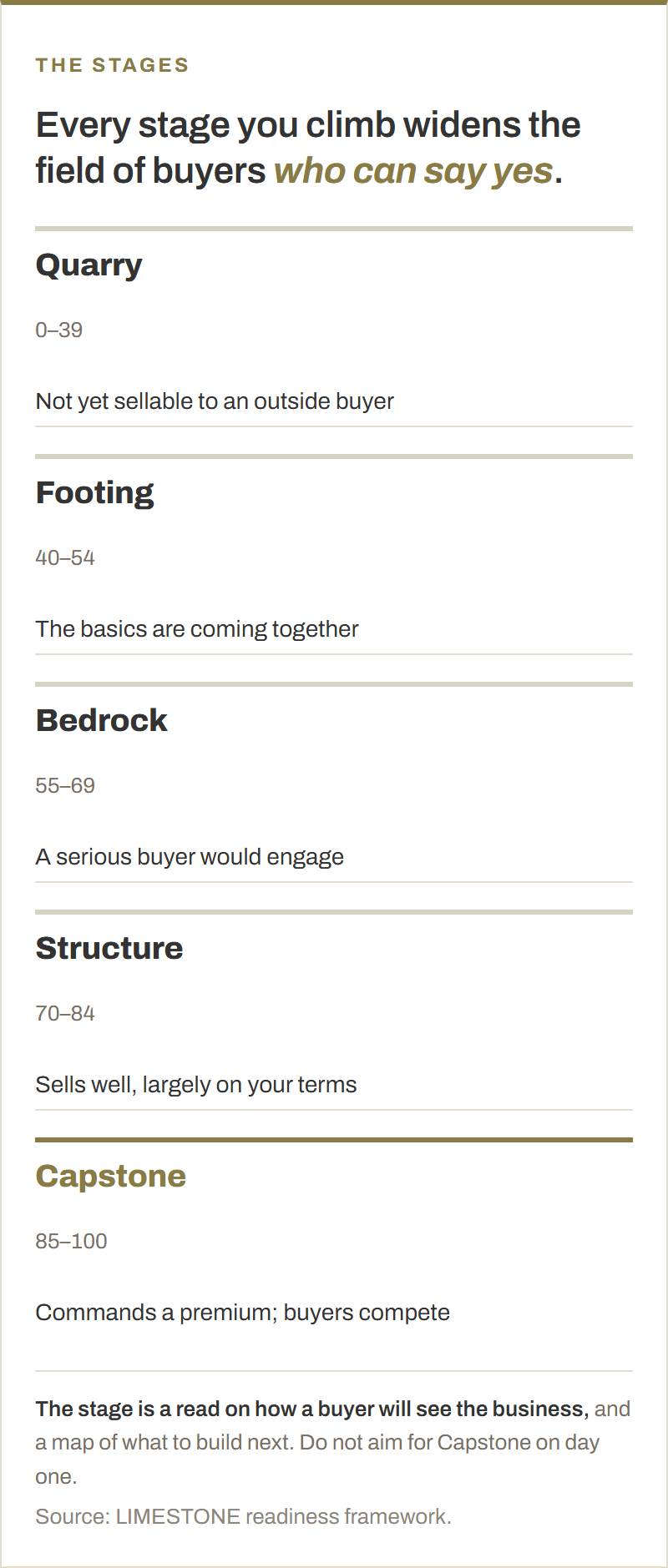
The stage is a read on how a buyer will see the business, and a map of what to build next.
A. Financial hygiene: the profit you can prove
Your adjusted EBITDA sets the headline price. What survives the buyer’s quality of earnings review sets the check that clears. Most owners lose money in the gap, because nobody tested the numbers before a buyer’s team did.
Build the bridge yourself, first.
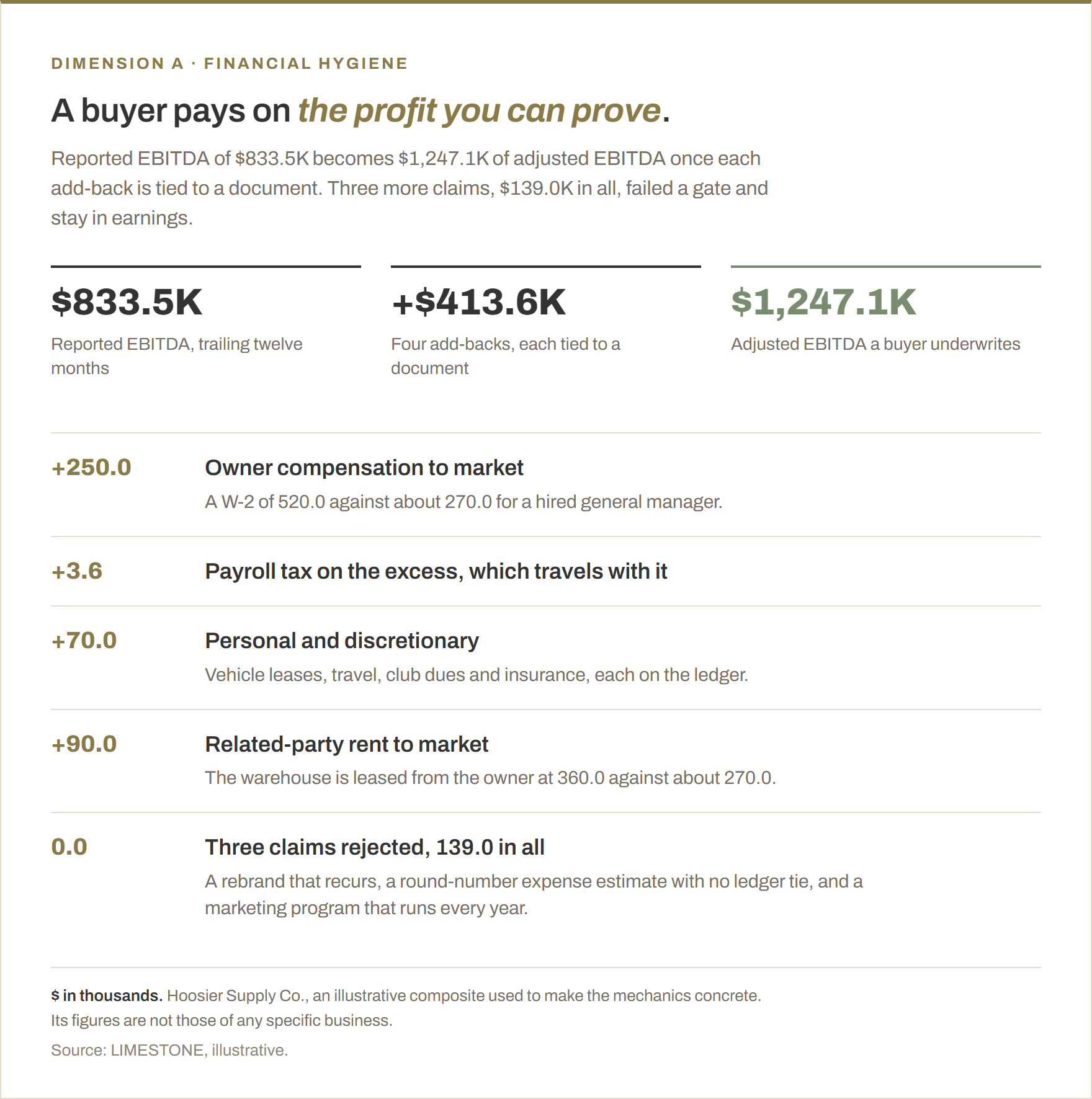
Every step of the bridge has to be supported, or the buyer takes it back out.
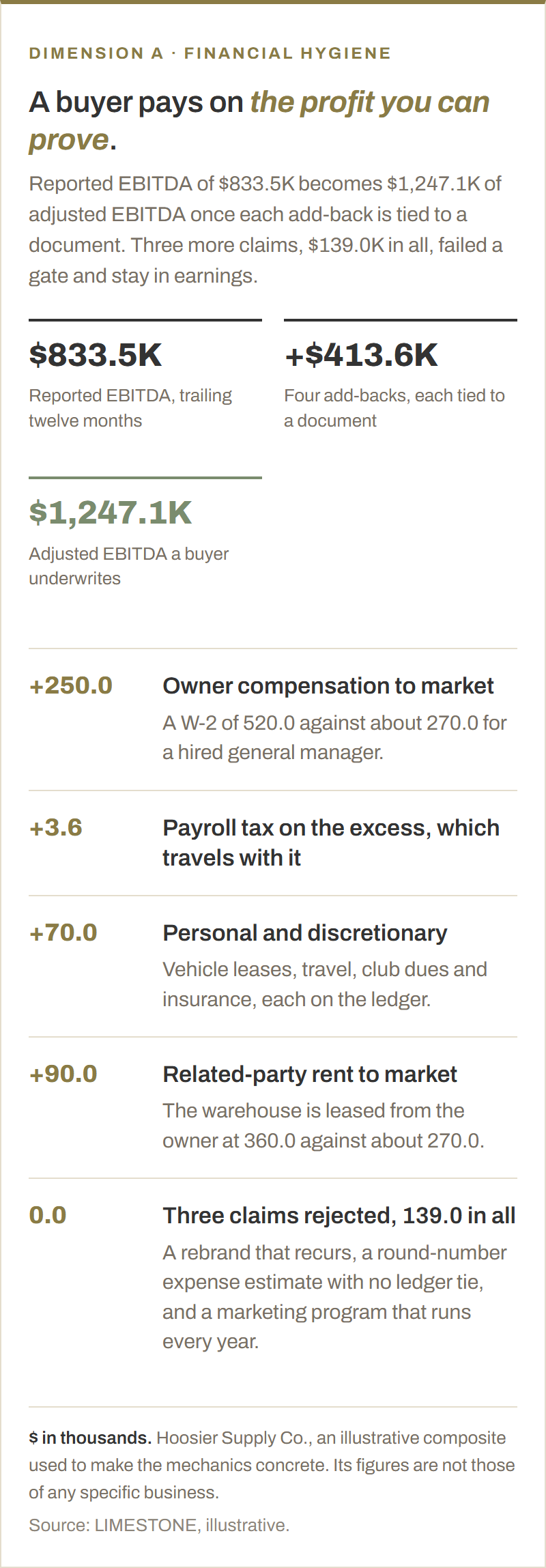
Every step of the bridge has to be supported, or the buyer takes it back out.
An add-back is you telling a buyer that a cost will not follow the business. A good buyer’s team tests every one. The rule we hold is simple: no source, no add-back. Ryan goes deeper on which adjustments survive a buyer’s review and which come out: add-backs, and the earnings a buyer is actually paying for.
Show the ones you rejected, too. That is not weakness. It is the thing that makes the rest believable.

The multiple works against you on the way down exactly as it works for you on the way up.
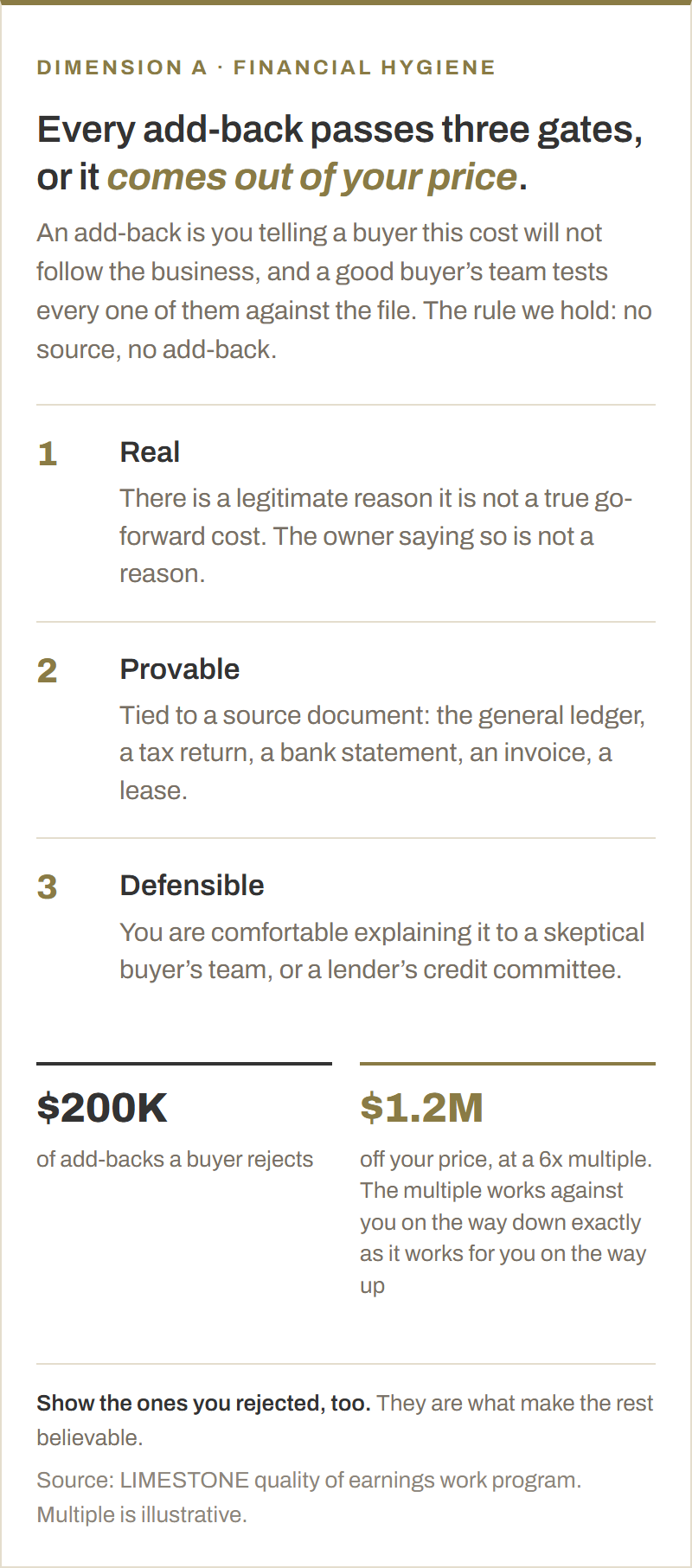
The multiple works against you on the way down exactly as it works for you on the way up.
The gates are not bureaucracy. They are exactly what a buyer’s team and a lender’s credit committee run every number through, so clearing them yourself first means nothing surprises anyone later.
Underneath the add-back file sits the less glamorous work: a clean chart of accounts, monthly closes a buyer can trust, revenue and margin you can cut by product and by customer, and a tax return that ties to the books. A buyer cannot underwrite what they cannot trust, and family-business bookkeeping rarely survives a buyer’s-eye review. Messy numbers are the first red flag, and the first thing a buyer wonders is what else is missing.
There is an opening here for owners who prepare. One M&A advisor quoted in ACG’s Middle Market Growth in December 2025 estimated that at least 90 percent of the private-equity-backed deals he sees use a sell-side quality of earnings, against only about half of founder-led lower-middle-market sellers. That gap is the edge.
A veteran SBA acquisition lender put it to us plainly: the cleanest deal he had worked drew 217 letters of intent. Buyers go a little crazy when the numbers just tie out.
B. Operational independence: the discount you control
This is the single most-cited reason a business sells for less, or does not sell at all. If the relationships, the decisions and the know-how live in your head, a buyer is not buying a business. They are buying a job that depends on you, and they price that risk hard.
It is worth being precise about why. A buyer is not paying for last year’s profit. They are paying for the profit they believe keeps showing up after you walk out the door. The more of that profit runs through you personally, the less of it they can count on.
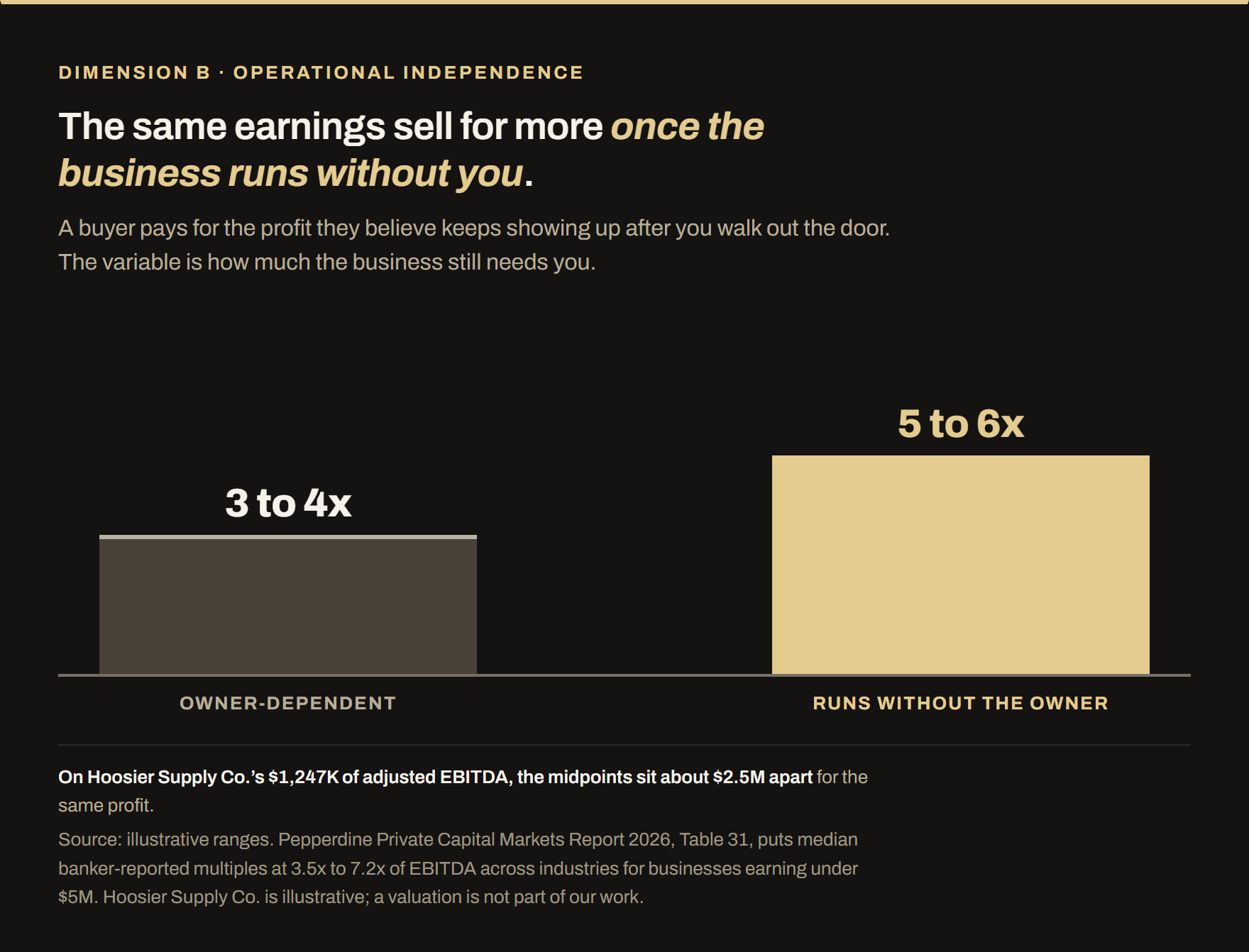
The variable is how much the business still needs you.
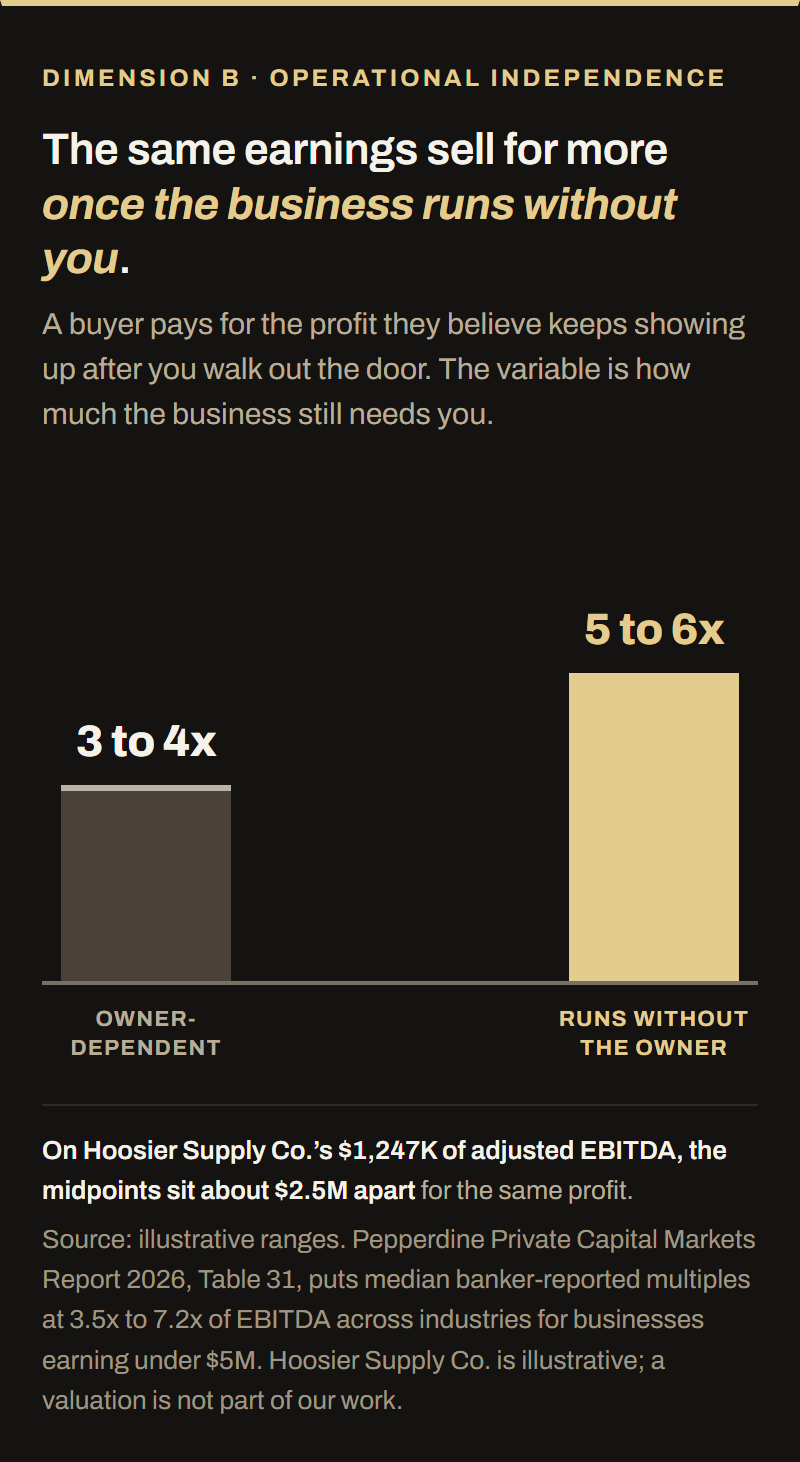
The variable is how much the business still needs you.
Owner-dependency also changes the shape of the deal, not just the price. Buyers hold money back in earnouts and escrow. De-risking yourself converts that back into cash at close. Two owners with the same profit and very different checks is the clearest version of this: same profit, very different price.
The work takes about two years, and buyers can tell the difference between independence that has been tested by time and an org chart drawn the month before diligence.
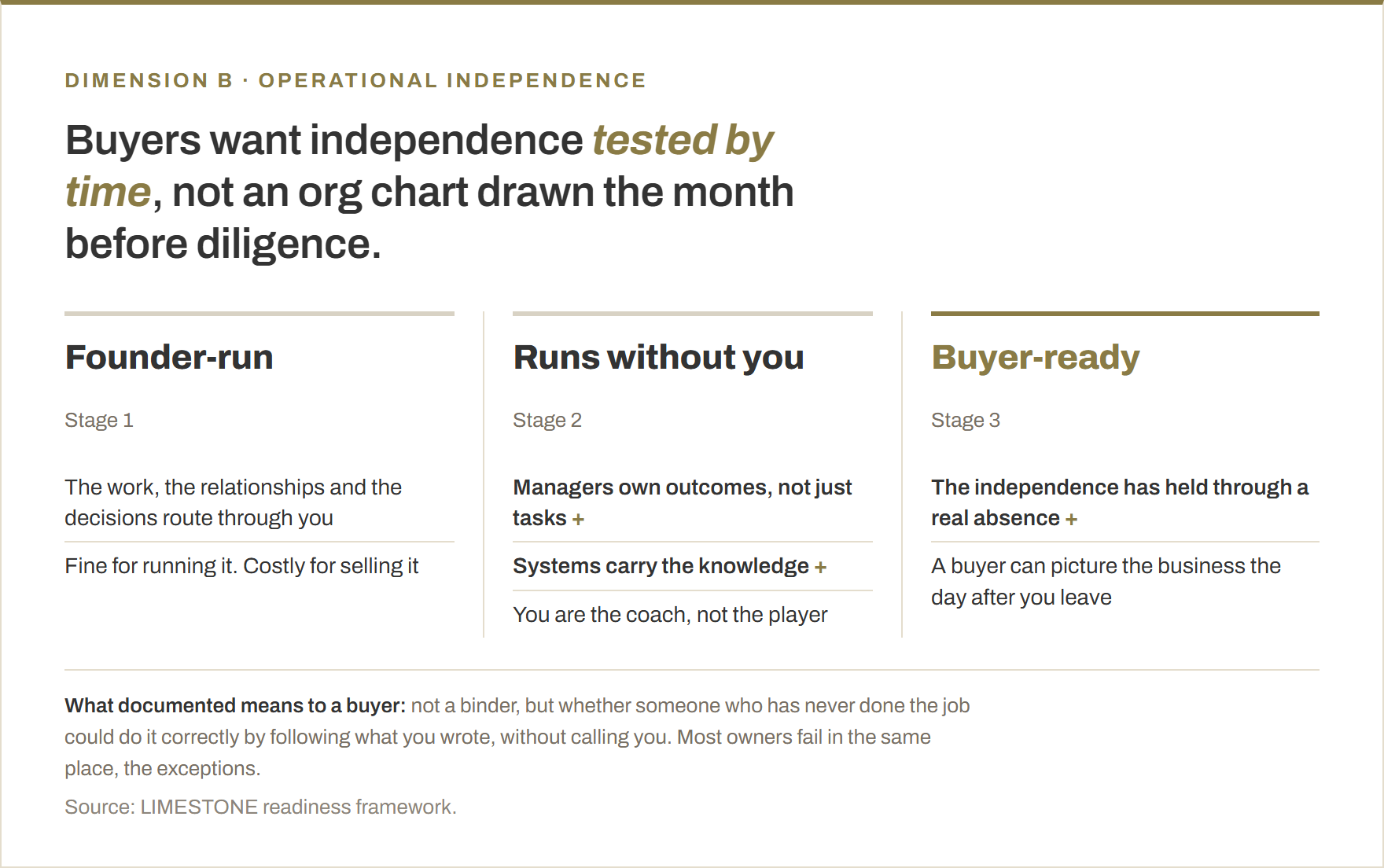
Buyers want independence tested by time, not an org chart drawn the month before diligence.
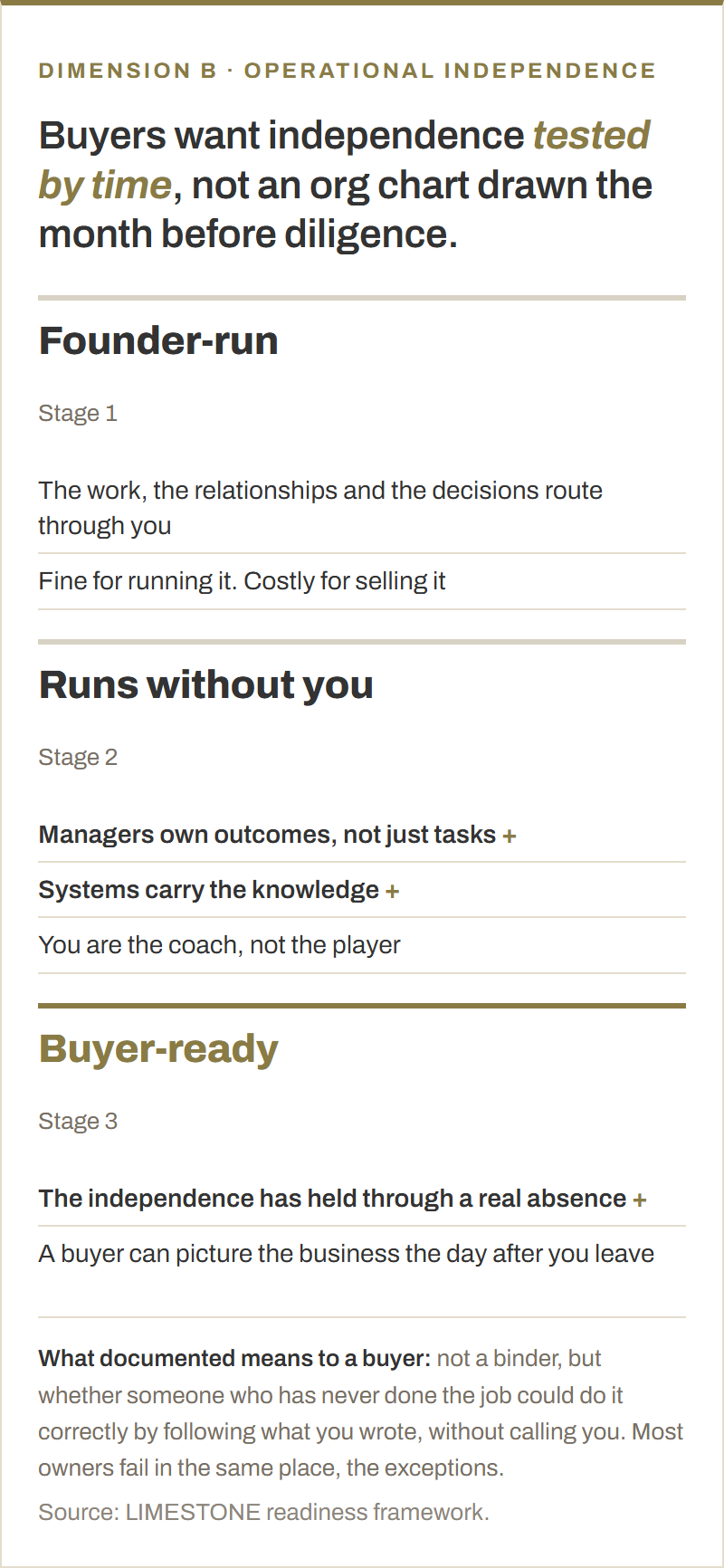
Buyers want independence tested by time, not an org chart drawn the month before diligence.
One warning on tooling. Buying software will not fix this. More than half of system implementations fail to deliver what was promised, and the failures cluster at the very start, in the gap between what the software expects and how the work actually gets done. You cannot write requirements for a process nobody has written down. Write it down first, then buy.
The cleanest way to find your owner-dependency is to leave. Not forever, and not as a stunt. Plan a genuine stretch away, two to four weeks, long enough that the exceptions surface. Name who decides what before you go, and tell the team, because an informal handoff tests nothing. Then resist the urge to check in, since the checking in is the habit you are testing.
What breaks is not a failure. It is your punch list, found on your schedule instead of a buyer’s. Four questions surface most of it:
Every honest answer either builds your confidence or hands you the next thing to fix. Both are cheaper found early.
C. Leadership bench: the people who stay
Management depth is one of the first things a serious buyer screens for. A credible second in command, and a team that stays, is what lets a buyer picture the business a year after you are gone.
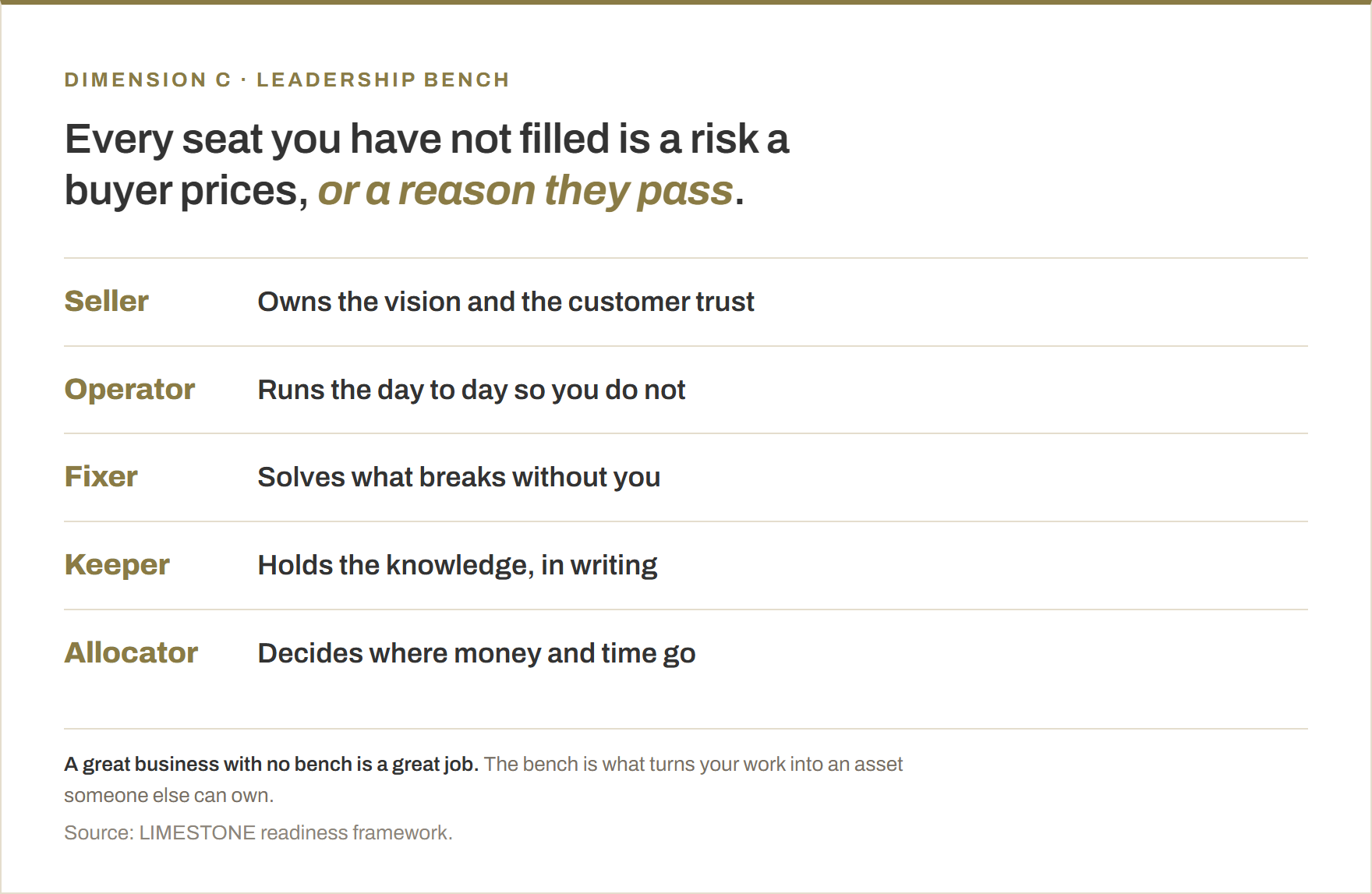
A great business with no bench is a great job.

A great business with no bench is a great job.
Retention is a design choice, not a hope. Phantom equity or stay bonuses often beat handing out real shares, which can leave the tail wagging the dog at the worst moment. A key customer who only trusts you is a concentration risk in disguise, so introduce, document and share the relationship early. And if something is only in someone’s head, it is not an asset a buyer can count on.
None of this is exotic. Do it early and it reads as good management. Do it during diligence and it reads as a scramble, which a buyer will price.
A lower-middle-market acquirer told us they would never buy from someone whose whole team walks out the door with them. The quiet question underneath all of this is: if the value is all cooked into you, what exactly am I buying?
D. Market and product: whether the numbers hold
Financial hygiene asks whether the numbers are real. This asks whether they will still be there next year. A buyer capitalizes the profit they believe keeps showing up, so durability is a separate test from accuracy.
Three things decide it: how concentrated your customers are, how much of your revenue comes back on its own, and whether you can raise price without losing the customer. Margin is their financial fingerprint. Buyer interest climbs sharply above roughly a twenty percent EBITDA margin, and a rising margin signals a moat while a falling one signals a commodity.
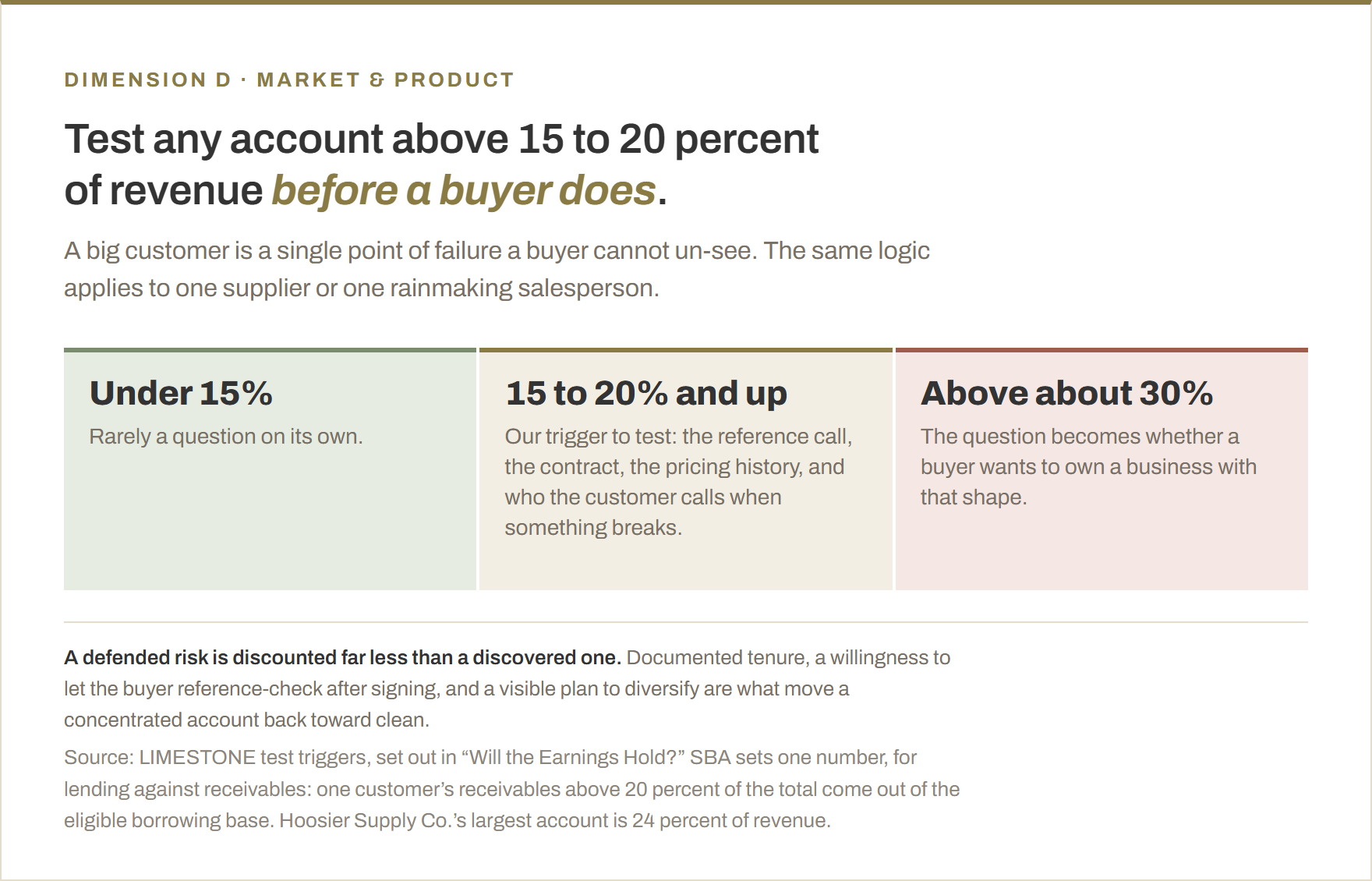
A defended risk is discounted far less than a discovered one.
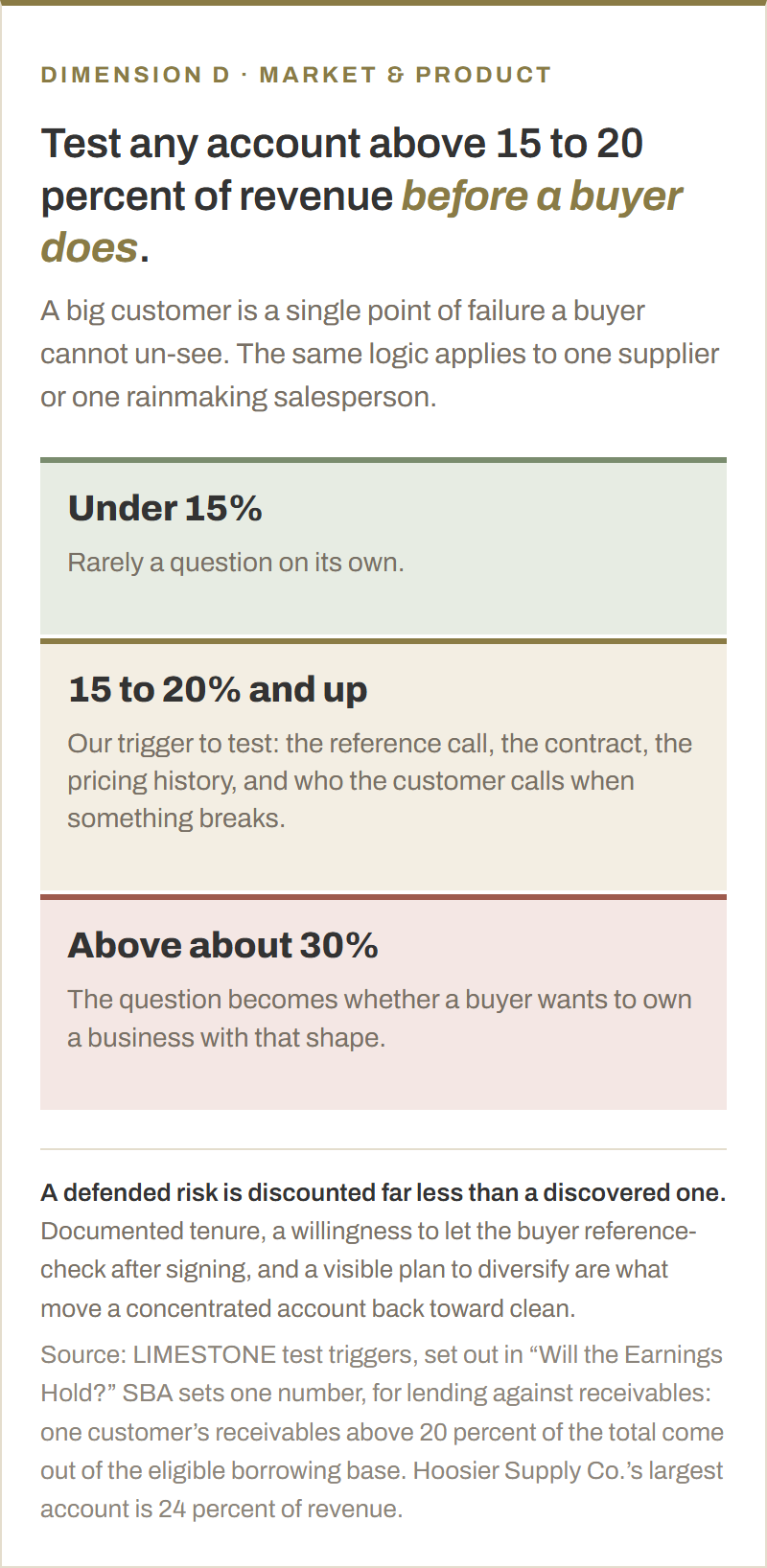
A defended risk is discounted far less than a discovered one.
The number itself is only half the story. A buyer also weighs how long the customer has been with you, whether the relationship sits with you or with the business, and whether they could walk tomorrow or are held by contract and switching costs. A concentrated customer you can explain and defend is a very different risk from one a buyer uncovers on their own.
On the other side of durability is recurring demand. Revenue that comes back on its own can command two to three times the valuation of revenue you have to win again every year, in the same business. And the surest sign of a durable business is pricing power. Most owners are underpriced, and have been for years.
Try a 10% price increase before any sale. If you keep nearly every customer, that is not a tweak. It is proof of a moat, and it flows straight to the earnings a buyer multiplies.
E. Transaction readiness: time and surprise
Once an offer is signed, the clock and the buyer’s skepticism both start working against you. The two things that kill deals are time and surprise, and you can remove both.
The defense is to run your own diligence before the buyer does. Assemble the data room they will ask for, have an advisor or a readiness partner pressure-test the numbers, and write down the answers to the questions you know are coming. Speed is a signal in itself: a document turned around in a day says you run a real business, and one that takes weeks says the opposite.
A surprise costs you more than the point it concerns, because it makes a buyer wonder what else you have not told them. As Ryan puts it: once somebody discovers one thing in the numbers, they start thinking about what else is there.
Then there is the piece almost nobody sees coming.
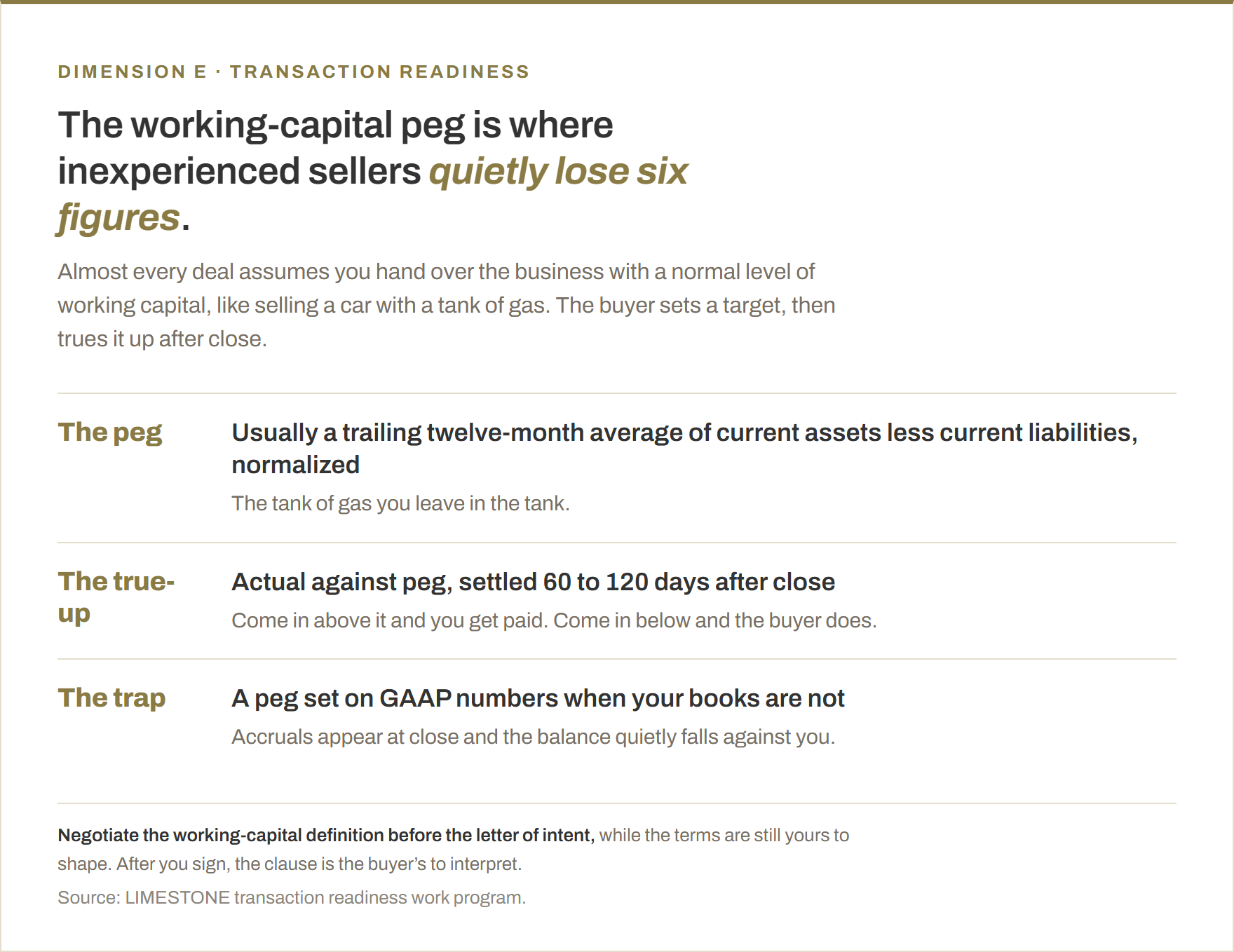
Negotiate the definition before the letter of intent, while the terms are still yours to shape.
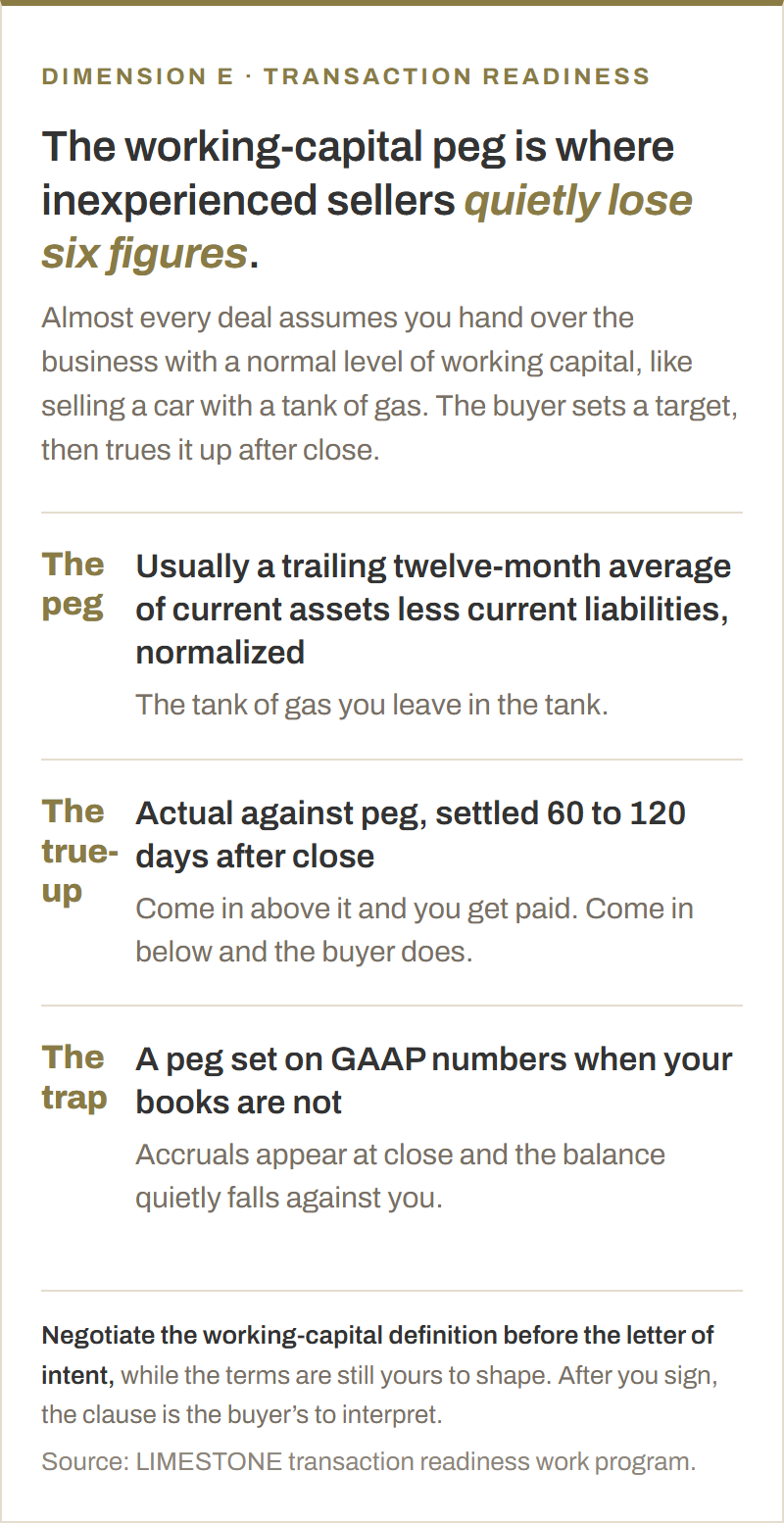
Negotiate the definition before the letter of intent, while the terms are still yours to shape.
The peg is only half of it. The other half is the bridge from the headline price to your actual proceeds, where a buyer subtracts bank debt and then a longer list of debt-like items: capital leases, deferred or unpaid taxes, customer deposits, accrued bonuses, earnouts. Owners fight over what counts, and the ones who have not mapped their own bridge lose the argument.
The price is set on EBITDA. What you take home is set by what survives quality of earnings and the working-capital true-up. Own both before you sign.
Diligence itself is a marathon that runs while you still have a business to operate. Buyers watch for performance to slip and for answers to slow, and some use the clock deliberately. A seller who has already proven the numbers gives a buyer less to dig through, and sixty to ninety days of exclusivity is typical. The prepared seller sets the tempo. The unprepared one spends sixty days reacting, and pays for it in price and terms.
Turn the questions around, too. Ask a buyer how many of their last ten deals under a letter of intent actually closed, what killed the ones that did not, and what would make them walk. A serious buyer answers plainly. The answers tell you whether you are dealing with a closer or a tire-kicker before you take your business off the market for them.
What the work is worth
Across the five dimensions, one is usually the binding constraint: the weakest link a buyer prices hardest. Closing it moves your value more than polishing the things you are already good at.
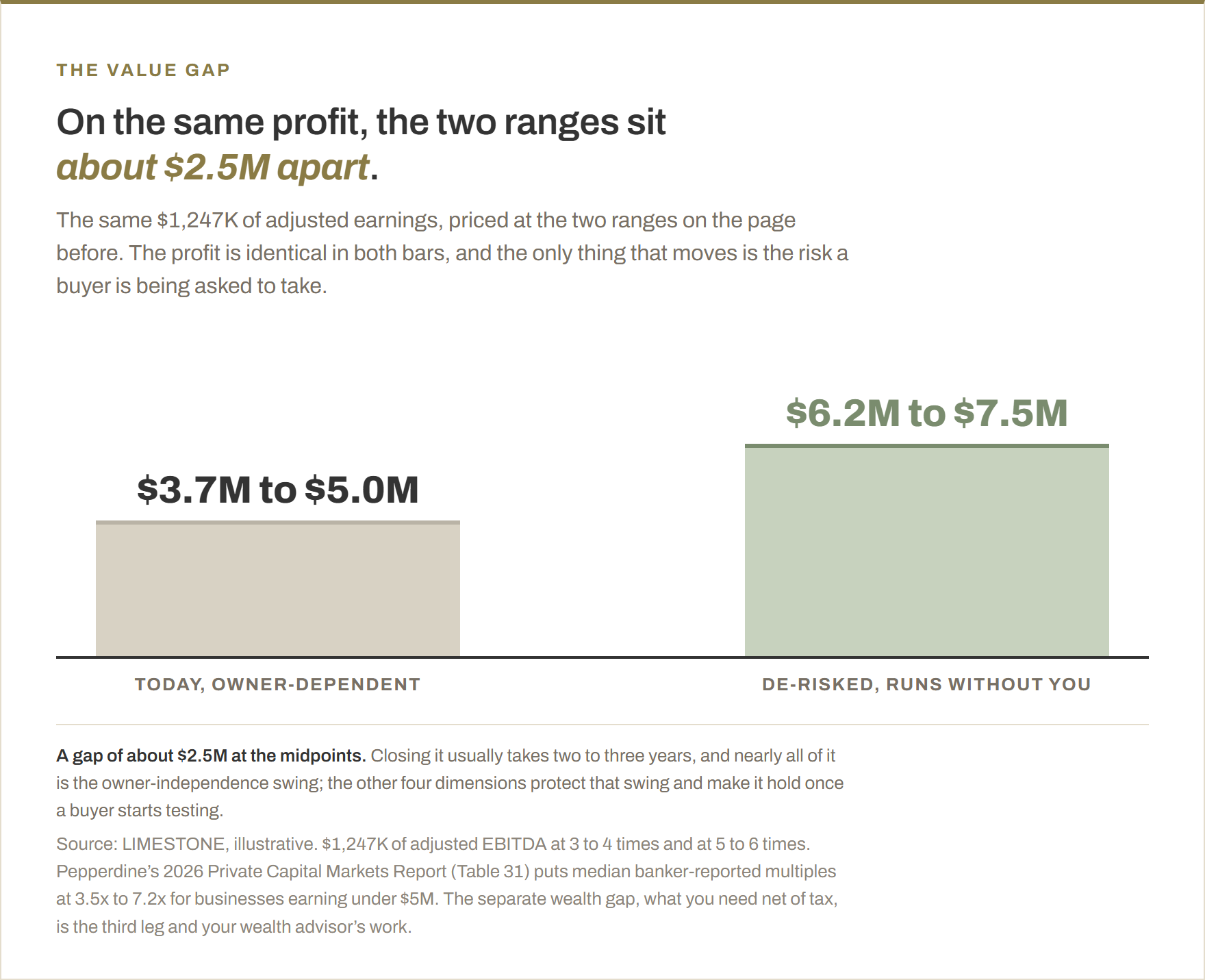
Nothing about the profit changes. Only the risk a buyer is being asked to take.
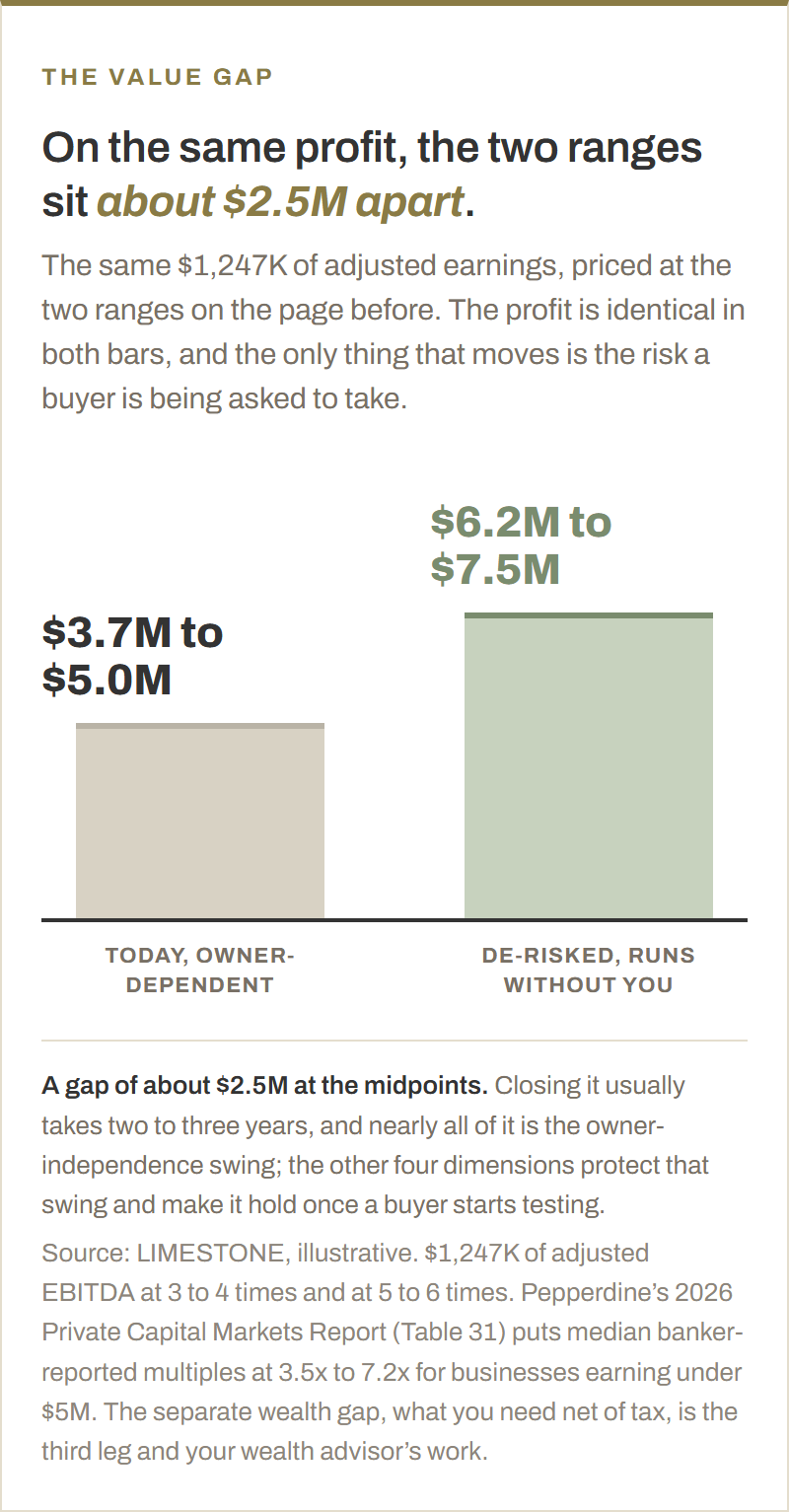
Nothing about the profit changes. Only the risk a buyer is being asked to take.
There are two ways to close that gap, and owners who start early pull both. De-risking lifts your multiple, which is most of what this guide covers. Growing the business re-rates it, because the same dollar of earnings is worth more inside a bigger business. Crossing size thresholds, somewhere near a million dollars of EBITDA, changes who shows up to buy, from individual searchers to private-equity platforms that pay more.
The two levers compound. A business that is both de-risked and bigger does not just sell for more. It opens to a deeper pool of buyers who can pay more.
Score yourself the way a buyer will
Rate the business 1 (not started) to 5 (buyer-ready) on each of the five dimensions. Be honest, because a buyer will be. Answer each with evidence you could hand across the table, not with optimism. If you cannot show it, it is not a five.
DimensionWhat a buyer will effectively askA. Financial HygieneCould you hand over a supported EBITDA bridge and defend every add-back with a document today?B. Operational IndependenceHas it run without you for a real stretch, and is the work that makes the money written down well enough for a stranger to follow?C. Leadership BenchAre the five seats filled by people other than you, and would they stay through a sale?D. Market & ProductIs your demand diversified, recurring, and priced with real pricing power?E. Transaction ReadinessCould you open a data room this month and answer diligence in 24 hours?
Add your five scores and multiply by four for a Foundation Score on a 100-point scale. Then find your stage on the ladder above, name the dimension holding you back, and start there.
Do not aim for Capstone on day one. A business at Footing that fixes its binding constraint and climbs to Bedrock is worth materially more, and is far more sellable, than one that stalls polishing a strength it already has.
Keep the five questions somewhere you will see them. Owners who revisit them once a quarter, and pick one thing to improve before the next, reach a sale with options instead of regrets. The work is rarely dramatic. It is a series of small, deliberate improvements that compound into a higher price.
The third leg, and how we help
Everything above is the first two legs. The third, what you need net of tax, your estate and your life after the sale, belongs with your wealth advisor and estate counsel. Start those conversations in parallel, because the window to plan well closes fast once a deal is moving.
You do not have to climb the whole ladder with us, or start at the bottom of it. Most owners begin with a single readiness read to find their binding constraint, then decide what is worth doing, and when.
A sell-side readiness review is a buyer’s-eye read across the five dimensions, ending in a prioritized punch list. A quality of earnings proves and defends a normalized number before you go to market, so it holds up in diligence instead of eroding your price. Embedded CFO and operating partner work is for when you want operators in the work with you over time.
Two ways to start, both free. Score yourself in about ten minutes with the Foundation Check, which names your constraint and scores you against the Indiana readiness benchmark. Or take a 30-minute readiness read with us, and we will tell you where you stand and the one thing to fix first.
Prefer it on paper? Download Bought, Not Sold as a PDF. Twenty-six pages, with the self-assessment laid out to write on. No form, and no email required.
Jared Luegers is the founder and managing partner of LIMESTONE Strategic Partners and a CFA charterholder. He supported operations through a $190 million strategic sale, helped acquire a small Indiana operating business, and led M&A at a $9B Indiana RIA. He is the founder of OWN Indiana. Ryan Anoskey, CPA, contributed the financial hygiene and transaction readiness sections; he has run more than 100 quality of earnings engagements, buy-side and sell-side.
Sources: Indiana ownership data from the Indiana Business Research Center, IU Kelley School of Business, for the Indiana Office of Entrepreneurship and Innovation, “Keep IN” Silver Tsunami reports, Phase 1 and Phase 3, 2026; output and jobs are the report’s full-closure ceiling. Sale-failure figures and multiples ranges are from the Pepperdine Private Capital Markets Report 2026 (page 58, 43 investment bankers responding; Table 31, page 65). Concentration triggers are LIMESTONE’s own test, with SBA’s 20 percent receivables rule from SOP 50 10 8.1. Other deal-market figures, covering letters of intent that close, quality of earnings adoption and working-capital mechanics, are directional lower-middle-market ranges drawn from EPI, GF Data, BizBuySell, Divestopedia and practitioner consensus, 2025. Hoosier Supply Co. is an illustrative composite used to make the mechanics concrete; its figures are not those of any specific business. Quotes from advisors, brokers, lenders and owners are anonymized and paraphrased from LIMESTONE field research. This guide is general educational information, not investment, tax, legal or accounting advice, and no figure here is a valuation, appraisal or promise.
