
What level of quality of earnings does a deal under $3 million need?
Ryan Anoskey, CPA · 14 September 2026 · 18 min read
LIMESTONE Strategic Partners scopes quality of earnings work to the size of the deal: Lite, Core or Full, for buyers, sellers and lenders on businesses earning $500K to $5M of EBITDA, from Carmel, Indiana.
A deal under $3 million usually needs a Lite or Core review, about twelve tests, where a full scope on a $10 million EBITDA manufacturer runs forty-six, and proof of cash is always one of them. Below $3 million SBA requires no quality of earnings; the buyer usually commissions any review, and the lender decides how far to rely on it. On an SBA 7(a) initial acquisition or business expansion at a business purchase price of $3 million or more, the lender must obtain it. A Lite review from us starts at $7,500 and takes 10 to 15 business days.
A full-scope quality of earnings on a $10 million EBITDA manufacturer runs forty-six tests. A $2 to $3 million deal needs about twelve, and proof of cash is always one.
A searcher on a $1.5 million deal asked the SearchFunder forum where to find a quality of earnings for under $10,000, because the quotes he had were around $20,000. Fifty-seven replies later, the last comment asked what level of review a business that size actually needs, and the thread ended there. This page answers it with the ladder we use, the fees and the clock we publish, and a column you will rarely find beside the price, which is what each row does not test.
Five rows, and the one you are in
A quality of earnings is a test of whether the reported earnings are real and supported by cash, run on the books, the tax returns and the bank statements. Two numbers size the deal, what the business earns and what you are paying for it, and each carries a threshold. Below about $1 million of EBITDA the market prices on seller’s discretionary earnings, which adds a market wage for the owner’s seat back to the number because the buyer will sit in that seat. Above it the market prices on adjusted EBITDA, which leaves the wage in as an expense because somebody has to do the job. The conventions cross at roughly $1 million of EBITDA. The other threshold is the SBA one, at a $3 million business purchase price on a 7(a) loan, and it decides whether the lender must have a review, which leaves the tests themselves where they were. The first four rows below run on what the business earns, and the fifth on what you pay. At the three to four times these deals trade at, a $2 to $3 million price is roughly $500,000 to $1 million of earnings.
Three terms in the table need saying once. The proof of cash reconciles the bank statements to the income statement and the tax return, period by period. The add-back gates are the three tests every proposed adjustment passes or fails, a stated reason, a source document that quantifies it, and whether a lender would accept it. The peg is the working capital the price assumes you are handed at closing.
| Deal band | The row, and what it tests | What it does not test | Fee and clock |
|---|---|---|---|
| Under about $400K of adjusted earnings | Red-Flag Review, which is not a QoE tier. A judgment read of what you already hold. Recomputed SDE, the add-back schedule scrubbed, concentration, whether the numbers hang together. | Nothing is tied to a document. No tie-outs, no cash proof, nothing a lender can rely on. | From $2,500. Dated at scoping. |
| $400K to about $1M of SDE One clean entity, nobody relying on the number | QoE Lite. The bridge from the filed return to adjusted EBITDA, every add-back through three gates with the declined items shown, owner pay reset to market, transcript and payroll ties, a proof of cash over the trailing twelve months plus the last full fiscal year, revenue trend and top-ten concentration, SDE beside adjusted EBITDA, a computed peg, the verdict. | The peg is computed, never tested. No receivable or inventory testing, no balance-sheet work, no debt-like items, no tax flags. The fiscal year before last is absent from the cash proof, so the three-period version a lender reads first is not there. | From $7,500. Ten to fifteen business days from Day 1. |
| $400K to about $3M of adjusted EBITDA A lender relies on the number or the peg is negotiated. Most deals we scope land here | QoE Core. Everything in Lite, the peg tested on receivable collectibility, payable aging, inventory obsolescence and accrual completeness, the proof of cash extended to the two preceding fiscal years, revenue quality in depth, customer and vendor concentration, margin by product and channel, run-rate EBITDA, benchmarks and ratios. | No net-proceeds bridge and no itemized debt-like items, so it does not say what you owe on day one. Tax exposures are flagged, never concluded. Owner dependence and bench are reported at a high level, never tested. | From $15,000. Ten to twenty business days. |
| Multiple entities, cash-heavy books, or above about $3M of EBITDA | QoE Full. Everything in Core, the debt and net-proceeds bridge, debt-like items itemized, maintenance against growth capex, a search for unrecorded liabilities, commitments and contingencies, related-party terms, worker classification, 1099 against W-2, cash-to-accrual conversion, tax exposures flagged and referred. | Whether the earnings survive the owner leaving. No financial tier reaches that. It takes reference calls, separate management interviews and a quantified revenue at risk, which is the operational engagement alongside. | From $25,000. Fifteen to twenty-five business days. |
| $3M business purchase price and above, on a 7(a) loan | Lender-engaged, at Core scope. The bank is the client and the addressee. Books, statements, filed returns and the IRS transcript reconciled to each other, the three-period cash proof, every add-back documented, revenue quality, a one-page summary for the credit memo. | Your questions. The bank’s report exists to produce an earnings figure it can underwrite. | $15,000 at $3.0M to $5.0M, $20,000 above $5.0M to $10.0M, $25,000 and up above that, quoted to the bank and passed through to the borrower. Fifteen business days from Day 1. |
Fees are our published floors, quoted as one fixed fee after a scoping call; the engagement letter governs. Each QoE tier includes a CPA-led financial review and an operator’s read; customer interviews and deeper operational fieldwork are separately scoped unless expressly included. Day 1 is the later of the day the last critical item on our request list arrives and the day payment clears.
Every provider prints what a review includes. The buyer who overspends or underspends usually did not ask what was left out.
What level of quality of earnings does a deal under $3 million actually need?
About twelve tests out of forty-six, chosen for what a deal this size turns on. The forty-six is our own count, from the full buy-side program for a manufacturer at $10 million of EBITDA with a lender in the deal and rep and warranty insurance behind it, eleven workstreams in all, and beside every workstream I wrote what stays on a $2 to $3 million deal, what drops, and what brings it back.
Three things stay at any size. The monthly proof of cash on the revenue side, because a bank feed is not something the seller can restate. The add-back testing through all three gates, because that schedule is the price negotiation itself. And the manual journal entry screen, which is cheap and is where small-company problems actually live, since real revenue comes from the billing system and adjustments come from somebody’s keyboard.
Most of what drops is precision a $2 million deal does not pay for, and each dropped test has a trigger written next to it, so concentration over 20 percent brings the revenue work back in full and adjustments over 15 percent of EBITDA bring back the full ledger sweep. A business at $5 million of EBITDA from one location is a clean file, and a business at $1 million across thirty locations is a Full-scope file at several times the effort. Complexity sets the scope.
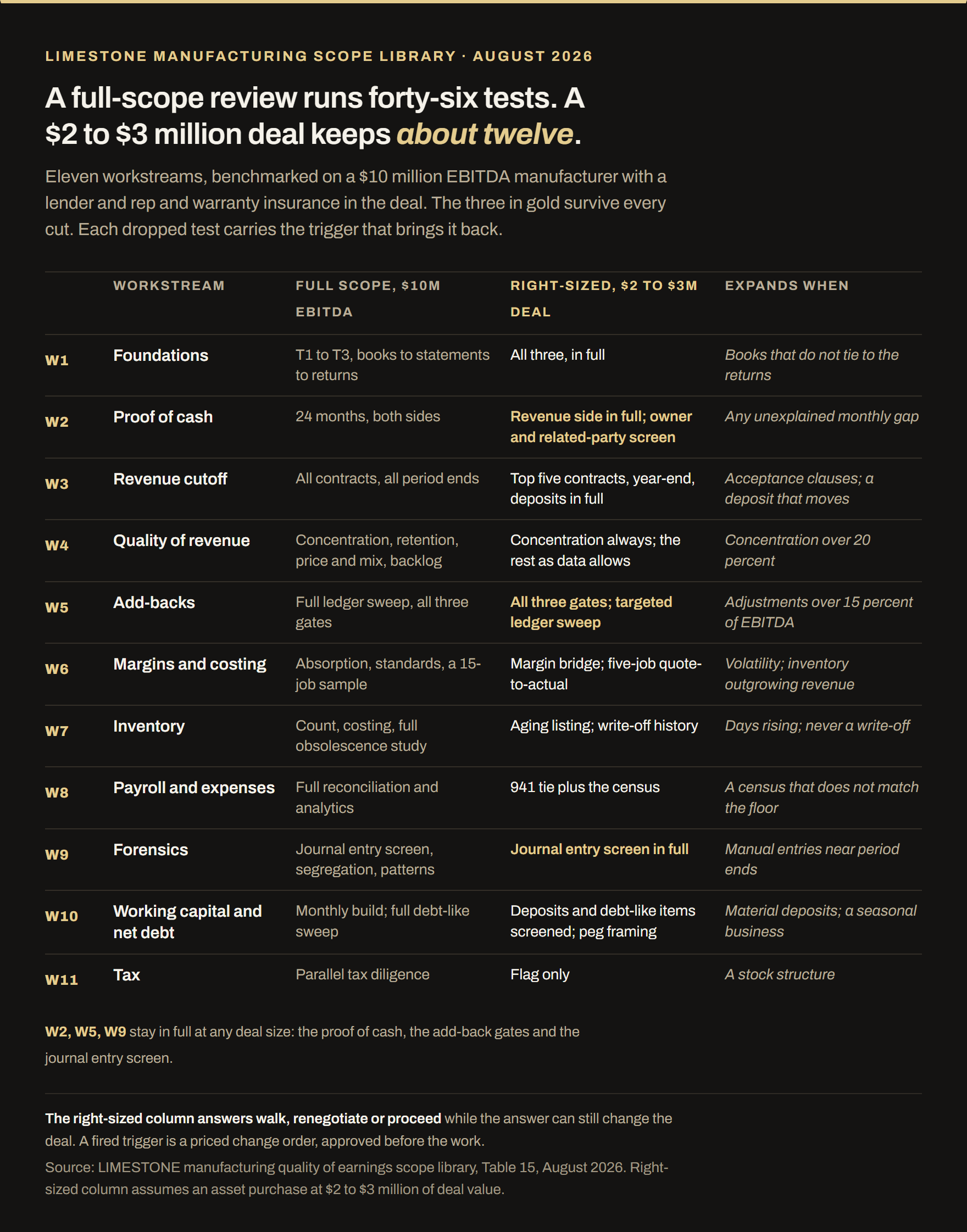
Eleven workstreams and forty-six tests at full scope, about twelve of them on a $2 to $3 million deal.

Eleven workstreams and forty-six tests at full scope, about twelve of them on a $2 to $3 million deal.
Is a light quality of earnings enough for a $2 million to $3 million acquisition?
Often, on one clean entity with straightforward revenue and no lender relying on the number. Most buyers in that band land on Core anyway, for two reasons. The first is the three-period proof of cash, which reconciles the trailing twelve months and the two prior fiscal years from the bank statements to the income statement and the tax return, is the item a lender reads first, and Lite does not carry it. A credit team that wants the older years will ask for them, and then you pay for Core twice.
The second reason is the peg. At Lite we compute it, which answers whether the number is calculated correctly, and at Core we test it, which answers whether the components are real. A peg that will be negotiated should be a tested one, or you can end up funding somebody else’s working capital at closing. On our worked example, Hoosier Supply Co., the four peg methods land within $53K of each other, so the argument is rarely about the method.
The word light means something different at every shop. One shop’s light review is three years of annual figures at $3,000 with no bank, tax or payroll reconciliation; another’s is the full analysis delivered in Excel without the written report at $20,000; a third is the same back-end work behind a shorter deliverable at $11,200; a fourth is a cash proof with a red-flag summary at $3,000 to $10,000. Ask which periods the cash proof covers and whether the peg was tested, and the four quotes stop looking alike.
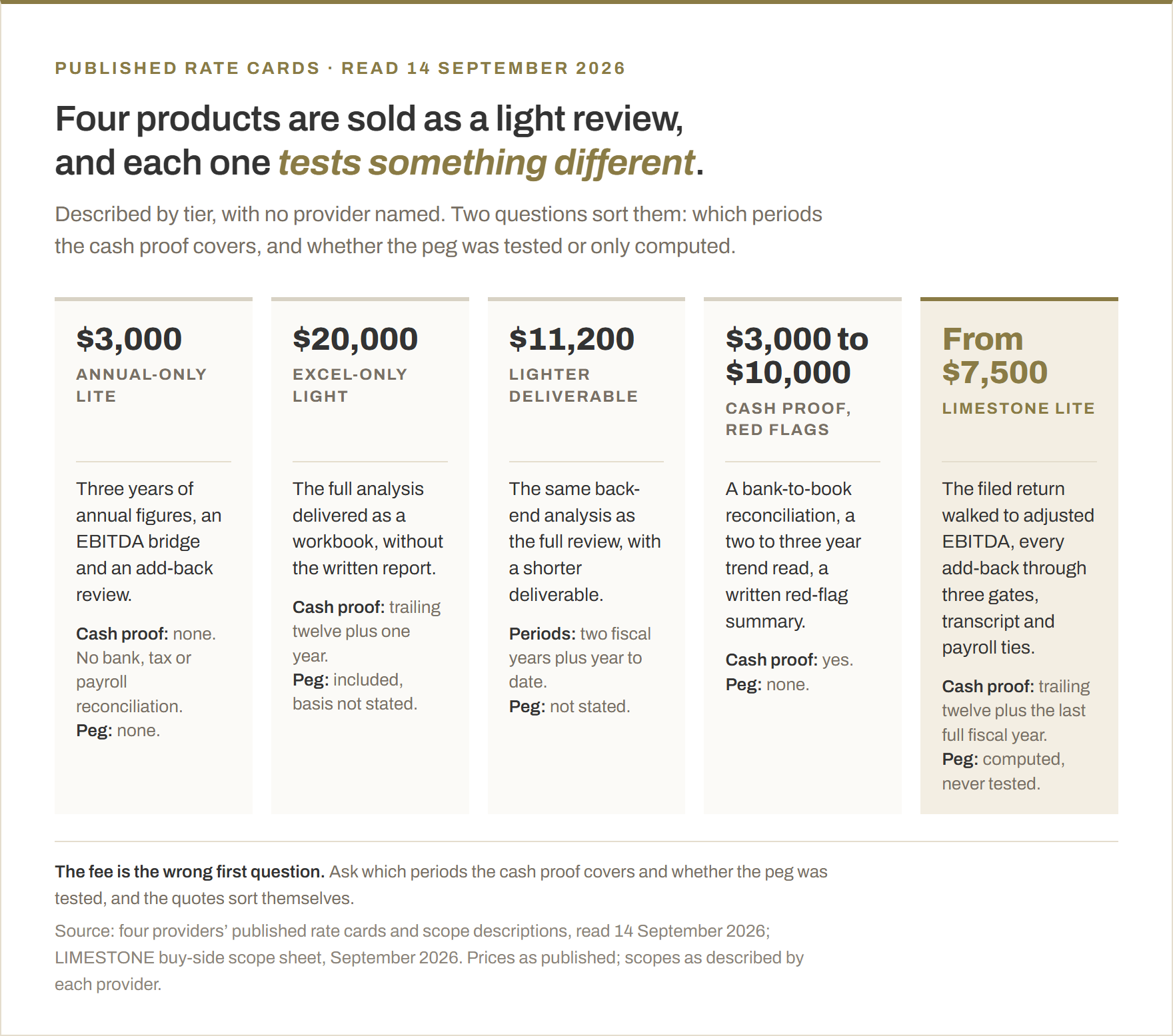
Two questions separate the products sold under one word, which periods the cash proof covers and whether the peg was tested.
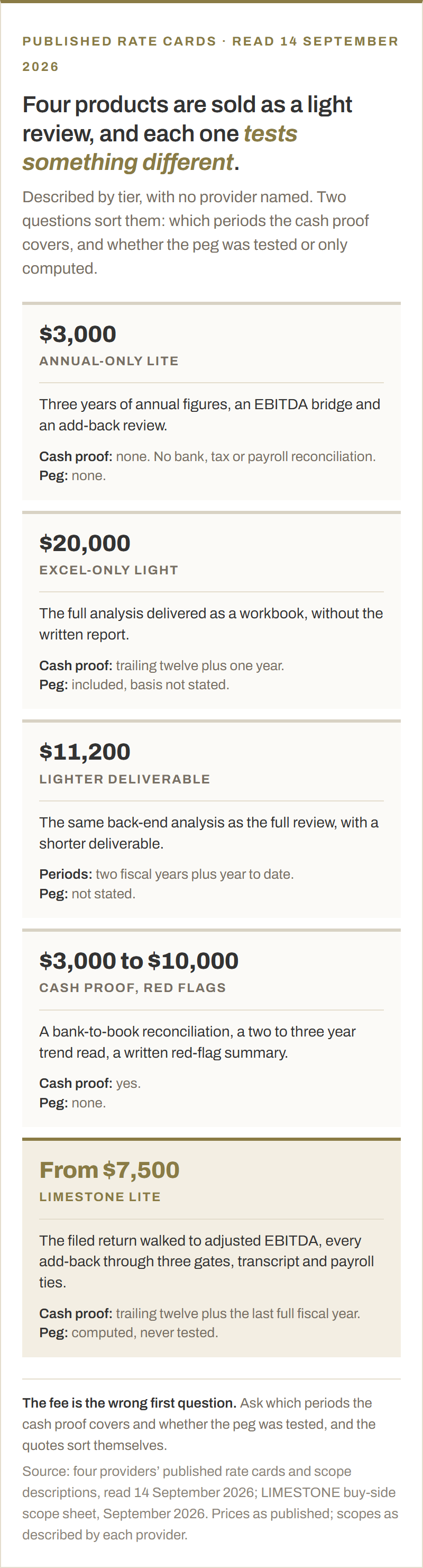
Two questions separate the products sold under one word, which periods the cash proof covers and whether the peg was tested.
What changes at $3 million on an SBA 7(a) loan
The lender’s obligation, and nothing about what a good review tests. SBA SOP 50 10 8.1, which applies to applications SBA receives on or after 1 October 2026, says that on an Initial Acquisition or Business Expansion “where the Purchase Price as defined in Paragraph A.1 is equal to or greater than $3 million, the Lender must also obtain a Quality of Earnings (QoE) in addition to the required Business Valuation.” Since the 25 September update the report “must not be prepared by or for the seller,” and the lender must run its debt service coverage test on the earnings figure the QoE produces, at 1.25 times on an initial acquisition and 1.15 times on a business expansion in the same industry. If that figure comes in below what the valuation assumed, the loan is sized down to it. The $3 million is the business purchase price, measured after owner-occupied real estate comes out at appraised value and before your equity and any seller note, so a $3.6 million deal with a $900,000 building is a $2.7 million business and the mandate does not attach. Owner buyouts, ESOPs and cooperatives are carved out of the requirement at any price, and since the update so is a deal built around an owner-occupied special purpose property, while an employee of 24 months or more buying out a single owner now counts as an owner buyout. The SOP also puts a clock on it, since the vendor must be retained and the engagement letter in place when the SBA loan number is issued, and it lets the lender pass the cost to the borrower and count what the borrower spends toward the equity injection.
For a deal that crosses the line, the lender-ordered report, the fee and the timing are on the SBA quality of earnings page.
Under the line, the same appendix says “Financial due diligence is required on all change of ownership transactions.” No independent report is mandated, and the lender still obtains a business valuation (at a business purchase price of $350,000 or less it may do its own), verifies the numbers behind it against the seller’s IRS transcripts, and underwrites coverage off the last fiscal year or a two-year average. It is why we scope most files under $3 million at Core when a lender is in the deal, since one report the bank can rely on means one set of numbers in the file instead of two. Whether a given bank asks for one varies, and some SBA lenders require nothing under the line beyond the valuation and the transcripts.
If you already hold a report you commissioned and the deal crosses the line, the updated text lets the lender use it if it elects to have one of its approved vendors review it, with the findings of that review in the loan file beside your report. SBA described that route in its lender training posted 28 August and wrote it into the SOP on 25 September. The notice announcing the update also mentions a reliance letter, which the SOP text does not, so plan on the review, and ask your lender whether it will take that route before you commission anything else. The rest of the rule is in what SOP 50 10 8.1 changes for acquisition loans, and whose report counts is in who orders the QoE on an SBA deal.

On a 7(a) initial acquisition or business expansion, $100,000 of business purchase price across the $3 million line makes the report a lender requirement and leaves the test list unchanged.

On a 7(a) initial acquisition or business expansion, $100,000 of business purchase price across the $3 million line makes the report a lender requirement and leaves the test list unchanged.
Is a Big Four quality of earnings overkill for a $3 million purchase?
Usually. Published ranges run from $40,000 to well over $100,000. Call it $60,000. On a $3 million price that is 2 percent of the deal and, on a 7(a) loan, a fifth of the ten percent equity injection, and what it buys is the scope a $10 million EBITDA deal with rep and warranty insurance needs. Rep and warranty cover is rare at this size and priced past what the deal will carry, so the review is the only protection in the structure, and it should be sized to the deal.
The mistake that costs more runs the other way. A $3,000 product with no bank reconciliation does not test the add-backs, and on most deals this size the add-backs are most of the earnings. If you already hold one, send it over and we will tell you what it did not cover before you buy anything else. On a home-care deal we read recently, priced just under $3 million, the two adjustments we expected a lender to make were enough on their own to move coverage from above the 1.25 SBA floor to 1.18.
The same business, three buyers
The same tests run for all three. What changes is which earnings figure the lender underwrites and who is allowed to rely on the report.
| Self-funded searcher on a 7(a) loan | Independent sponsor | The lender behind the deal | |
|---|---|---|---|
| How they underwrite | Underwrites on SDE below about $1 million of earnings and adjusted EBITDA above it, and personally guarantees the debt | Underwrites on adjusted EBITDA, answers to capital partners, usually carries no personal guarantee on the operating debt, and buys more than once | On a 7(a) loan, 1.25 times coverage off the last fiscal year or a two-year average. Behind a sponsor, the coverage and debt tests the credit agreement sets, on adjusted EBITDA against a forward model |
| Which row they land on | Usually Core, because the lender will rely on the number and the peg will be negotiated | Usually Core for a platform and a Red-Flag Review for each bolt-on, with the operational engagement standing in for the portfolio-operations team a sponsor of that size does not carry | Under $3 million, or on conventional debt at any price, may read the buyer’s report; some ask for a reliance letter naming the bank, and some credit policies will not rely on a borrower-commissioned report at all. On a 7(a) initial acquisition or business expansion at a business purchase price of $3 million or more, obtains its own report or has one of its approved vendors review the buyer’s |
| What they ask us | can I carry this debt personally if the add-backs come out | what will my capital partners ask that this report does not answer | was this prepared for me, by someone with no stake in the closing |
The 1.25 times coverage floor is from SBA SOP 50 10 8.1, Appendix 15; conventional lenders set their own. Which row each buyer lands on is our read of the engagements we scope.
When the review is not worth buying
Under about $400K of adjusted earnings the fee stops being proportionate to the decision, and you are better off buying a Red-Flag Review and running the proof of cash yourself. Bridge EBITDA back to the net income on the tax return and account for every line between them, depreciation, interest and the book-to-tax differences included, then reconstruct receipts from twelve months of bank statements and tie them to reported revenue. A buyer at a $500,000 purchase price with $130,000 of earnings asked us for a review in September 2026 and we priced a read of what he already held instead, because the full version costs more than the question is worth at that size.
Above that line the fee is small against what it protects. On Hoosier Supply, three of the eight add-backs the seller proposed did not clear the gates. They were worth $139.0K of earnings, and at four times that is $556K of purchase price resting on costs that do not go away, against a $15,000 review. Financed into a ten-year 7(a) at roughly 10.5 percent, a $15,000 report costs about $202 a month, and the SOP lets what you spend on it count toward the equity injection. In the 2023 Self-Funded Search Study, 279 searchers responded and 109 had closed on a business. About 64 percent of the 109 bought a review, most of them spent under $20,000, and roughly a third closed without one.

The $15,000 Core fee is 1.5 percent of a $1 million price and 0.5 percent of a $3 million one.

The $15,000 Core fee is 1.5 percent of a $1 million price and 0.5 percent of a $3 million one.
How this was built, and where it stops
The forty-six tests and the twelve that survive are from our own manufacturing scope library, written in August 2026, and the tier scopes, fees and clocks are the ones on our published scope sheets and on what a quality of earnings report costs. Every SBA rule is quoted from SOP 50 10 8.1, Appendix 15, or transcribed from the Office of Capital Access lender training posted 28 August 2026. Hoosier Supply Co. is the sample company used across our published samples so that one set of figures can be tested in public. A quality of earnings is a consulting engagement under the AICPA consulting standards, outside the attest standards that govern audits and reviews, and it carries no opinion and no assurance.
SBA published a technical update to the appendix on 25 September, and this page was updated on 27 September 2026 to match it. The row a deal lands on is our read of the deals we scope, and a lender’s overlay can put it a row higher. And this page is about whether the earnings are accurate. Whether they are transferable is a different question, and the due diligence field guide for self-funded buyers carries that one.
Send us the shape of the deal, meaning purchase price, whether real estate is in it, how many entities and bank accounts, whether the books are cash or accrual, and whether a lender is relying on the number. LIMESTONE will tell you which row you are in and whether a review is worth buying at all. Fifteen minutes, nothing to sign. If it is worth buying, we send you one fixed fee in writing, usually within a business day, and you can see the full sample report first with no form and no email required.
Questions we hear
Is QoE Lite enough for a $2 million to $3 million acquisition?
On one clean entity with straightforward revenue and no lender relying on the number, yes. Where a lender will rely on it or the working capital peg will be negotiated, most buyers in that band land on Core, because the three-period proof of cash is the item a lender reads first and Lite does not carry it, and because Lite computes the peg where Core tests it.
How many tests does a deal under $3 million actually need?
About twelve tests out of the forty-six a full-scope review runs, chosen by the complexity of the file. The proof of cash, the add-back gates and the journal entry screen stay at any size, and the rest drop until a trigger brings them back, such as concentration over 20 percent or adjustments over 15 percent of EBITDA. In practice that lands on the $7,500 Lite for one clean entity and the $15,000 Core once a lender relies on the number.
Are there good quality of earnings providers for under $10,000?
Yes, and ours is one: QoE Lite starts at $7,500, with a proof of cash, every add-back through three gates and a computed peg. Published products under $10,000 run from a $3,000 annual review with no bank, tax or payroll reconciliation to a cash proof with a red-flag summary. Where a lender will rely on the report, it will want the three-period proof of cash in Core. Ask any provider which periods the cash proof covers and whether the peg was tested.
Which firms do quality of earnings for deals under $5 million of EBITDA?
Boutiques and regional CPA firms, priced from about $10,000 to $25,000. LIMESTONE works books of roughly $500K to $5M of EBITDA at fixed fees from $7,500, and a CPA leads every report.
Will my lender accept a light review on a deal under $3 million?
Lenders set their own requirements, so no provider can promise it, and the SBA rule names a three-period cash proof, which Lite does not carry. Under $3 million no rule requires a report. On a 7(a) loan the SOP still says financial due diligence is required on all change of ownership transactions, and the lender verifies the valuation’s numbers against the seller’s IRS transcripts and underwrites coverage off the last fiscal year or a two-year average. On conventional debt or a seller note the lender sets its own bar. Ask before you buy, and if the answer is Core, buy Core once.
What does a quality of earnings not test at any tier?
Whether the earnings survive the owner leaving. Every financial tier reports owner dependence, relationship ownership and bench depth at a high level and no tier tests those to conclusion, because that takes reference calls, separate management interviews and a quantified revenue at risk. A proof of cash also cannot catch an invoice billed to a friend of the owner, since the money moved and the reconciliation agrees with itself.
Sources: LIMESTONE manufacturing quality of earnings scope library, August 2026, and the LIMESTONE buy-side and sell-side scope sheets, September 2026; SBA SOP 50 10 8.1, Appendix 15 (issued 14 August 2026, with technical policy updates published 25 September 2026, effective for applications SBA receives on or after 1 October 2026), quoted from the published documents; SBA Office of Capital Access, Appendix 15 lender training, posted 28 August 2026, transcribed in full by LIMESTONE; published rate cards from four quality of earnings providers, read 14 September 2026, described by tier with the providers unnamed; Search Investment Group, 2023 Self-Funded Search Study, 279 respondents, Figures 24 and 25. Current as of 27 September 2026.
Ryan Anoskey is a CPA and a partner at LIMESTONE Strategic Partners. He has run more than 100 quality of earnings engagements over his career, buy-side and sell-side, across manufacturing, healthcare, contracting and multi-site roll-ups, including work before joining LIMESTONE.