
Due Diligence for the Self-Funded Buyer
Ryan Anoskey, CPA and Jared Luegers, CFA · 12 September 2026 · 11 min read
LIMESTONE Strategic Partners runs financial and operational due diligence for self-funded buyers on SBA 7(a) acquisitions of businesses earning $500K to $5M of EBITDA, at fixed fees, from Carmel, Indiana.
A self-funded buyer has five questions to answer in the order the money is spent: are the earnings real, will they hold, can it carry the debt, what do I owe on day one, and can I run it. Most of a diligence budget is committed after exclusivity, so a Red-Flag Screen from $2,500 before the letter of intent, credited toward the full report, is the cheapest place to learn that you should walk.
A self-funded buyer on an SBA 7(a) deal has five questions to answer before he signs, and they are worth answering in the order the money is spent rather than the order they occur to him. Ninety-six percent of a diligence budget is committed after exclusivity begins. This is the whole method, published.
Each question below links to the page that answers it in full. Work them in sequence and a bad answer early saves you the cost of every question behind it. The sequence is the only real advantage a buyer this size has, because almost none of the money is spent before the seller signs.
The five questions, in the order the money is spent
Are the earnings real?
The bank statements against the tax return, the add-back schedule rebuilt rather than accepted, and a proof of cash. On the worked example in the guide, three of the seller’s eight add-backs did not clear. They were worth $139.0K of earnings, and at four times that is $556K of purchase price resting on costs that do not go away. Are the earnings real?
Will the earnings hold?
Concentration, reference calls, and what the revenue actually is. SBA sets no concentration threshold when it tests the earnings and a 20 percent default on outstanding receivables when it lends against the invoice on a working capital line, so the same account can be a paragraph in one document and a hole in the collateral in the other. Will the earnings hold?
What do I owe on day one?
The working capital peg, the debt-like items, and the tax that follows the business rather than the entity. A peg can be calculated correctly and still be wrong, because a computed peg answers what the balances averaged and a tested peg answers how much of that converts to cash for you. What do I owe on day one?
Can it carry the debt?
From 1 October the lender must use the earnings from the quality of earnings in the debt service coverage determination, and where that coverage will not support the structure the loan amount must be reduced. The add-back argument and the financing argument became the same argument. Can it carry the debt?
Can I actually run it?
Which of the five critical seats the seller holds, and whether anyone is named behind him. A business can be profitable without being transferable, and that is measurable before closing rather than discoverable after. Can I actually run it?
What the work costs, and when you commit it
On a $3.0M business purchase price the diligence stack runs about $48,500, which is 1.6 percent of the price. Add the financing lines and the total outside the purchase price reaches about $127,937, or 4.3 percent of the price and 43 percent of your ten percent equity injection. The single largest line is not a diligence fee at all. The SBA guaranty fee on that deal is $73,437, more than every diligence line combined.
Sequencing matters more than the total. Before the letter of intent the only real cost is your own time and travel. Ninety-six percent of the budget is committed after exclusivity begins, and 46 percent of it is still unspent at the point the financial and operational findings arrive, which is precisely the money a bad finding saves you and the reason the order matters more than the total. The financial work alone can take four to five weeks out of a ninety-day exclusivity window.
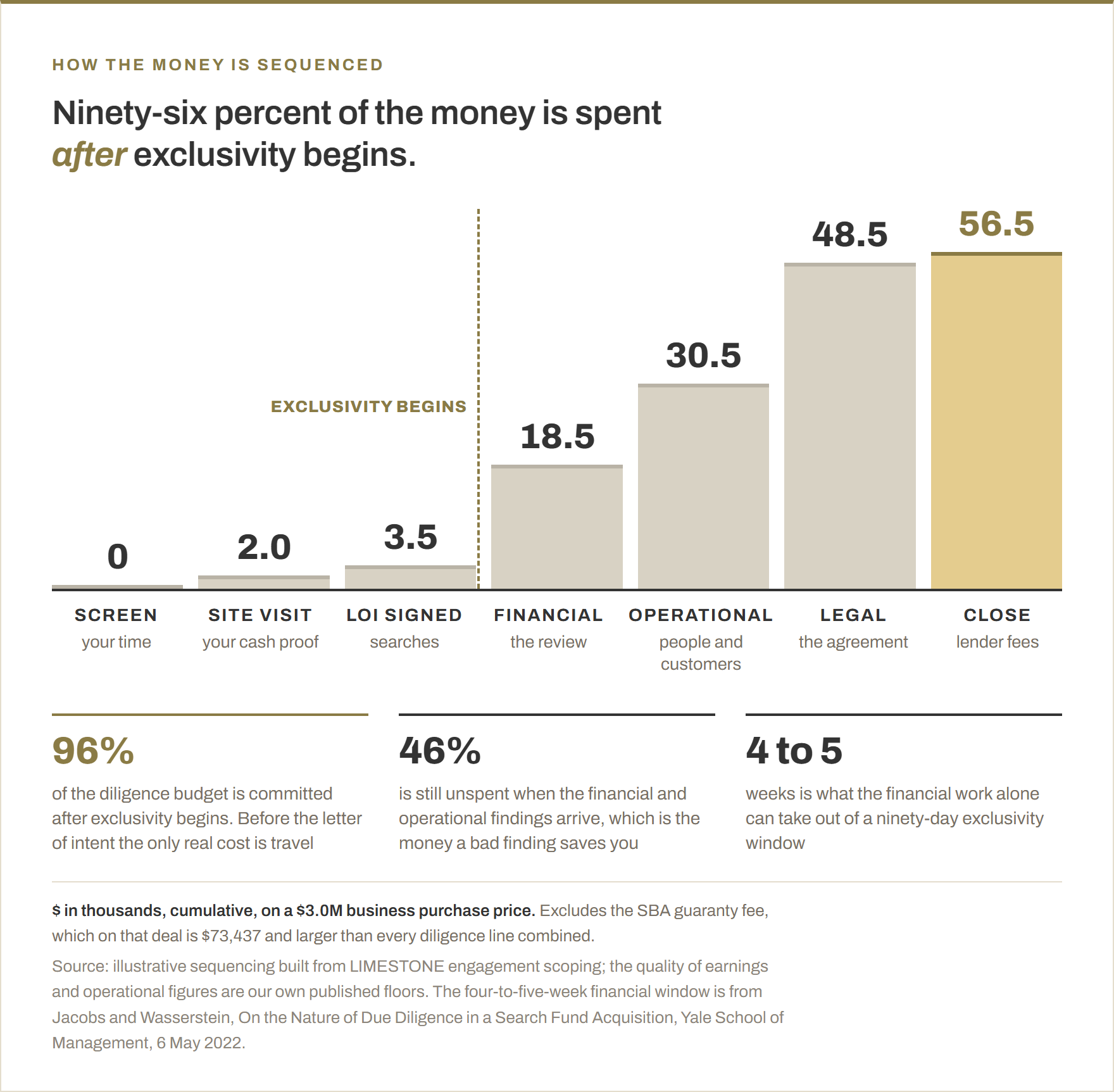
Exclusivity begins before the financial and operational work reports, so most of the budget is committed before the findings that would change your mind arrive.
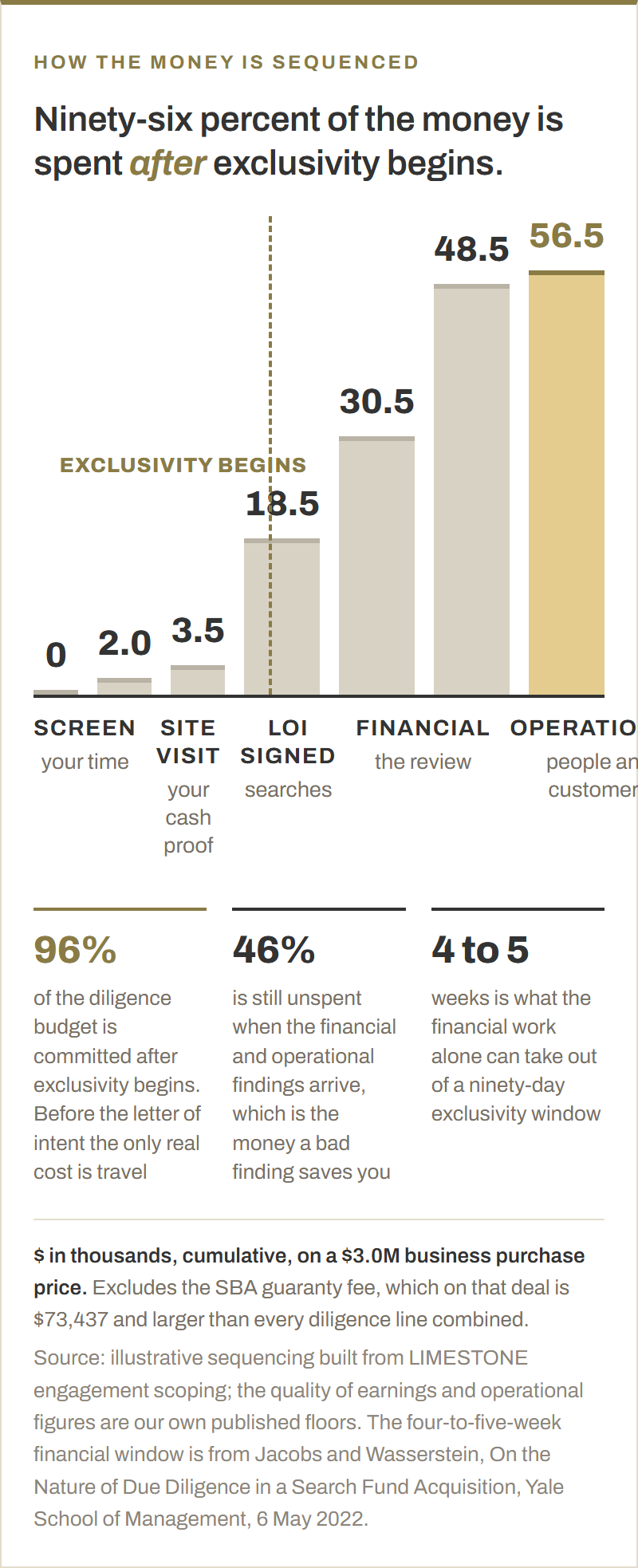
Exclusivity begins before the financial and operational work reports, so most of the budget is committed before the findings that would change your mind arrive.
What changed on 1 October 2026
SBA SOP 50 10 8.1, Appendix 15, requires the lender to obtain a quality of earnings on Initial Acquisition and Business Expansion deals at a business purchase price of $3 million or more, alongside the business valuation. The threshold is measured on the business purchase price with owner-occupied real estate removed at its appraised value, and it is measured independently of total project costs, the application of borrower equity, or the structuring of seller debt. Owner Buyout, ESOP and cooperative deals are exempt at any size, and since the 25 September update so is a deal built around an owner-occupied special purpose property. An employee of 24 months or more buying a single owner out now counts as an Owner Buyout; under 24 months, the Initial Acquisition standards apply, the quality of earnings included.
The report has to be independent and obtained for the lender’s benefit, and since 25 September the appendix says it “must not be prepared by or for the seller.” A report you commissioned can reach the file once one of the lender’s approved vendors has reviewed it, the route SBA first described, unprompted, on its lender training call of 26 August 2026:
“Say you have a buyer who engages their own independent QoE. We’re not prohibiting the lender from using that report. However, it has to be reviewed by one of their approved vendors and it can be incorporated into their report.”
On the same call SBA said “there’s some flexibility that we’ll be adding and clarifying in the tech update,” and the technical update of 25 September wrote the vendor review into the SOP. SBA’s notice announcing it also mentions a reliance letter, which the SOP text does not, so plan on the review. The question to put to your lender is whether it keeps an approved vendor list and will have one of those vendors review a report you already hold. That is one email, and the answer sets your budget weeks before you would learn it the hard way.
The defaults in the diligence literature were built for larger deals
A buyer paying $1 million to $5 million reads the same articles a private equity associate reads, and the defaults inside them were built for a different animal. Four bands, and almost none of the defaults carry across them.
| Enterprise value | How it gets financed | Structure | A working capital peg | Rep and warranty insurance |
|---|---|---|---|---|
| Under $1M | Seller note and cash, occasionally a small 7(a) | Asset purchase, almost always | Rare. Working capital passes with the assets and nobody measures it | No |
| $1M to $5M This is you | SBA 7(a), 10% down, a personal guarantee, a seller note on full standby | Asset purchase, occasionally stock | Sometimes, and usually computed rather than negotiated | No |
| $5M to $15M | Bank debt with a sponsor, or mezzanine behind it | Stock purchase common | Standard, negotiated, with a collar | Occasionally, above roughly $10M |
| $15M to $30M | Institutional debt, a credit committee, a rating | Stock purchase or a merger | Standard, with a true-up and an escrow | Routine |
Three things in the literature are worth ignoring at your size. Representation and warranty insurance is priced for deals ten times larger. Locked-box mechanics assume audited accounts you do not have. And above all the budgets: Yale’s illustrative diligence budget notes that legal transaction services alone “can be another cost of approximately $100,000 to $200,000 per deal,” which on a $3 million price is a third to two thirds of your whole equity injection.
Importing a default from a larger deal is among the most expensive mistakes available in this band, because those defaults assume a buyer who can walk away from a bad outcome without it following him home.
What this work cannot do
A quality of earnings is non-attest work. No opinion, no assurance, and no confirmations sent to anyone. The number of third-party confirmations in a quality of earnings is zero, and an audit sends them. Every procedure tests whether the records reconcile to cash. Most of what that finds is sloppiness, some of it is advocacy, and determined concealment is a third thing this work is not built to catch. An invoice billed to a friend of the owner moves real money, so the reconciliation agrees with itself.
There are also three deals that should not buy a full review, and we’ll say so before you pay for one. Under about $400K of adjusted earnings the fee stops being proportionate to the decision, and you are better off buying the screen and running the proof of cash yourself. Where a seller will not produce bank statements, the refusal has already answered the question. And on a deal you have decided to leave, a report documents the walk-away rather than changing it.
The guide, complete and ungated
The full method runs to 44 pages and there is no form in front of it. It carries the earnings ladder from the filed return upward, the three gates an add-back has to clear, the adjustments register with the three items that failed and the gate each one failed, the complete thirteen-question reference-call protocol, the four working capital peg methods against the month the peg sits on, the coverage arithmetic at every loan size and both amortizations, the five critical seats with who holds each, a one-page diligence plan to print and fill in, and a request list ordered by how long a seller takes to produce each item rather than by subject.
Download the printed edition, 44 pages, no email required.
How we help
We read one live deal at no charge, twice a month. Thirty minutes, on a deal under letter of intent, and you send the broker’s package, the add-back schedule and three years of returns. We’ll tell you what we’d test first and whether a review is worth buying at all. There’s no report and no follow-up sequence.
Beyond that the work is fixed-fee and quoted before it starts. A Red-Flag Screen is credited in full against a review. A light quality of earnings starts at $7,500 and runs ten to fifteen business days from complete data: proof of cash, the add-back register and the earnings ladder. The core review starts at $15,000 and adds working capital and the peg, revenue quality, concentration and the lender bridge. The full review starts at $25,000 and adds tax and related-party exposure, quality of net assets and the sensitivity set. Operational diligence is a separate engagement that runs alongside any scope: the five seats, relationship ownership, the six reference calls and the management interviews.
Two standards we publish and hold to. Reliance is a named, priced liability, so if your lender wants to rely on a report you commissioned, that extension is negotiated, documented and paid for, and on an SBA loan the SOP also requires a review by one of the lender’s approved vendors. And one firm should not write both the valuation and the review on the same deal.
How this was built, and where it stops
Every SBA rule on this page is quoted from SOP 50 10 8.1 or transcribed from the Office of Capital Access lender training of 26 August 2026, which we hold in full. The two-stage diligence frame, the ninety-day window, the four-to-five-week financial estimate and the confirmation-bias discipline are from Jacobs and Wasserstein, On the Nature of Due Diligence in a Search Fund Acquisition, Yale School of Management, 6 May 2022. Fee lines come from our own published sheet. The worked example, Hoosier Supply Co., is a fictional composite used across our published samples so that one set of figures can be tested in public; every name and figure attached to it is illustrative.
Three limits worth stating plainly. Nobody holds a return dataset on self-funded search the way Stanford holds one on traditional search funds, so any expected return quoted to you for this path is a number that does not exist. This page offers no legal advice, no tax advice and no recommendation about which lender to use. And the SBA material carries a date for a reason: SBA published a technical update on 25 September, and this page was updated on 27 September 2026 to match it.
Questions we hear
Is a quality of earnings actually necessary?
From 1 October it is not a judgment call on an Initial Acquisition or Business Expansion at a $3 million business purchase price or more, because the lender is required to obtain one, unless the deal is built around an owner-occupied special purpose property. Below that threshold it is a judgment call, and the honest answer depends on the size of the decision. Under about $400K of adjusted earnings the fee stops being proportionate and a screen plus your own proof of cash is a defensible position. Above it, the thing you’re buying is not a document. You are buying a number your lender will underwrite and you will personally guarantee.
How much diligence is enough to make a go or no-go decision on submitting a letter of intent?
Less than most buyers think, and it costs almost nothing. Before the letter of intent the work is a screen of the broker’s package against the tax returns, a site visit, and a proof of cash off twelve months of bank statements. That is where you find the gap between reported earnings and what actually landed in the bank. Everything expensive belongs after the seller signs, which is the whole reason the sequence is worth respecting: 96 percent of the budget is committed after exclusivity begins.
Does anyone have experience doing their own light quality of earnings?
Buyers do it, and on the smaller deals it is a reasonable call. The two procedures that carry most of the value are within reach of a numerate buyer: compare EBITDA to the net income on the tax return and explain the gap to the dollar, then reconstruct receipts from the bank statements and tie them to reported revenue. What a buyer usually can’t do alone is defend the add-back schedule to a credit committee, or find the cost that is real, paid, recorded and sitting in the wrong account. If your lender is required to obtain a report, doing your own analysis does not substitute for it, though an independent quality of earnings you commission can reach the file after the lender’s vendor reviews it, and doing the work yourself means you won’t be surprised by theirs.
What is the real risk of bad diligence and a poor quality of earnings report?
The expensive failure is a number that is right and untested. A schedule can foot, reconcile and still carry three add-backs that a lender will strike, and the consequence arrives as a smaller loan rather than a correction. A second failure is scope. A report that ties to cash to the penny tells you nothing about whether a cost was classified correctly, and a buyer who believes the tie covers classification has bought false comfort. Ask what was tested, what was not, and what the provider would say to a credit committee.
Would you pay for an AI-generated quality of earnings?
No, and we’ll say what we do use it for. We use it to collect documents, to summarize long files and to check our own arithmetic. The work itself is judgment: whether a cost is going to recur, whether the revenue travels to a new owner, and what a credit committee will accept when it is challenged. The judgment is the product, and it is what you are paying a person to put their name against. A report nobody will defend out loud is not worth what it costs to produce.