
A seller’s add-back schedule only ever moves the number up
Ryan Anoskey, CPA · 12 September 2026 · 10 min read
LIMESTONE Strategic Partners works up from the tax return, never down from the broker’s number, on every quality of earnings review it prepares for buyers of businesses earning $500K to $5M of EBITDA.
A seller’s add-back schedule only moves the number up, so we test it from the tax return upward: return to books, books to bank, then each add-back through three gates. On the worked example three of eight add-backs failed, worth $139.0K of earnings and about $556K of price at four times. Proof of cash catches what the ledger cannot, and it is in every review we run.
A seller’s add-back schedule only ever moves the number up. On the worked example in the field guide, three of eight add-backs did not clear. They were worth $139.0K of earnings, and at four times that is $556K of purchase price resting on costs that do not go away.
A sell-side schedule is an advocacy document. Rebuilding it is most of what the financial work actually is, and the gate a line fails tells you something about the seller as well as about the cost.
The three gates an add-back has to clear
Every line on the schedule has to clear all three before it goes back on. One gate is about the cost, one is about the evidence, and one is about whether anybody will defend it out loud.
Gate one, is it real?
There is a legitimate reason the cost is not a go-forward operating expense: non-recurring, personal, related-party, or a normalization to market or to accrual. The owner’s word is not a reason. Two examples make the line clear. The bracelet an owner bought his wife comes back to earnings. The gold watch every tenured retiree receives stays in them, because that cost runs to the people who are staying and you will be paying it too.
Gate two, is it provable?
The amount ties to a source. The ledger, the return, a bank statement, an invoice or the payroll register. A round figure for personal spending stays off the schedule until it is itemized, and “about thirty thousand” is not an itemization.
Gate three, is it defensible?
We would explain it out loud, with the support in hand, to a skeptical credit committee. If either of us would hedge, it does not clear. Gate three does more work than it looks like it does, because from 1 October the lender must use the tested earnings in the coverage determination, so an add-back nobody will defend is a smaller loan rather than an argument.
Two rules that sit over the whole schedule
Costs travel with the revenue they produced. An expense cannot leave the model while the revenue it generated stays in it. A seller who strikes the cost of the salesperson who won the account has to strike the account too, and almost nobody offers to.
Infrequent is not one-time. A machine rebuild every five years belongs in the earnings stream if the buyer will face it. It gets spread across the cycle and the basis is stated, rather than removed because it did not happen last year.
The register, as it was tested
Showing the items that failed is what makes the ones that passed believable. Every line the seller put forward is below, with the gate it failed.
| Item | What it rests on | $ in thousands | Result |
|---|---|---|---|
| Excess owner compensation | A W-2 of 520.0 against a market general manager benchmark near 270.0 | 250.0 | Taken |
| Related-party rent to market | Warehouse leased from the owner at 360.0 against a market rate near 270.0 | 90.0 | Taken |
| Personal and discretionary expenses | Itemized: vehicle leases 33.0, travel and meals 9.0, club dues 18.0, insurance 10.0 | 70.0 | Taken |
| Payroll taxes on the excess compensation | Employer payroll taxes attaching to the excess above. They travel with it | 3.6 | Taken |
| One-time legal settlement | Supplier dispute settled September 2024, so 95.0 sits outside the measurement window | nil | Taken |
| Accepted, trailing twelve months | 413.6 | ||
| Rebrand and website, claimed one-time | 85.0 claimed in FY2025. Brand spend recurs on a refresh cycle. Fails gate one | (85.0) | Declined |
| Estimated personal expenses | A round number with no ledger tie. Fails gate two | (30.0) | Declined |
| Marketing program, claimed one-time | Lead generation recurs at 2 to 4 percent of revenue every year. Fails gate one | (24.0) | Declined |
| Adjusted EBITDA, trailing twelve months | Reported EBITDA of 833.5 plus the accepted items | 1,247.1 |
Hoosier Supply Co. (illustrative), a fictional composite used across our published samples. $ in thousands. Accepted items are the trailing twelve months to 30 June 2026; each declined item is shown at the amount claimed in the period it was claimed, which is how the three total 139.0.
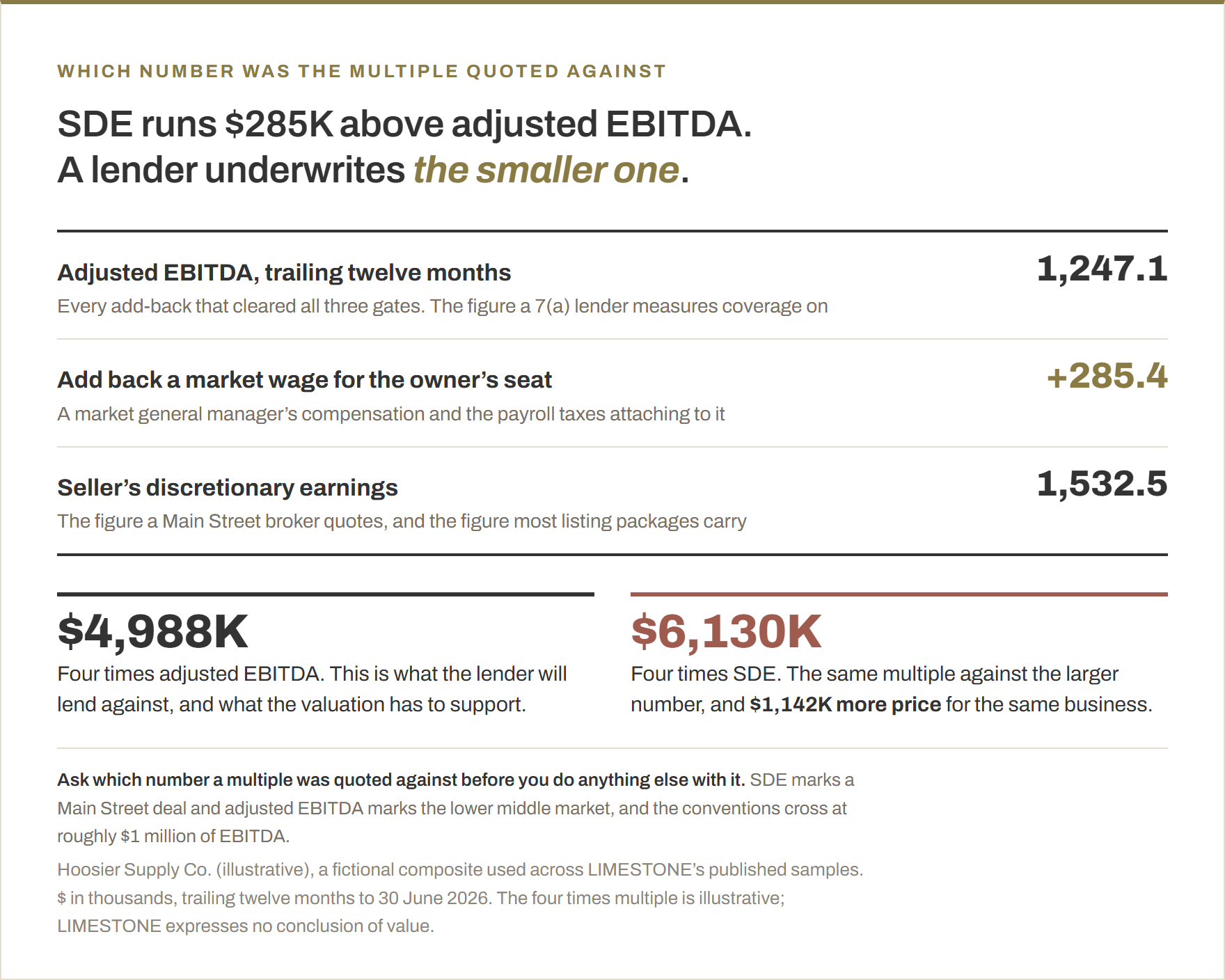
The same four times multiple against SDE rather than adjusted EBITDA is $1,142K more price for the same business.
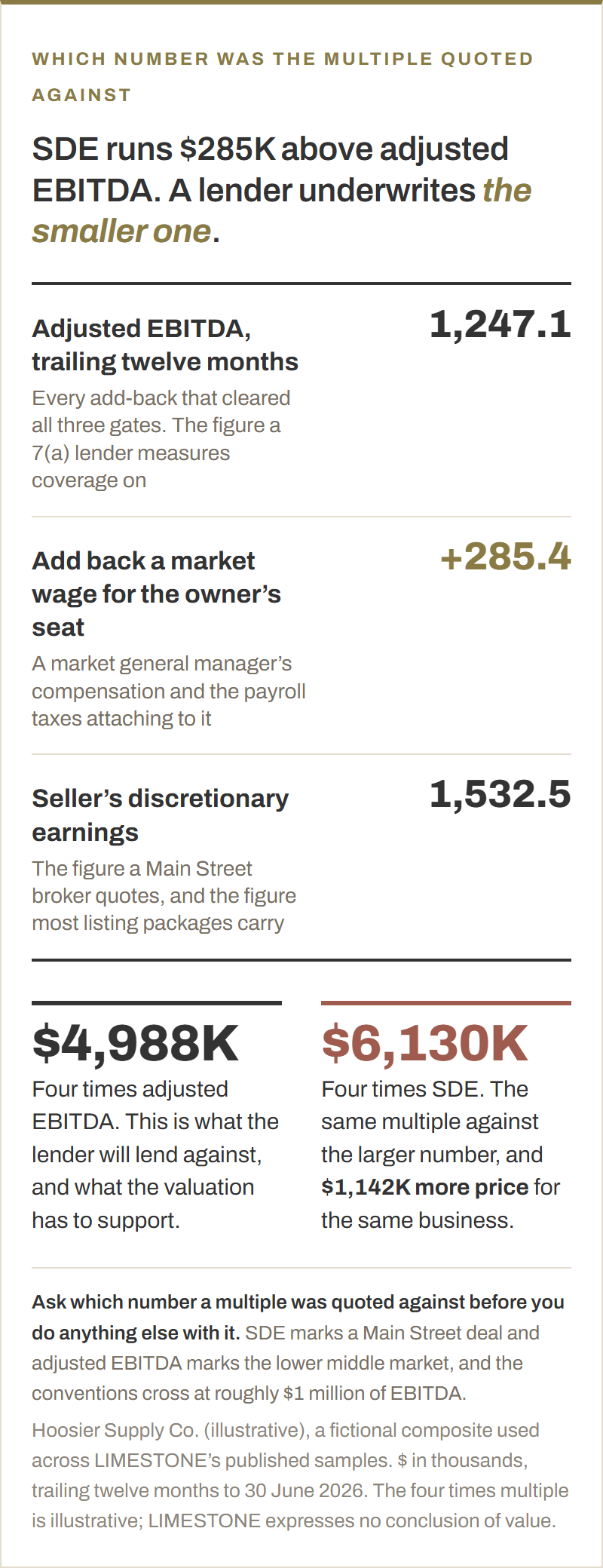
The same four times multiple against SDE rather than adjusted EBITDA is $1,142K more price for the same business.
Read the declined column rather than the accepted one. Two of those three failed gate one, which is the gate about whether the cost is genuinely not a go-forward expense, and both were described as one-time while recurring in all three years under the same description. It is the most common pattern at this size, and the cheapest one to find.
Work up from the return, not down from the broker’s number
The tax return is the one figure in the file that carries a signature and a penalty behind it. So the ladder starts there and climbs, each rung naming the document that proves it, because a rung without a document is one you have agreed to accept on somebody’s word.
| Rung | The document that proves it | FY2025 ($000) |
|---|---|---|
| Ordinary business income per the federal return | Form 1120-S, line 21, agreed to the IRS Record of Account transcript | 416.5 |
| Depreciation in excess of book | Section 179 and bonus, Schedule M-1 | 80.0 |
| Meals at fifty percent, penalties, officer life | Schedule M-1, each line recomputed | (12.0) |
| Net income per books | Ties to the internal profit and loss statement | 484.5 |
| Interest expense | General ledger, agreed to the loan statements | 50.0 |
| Depreciation | General ledger and the fixed-asset register | 162.0 |
| EBITDA as reported | Recomputed, not taken from the broker’s package | 696.5 |
| Tested add-backs | The add-back register above, FY2025 portion | 413.6 |
| Adjusted EBITDA, FY2025 | The number a lender underwrites | 1,110.1 |
Hoosier Supply Co. (illustrative), fiscal year 2025. The trailing-twelve figures in the register above run higher, at 833.5 reported and 1,247.1 adjusted; the ladder is set on a filed year because that is where the signature is.
The cheapest test in financial diligence
Yale puts it in one line. Compare EBITDA to the net income on the tax return. Here the gap between book net income of 484.5 and reported EBITDA of 696.5 is 212.0, and it is interest of 50.0 plus depreciation of 162.0. It reconciles to the dollar. Where a gap that size cannot be explained in two lines, stop and start asking.
Proof of cash, and what it structurally cannot catch
A proof of cash reconstructs receipts and disbursements from the bank statements and ties them to the income statement and the return. SBA now requires one on every mandated report and it is the procedure a buyer should never let a provider scope out of an engagement, because it is the only one that goes looking for money rather than reading about it. On this business the variance across two fiscal years and a trailing twelve came in at 0.05 percent against a one percent tolerance.
What it catches: deposits that do not reconcile to reported revenue, income that was never operating revenue at all, expenses in the ledger that never left the bank, and payments out of the bank that never reached the ledger. A cash-basis book never converted to accrual shows up here.
What it structurally cannot: an invoice billed to a friend of the owner, because the money moved and the reconciliation agrees with itself. Yale calls those invoices that “may exist only to amplify revenue and earnings as part of a window-dressing scheme.” Nor can it catch an expense that is real, paid, recorded and sitting in the wrong account, which is why bad debt reserves are the usual hiding place: under-reserving overstates earnings and leaves no cash trail at all.
Which is worth saying plainly, because a tie at 0.05 percent tells you nothing at all about how a cost was classified. Two different tests. Buy both.
SDE against adjusted EBITDA, and where the line sits
Seller’s discretionary earnings adds back a market wage for the seat the owner occupies, on the reasoning that the buyer will occupy it himself. Adjusted EBITDA leaves the wage in, because somebody has to do the job. Both are defensible. A buyer handed a multiple against one who models it against the other misprices the business badly.
On this business adjusted EBITDA is 1,247.1 and SDE is 1,532.5, a difference of 285.4. At four times, that is $4,988K against $6,130K. The same multiple against the larger number is $1,142K more price for the same company, and the lender lends against the smaller one.
SDE marks a Main Street deal and adjusted EBITDA marks the lower middle market, and the conventions cross at roughly $1 million of EBITDA. Below that line a buyer usually replaces the owner in the job, and above it he usually hires somebody to do it, which is the whole reason the wage stays in the model on one side of the line and comes out on the other. Ask which number a multiple was quoted against before you do anything else with it.
How this was built, and where it stops
The three gates and the two rules are our own test, applied on every engagement. The EBITDA-to-net-income comparison and the window-dressing quotation are from Jacobs and Wasserstein, On the Nature of Due Diligence in a Search Fund Acquisition, Yale School of Management, 6 May 2022. The cash proof requirement and the coverage determination are SBA SOP 50 10 8.1, Appendix 15. Every figure on this page was recomputed from first principles and reproduces exactly; Hoosier Supply Co. is a fictional composite used across our published samples so that one set of numbers can be tested in public, and we express no conclusion of value.
One limit worth stating. This page is about whether the earnings are accurate. Whether they are transferable is a different question with different procedures and no overlap, and a business can be thoroughly profitable and only lightly transferable.
Questions we hear
Do you add back the owner’s draw when calculating SDE?
Not as a draw, no. A distribution is not an expense, so it never reduced earnings and there is nothing to add back. What you add back is the compensation that ran through payroll for the seat the owner occupies, and only the portion above a market wage for that seat. If an owner takes $520K on a W-2 where a general manager would cost $270K, the add-back is the $250K of excess, plus the employer payroll taxes attaching to it. Get this one wrong in the other direction and you have counted the same money twice.
Do owner drawings shown in retained earnings count toward SDE?
No, and the place they appear is the clue. Retained earnings is a balance sheet account. SDE is an earnings measure built off the income statement, so a movement in equity has no path into it. If you find drawings sitting in an expense account rather than in equity, that is a bookkeeping finding rather than an add-back, and it is worth asking what else has been posted the same way.
Are SDE and EBITDA the same thing?
No, and the gap is usually a market wage for one seat. EBITDA is earnings before interest, tax, depreciation and amortization, with the owner’s compensation still in it. SDE adds that compensation back on the reasoning that a single owner-operator will replace it with his own labor, so on our worked example the gap between the two measures is $285.4K, which at a four times multiple is $1,142K of purchase price for exactly the same company. The conventions cross at roughly $1 million of EBITDA, and a lender on an SBA deal underwrites the smaller figure.
Which taxes do you add back?
Income taxes come out because EBITDA is defined before them, and on an S corporation they were the owner’s liability rather than the company’s anyway. Payroll taxes do not come out, with one exception. The employer payroll tax attaching to an owner-compensation add-back travels with that add-back, because it would not exist at a market wage. Property tax, sales tax and excise tax stay in. They are operating costs and they will arrive on your desk in your first month.
Can bad debt be an add-back?
Rarely, and a claim that it should be is worth testing rather than accepting. Bad debt on a business that sells on terms is an operating cost of selling on terms, and it recurs. A specific, identified, non-recurring write-off of one account that failed for a reason the business will not meet again can clear gate one, and it needs the invoice, the collection file and the reason. What we look at first is the reserve rather than the write-off, because under-reserving overstates earnings and leaves no cash trail, which makes it invisible to a proof of cash.
Is six figures of add-backs against about $200K of net income an SBA problem even if the seller is trustworthy?
The coverage floor answers it, whatever you think of the seller. An adjustment the lender cannot support with its own analysis is ineligible for the coverage test, and at a business purchase price of $3 million or more the lender must use the earnings from the quality of earnings in that test. Where coverage will not support the structure, the loan comes down or you put in more equity to meet the minimum. So each add-back has to clear all three gates in front of a credit committee, and the ones that do not clear come out of the loan. On a business that size the add-backs are most of the earnings, so the review decides the deal.