
RIA Enterprise Valuation: What Drives It
Jared Luegers, CFA · 25 March 2025 · 11 min read
The average RIA multiple rose from about four times EBITDA in 2005 to nearly ten times last year. What a buyer actually pays for is organic growth, an operating margin in the 25 to 35 percent band, client age, niche expertise and team depth. Size decides which kind of buyer you attract.
Setting the Stage: Valuation in Today’s RIA Landscape
Valuation in the Registered Investment Advisor (RIA) space is subjective, just like in any other industry. It comes down to what the market of individual buyers is willing to pay and what the seller is willing to accept at any given point in time. What one acquirer finds critical might not matter to another. When you sell your RIA, offers will differ based on the buyer’s goals and their internal corporate development guidelines for what they’re willing to pay. Experienced buyers often assess 20-30 factors, relying on disciplined, institutionalized criteria if they’ve been in the game awhile. Still, certain value drivers consistently emerge for firms securing strong valuations and top-tier deals.
We’ve come a long way in this industry. For over 50 years, RIAs operated as an artisanal cottage industry, but the last decade has brought significant institutionalization, professionalization, and centralization, not consolidation. Strong U.S. equity markets deserve a shout-out for driving much of the strong performance of the RIA space, drawing in investor groups. Just ten years ago, firms with $2-5 billion in AUM were big players. Now they’re tuck-ins for massive aggregators like Corient or Creative Planning, a clear sign of how large these buyers have grown. Valuations have swelled over this period, fueled by robust asset markets boosting AUM, low interest rates easing M&A financing, and new investors eyeing consolidation opportunities. The average RIA multiple has jumped from 4x EBITDA in 2005 to 6x by 2015 to nearly 10x EBITDA as of last year, per industry data, raising the question: where do we go from here?
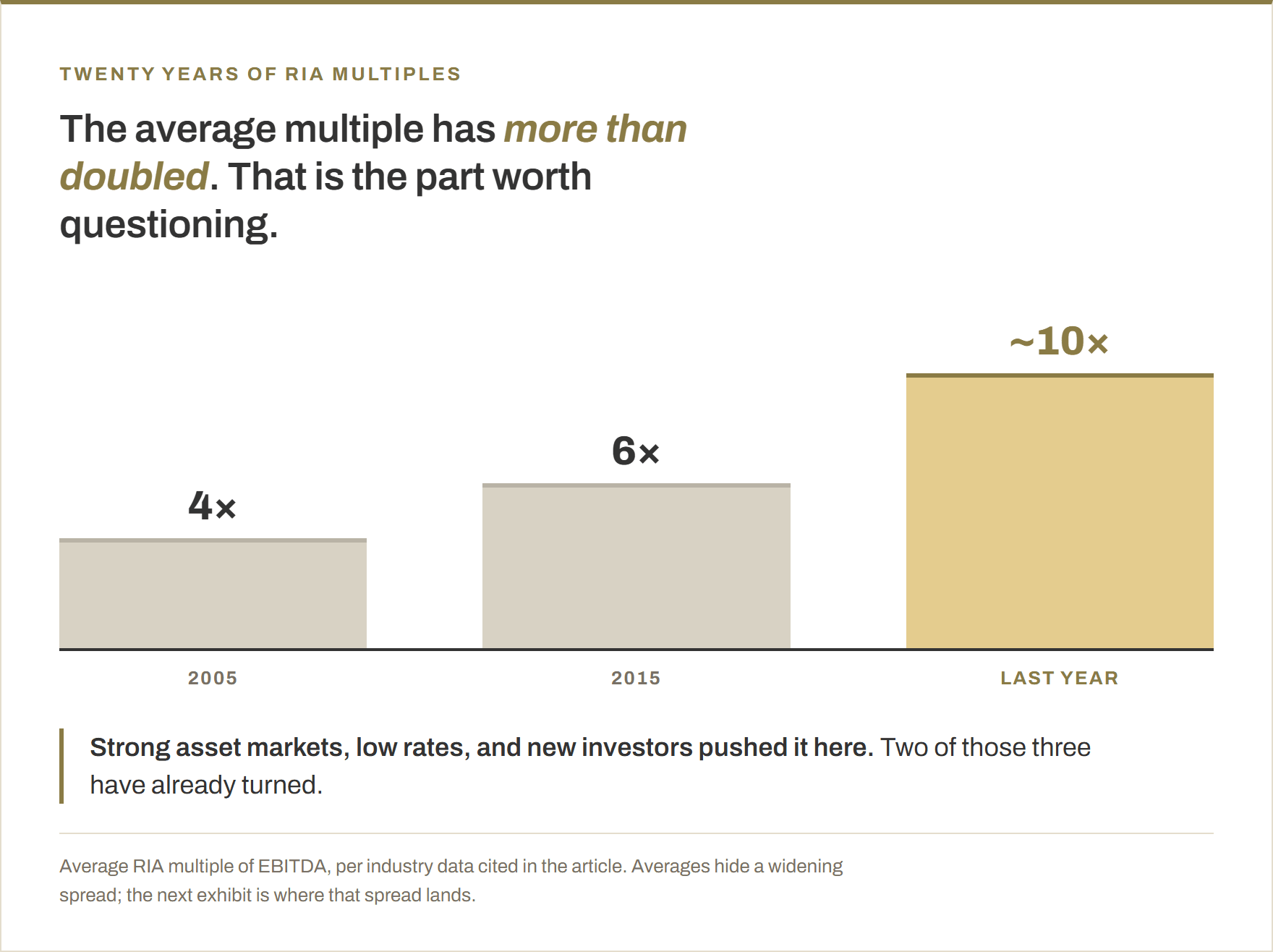
This is the number owners quote to each other at conferences. Very few firms actually transact at the average.
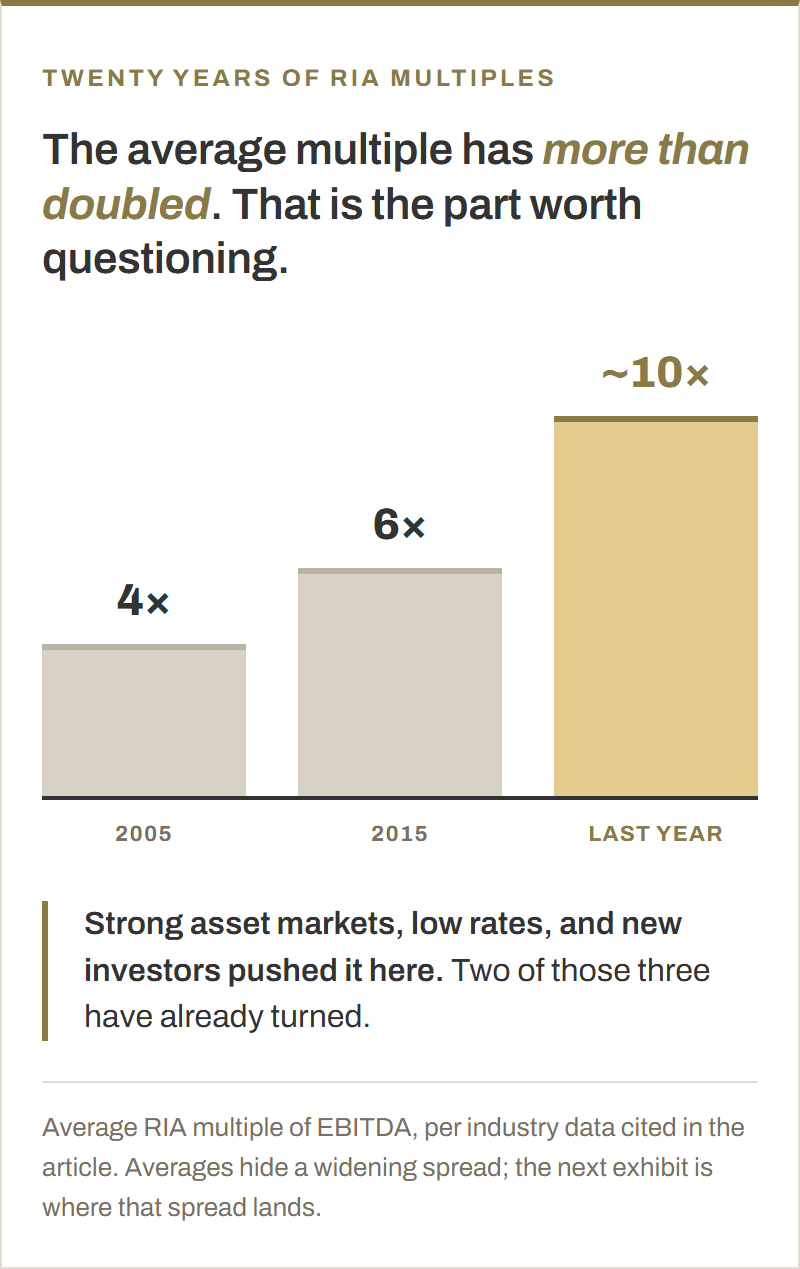
This is the number owners quote to each other at conferences. Very few firms actually transact at the average.
I believe valuations have tapped out and will adjust lower from here, except for a select group of firms. In my opinion, we’ve entered a new, longer-term bearish interest rate environment, and it’s still early days. I’m not saying rates will skyrocket, but I think the days of much lower rates are behind us. They might ease when the next recession hits (whenever that may be), but global shifts, like geopolitics, inflationary pressures, and massive debt, not just in the U.S. but worldwide, are ushering in a new paradigm for investors. The rooster is finally coming home to roost. DOGE can try, but cutting spending enough to tame deficits feels like a pipe dream after letting it run too long. I don’t think markets are fully pricing in this cycle, and it’s going to impact RIA valuations, along with business valuations broadly. This assumes we don’t see a significant drop-off in asset markets; that’s a topic for another article.... That said, I caveat this with my belief that the RIA market will keep growing, taking share from other channels, expanding service offerings, and ultimately creating additional economic value. Investors and aggregators aren’t likely to exit, so valuations should stay stronger than pre-2015 levels.
To grasp where this is headed and what drives value today, we’ll view RIAs through two lenses: tuck-ins, like those targeted by firms like Corient or Creative Planning, and platforms, like those pursued by private equity firms like Bain Capital and TPG. Whether you’re selling, staying independent, or planning succession, these insights matter. You should always be thinking about what builds strong enterprise value for your firm.
The Future of RIA Valuations: A Shifting Horizon
Looking ahead, I see valuations in the RIA space growing much more sporadic across the spectrum. I don’t expect a significant drop-off, but buyers are becoming increasingly selective and starting to offer less guaranteed in overall deal packages. They’re not just scooping up assets to scoop up assets anymore. That math doesn’t pencil as easily with higher debt costs. Once aggregators dominate a geographic area, why buy the small tuck-in across the street when they can win those clients organically?
Still, enterprise platform RIAs, those $2-25 billion firms with strong infrastructure and growth potential, will maintain continued top-of-market strong valuations. Private equity and other capital sources are willing to pay premiums for a “buy and build” platform firm that can deliver on both organic and inorganic growth; these are the crown jewels for investment.
The picture changes across the size spectrum. The cohort of sub-$1 billion RIAs will see valuation pressures unless they have all the key characteristics buyers are looking for, which frankly most don’t have. Small RIAs get bought for assets at lower multiples, though still above historical norms. On the other end, mega-aggregator RIAs at $250 billion+ that have gotten eye-popping multiples of 20x+ will find organic growth harder and harder to come by with the law of large numbers. I expect we’re approaching the time where we start to see breakaway advisors from these firms as the economics no longer incentivize the next generation to stay. These firms are becoming so big that the only way for their PE backers to realize their investments is to take them public, and the public market isn’t giving the same valuations as the private space.
I envision valuations resembling a standard distribution. I’ll caveat this by noting it’s a broad generalization; there will be exceptions based on unique offerings or strategies. Here’s how I see it playing out. Growing $2-25 billion platforms secure the best deals. The $250 billion+ giants struggle to grow, settling into public market multiples as going public becomes their endgame. Small firms face the asset-deal squeeze. That’s why I’m a fan of strategic minority investor groups like Rise Growth Partners, Elevation Point, and Constellation Wealth Capital. They’re investing in that mid-tier sweet spot I believe will remain hot and see the most growth, whether organic or inorganic. What follows explores what’s driving enterprise value today for both tuck-ins and platforms, while connecting it to where I see valuations heading based on these trends.
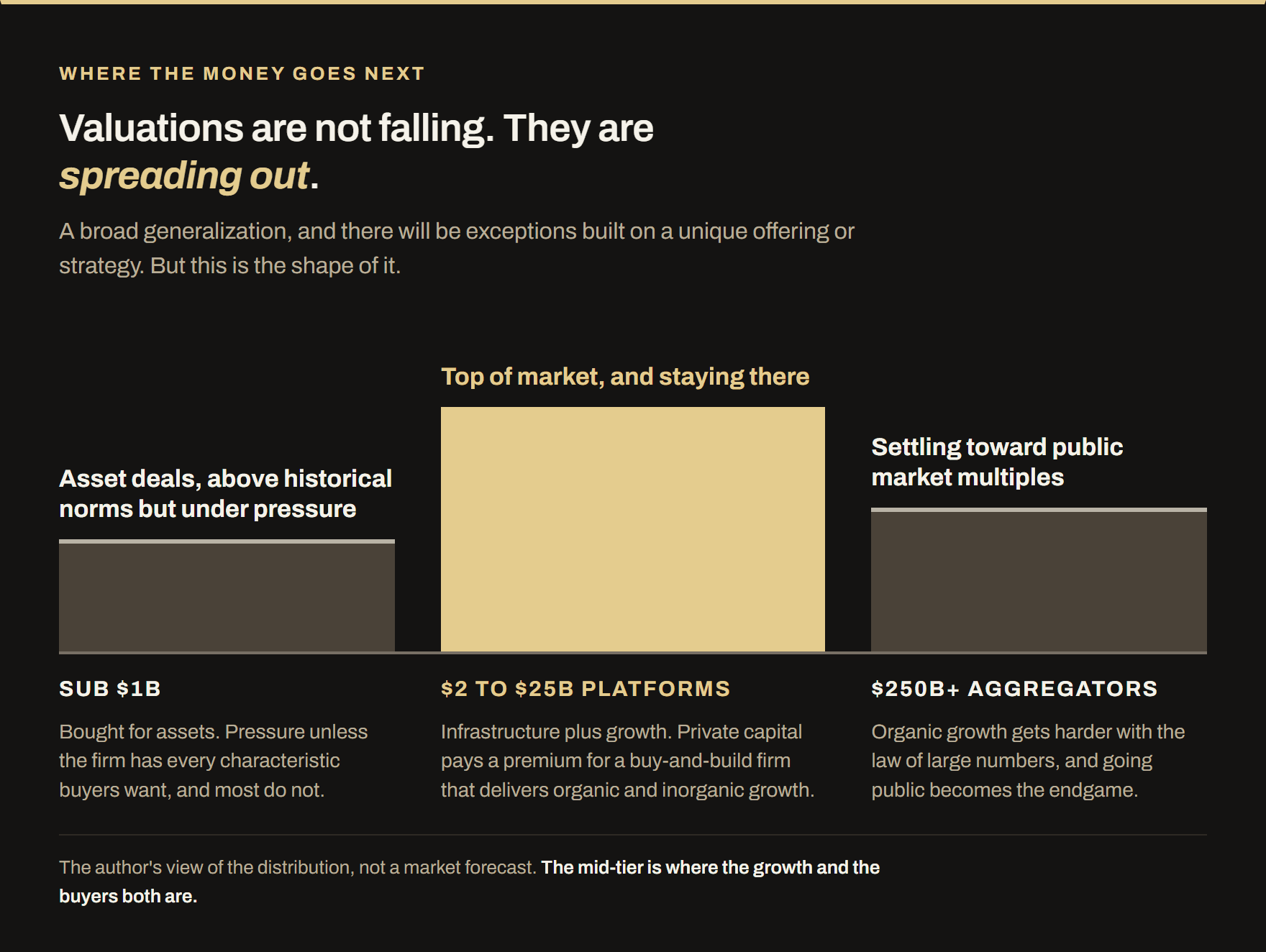
Valuations are not falling across the board. They are spreading out, and the mid-tier is where they hold.
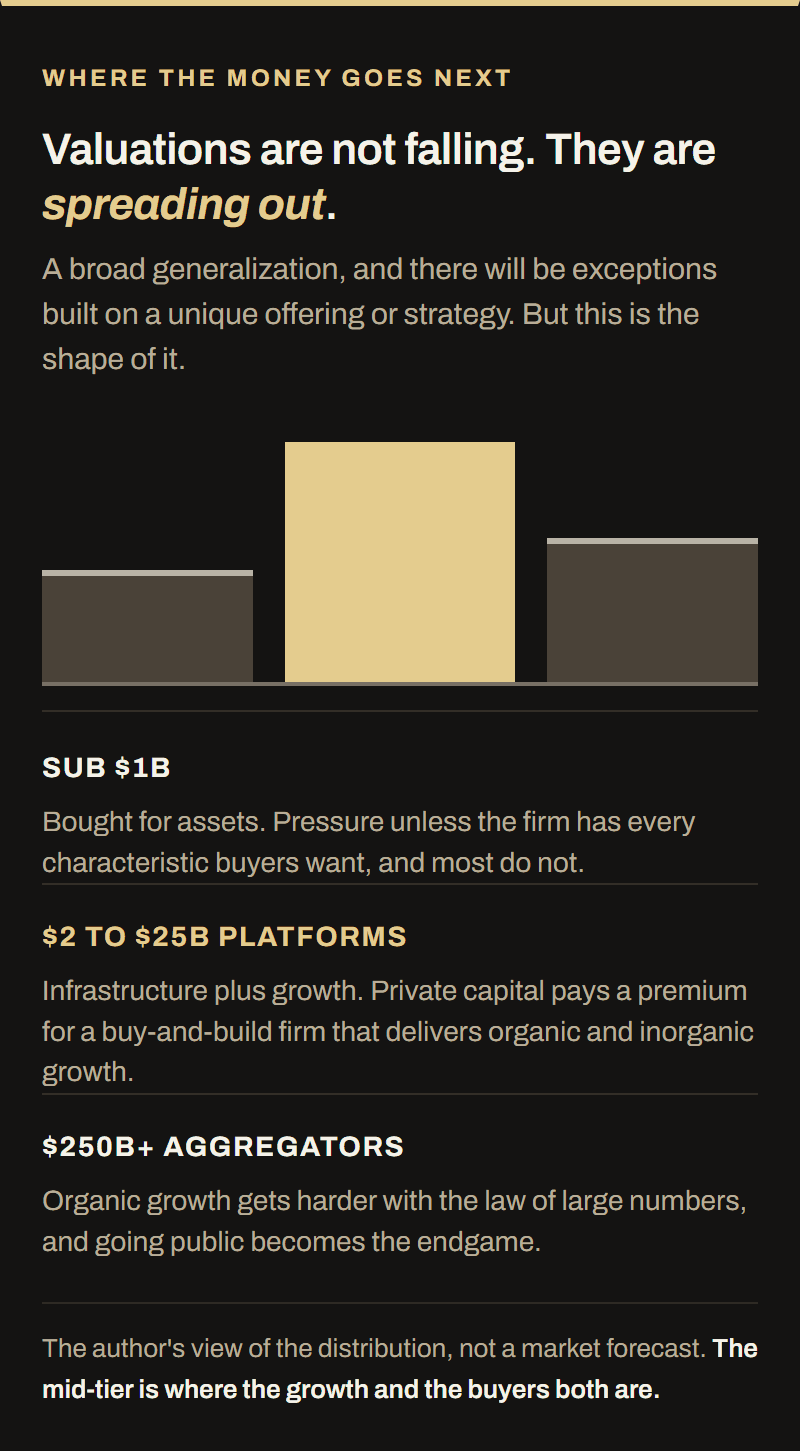
Valuations are not falling across the board. They are spreading out, and the mid-tier is where they hold.
What Drives Enterprise Valuation: Tuck-Ins and Platforms
Here’s where we break down the nuts and bolts of what will continue to drive stronger valuations. For tuck-in firms (smaller firms integrated into larger RIAs) and platform firms (larger firms PE and other forms of private capital backs to scale), some drivers overlap, while others diverge. Even if you’re not selling or taking capital, these factors shape your firm’s worth, crucial for succession or equity offers to keep talent. You want a fair price if you’re handing off equity, right? Let’s start with what applies across the board, then zoom into each type.
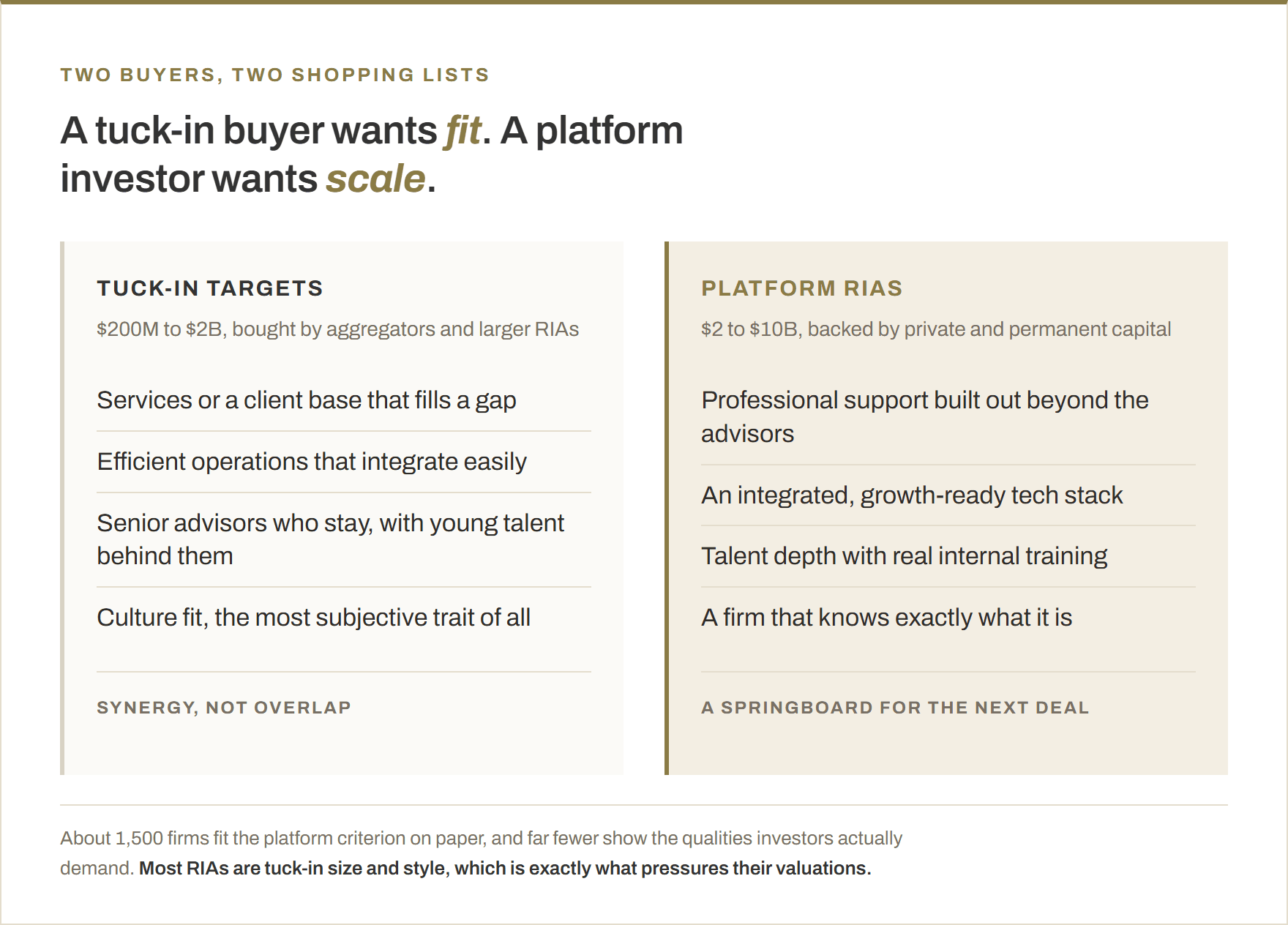
Know which list your firm is on before you decide what to fix.
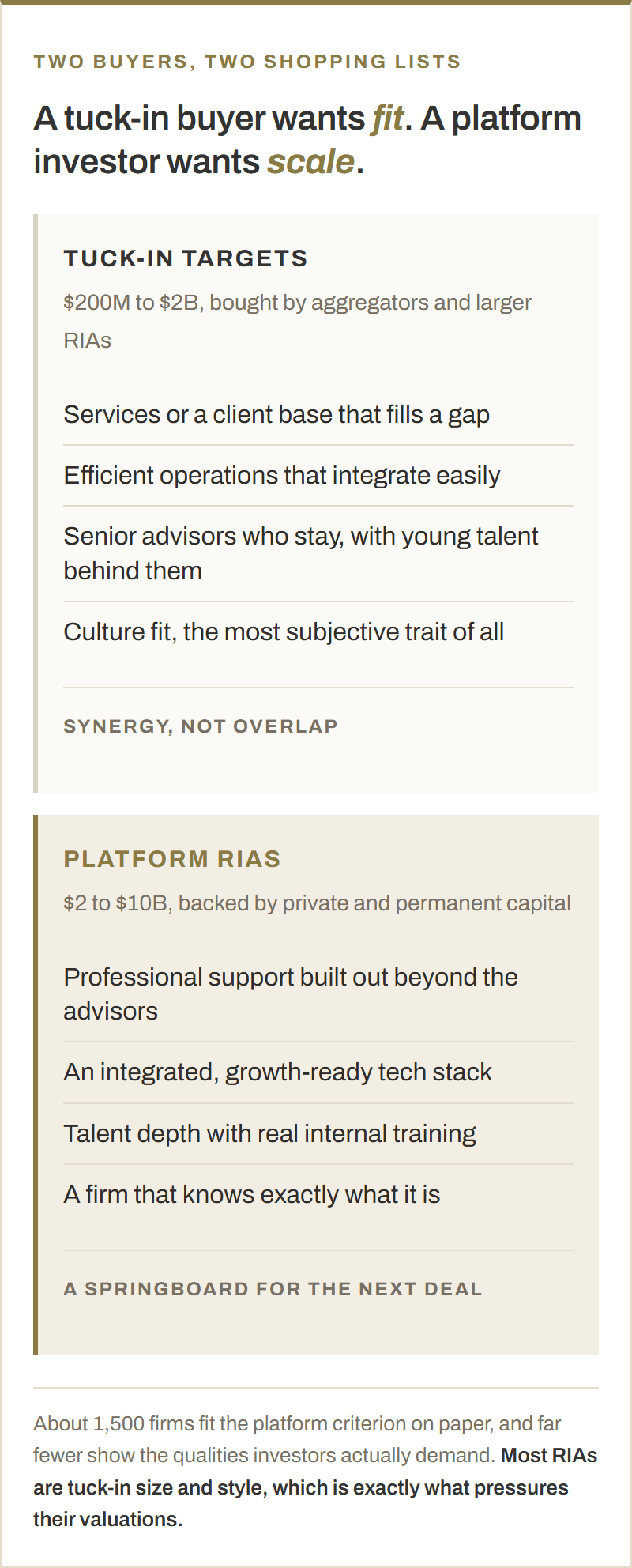
Know which list your firm is on before you decide what to fix.
Common Characteristics Driving Enterprise Value
Certain traits boost an RIA’s value no matter who’s in the buyer or investor seat. These reflect a firm’s health, growth potential, and staying power.
- Organic Growth: Bringing in clients organically is a cornerstone of value. Firms with positive net asset flows and high retention rates prove sustainable revenue. Strong asset markets have masked true organic growth in this industry for the last 15 years, but given current market valuations, it’s hard to see that continuing much longer. Prudent buyers and investors view market returns as icing on the cake, not the cake itself. It’s too risky to rely on, especially with debt in the mix.
- Strong Profit Margins But Not Too Strong: Profitability shows efficiency, but extremes raise concerns. Margins too high might signal underinvestment in growth, while too low suggests inefficiency or undercharging (which isn’t the easiest to correct). Typically, operating margins between 25% and 35% signal a good business, with the caveat that more practice-based firms are likely higher. Buyers favor firms balancing today’s profits with investing in tomorrow’s potential.
- Younger Client Base: A roster heavy on younger, wealth-building clients outshines one full of retirees cashing out. It reduces risk and fuels future growth, a win for buyers and successors alike.
- Specialized Services or Offerings: Firms with unique angles, like niche expertise or proprietary strategies, stand out. They’ve built specialized knowledge or offerings that the marketplace values. That loyalty can drive valuations higher.
- Multi-Generational Advisor Structure: A team spanning generations, with equity or profit-sharing for younger advisors, ensures continuity. Spreading equity fosters accountability and secures succession. Experts see this as a forward-thinking move that boosts stability and appeal.
- Top Talent and Leadership: Top talent ranks alongside organic growth as a prized attribute for acquisition targets. With a shortage of advisory talent, most buyers aim to acquire it rather than develop it in-house right now. A strong leadership team reduces founder reliance and eases transitions. Fidelity’s 2023 study notes 90% of buyers prioritize talent, making it the top M&A driver.
- Strong Brand and Culture: A great reputation and tight culture retain clients and staff. It’s lower risk and amplifies presence, catching buyers’ attention. A strong brand means you’re known for something (hopefully positive), and that distinction is what buyers and investors seek.
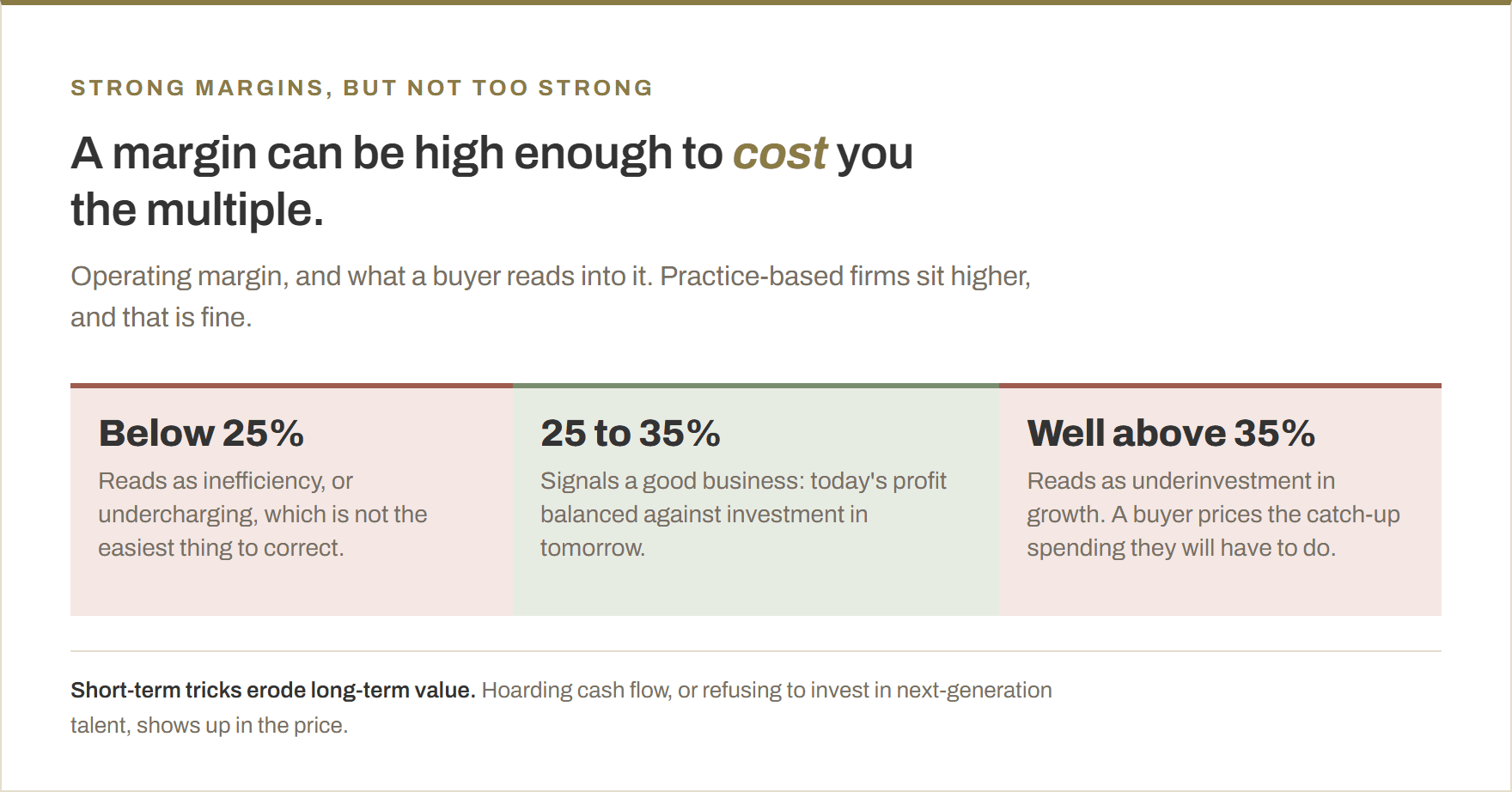
The instinct before a sale is to cut costs and show a higher margin. Past a point that instinct works against the price.
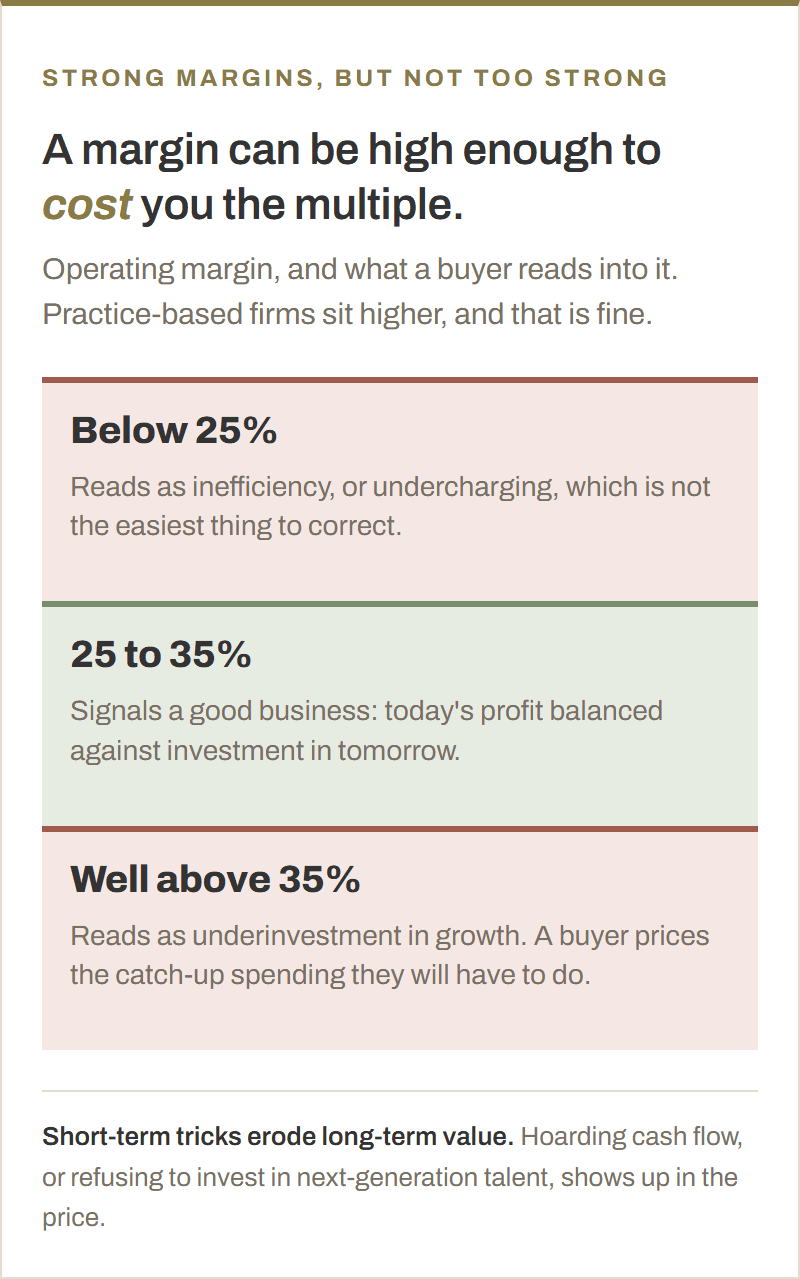
The instinct before a sale is to cut costs and show a higher margin. Past a point that instinct works against the price.
Characteristics Valued in Tuck-In Targets
Tuck-ins are smaller RIAs, typically in the $200 million to $2 billion AUM range, acquired by aggregators and larger RIAs to fit into their operations. Here’s what these buyers primarily seek, since they don’t need firms with strong platform qualities.
- Complementary Services or Client Base: Tuck-ins that fill gaps, like a new region or niche, are top choices. It’s about synergy rather than overlap, expanding the acquirer’s reach and expertise.
- Efficient Operations: Low overhead and streamlined processes ease integration. Buyers aim to minimize effort in blending non-advisor talent into their firm, avoiding acquisition-related layoffs, which are never pleasant. They want smooth transitions.
- Strong Advisor Talent: Skilled senior advisors who stay post-sale, backed by a stable of young, up-and-coming talent to take over client relationships, are key. For aggregators, this often trumps organic growth, as they believe their platform can equip top talent with resources to drive growth.
- Culture Fit: This is the most subjective trait, varying by acquirer, but they target firms sharing their mindset and philosophy, whether in work style or client service. An acquiring firm sees risk, for instance, if they focus on holistic planning while the target only handles portfolio management. They’ll still buy, but they need assurance the team will adapt to their service model.
Most RIAs fall into this tuck-in size and style, making them common rather than unique. Going forward, this will pressure their valuations. I believe this group must be more strategic than ever in presenting what buyers want to maximize value if they’re considering an external sale.
Characteristics Valued in Platform RIAs
Platforms, typically $2-10 billion firms at the time of being initially pursued by private equity and permanent capital types, are built for growth. Buyers prioritize scale and scalability. They seek firms that provide a foundation for acquisitions and ideally fuel organic growth too. This is the “buy and build” strategy, often the start of a “roll-up” story. About 1,500 firms fit this criterion on paper, but far fewer exhibit the platform qualities investors demand. Here are the core traits they target.
- Scale and Growth Potential: Firms with more than just a strong advisory team (ones that have built a platform with professional support in areas like technology, compliance, marketing, and training) are key. These serve as a foundation and springboard for more acquisitions, creating a standardized business as new firms join. We’re seeing less of aggregators buying firms and letting teams operate however they want.
- Scalable Technology and Operations: A fully integrated, growth-ready tech stack drives efficient operations. It includes departments that take on tasks the legacy model left to advisors wearing multiple hats, freeing them to focus on serving clients well and winning new business. These firms often surround their clients with teams of specialists so everyone can focus on what they do best for the firm’s clients.
- Talent Depth With Internal Training Programs: A deep bench with training signals longevity. Investors seek firms that double as breeding grounds for the next generation of advisor talent, supporting organic growth and attracting the best in the field.
- Firms That Know What They Are: Focused firms stand out. Investors back platforms with a clear, successful strategy and target market. They want an executive team with a proactive game plan to build the business, not just reacting to client referrals as they roll in.
Platforms command premium valuations and will for the foreseeable future in this AUM range. They’re the breeding ground for investors to achieve strong ROIs. I don’t see the industry consolidating into 10 mega-firms. It’ll more likely mirror the accounting industry, with a few giants but a significant number of strong regional and niche-focused firms in the $5 billion to $100 billion AUM range, in my view.
Why This Matters Whether You’re Looking to Sell, Take Investor Capital, or Not
Not planning to sell or take investor capital? These drivers still shape your firm’s future, especially for succession, talent, or simply staying strong. Whether you’re eyeing an exit, seeking growth funding, or running your RIA solo, understanding what builds enterprise value keeps you in control.
- Internal Succession Planning: A clear valuation ensures fair equity handoffs. It avoids disputes and aligns the next generation with your vision, whether you’re passing the baton or not.
- Attracting and Retaining Talent: Equity linked to firm growth motivates advisors to stay and contribute. A multi-generational setup with fair buy-ins turns staff into owners, not just employees.
- Fair Valuation for Equity Transitions: Internal buyouts or partnerships need a real price. It preserves your legacy and secures their stake, keeping the firm solid even if you’re not selling externally.
- Building a Sustainable Business: Growth, efficiency, and talent create resilience. That’s the backbone of a firm that thrives, whether you’re courting buyers, investors, or charting your own course.
Short-term valuation tricks, like hoarding cash flow or client relationships by not investing in next-gen talent, can erode long-term value. Balance profitability with smart investments, and you’re positioned well: sale, capital, or none of the above.
Looking Ahead at RIA Valuation
Enterprise valuation in the RIA space combines financial performance, operational strength, human capital, and strategic focus. Organic growth, smart margins, younger clients, niche expertise, multi-generational talent, scalable technology, strong leadership, and a distinctive brand drive value across all RIAs. Tuck-ins succeed with fit and low risk. Platforms leverage scale and growth potential. As rates rise and buyers grow selective, I see $2-25 billion platforms continuing to command high valuation multiples going forward while the others see valuations compress a bit. Smaller firms settle for the best deal offered to them, while giants face growth limits, breakaways, or IPOs.
Whether you’re selling, taking capital, or staying independent, focusing on these drivers strengthens your firm’s position today and tomorrow. I expect more volatility ahead as market cycles shift, but platforms in that mid-tier range will remain the prime targets for investors chasing returns. That’s where the real opportunity lies over the next decade.
