
The RIA CFO role: from cost center to value driver
Jared Luegers, CFA · 17 March 2025 · 6 min read
Finance changes shape four times as an RIA scales from $200 million to $2 billion in AUM: reactive at $200 million, proactive at $500 million, strategic at $1 billion, a value engine at $2 billion. What each stage needs, and when to hire and when to outsource.
Written in March 2025.
Today, the CFO and finance function are about driving value. They partner with the CEO and leadership to scale advisory firms.
Finance has transformed from a back-office task into a forward-looking navigator. It uses current data and analytics to find opportunities and inform decisions. CFOs now oversee tech investments, hiring strategies, and even acquisitions. This change positions finance as a strategic force, aligning resources with growth ambitions.
For RIAs scaling from $200 million to $2 billion in AUM, this evolution is critical. At smaller sizes, finance feels simple, almost routine. As complexity mounts, clinging to an outdated cost-center view limits potential. Leaders who rethink finance gain a competitive edge, using it to chart the future and strengthen their firms.
This piece walks through the $200 million to $2 billion journey: what changes at each stage, and the team each stage needs.
Reframing Finance From Burden to Driver
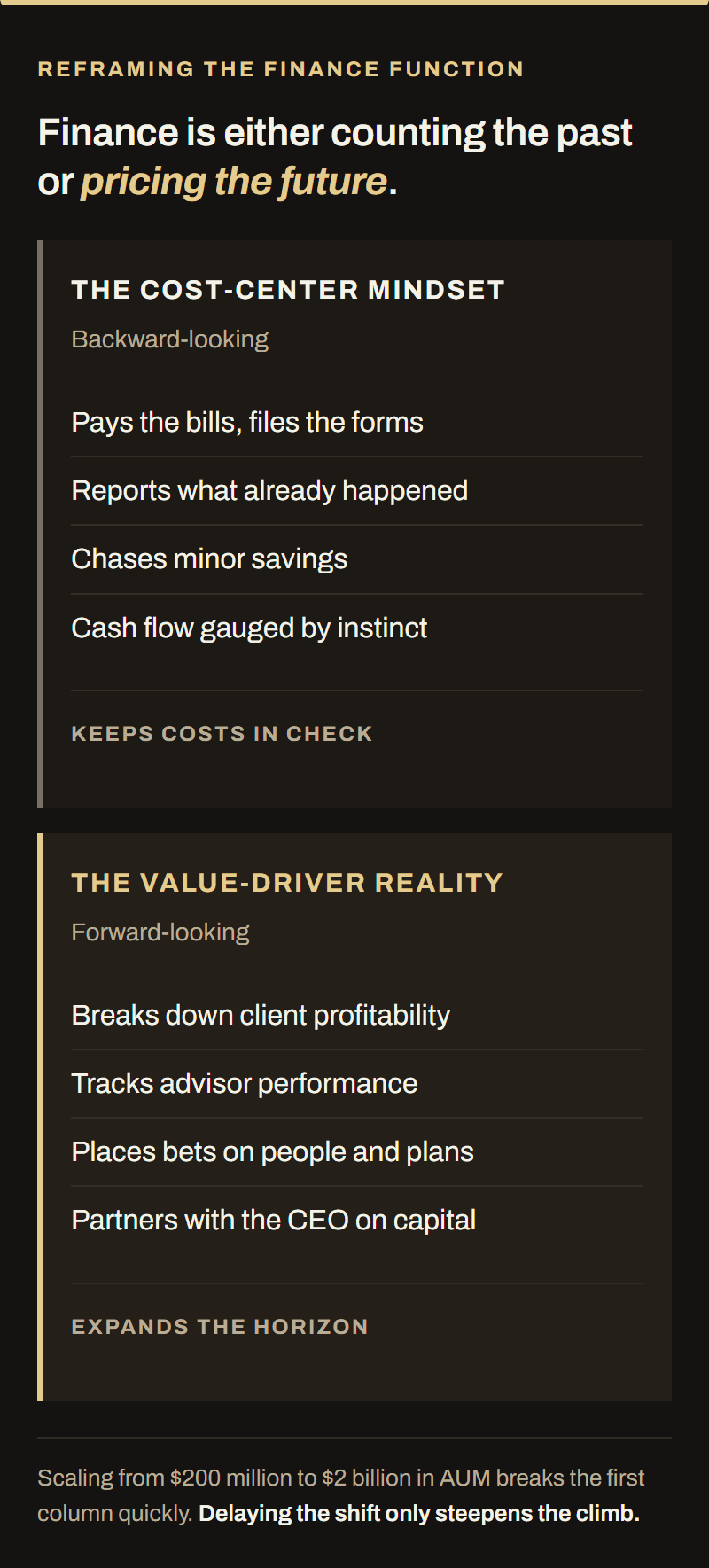
The Cost-Center Mindset
At $200 million in AUM, finance for most RIAs focuses on the basics. It handles bills, taxes, and standard reporting. Someone keeps the operation humming, which suits a smaller firm. This matches the historical view of finance, where the priority was keeping costs in check.
Scaling to $2 billion breaks that framework quickly. Sticking to a backward-looking view keeps finance tallying expenses. Cash flow becomes harder to gauge intuitively with ongoing investment costs. Decisions feel uncertain. Firms that stay in this mode chase minor savings while missing larger opportunities. Growth adds moving parts, and a basic finance setup struggles to keep pace. Delaying the shift only steepens the challenge ahead.
The Value-Driver Reality
Picture finance as your growth opportunity identifier. It digs into both financial and operational data to reveal what’s thriving and what’s faltering. The introduction of expanded data and better tech to track said data has been a big driver of this shift. For instance, finance can break down client profitability to highlight top revenue sources, sharpening your focus on high-value services. It might also track advisor performance, spotting underperformers for coaching or reassignment. These insights keep you proactive.
The role extends further, linking every part of your firm to the broader vision. Finance becomes a guide, placing smart bets on people and plans. Early on, every dollar matters. Later, every choice carries impact. A finance team built this way accelerates progress and keeps you moving forward.
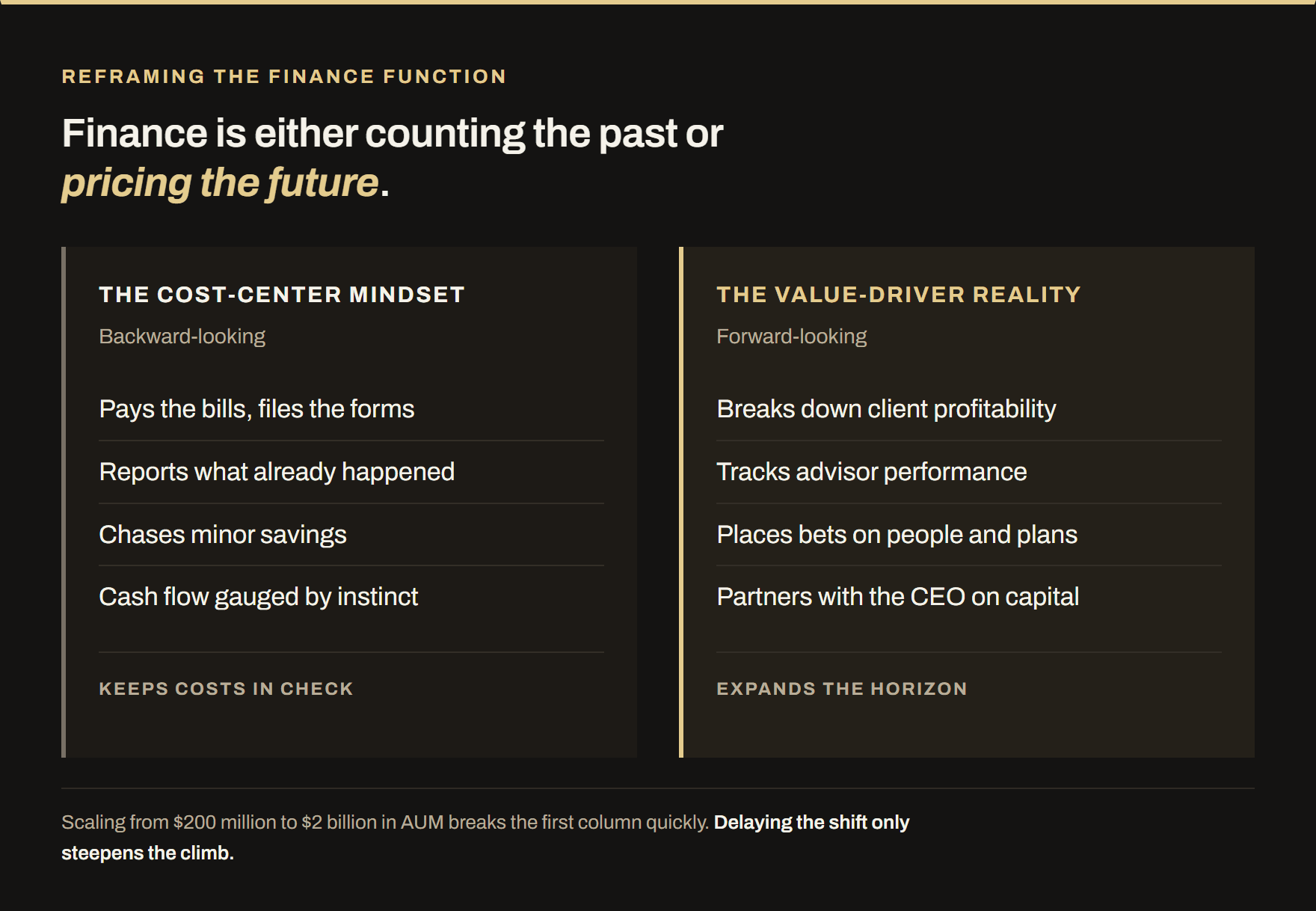
Many firms run the left column well past the point where it has stopped working.
Many firms run the left column well past the point where it has stopped working.
The Scaling Journey from $200M to $2B AUM
Here’s how finance evolves as RIAs scale from $200 million to $2 billion in AUM. Each stage brings new demands on finance.

Each stage changes what finance is for.

Each stage changes what finance is for.
$200M AUM: Reactive Roots
At $200 million in AUM, generating $1.5 to $2 million in revenue, finance stays lean and reactive. A bookkeeper manages all the necessities. Some firms outsource this, or the owner handles it. They are using their basic accounting systems to get by. Cash flow tracking isn’t complex yet, though it lacks strategic depth.
The focus is on just getting it done: pay bills, file forms, keep going. Scaling exposes the limits fast. The owner’s time grows scarce, shifting toward business-building. Here’s my recommended team:
- In-house or Outsourced Bookkeeper
- Fractional CFO
A full-time CFO costs too much at this stage. A fractional CFO, working a few hours weekly, can map your future once the bookkeeper’s books tie. Choose one who plans ahead and works as part of the leadership team. Start laying groundwork like:
- A functioning firm forecast model
- A budgeting process
- A strategic planning framework
Waiting builds technical debt, so begin early. Finance starts hinting at what’s next, planting seeds for growth. Every dollar counts here. Let finance nudge you forward.
$500M AUM: Proactive Foundations
At $500 million in AUM, with $4 to $5 million in revenue, finance holds steady but feels pressure from mounting needs. A bookkeeper, possibly in-house now, is completing all the requirements yet processes and procedure are not built out or optimal. Financials remain clear, yet strategy lags. The firm is becoming a business.
The CEO/owner focuses more on strategy. Here’s the team I’d build:
- Full-Time Controller
- Fractional Strategic CFO
A controller strengthens processes, bringing bookkeeping in-house. Pair this with the fractional CFO who plans ahead, supported by the controller. Some firms hire a full-time “CFO” here, but often it’s a controller-level hire due to cost. I’d prioritize a strong COO instead, saving top CFO talent for later.
M&A interest emerges, though not fully in-house yet. Use advisors or fractional corporate development help for deals. Tools like EOS sharpen KPI tracking. Finance begins sketching next steps. Act now to avoid more technical debt. Complexity will rise faster from here, so turn finance into your guide.
$1B AUM: Strategic Leap
At $1 billion in AUM, yielding $8 to $10 million in revenue, finance stretches but pivots to strategy. A controller and small team handle payroll, compliance, and ops data on NetSuite. Cash flow stays manageable, yet growth demands more.
The CEO/owner’s role is all vision now or splitting time with their client book. Here’s my team setup:
- Full-Time Controller
- Full-Time Strategic CFO
- Full-Time FP&A Analyst
- Fractional Corporate Development Manager / M&A Advisor
A top-tier strategic CFO becomes affordable and essential as needs mount. The controller keeps operations tight, while an FP&A analyst supports the CFO’s strategic focus. Do not bury the CFO in routine work; segment the duties. They’re also building dashboards and models for departments to run their areas effectively. Finance now:
- Drives strategy
- Tracks KPIs
- Prices every cost before it is committed
- Partners across the firm
M&A leans on external advisors, though a full-time corporate development hire nears if deals are key. Finance steers decisions here.
$2B AUM: Value Engine
At $2 billion in AUM, with $15 to $20 million in revenue, finance powers the firm. A strategic-focused CFO, controller, FP&A team, and deeper analytics across all firm systems. Strategy is central from here. By this point most of the build-out cost is behind the firm, and the cost structure starts to scale.
The CEO/owner is hopefully living full-time strategy by now. Here’s the team:
- Full-Time Controller
- Full-Time Strategic CFO
- Full-Time FP&A Lead
- Full-Time Data/BI Specialist
- Full-Time/Fractional Corporate Development Manager
A data specialist bridges tech and finance, laying roots for more business intelligence on your firm’s operational data. Getting access to analyzable data is no easy feat in any company.
If M&A drives growth, a full-time corporate development hire manages outreach and deals. Finance fuels the operation and scales with the firm.
Embedding the Shift
The bands are a rough guide for advisory firms; the trigger for each hire is what is broken, as we set out in you may need a controller instead.
Action Steps
Match your stage:
- $200M: A fractional CFO sparks the shift or aids advisor tuck-in structuring.
- $500M: Add a controller and EOS for processes.
- $1B: A full-time strategic CFO and FP&A steer the path.
- $2B: Data and corporate development roles solidify it.

A firm that hires the $1 billion seat at $200 million overspends on finance.

A firm that hires the $1 billion seat at $200 million overspends on finance.
Don’t skimp on talent, but don’t overreach either; match the stage. There are more options than ever to scale with outside talent.
Tell your firm finance is there to help them grow.
Bringing It All Together
From $200 million to $2 billion, finance grows from a necessity to your firm’s backbone. It starts basic, shifts to process-building, then steers strategy, and finally powers scale with data and deals. The difference between keeping the books and leading financial decisions matters in advisory businesses just as it does in other owner-led companies, and it is the work behind our CFO & Operating Partner service.
Whether it is a fractional CFO early or a full-time corporate development hire at the top, you set the pace. Our CFO and operating partner work is priced by level on that page, and a call settles which seat the firm needs first.
