
Inorganic Growth 101: Laying the Deal Groundwork
Jared Luegers, CFA · 8 April 2025 · 11 min read
Before an RIA buys anything it needs a corporate development function: a stated acquisition thesis, capital settled in advance, a way to source deals instead of waiting for one, a standard evaluation, and an integration playbook that exists before close. Integration is the block firms underestimate, and it can undo a good deal.
The Age of Strategic Growth Is Here
The RIA industry has blossomed strongly coming out of the Great Recession of 2008 and continues to see its relevance grow compared to other channels in the wealth management space. Strong asset markets driving substantial AUM and associated revenue growth have made this an incredibly rewarding industry, attracting substantial capital from investors eager to participate.
Private equity firms have entered this fragmented industry aiming for consolidation, a strategy familiar to these investors. Most have found success and will continue to find success, provided they carefully account for the unique, relationship-driven nature of wealth management.
Currently, many RIA owners are nearing retirement without clear internal succession plans, or they have firms whose valuations have grown beyond what next-generation advisors can afford. With over a third of advisors expected to retire in the next decade, the supply of RIAs poised to transition is considerable. The industry includes over 10,500 SEC-registered RIAs under $1 billion AUM and approximately 18,000 state-registered RIAs managing under $100 million. While this number will significantly decrease over the coming decade, true industry-wide consolidation where only a few firms dominate remains unlikely. Instead, the trend will resemble increased concentration, similar to the accounting industry's evolution.
I anticipate this concentration will accelerate as older RIA owners inevitably choose retirement, triggering increased inorganic growth activity. Small to mid-sized RIAs will likely seize this opportunity by acquiring these available practices. More firms will attract private capital, particularly private equity, accelerating inorganic growth strategies. Additionally, valuations for smaller legacy RIAs will likely decline, becoming more attractive as their availability increases significantly and macroeconomic pressures mount, especially impacting firms below $200 million AUM.
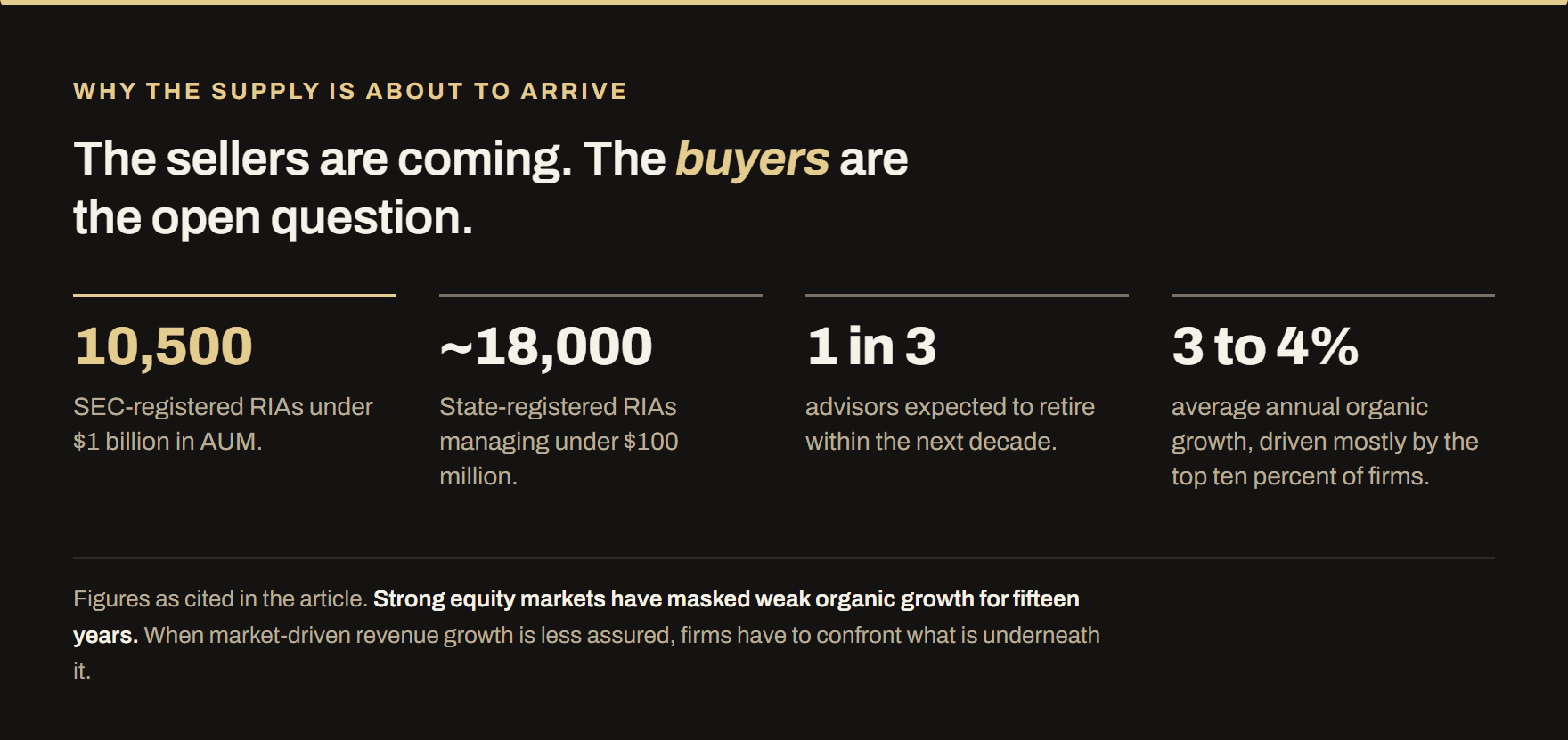
The sellers are coming. Whether your firm is a buyer is the open question.
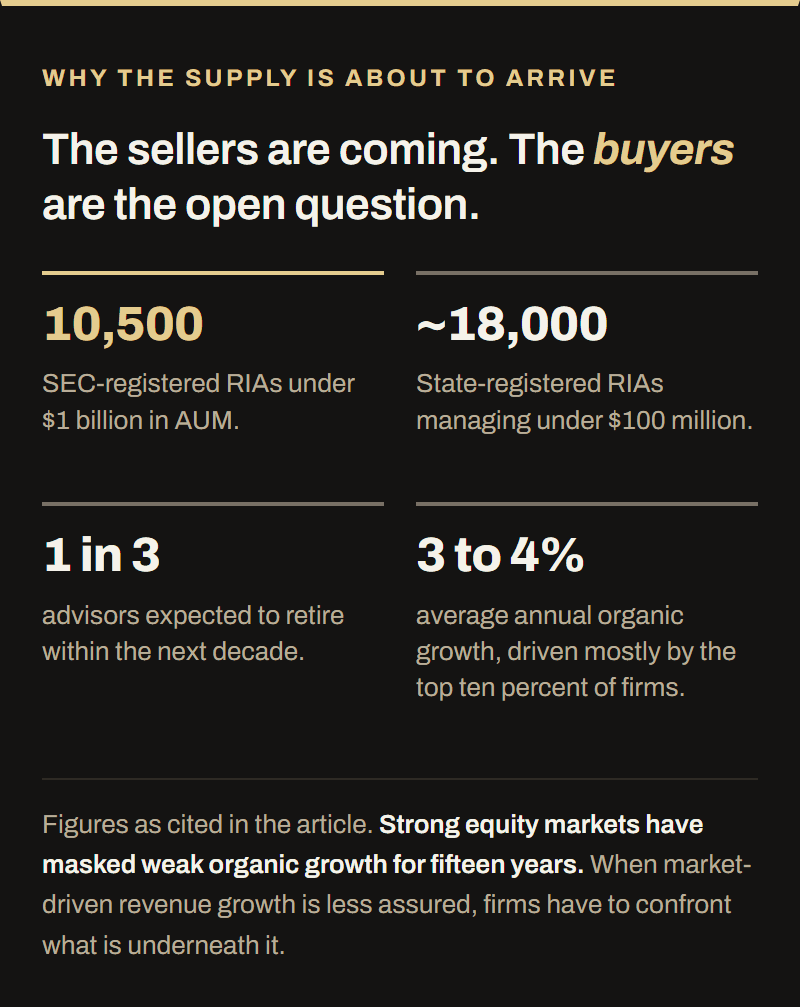
The sellers are coming. Whether your firm is a buyer is the open question.
And what is the catalyst that I expect will get more firms in the $500 mil to $3 billion AUM range to jump into the race to acquire RIAs and advisor books?
Primarily, I expect the slowing or stagnation of revenue growth at these firms due to anticipated subdued equity market performance. After nearly 15 years of bull market conditions driving most revenue growth, we are likely entering an extended period of range-bound equity markets at best, driven by high valuations, elevated interest rates, and persistent inflation. Historically, strong equity markets have masked weak organic growth, which typically averages just 3-4% annually, primarily driven by the top-performing 10% of firms.
With market-driven revenue growth less assured, RIAs will need to confront their limited organic growth strategies. Achieving organic growth through marketing is challenging and uncertain, prompting firms to increasingly embrace inorganic growth methods, such as acquiring smaller RIAs or recruiting advisors with established books. These strategies provide clearer and more measurable returns.
However, most RIAs lack significant experience with inorganic growth. Past efforts to recruit individual advisors were often informal, suboptimal, or ineffective in today's highly competitive market. Consequently, firms face a steep learning curve to develop compelling offers that successfully attract new partners.
This context underscores why the subject matters. The aim is to guide small and mid-sized RIAs through the M&A process and help them establish disciplined corporate development programs aligned with emerging market trends. What follows is a high-level overview of what it means to build a disciplined corporate development function, enabling your firm to move beyond intentions toward consistent strategic execution. The age of strategic growth is clearly here, and firms prepared to act strategically will have the advantage.
What Corporate Development Really Means for RIAs
In many large companies, especially public and private equity backed companies, the corporate development is its own department tasked with mergers and acquisitions, joint ventures, and strategic partnerships. Sometimes the full strategy team is housed in this department. In an RIA context, the term generally describes an internal function that propels growth by acquiring entire firms, recruiting breakaway advisors, or onboarding entire teams from rival wealth channels.
Most RIAs in the $500 million to $3 billion range have not devoted formal resources to corporate development unless they are actively doing several deals a year and/or are private equity backed. Most often in these smaller RIAs, the corporate development process is led by leadership, usually the owner of the firm with support from the CFO to do one off negotiations with an opportunity that came across their plate.
This is the reactive approach, waiting for deals or recruits to surface and then improvising a structure. That may work once or twice, but a well thought out corp dev program creates a purposeful, repeatable engine that aligns with your long-term goals if you are looking to have inorganic growth as one of your firm’s long term growth drivers. Some might split the middle by using a M&A advisor who might help find potential partners.
Typically, corporate development involves:
- Defining your acquisition strategy, key criteria, and financing availability.
- Building and managing a pipeline of potential sellers and breakaway advisors.
- Evaluating cultural, financial, and operational fit.
- Overseeing diligence, negotiations, and closings.
- Providing integration support so the deal truly succeeds post-close.
Having an internal corporate development structure focuses on building a consistent full soup to nuts process for sourcing and executing multiple deals with the internal team. Given the influx of outside capital in wealth management, competition for quality acquisitions and advisor talent is growing, which is requiring firms to really invest in their approach to this growth avenue. Taking a “we’ll figure it out if the right deal comes along” approach will leave you lagging behind more proactive firms when it comes to closing new successful partnerships.
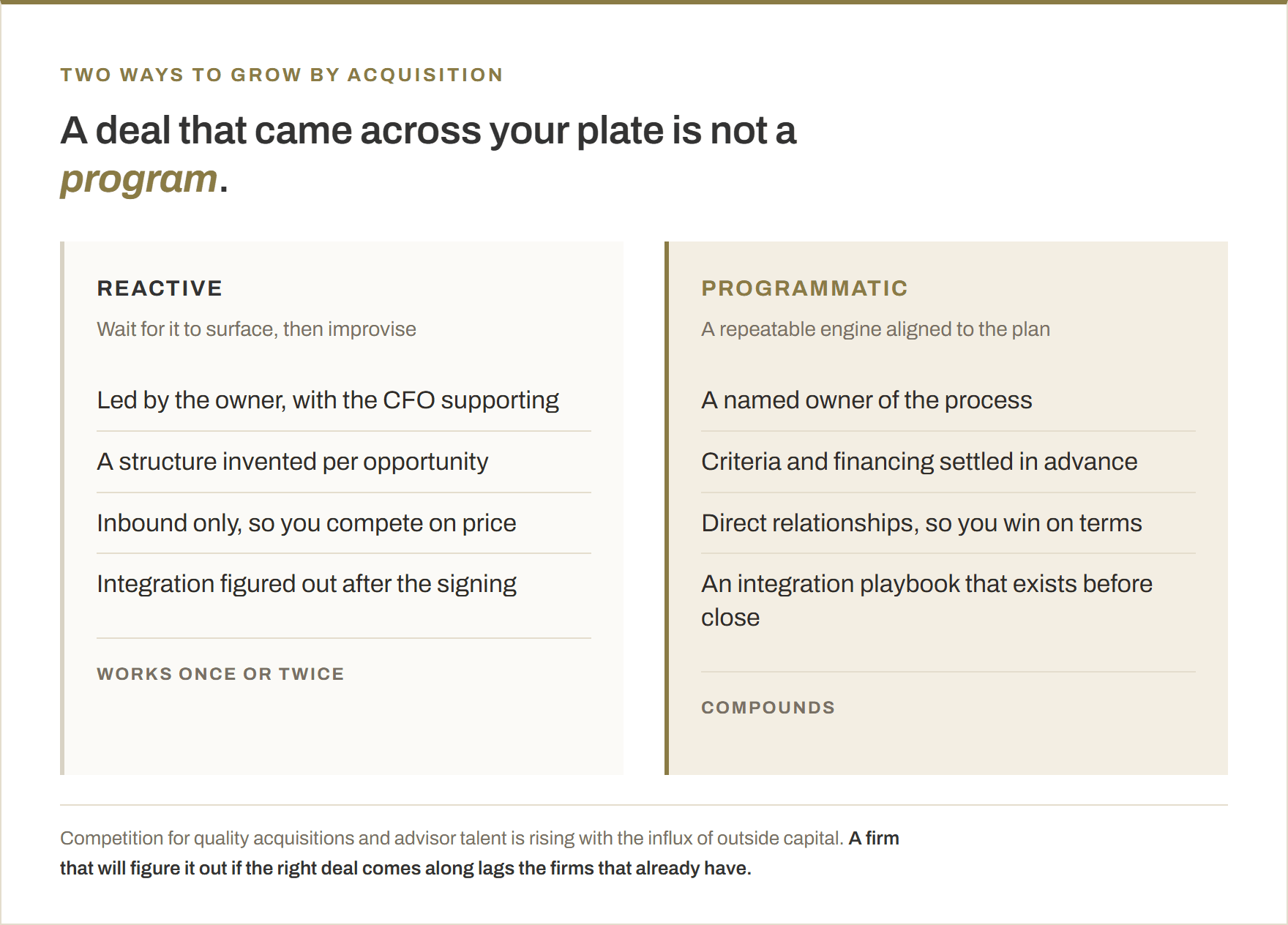
Most firms sit further left here than they think. One completed acquisition is not evidence of a repeatable engine.
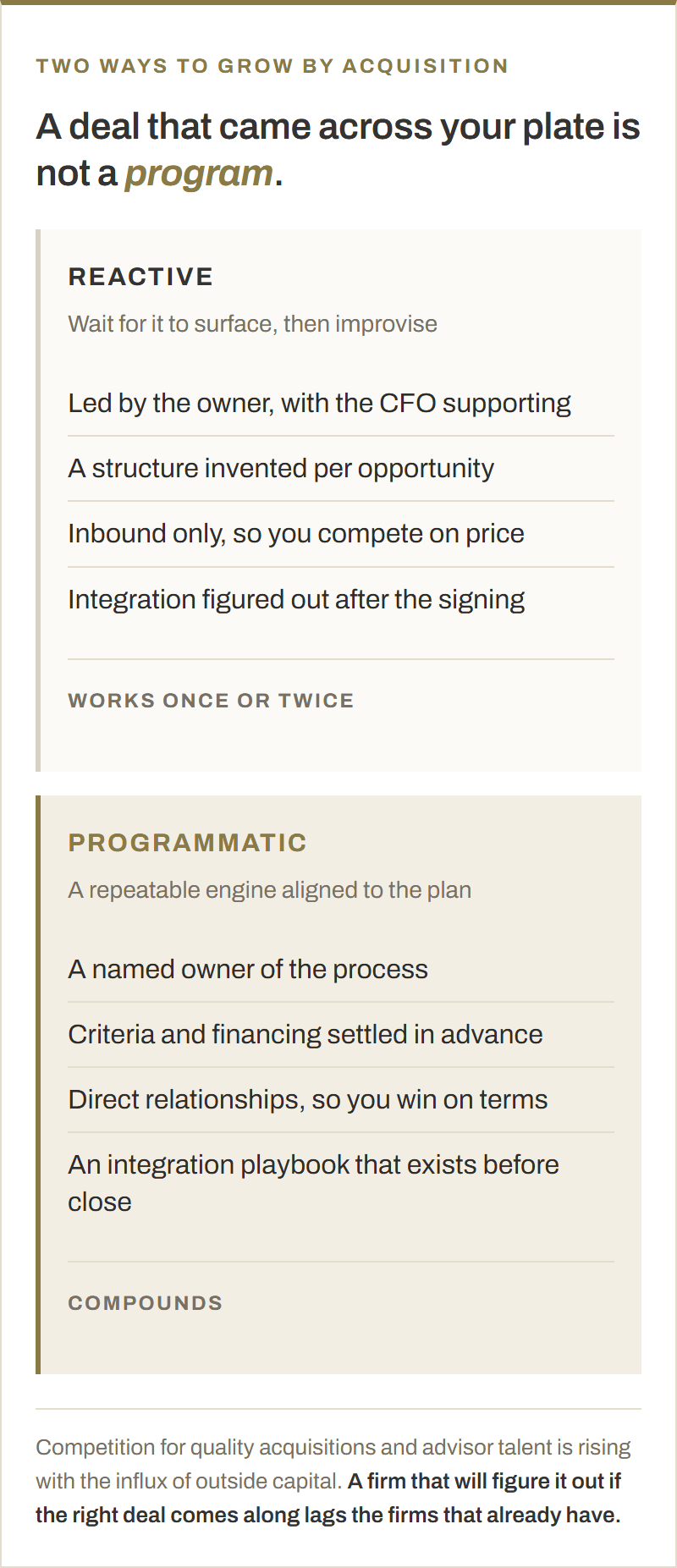
Most firms sit further left here than they think. One completed acquisition is not evidence of a repeatable engine.
Why Now? Why You?
Before committing to building a corporate development strategy, it is worth asking whether this path truly serves your firms aspirations. The backdrop might look compelling, with more retiring RIA owners, higher valuations the bigger you get, and the increasing number of breakaway advisors exploring new affiliations, but those macro trends only matter if you want to leverage them for your own strategic goals. In other words, the real question is whether you want inorganic growth to be part of your story.
Many mid-sized RIAs begin to consider acquisitions or advisor recruitment once they have established a solid operational platform and secured the strategic capital required to pursue such deals. Deploying this capital to accelerate your growth rate can be highly attractive, especially since sustaining previous growth rates becomes more challenging as your firm grows larger. When you can confidently forecast strong returns on investment and carefully vet potential partners for alignment, inorganic growth can create significant value for everyone involved.
Yet, none of this means your firm must pursue M&A. If you are content maintaining your current size or if your leadership team prefers to focus exclusively on organic initiatives, that is a valid and strategic choice. Inorganic growth requires substantial resources, commitment, and the willingness to navigate a steep learning curve. It also introduces new risks, complexities, and variables as new teams and processes are integrated.
So, how do you decide if now is the right time? Consider these questions carefully:
- Does your long term plan call for accelerated growth beyond what organic methods can deliver?
- Would strategic acquisitions or recruiting established advisor teams meaningfully improve your competitive position?
- Are you comfortable dedicating budget and leadership bandwidth to M&A rather than focusing solely on other initiatives such as marketing or technology?
- Is your team ready to develop new skills around deal sourcing, negotiation, and integration?
- Have you clearly defined what success looks like if you pursue a deal, whether it's financial returns, expanded services, or entry into new markets?
If your answers align with your long-term vision, inorganic growth might indeed be worth pursuing. If not, honesty about your firm’s priorities will help you avoid half-hearted M&A attempts. Once you commit, you’ll want to ensure your firm’s culture, processes, and leadership can effectively handle acquisitions without disrupting existing operations. That’s precisely where we’ll go next.
The Strategic Mindset and Readiness for M&A
Before you start evaluating acquisition targets or advisor lift-outs, it is important to assess whether your firm is truly prepared for inorganic growth. Readiness goes beyond finances and touches culture, operations, leadership bandwidth, and your willingness to be selective. The questions below will help you determine if you have the infrastructure and mindset to handle M&A effectively:
- Are our financial statements clean, and can we clearly articulate our profitability and growth story?
- Do we have a defined culture and client service model that new partners and clients can adapt to?
- Can our leadership team handle the added complexities of integration, from operations to compliance?
- Are our processes and technology scalable enough to support new advisors or acquisitions?
- Who in our organization is going to own the M&A process and coordinate all the moving parts?
Thinking strategically means using M&A as a way to strengthen your firm’s mission, not just as a quick boost to AUM. It requires the discipline to pass on deals that do not truly fit your long-term vision, even if they seem tempting at first. In many cases, it means saying “no” more often than “yes” in order to maintain the caliber of acquisitions and advisors you bring on board. By grounding your inorganic growth strategy in a clear sense of purpose, you increase the likelihood that each deal you pursue will add real value for both your team and your clients.
What It Takes to Build One at a High Level
Here is a snapshot of the core components needed to build a true corporate development function:
- Strategic Readiness: Make sure your finances, operations, and leadership structure can handle M&A.
- Acquisition Thesis: Determine which types of firms or advisors you want, and why they should choose you.
- Sourcing Engine: Develop a proactive system for identifying opportunities, rather than waiting for them to find you.
- Evaluation Process: Standardize how you assess cultural compatibility, revenue potential, and operational fit.
- Deal Structuring: Decide on valuations, earnouts, equity components, and payment timelines.
- Integration Playbook: Plan for what happens post-close so your team and clients remain aligned and supported.
- People and Resources: Figure out if you need a full-time corporate development lead, a fractional executive, or a cross-functional committee.
These seven building blocks give structure to your M&A efforts and help ensure that each deal moves you toward your broader goals. However, misconceptions and unfounded assumptions can easily derail even the most promising strategy.
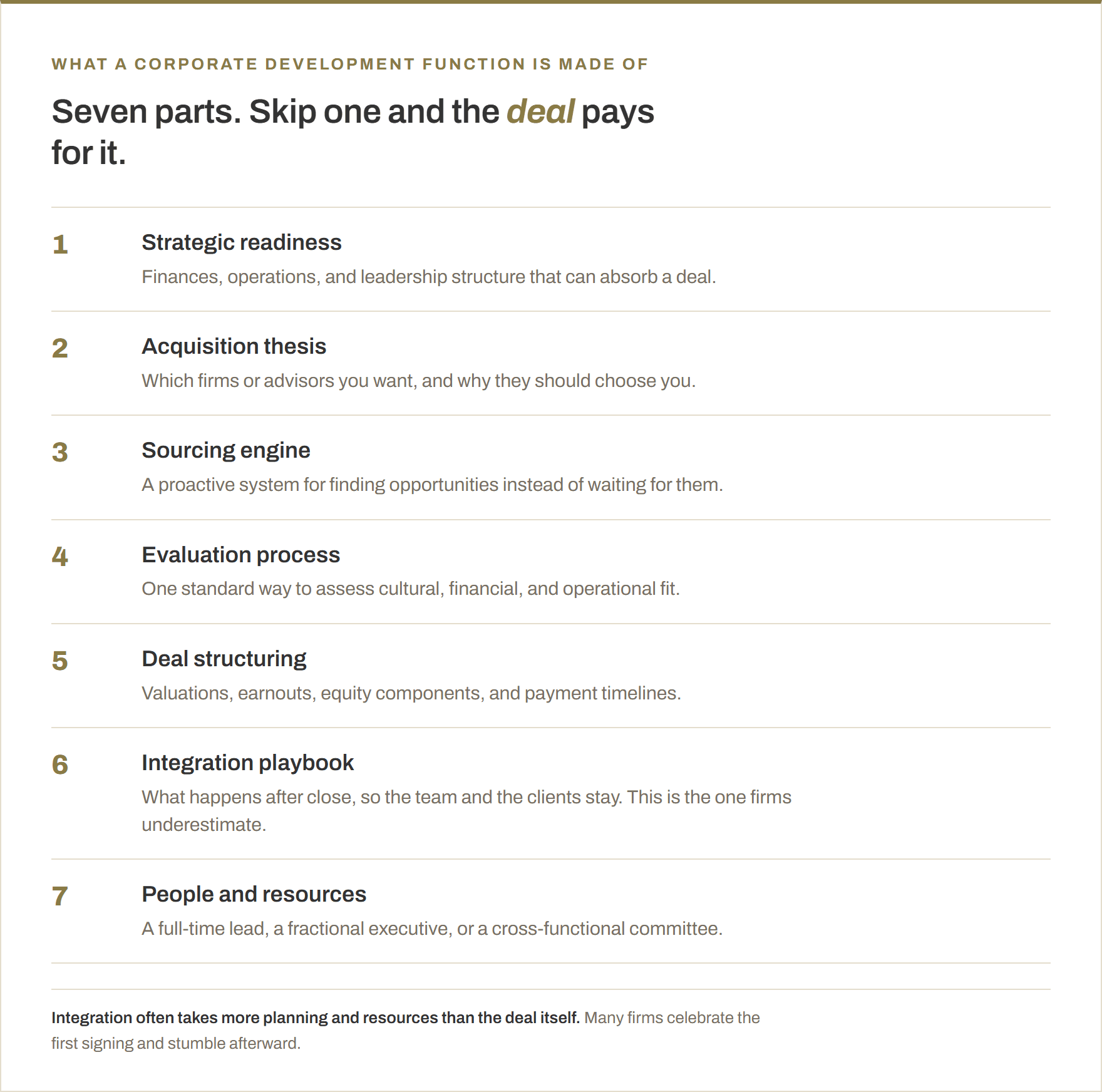
The first five blocks are what firms build. The last two decide whether the acquisition still looks smart two years on.
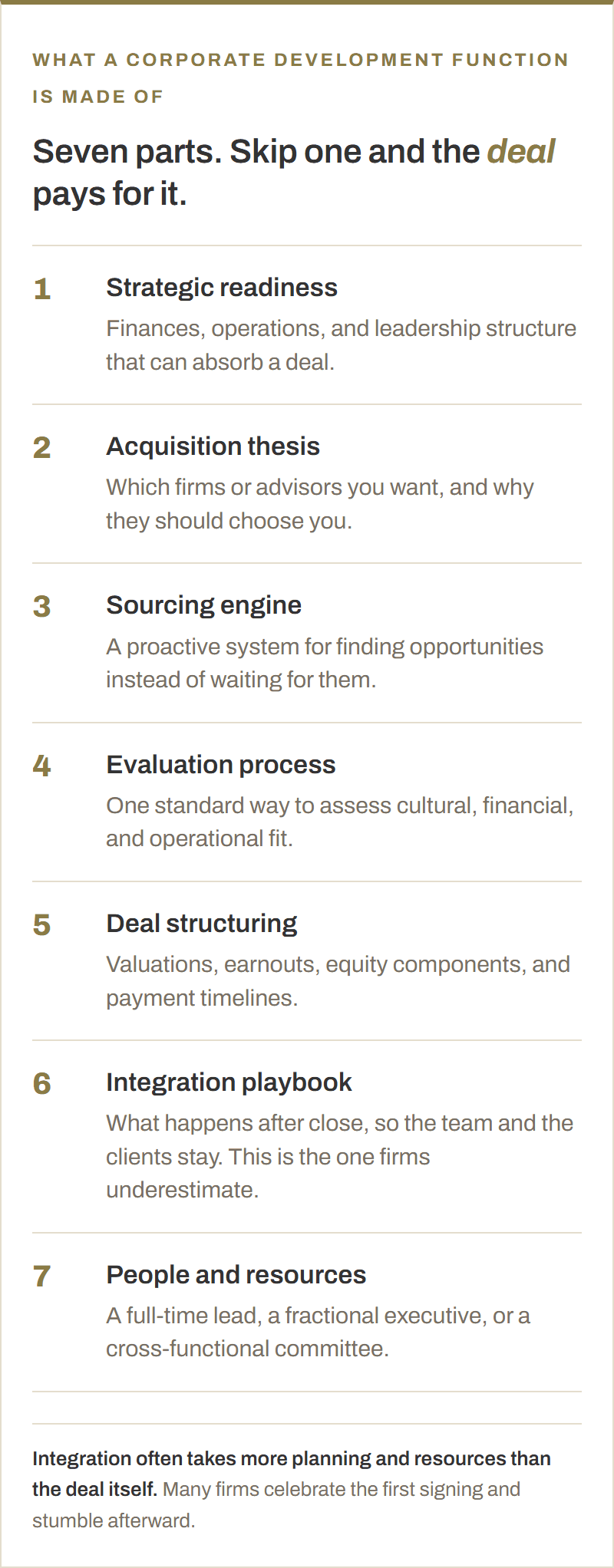
The first five blocks are what firms build. The last two decide whether the acquisition still looks smart two years on.
Myths That Hold Firms Back
A handful of assumptions can derail a firm’s M&A ambitions, especially if you are new to the process:
- “We are too small.” - If your firm has between $500 million and a few billion in AUM, you're actually in an excellent position to begin developing a disciplined acquisition approach. You don't have to fully commit from day one, and you might not even execute your first deal immediately, but starting early preparation sets the stage for future success.
- “The right deal will find us.” - Sellers typically have multiple suitors, especially in the current market environment. Relying solely on inbound opportunities or investment bankers limits your potential. Building direct relationships not only expands your opportunities but also helps you win deals, and importantly, win them on favorable economic terms.
- “We can handle it all in-house.” - Successful M&A spans finance, culture, legal, and negotiations. Even if you manage most of the process internally, specialized external expertise is often essential. Handling deals in-house can work well if there's a clear, structured approach and someone explicitly responsible for coordinating the process. However, adding support from external experts can provide peace of mind and the added confidence that the deal will succeed.
- “Integration is straightforward.” - In reality, integration often requires more planning and resources than the deal itself. Failing to effectively integrate a newly acquired team can undermine an otherwise successful acquisition. Many firms celebrate signing their first deal but stumble afterward because they underestimate the importance of working proactively with their teams to ensure a smooth transition. Poor integration can lead to lasting issues down the road.
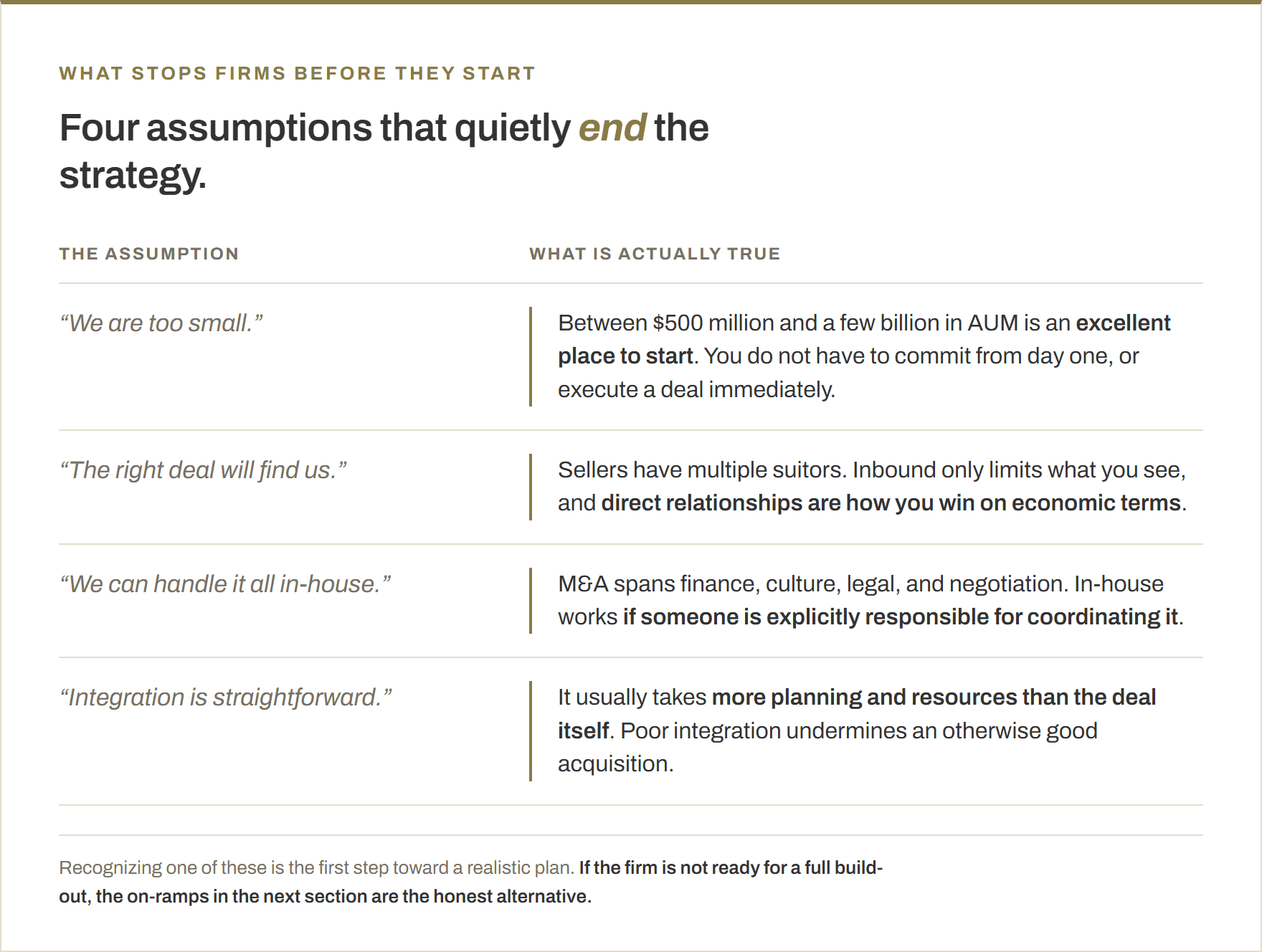
These are the reasons firms give for waiting. The cost of waiting is that the sellers worth buying go to someone who did not wait.
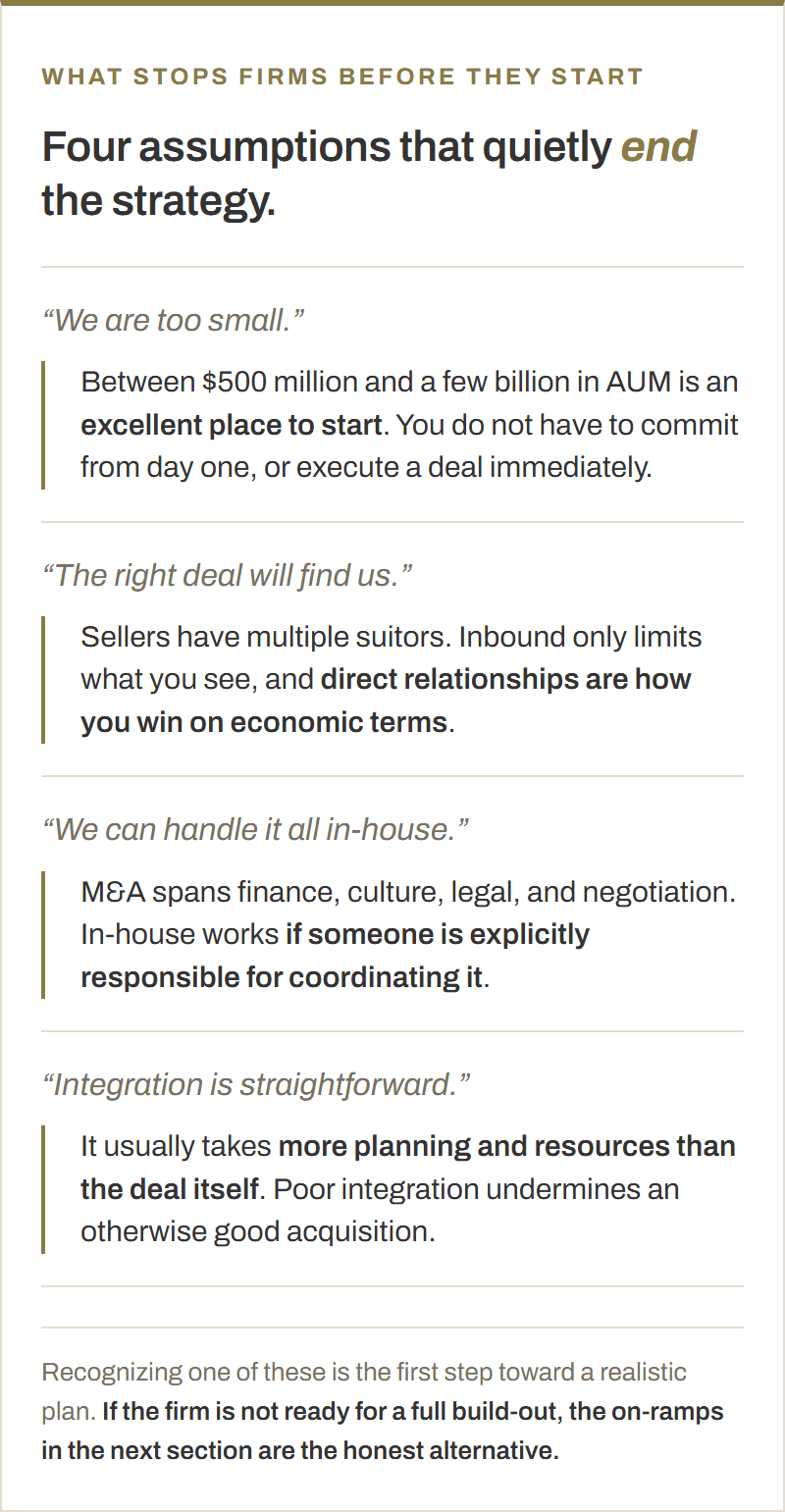
These are the reasons firms give for waiting. The cost of waiting is that the sellers worth buying go to someone who did not wait.
If any of these myths sound familiar, don’t be discouraged as recognizing them is the first step toward building a realistic and effective plan. Even if you realize your firm isn't yet ready for a full corporate development build-out, there are still viable ways to pursue inorganic growth without overextending your resources. We’ll explore these alternative approaches next.
Alternatives for Earlier-Stage Firms
If you’re not yet ready to launch a fully staffed corporate development team, and frankly, most firms shouldn’t overinvest from the start, you can still strategically prepare for inorganic growth by easing into it slowly. Taking gradual steps allows you to determine what is truly right for your firm while laying the groundwork for future success. Here are a few practical options:
- Fractional Corporate Development Partners: Engage a part-time specialist who can provide strategic guidance, build your deal pipeline, lead negotiations, and assist with post-close integration without the commitment or expense of a full-time hire.
- Buy-Side M&A Advisors: Retain an external advisor to identify potential sellers, manage outreach, and close transactions. This approach tends to be transaction focused, making it suitable if you plan just one or two deals as a short-term solution.
- Outsourced Diligence Support: If you already have a potential target, external experts can handle critical financial, compliance, or operational diligence, ensuring comprehensive assessments without burdening your internal team.
- Management Consultants: If you are still evaluating whether inorganic growth is right for you, a management consultant can help map out your acquisition strategy. They provide insights on readiness, strategy formulation, and integration planning before you commit to a more permanent approach.
Regardless of the path you choose, the goal is to adopt a strategic mindset and consistent approach, even if you are not yet prepared to build a full corporate development function. With thoughtful guidance, you can pursue inorganic growth at your own pace, steadily build internal capabilities, and create a repeatable process aligned with your firm’s long-term vision.
Final Thoughts for Now
The days of relying heavily on rising equity markets to drive growth may be behind us. In an environment where robust market appreciation is no longer guaranteed, your firm might find it challenging to sustain the momentum enjoyed in recent years. Adopting a proactive corporate development strategy can help maintain growth even when market returns become uncertain. However, it is crucial not to rely solely on inorganic growth. The most successful firms, and the ones others genuinely want to join, are those consistently growing organically by attracting new clients and assets.
Ultimately, successful M&A begins with clarity of purpose. When you clearly understand why inorganic growth matters to your firm, building a structured corporate development capability becomes a natural extension of your broader vision. This clarity allows you to focus on deals that truly advance your firm’s goals rather than chasing every attractive opportunity that arises.
