
What an Operating Partner Actually Does After the Close
Jared Luegers, CFA · 30 August 2026 · 8 min read
LIMESTONE Strategic Partners takes the operating partner seat with buyers after the close, from Carmel, Indiana, usually after preparing the quality of earnings on the same deal.
After the close, some things change whether you decide them or not, because they belonged to the seller and the seller has gone. Sort the forced changes from the chosen ones first, instrument the business before you change it, and make the people decisions on purpose, because they are being made either way. That is the first hundred days in the operating partner seat.
You do not get to change nothing. Some things change on the day you close whether you decide them or not, because they belonged to the seller and the seller has gone. Sort those from the changes you are choosing, and the two pieces of advice everyone gives you stop contradicting each other.
A buyer taking over a lower-middle-market business gets handed two pieces of advice, and they do not agree.
The institutional one says move. About 90% of private equity firms build a 100-day plan, and McKinsey’s line to new portfolio-company chief executives is that if a problem is confirmed after 90 days, it is already too late. The operator one says the opposite: do no harm, change nothing, spend the first six months as a student of the business.
Both camps are right, and they are talking about different changes.
Sort the changes before you make any
Put every change in front of you into one of two columns.
Forced. It changes because the transaction happened. You did not choose it, you cannot defer it, and if you ignore it something breaks on a date you do not control.
Chosen. It changes because you think the business will be better for it. It can wait a quarter without harm. It costs you credibility if you get it wrong and earns you some if you get it right.
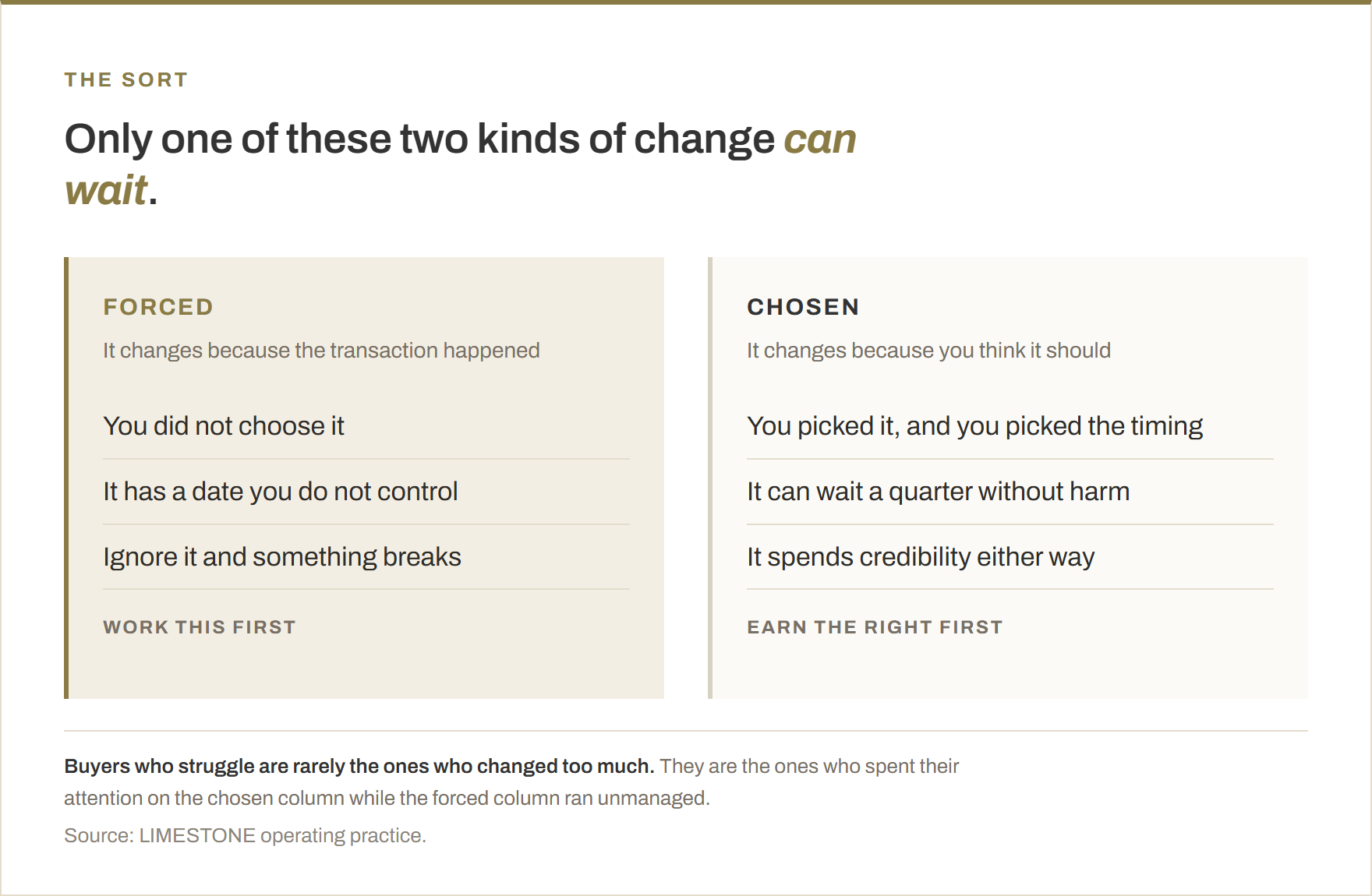
The institutional advice and the operator advice are each right about one column.
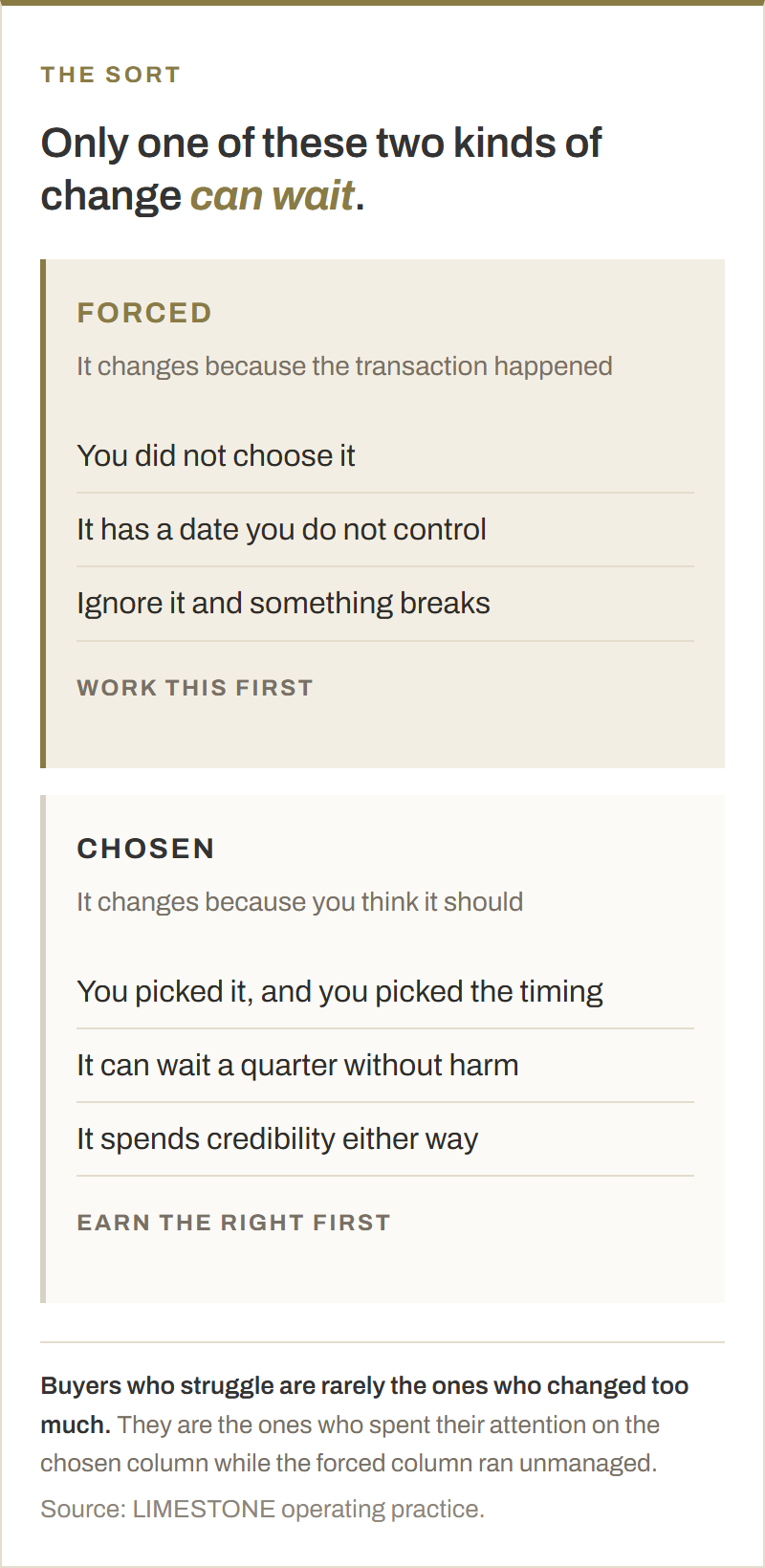
The institutional advice and the operator advice are each right about one column.
The institutional advice is right about the forced column and wrong about the chosen one. The operator advice is right about the chosen column and dangerous applied to the forced one, because a change-of-control clause does not care that you are being patient.
Where you see the forced column most clearly
I have not run a business through its first 100 days after buying it, and I would rather say that before I draw any lessons from what I have done.
What I have done is sit in the finance seat while a carve-out happened around me. After we sold Gladieux Energy to Sunoco for $190 million, the platform bought Shell’s refinery business in Denmark, and I worked with that team on FP&A and on evaluating further refinery acquisitions. That is a finance and corporate development seat rather than an operating one, and the deal is far larger than anything a searcher is buying.
It is still the clearest view of forced change I have had, and there is a reason the finance seat is where you see it. When a business comes out of a parent, somebody has to rebuild the reporting, the treasury, the payroll interface and the month-end close from nothing, because all of it belonged to the parent and none of it comes across. That person finds out, in order and with dates attached, exactly which things were never theirs to keep.
Nobody chose those changes. They arrived with the transaction.
Every owner-led business is a carve-out
Here is the part that should concern a buyer more than it usually does. When you buy a business from the person who built it, you are also buying a carve-out. The systems were never written down, because they lived in one person’s head, and that person now takes your calls as a courtesy.
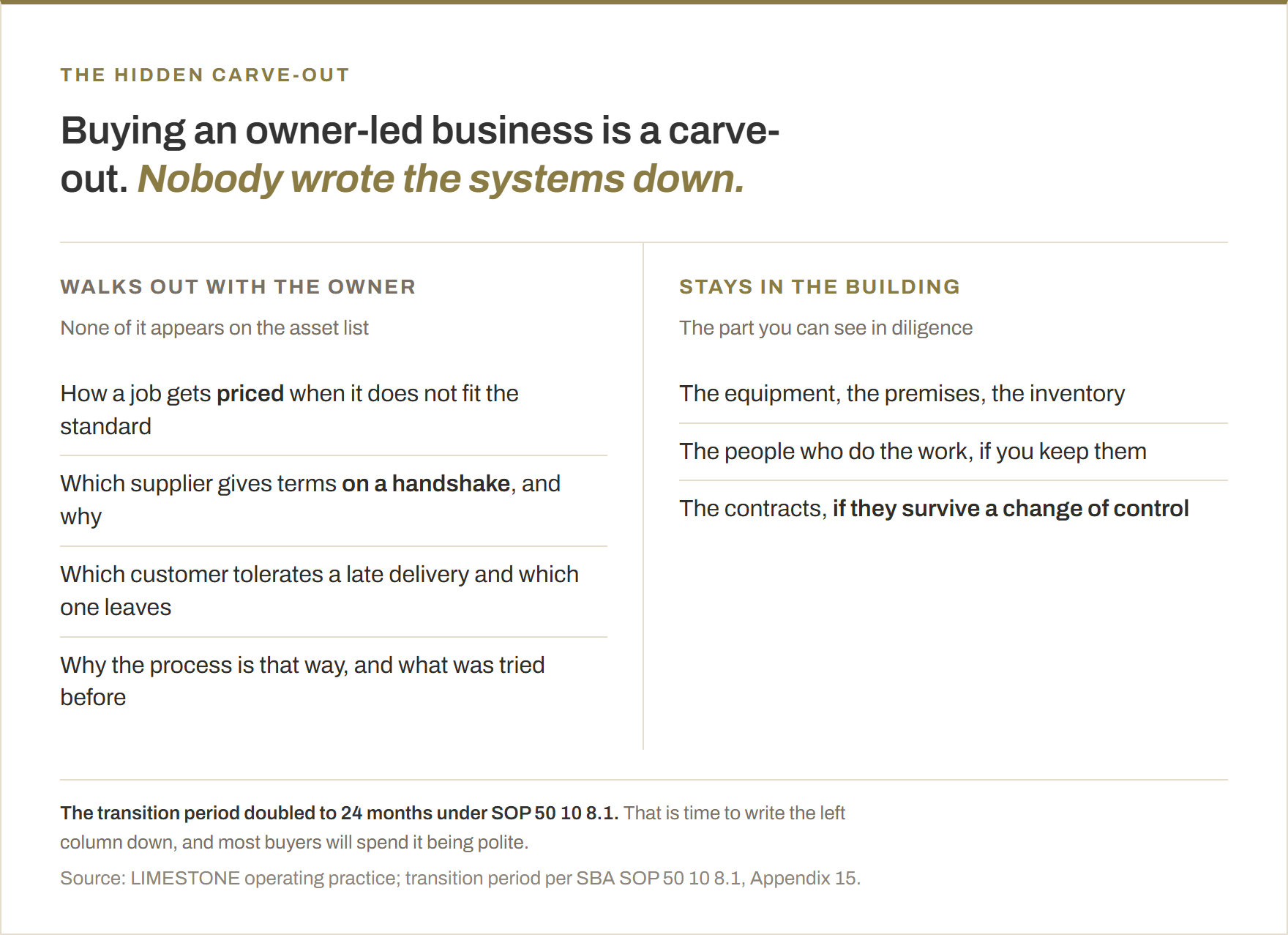
Nothing in the left column appears in diligence, and all of it is load-bearing.
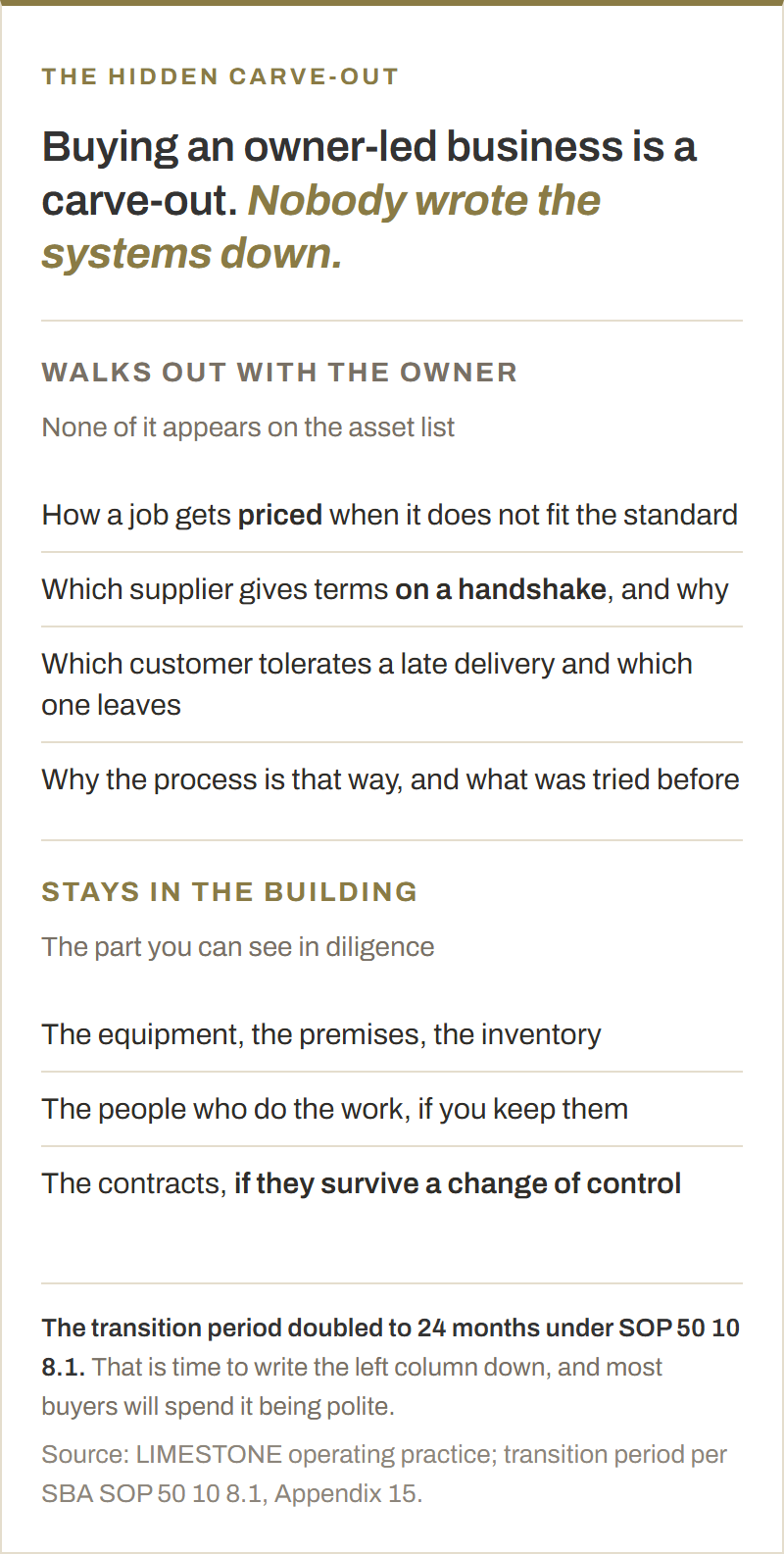
Nothing in the left column appears in diligence, and all of it is load-bearing.
The list of forced changes is longer than most buyers expect and almost none of it is strategic.
| What usually turns out to be forced | Why it has a date attached |
|---|---|
| Contracts with change-of-control clauses | Consent is often required before the assignment is valid, and the counterparty knows it before you do. |
| Bank and lender facilities | Often personally guaranteed by the seller, and a personal guarantee does not transfer. |
| Insurance | Policies written in the seller’s name need rewriting at completion or they lapse. |
| Software and subscriptions | Frequently licensed to the owner personally, on their card, in their email. |
| Supplier terms agreed on a handshake | The terms were extended to a person, not to the company. |
| Key employees deciding whether to stay | That decision is being made in the first few weeks whether you manage it or not. |
| Customer notification | Somebody will tell them. It is better that it is you. |
Work that list first. It is unglamorous, it is invisible when it goes well, and it is most of the job in month one.
The people decision is being made whether you manage it or not
The reason restraint matters in the chosen column is not politeness. It is that the expensive failure in these deals is people, and the window is shorter than buyers think.
Where integration is handled badly, key employees leave early, and most of them decide whether they are staying well before the integration plan expects them to. The percentages that circulate on this mostly trace to vendor and startup blogs, so I am not quoting them. The direction is consistent enough to plan around.
In a business with concentrated customers, losing a handful of the people who carry those relationships can take 10% to 20% of revenue out with them. That is a bigger number than most of the operational improvements a new owner arrives wanting to make. And it moves first.
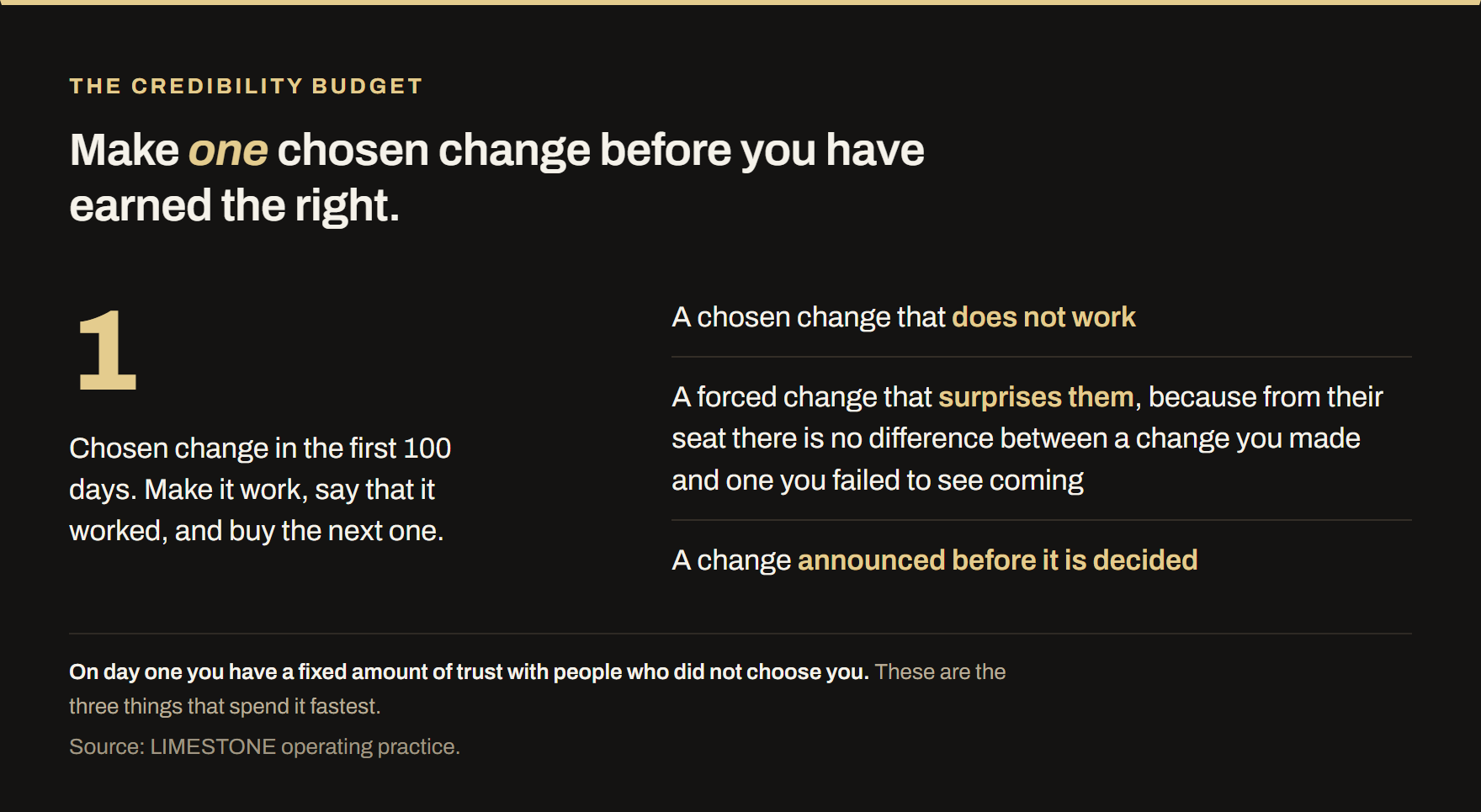
You spend this whether you intend to or not. The question is what you buy with it.
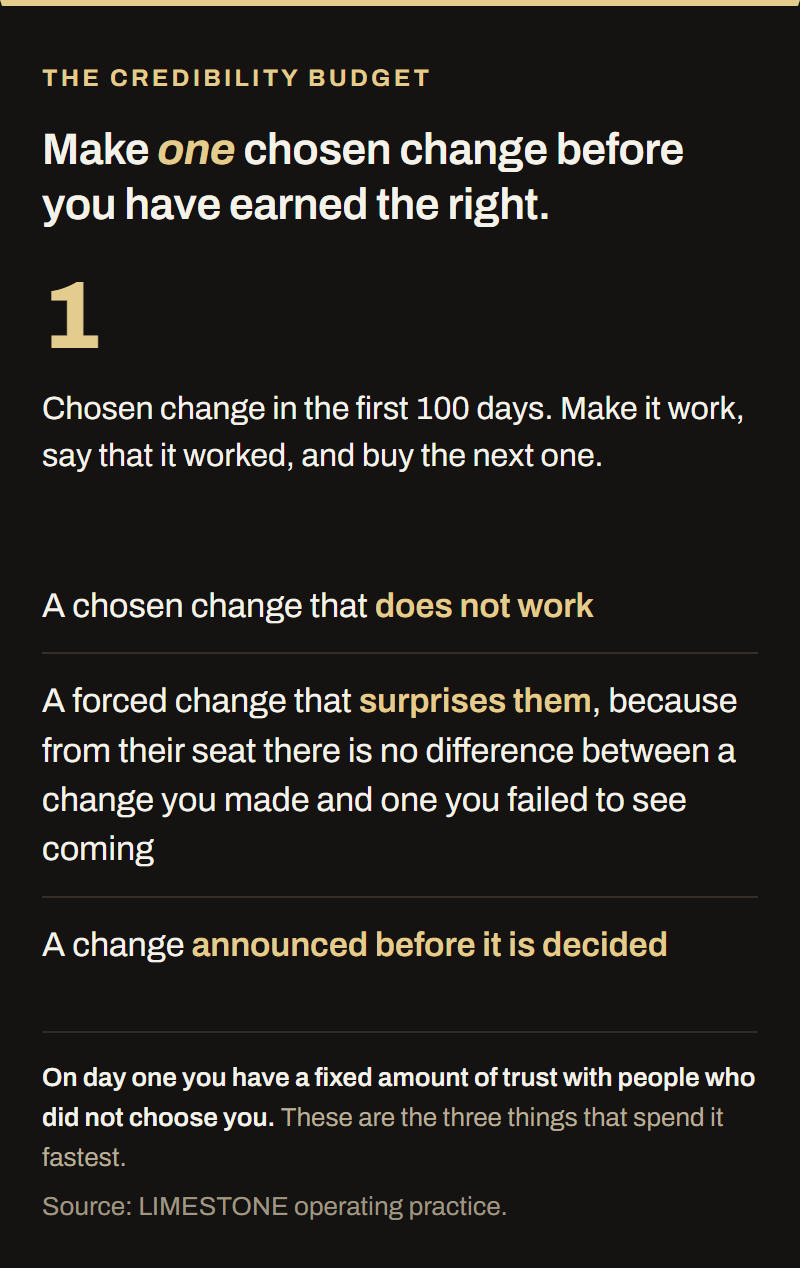
You spend this whether you intend to or not. The question is what you buy with it.
So handle the forced list quietly and early, and spend what credibility is left on one chosen change that pays inside the first year. Say out loud that everything else is on hold until you have earned the right. People can work with that. What they cannot work with is a new owner who rewrites the commission plan in week three because it was on a slide.
There is a useful test for the odd process you are itching to fix. It is usually one of three things: something that made sense once and no longer does, something that still quietly makes sense in a way you cannot yet see, or the previous owner’s preference. You often cannot tell which until you change it and watch what breaks.
Instrument before you change
You cannot tell whether a change worked if you never had a baseline, and most businesses at this size measure almost nothing a new owner needs.
| What to instrument in week one | What it tells you |
|---|---|
| Cash in and cash out, weekly | Whether the business behaves the way diligence said it would. |
| Revenue by customer, monthly | Concentration, and whether anybody is quietly leaving. |
| The order or job pipeline | The only forward-looking number most businesses this size have. |
| Gross margin by job or product | Where the money is made, which is often not where the owner said it was. |
| Days sales outstanding | Whether collections were being carried by the owner’s relationships. |
| Headcount and open roles | The cost line that moves fastest and is hardest to reverse. |
| One weekly leadership meeting, 30 minutes | Whether decisions are being made without you, or not at all. |
None of that is a systems project. It is a spreadsheet and a standing half hour, and it can be running inside two weeks.
What we install, and in what order
When we take an operating seat the sequence is the same every time. What we build depends on the business; how we work does not.
By day 30 there is a scored read of the business with the binding constraint named in one sentence, a weekly leadership meeting running to a fixed agenda, and the monthly close underway. By day 60 there is a KPI dashboard somebody internal owns, a 13-week rolling cash forecast, and a decision authority matrix that says who decides what, so decisions stop routing through one person out of habit. By day 90 the weekly meeting has been handed to somebody inside the business and we participate in it rather than run it.
The handoff is the point. We facilitate early only to model the standard, and when a recurring task keeps landing on us it belongs on the org chart instead.
It is also most of what separates this seat from the three it gets confused with.
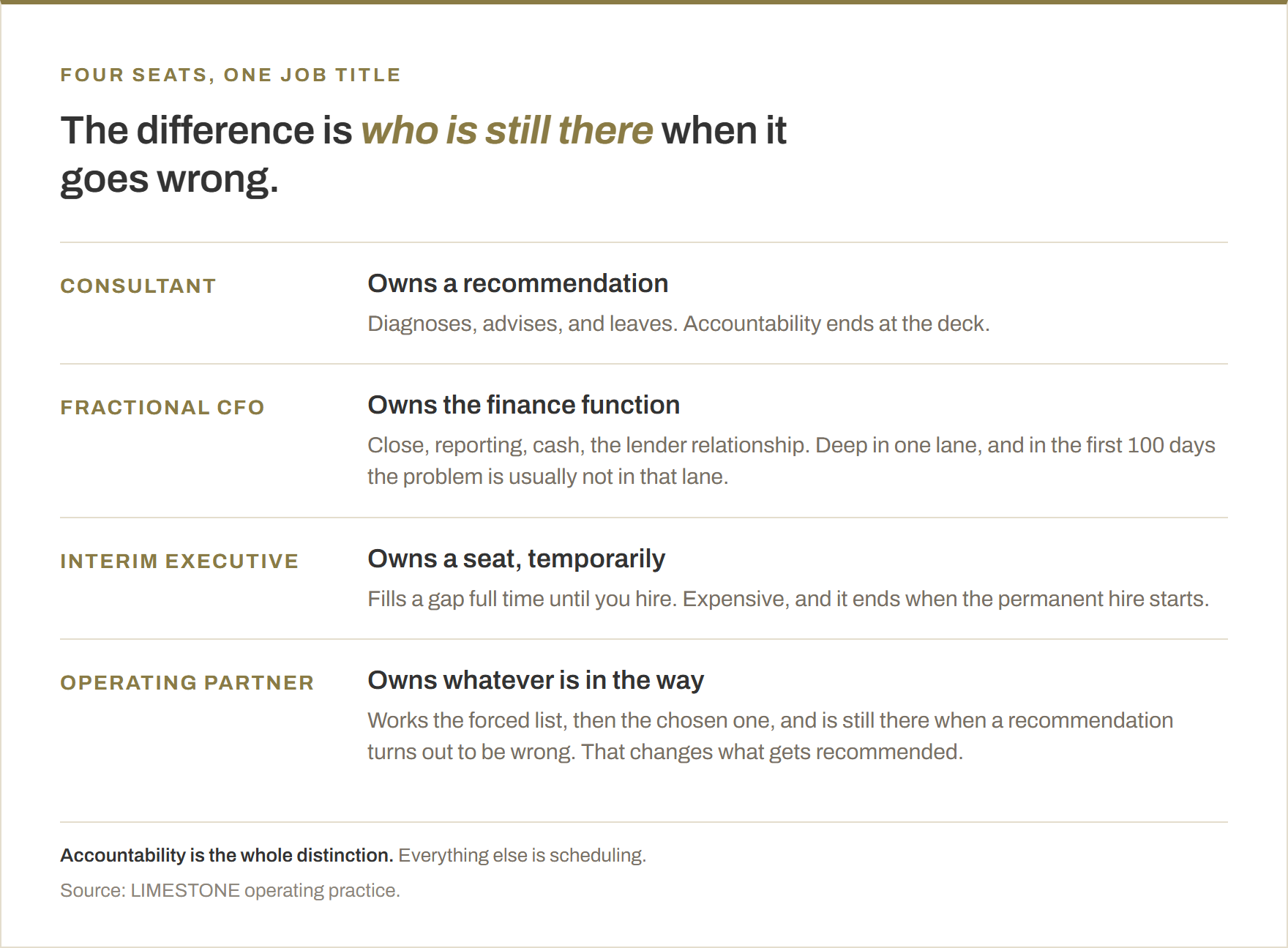
Three of the four leave. That is most of what separates them.
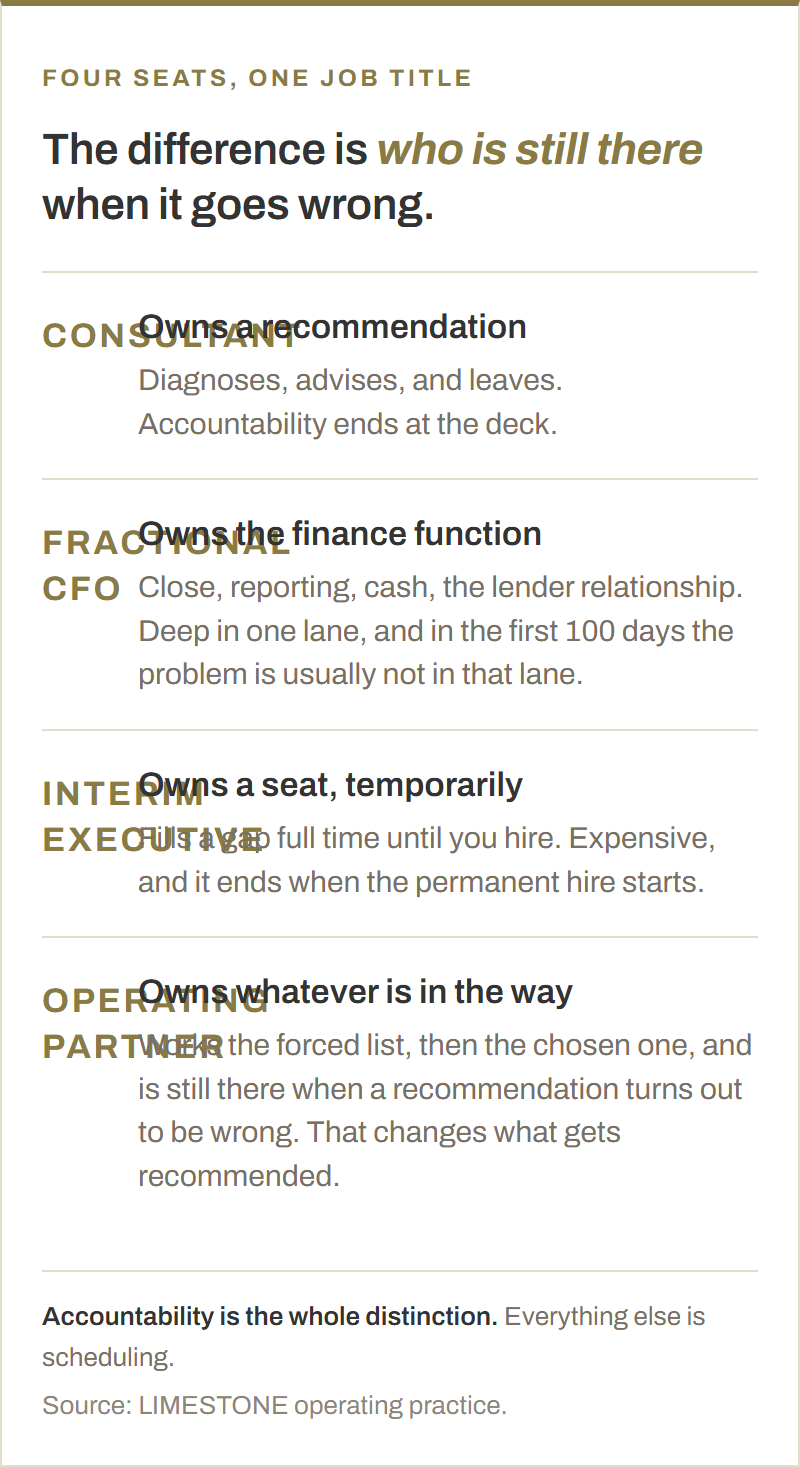
Three of the four leave. That is most of what separates them.
The limits, including one that applies to us
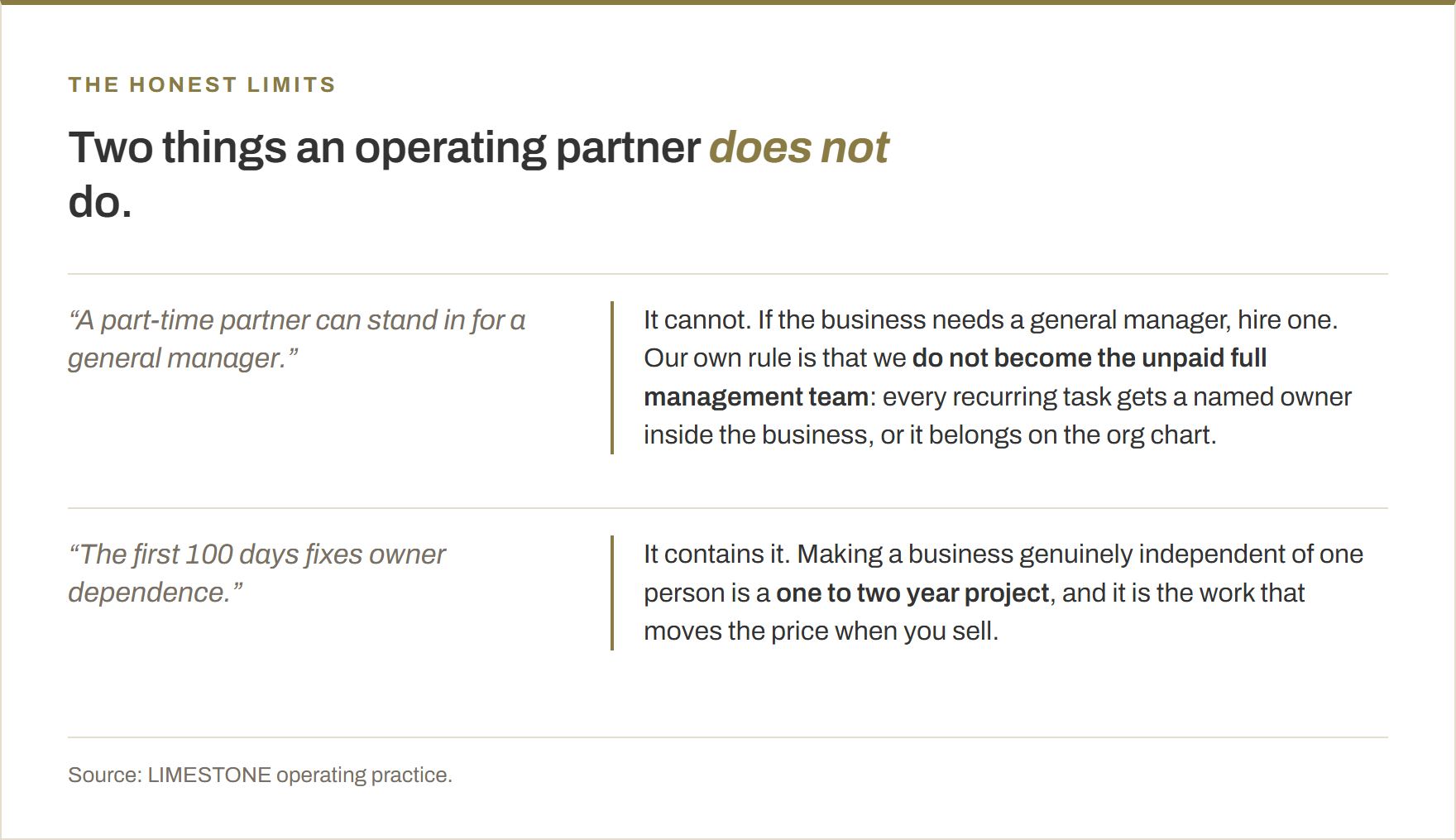
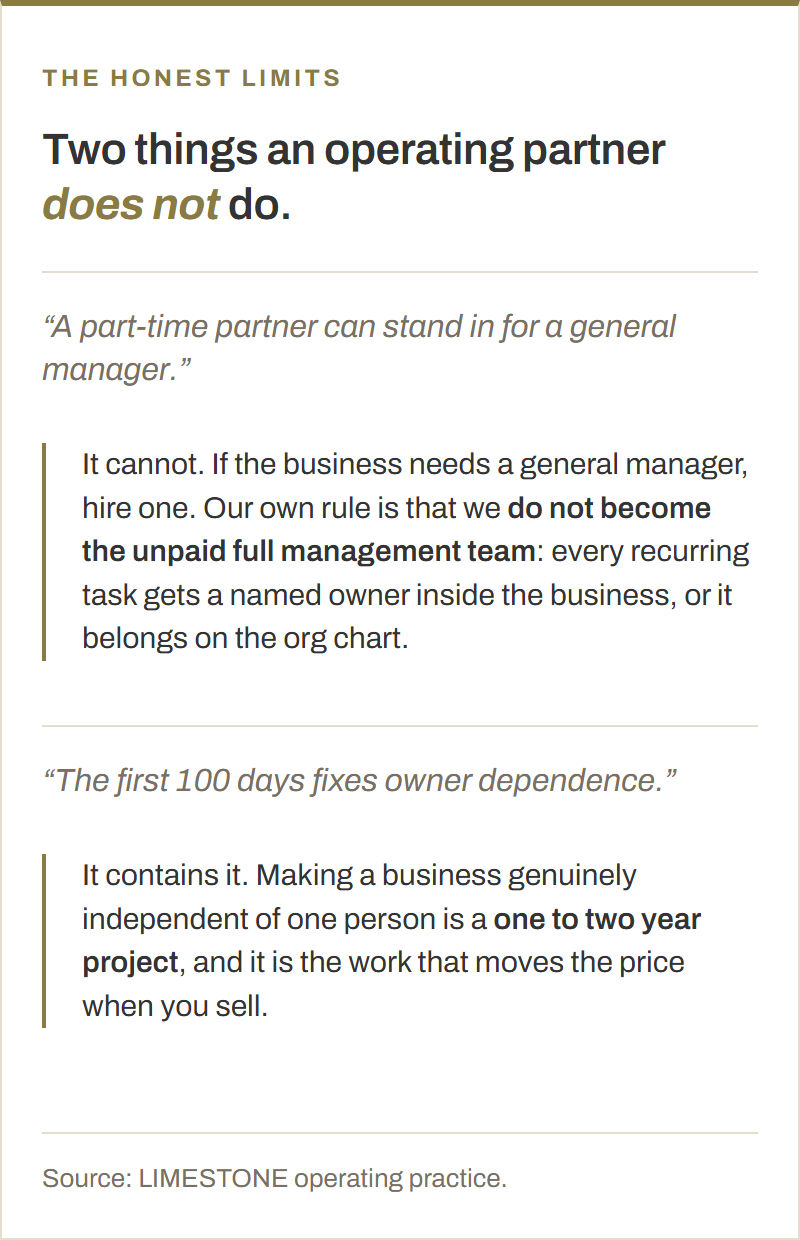
An operating partner does not replace a management team. Our own rule is that we will not become the unpaid full management team, and every recurring task gets a named owner inside the business. If what you need is a general manager, hire a general manager.
A limit stated up front is cheaper than one discovered in month four.
A limit stated up front is cheaper than one discovered in month four.
And the honest limit on this article. The engagements we run today are owner-side: founders scaling or preparing to exit, rather than portfolio companies we took over after a close. It is the same install in a different chair, and I would rather say so than imply a portfolio seat we do not currently hold.
Your first two weeks
Pull every contract and find the change-of-control clauses. That is the highest-return afternoon available to you, and most of it was discoverable in diligence.
Write the forced list before you write the strategy. If a change has a date on it that you did not choose, it goes at the top.
Ask the seller the questions only they can answer, and write the answers down while they are still taking your calls. If you financed with an SBA loan, the seller transition period doubled from 12 months to 24 under SOP 50 10 8.1, which is far more runway than buyers had a year ago, and most of them will spend it being polite.
Then pick a single chosen change, make it work, tell everyone it worked, and buy the credibility for the next one.
Questions we hear
How is this different from a fractional CFO? A fractional CFO owns the finance function, and owns it properly. An operating partner owns whatever is in the way, which in the first 100 days is usually not finance. It is a supplier relationship, a key employee deciding whether to stay, or a system that quietly belonged to the seller.
When should I bring someone in? Before close, if you can. The difference between finding a change-of-control clause in week two of diligence and week two of ownership is the difference between a negotiation and a problem.
Do you take equity? Sometimes, and it depends on the situation rather than on a policy. We would rather agree the scope and the fee first and talk about alignment second, because a stake is not a substitute for the work being right.
What does it cost? We scope it fixed-fee against a written list rather than hourly, so you know the number before you start. The first months run heavier than the steady state, and we say which is which up front.
Want to walk your own forced list? If you are under LOI or recently closed, we will go through the contracts and the transition points with you on a call and tell you what we would work first. No charge and no pitch. If you are earlier than that, the two worth reading are what a quality of earnings report will not tell you and same profit, very different price.
Jared Luegers, CFA, is the founder and managing partner of LIMESTONE Strategic Partners. He supported operations through a $190 million strategic sale, worked in the FP&A and corporate development seat at an energy platform that acquired Shell’s Danish refinery business, and now sits in operating and CFO seats with lower-middle-market owners in Indiana.
Sources: Grant Thornton and PitchBook on private equity 100-day planning; McKinsey on new portfolio-company chief executives; SBA SOP 50 10 8.1, Appendix 15, on the seller transition period; LIMESTONE delivery method.
