
Two owners. Same profit. Very different price.
Jared Luegers, CFA · 26 June 2026 · 5 min read
LIMESTONE Strategic Partners is an Indiana diligence and operating partner firm: quality of earnings and readiness reviews that show an owner what a buyer will price, and the two seats that fix it.
Two businesses can earn the same profit and sell for very different prices, because a buyer is paying for how certain the earnings are once the owner is gone. As an illustration, a business that runs through its owner tends to trade nearer 3 to 4 times profit; a lower-risk, buyer-ready one commonly trades at 5 to 6 times, sometimes more. Pepperdine’s 2026 Private Capital Markets Report puts median banker-reported multiples for businesses earning under $5 million at 3.5 to 7.2 times EBITDA. Five things decide which one you are, and all five are buildable.
Two businesses can earn the same profit and sell for very different prices. A buyer is not paying for last year’s earnings. They are paying for how certain those earnings are once you are gone, and five things decide that. All five are buildable, and all five take time.
Two owners I think about often sold their businesses the same year.
Same industry. Profit within rounding distance of each other. On paper, two nearly identical businesses.
One walked away with a check that set up the rest of his life. The other walked away with a fraction of it, ran the math on what was left after taxes and debt, and quietly started looking for his next job.
Same profit. Very different price.
Most owners assume those two things move together. More profit, higher price. It feels obvious. It’s also wrong, and finding that out the week a buyer slides an offer across the table is the most expensive way to learn it.
Your profit is not your price
Here’s the part nobody explains until it’s too late.
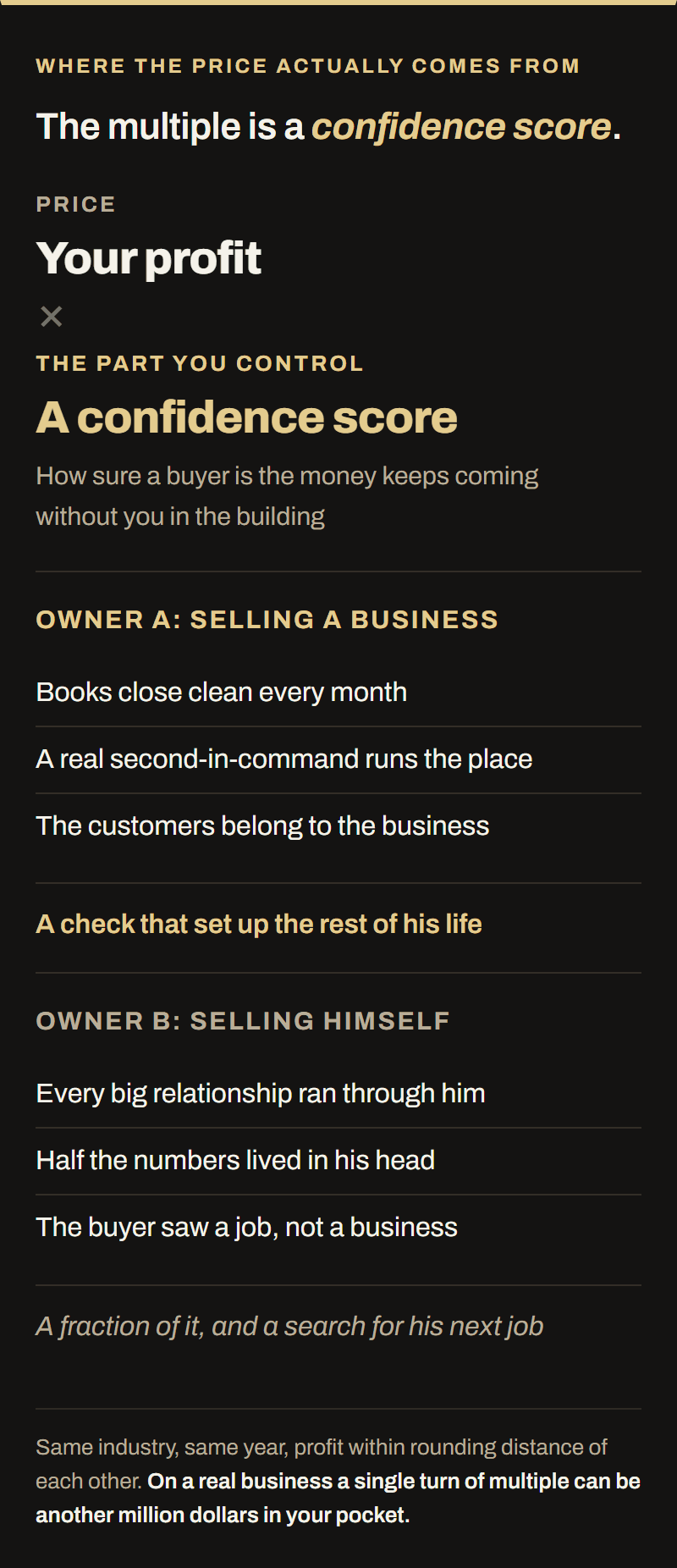
A buyer isn’t paying you for last year’s profit. Last year is gone. They’re paying for how sure they are that the profit keeps showing up after you hand over the keys. That’s it. Price is your profit times a multiple, and the multiple is really just a confidence score: how sure is this buyer that the money keeps coming without you in the building?
Confident buyer, higher multiple. Nervous buyer, lower multiple, or no deal at all. Two businesses with the same profit can sell turns of multiple apart, and on a real business a single turn can be another million dollars in your pocket. That spread is the whole game. And almost all of it is inside your control.
So what was different about my two owners?
The first one had spent years quietly making himself unnecessary. His books closed clean every month. He had a real second-in-command who ran the place. The customers belonged to the business, not to his cell phone. When the buyer asked, “what happens if you take a month off,” the honest answer was “nothing, it already happens.” The buyer was buying something that runs.
The second owner was the business. Every big relationship ran through him. The numbers lived half in the accounting system and half in his head. When the buyer pictured him gone, they didn’t see a business. They saw a job they’d have to show up for every day. And nobody pays a premium to buy themselves a job. So the buyer discounted hard, because every dollar of that profit had the owner’s fingerprints on it.
Same profit. One was selling a business. The other was selling himself.

Owner B could have become Owner A. That work takes a couple of years, which is why it has to start well before a sale process opens.
Owner B could have become Owner A. That work takes a couple of years, which is why it has to start well before a sale process opens.
The five things that move the number.
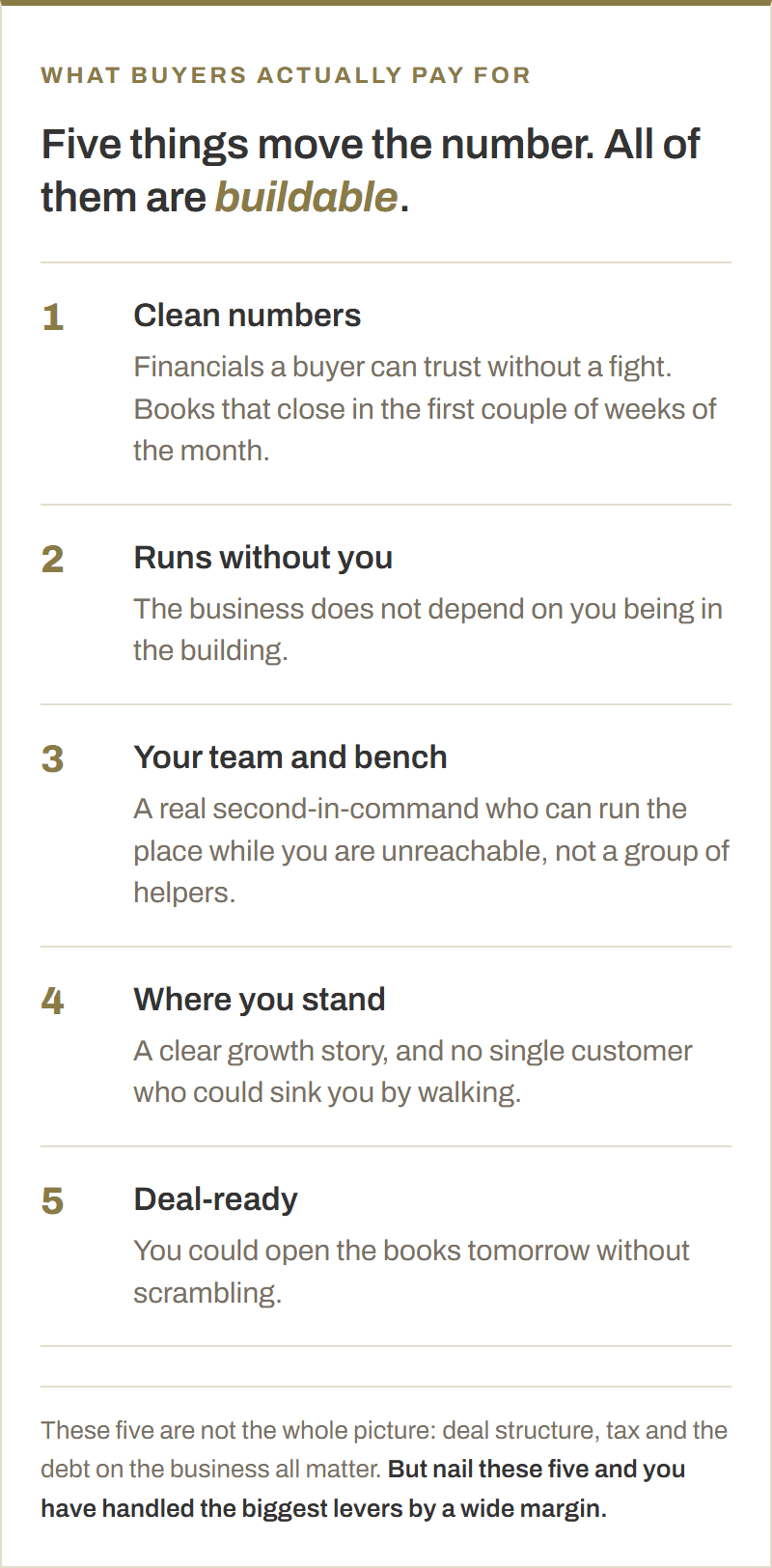
After watching this play out again and again, the things that decide your price come down to five. None of them are magic. All of them are buildable.
- Clean numbers. Financials a buyer can trust without a fight.
- Runs without you. The business doesn’t depend on you being in the building.
- Your team and bench. There’s a real second-in-command, not just you and a group of helpers.
- Where you stand. A clear growth story, and not one giant customer holding the rope.
- Deal-ready. You could open the books tomorrow without scrambling.

None of the five is magic, and all of them are buildable.
None of the five is magic, and all of them are buildable.
That’s the list worth knowing. These five aren’t the whole picture. How your taxes and deal are structured matters, so does how much debt sits on the business, and there’s more in the weeds than that. But nail these five and you’ve handled the biggest levers by a wide margin. Good looks like books that close clean in the first couple weeks of the month, a real second-in-command who can run the place while you’re unreachable on a beach, and no single customer who could sink you by walking. I wrote up the longer version of each one here: how to increase the value of your business before you sell.
And if you’re reading this thinking you’re behind, you’re in good company. The Exit Planning Institute’s owner-readiness research has found for years that only about a third of owners have a written plan for what is usually the single biggest transaction of their lives. Study after study on small businesses lands on the same uncomfortable fact too: most of them lean on just one or two key people, and usually the owner is one of them. The gap is everywhere. Closing it is rare. Rare is exactly what gets paid for.
And it doesn’t matter much where you sit on the clock. Whether you’re three years out or already deep in a conversation with a broker, knowing your gaps is what changes the number. Starting early gives you more room to move, but it’s almost never too late to stop leaving money on the table. If you’re closer to the finish line than that, the full version of the work is here: how to get your business ready to sell.
Here’s the part for the owner who isn’t selling anytime soon
Because this is the whole point.
Every single thing on that list makes your business better right now, today, whether you ever sell or not. Clean numbers mean you actually know where you’re making money. A business that runs without you means fewer 11pm phone calls and a vacation that’s actually a vacation. A real number two means you can finally grow past your own calendar instead of hitting the ceiling of your own hours.
The exact same work that makes a business worth more to a buyer in three years is what makes it run better, throw off more cash, and stress you out less this quarter. You’re not choosing between running it well and selling it well. It’s the same job. The same work pays twice. That’s most of what LIMESTONE does with owners, and most of them are years away from selling anything.
That’s why I don’t really think of this as exit planning. I think of it as building something worth more that you get to enjoy in the meantime, and sell on your terms whenever you decide, if you ever decide at all.
Don’t guess your number
And please don’t wait for a broker to hand it to you at the finish line, when there’s no time left to change it.
Find out where you actually stand. Your CPA can tell you last year’s number and what you’ll owe in tax. That’s not the same as knowing what a buyer would actually pay, or which gap is costing you the most. The free Foundation Check, on LIMESTONE’s website, takes about ten minutes. It reads your business across those five things and shows you the one that’s holding your value back the most. No pitch. If we can’t help you, we’ll tell you that straight, and point you to who can.
Jared Luegers is the founder and managing partner of LIMESTONE Strategic Partners and a CFA charterholder. He supported operations through a $190 million strategic sale, helped acquire a small Indiana operating business, and led M&A at a $9B Indiana RIA. He is the founder of OWN Indiana.
Sources: Pepperdine Private Capital Markets Report 2026, Table 31, page 65: median deal multiples by EBITDA size and industry.
