
A working capital peg can be calculated correctly and still be wrong
Ryan Anoskey, CPA · 12 September 2026 · 13 min read
LIMESTONE Strategic Partners sets and tests the working capital peg in every quality of earnings report it prepares, for buyers and sellers of businesses earning $500K to $5M of EBITDA.
A working capital peg can be computed correctly and still be wrong. We calculate it four ways, test how much of the average balance converts to cash, and name the debt-like items that sit outside it. Since SBA’s 25 September update a post-closing true-up that pays the buyer back can stay in an SBA-financed deal.
A working capital peg can be calculated correctly and still be wrong. A computed peg answers what the balances averaged. A tested peg answers how much of that converts to cash for you, and since SBA’s 25 September update a true-up that pays you back can stay in the business on a 7(a) deal.
Everything on this page is money you owe on the morning after closing, and most of it is not in the purchase price. The peg, the debt-like items, and the tax that attaches to the business itself and passes to whoever owns it next.
Computed against tested, which is the distinction that costs buyers money
Almost every provider delivers the computed peg, which is twelve month-end balances of current assets excluding cash, less current liabilities excluding debt, averaged across the window and struck on a cash-free and debt-free basis. On our worked example that is $1,297.1K, which is 11.8 percent of trailing revenue and correct to the dollar. What has this business historically carried?
The tested peg is the same arithmetic run after aging the receivables, testing the inventory for saleability and obsolescence, and confirming that accrued liabilities are complete. How much of that converts to cash for you?
What the testing found on this business
Days inventory on hand runs at 61 against a 45-to-75 band, which reads comfortable until you age it. The computed peg carries the slow-moving portion at cost, because that is what the balance sheet says it is worth. A buyer who accepts the computed figure as a negotiated one is funding somebody else’s working capital. And calling it a fair price.
Four methods, four answers, and the month decides
The four methods land within $53K of each other here, so no method distorts the price on this business. Where a business is growing or genuinely seasonal that spread widens fast, and the month the peg sits on starts deciding the number.
| Method | Result | When to use it |
|---|---|---|
| Trailing twelve-month average | 1,297.1 | Recommended here. It smooths the December and January trough, where the operating account ran brief overdrafts |
| Six-month average | 1,319.7 | For a business growing fast enough that a year-old month no longer represents it |
| Three-month average | 1,327.7 | The most exposed to whichever season you happen to close in |
| Same month, prior year | 1,275.0 | A cross-check for a seasonal close date |
Hoosier Supply Co. (illustrative). $ in thousands. Twelve month-end adjusted balances; the trailing twelve-month average is 1,297.1. Working capital is defined as current assets excluding cash less current liabilities excluding debt, on a cash-free and debt-free basis.
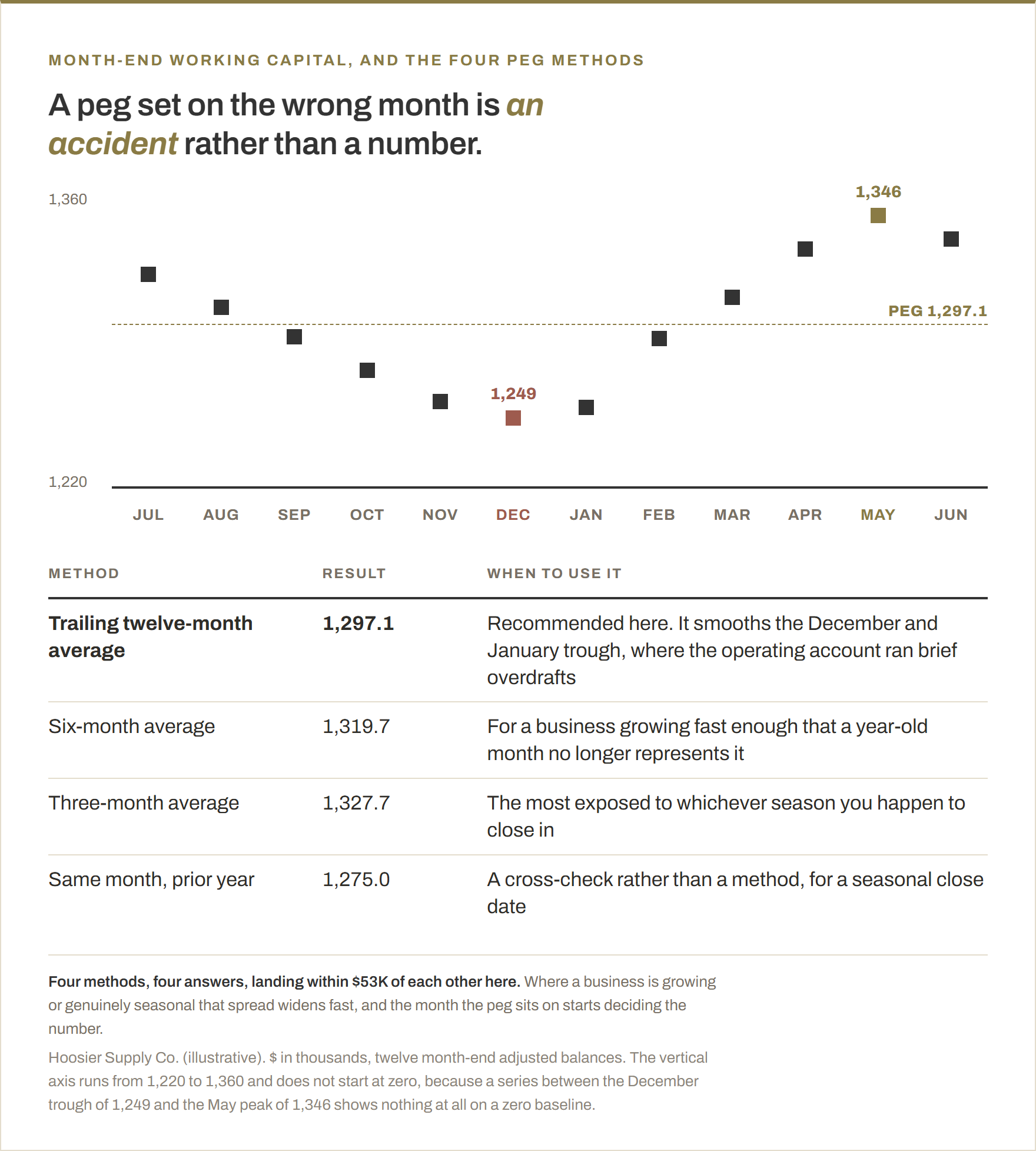
The four peg methods land within $53K of each other, so which months you count matters more than which method you name.
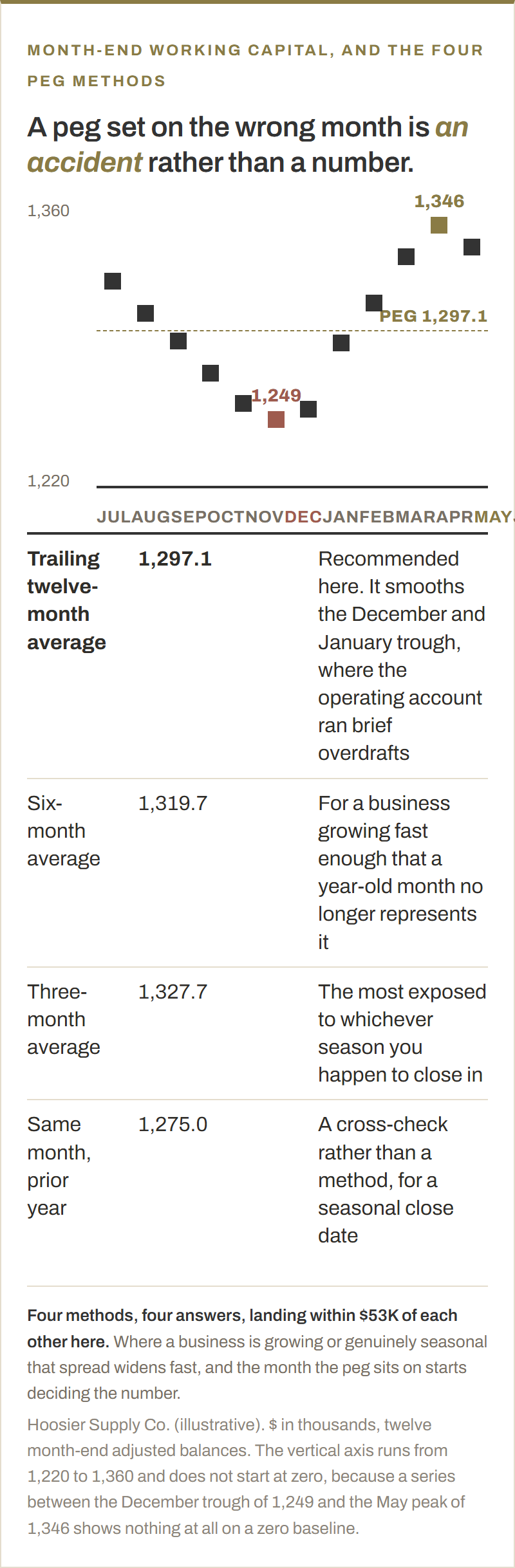
The four peg methods land within $53K of each other, so which months you count matters more than which method you name.
The question to ask your advisor is which month-end balances went into it, and what the peg would be on the other three methods. SRS Acquiom’s 2022 Claims Insights Report found a purchase price adjustment mechanism in 92 percent of the deals it covered, so this is a standard conversation. Ask it.
What the SBA rules allow after closing
Working capital adjustments are standard in private-target deals and they normally settle sixty to ninety days after closing. Since SBA’s 25 September update the SOP says in terms how one works on a 7(a) change of ownership: a working capital adjustment in the purchase agreement “is not a rebate to the Borrower,” because “the funds remedy a lack of working capital at the time of the acquisition,” and any cash paid to you “may be retained to support the ongoing working capital needs of the business and is not required to pay down the change of ownership loan.”
Money moving to the seller after closing
“Seller earnouts are prohibited.” That removes any payment tied to how the business performs after you own it. A true-up that runs the other way, money you owe the seller because more working capital arrived than the peg assumed, is something the SOP does not address in terms, so settle how it will be paid in the purchase agreement and clear it with your lender before closing. Escrow is tight as well. A lender may use an escrow account “for not more than 5 business days to facilitate a loan closing,” which is a limit on its closing escrow, and a holdback meant to sit for sixty days needs a structure your lender has agreed to.
Money moving back to you
Two different payments can come back to you, and the SOP treats them differently. A buyer rebate based on business performance is allowed “because this is a benefit to the Borrower,” and it carries a condition: “If the Borrower receives funds based on a rebate from the seller, proceeds must be applied to pay down the principal balance of the 7(a) loan,” with no subsidy recoupment fee under 13 CFR 120.223. A working capital true-up is not a rebate, so that cash can stay in the business and fund its working capital.
SBA SOP 50 10 8.1 with Technical Policy Updates (25 September 2026), Appendix 15 Para. A.1 for earnouts, rebates and the working capital true-up and Para. C.2 for the equity treatment; Section B, Ch. 6, Para. D for the five-business-day escrow limit. Effective 1 October 2026. Quotations are verbatim.
What to do with this at the negotiating table
Settle working capital at closing with a peg you have tested, because a peg that was only computed is the one both sides end up arguing about after the wire. Write the true-up into the purchase agreement as a working capital adjustment, since the SOP now lets cash that comes back to you under it stay in the business, and keep performance protection in a buyer rebate priced knowing it pays down principal. And check the arithmetic. Total debt supporting the transaction is limited to the business valuation amount, and any shortfall has to come in as additional equity, where a limited source such as more seller debt goes on full standby.
Debt-like items, named, tested and reported even when the answer is nil
Debt-like items are obligations that behave like debt and do not look like it on the face of a balance sheet. Each one is a line an experienced buyer deducts from the price, and the procedure is always the same: name the category, test it, and report the result even when the result is nil and there is nothing to report.
| Category | Result | Why it does not look like debt, and where it hides |
|---|---|---|
| Accrued paid time off | Clear | Earned, unused, payable in cash the day anyone leaves. On a cash-basis book it appears nowhere |
| Customer deposits and prepayments | Clear | Cash already received for work not yet done: revenue on the way, an obligation today |
| Unremitted sales and payroll tax | Clear | Collected in trust and owed to a state. It survives an asset purchase |
| Deferred compensation and bonuses | Clear | Promised for a period the buyer owns. Usually undocumented, and always remembered |
| Accrued owner distributions | Clear | Declared and unpaid on an S corporation. Reads as equity, behaves as a payable |
| Aged payables and capital leases | Clear | A supplier financing the business without a note, and debt with a different word on the document |
Hoosier Supply Co. (illustrative). Source: engagement model, from the debt schedule, payroll register, accrual detail and state filings.
All six came back clear here. The debt-like adjustment to the equity bridge is zero. A nil result is still a finding and it belongs in the report, because a report with no debt-like section has not told you whether the work was done. Ask for the section.
Where an asset purchase stops helping
Most buyers in this band buy assets partly because they were told it leaves the liabilities behind, and it leaves most of them behind. Tax is where the reasoning stops. Several states attach the obligation to the business itself, whichever entity incurred it, so a buyer who keeps the doors open and the same customers served inherits the liability along with the trade.
| Exposure | On this deal | What was found, and what it costs to settle |
|---|---|---|
| Sales and use tax, economic nexus | 60 to 90 | Three neighboring states with likely economic nexus and no registrations found, plus penalties. Settled through voluntary disclosure and an escrow |
| Worker classification | 20 to 40 | Two long-tenured 1099 contractors who look employee-like. Reclassification re-burdens earnings going forward, which moves your coverage ratio |
| Local and franchise filings | Question | One county gross-receipts filing appears missed. The amounts are usually small and the penalty regime is not |
Hoosier Supply Co. (illustrative). $ in thousands. Source: engagement model, from the state filings, the payroll register and the general ledger.
We identify and quantify these and we do not settle them. Clearance certificates, voluntary disclosure and reclassification are tax specialist work, and the referral is part of the engagement. Two 1099 contractors who have worked the counter for nine years is a payroll question with nine years behind it, and the state finds these eventually.
Run the searches before you need them
These cost about $1,500 and a week, and they belong in week one of exclusivity, well before the loan closing in week ten. Every one of them turns up recorded interests and none of them reads a contract, so what they find is narrow, cheap and worth having early.
| The search | What it actually finds |
|---|---|
| UCC-1 financing statements Secretary of state, every state | Every lien against the assets you are buying, in every state the business has operated or held equipment. Stale filings from paid-off loans are common and have to be released before closing |
| Judgment and litigation County and federal | Docket searches in every county of operation and the federal district. What it misses is a dispute that has not been filed yet, which is why you also ask the question out loud |
| Tax liens Federal, state, county | Filed liens only. An unpaid liability that nobody has assessed yet does not appear, which is the entire point of the tax section above |
| Entity good standing And every name it has used | Formation, amendments, registered agent and assumed names. Search every historical name and affiliate, because filings follow the name, whatever business is behind it |
| Bankruptcy and the principals Federal, by name | PACER, on the seller and on every entity he has controlled. A prior filing is not disqualifying, and it changes how you read the rest of the file |
| Fixtures and titled assets Vehicles and equipment | Titles for anything on wheels, and fixture filings on anything bolted down. SBA requires a lien on a vehicle valued above $20,000 at the time the loan number is assigned, so the list matters to your lender too |
LIMESTONE method. The lien requirement on a vehicle above $20,000 is SBA SOP 50 10 8.1.
All six sit near the top of a request list ordered by production time. Not one of them needs the seller at all, which is exactly why they should be running while you are still waiting on him. Order them in week one.
How this was built, and where it stops
The earnout prohibition, the buyer rebate condition, the working capital true-up, the five-business-day escrow limit and the vehicle lien threshold are quoted from SOP 50 10 8.1 at the paragraphs named above. The 13 CFR 120.223 point on subsidy recoupment is the regulation. The peg methods, the debt-like categories, the tax exposures and the search list are our own method. Hoosier Supply Co. is a fictional composite used across our published samples, and the whole method is in the field guide, every figure attached to it is illustrative, and we express no conclusion of value.
Three limits. We quantify tax exposures and we do not settle them, because that is specialist work. Nothing here is legal or tax advice. And the SBA material carries a date: this page was updated on 27 September 2026 for SBA’s technical update of 25 September, which changed how the SOP treats a working capital true-up.
Questions we hear
How does a working capital peg work?
You and the seller agree a normal level of working capital for the business, and the price adjusts for whatever is actually delivered at closing against that level. Deliver more than the peg and the seller is owed the difference. Deliver less and you are owed it. The peg itself is usually an average of month-end balances over some window, struck on a cash-free and debt-free basis, which means cash comes out of the calculation and so does every dollar of interest-bearing debt. It goes wrong in two places. The window, and the testing. A three-month window on a seasonal business measures a season. And an untested peg values receivables nobody has aged and inventory nobody’s looked at.
What is a working capital peg?
It’s the agreed normal level of working capital the seller has to leave in the business. Think of it as the fuel in the tank on the day you take the keys, which is a useful picture right up to the moment somebody asks how much of the fuel is water. Yale puts the consequence better than a definition does: “An inaccurate working capital peg might mean the searcher pays for inventory that is gone by 12:01 AM on the day they take over as CEO.”
How do you build a peg when accounts payable is not tracked monthly and only payments are recorded?
The best technical question in the harvest, and it comes up constantly on businesses this size. You rebuild the balance you need from the documents that do exist. For payables, take the vendor statements at each month end together with the check register, and reconstruct the open balance by matching every invoice to the payment that cleared it after that date. It’s slow, and it isn’t an estimate. For in-transit inventory, work from the purchase orders, the carrier documents and the terms on each order, because the terms tell you when title passed and therefore whose balance sheet it belongs on. Where a month genuinely can’t be rebuilt, say so in the report. Use the months you can and widen the window, and claim no more precision than the records support. A peg built on four reconstructed months with the method stated is worth more than twelve months of numbers nobody can source.
How essential is tax diligence on an asset deal?
More essential than on a stock deal. Which isn’t what most buyers assume. The logic that an asset purchase leaves liabilities behind holds for most of them. It fails for the ones that attach to the business itself. Sales and use tax, payroll tax and a misclassified workforce all follow the operations. They come with you. The exposure on our worked example runs to a range of $80K to $130K across three categories. Against a ten percent injection, that is a meaningful share of the cash you are putting in.
If I do require tax diligence, what is the minimum scope?
Four things, and all four are answerable inside a week. Not one of them is expensive. State registrations against where the business actually ships, which is the economic nexus question. The payroll register read for anyone paid on a 1099 who looks employee-like. Any local or franchise filing the business should be making and might not be. And confirmation that sales tax collected has actually been remitted, because collected-and-unremitted is money the business is holding in trust for a state, and there is nothing to argue about later. That distinction decides who pays. Anything beyond that is worth buying only if one of those four turns something up. Start there.
Is asking for both a seller note and a five percent escrow holdback double-dipping?
Fair question, and on an SBA deal the instrument is usually the problem. Seller earnouts are prohibited on a 7(a) change of ownership, and the lender’s closing escrow is limited to five business days, so a holdback meant to sit for sixty days needs a structure your lender has agreed to. What works is a seller note on full standby, which counts toward the equity injection and becomes refinanceable after 36 months in place and current, a buyer rebate for performance protection, which pays down principal, and a working capital adjustment in the purchase agreement, which since the 25 September update is not a rebate and can stay in the business. Asking for those is not double-dipping.