
The loan decides the price more than the multiple does
Ryan Anoskey, CPA · 12 September 2026 · 12 min read
LIMESTONE Strategic Partners runs the debt service coverage math inside every quality of earnings report it prepares for SBA 7(a) buyers and lenders, from Carmel, Indiana.
From 1 October 2026 the earnings in the quality of earnings report set the debt service coverage on a 7(a) acquisition, and where coverage will not support the structure the loan amount must be reduced and the gap filled with equity. The floor on an initial acquisition is 1.25 times. Three levers move it: the add-backs that survive testing, the price and amortization of the debt, and the equity injection.
From 1 October a 7(a) lender must use the earnings from the quality of earnings in the debt service coverage determination, and where that coverage will not support the structure the loan amount must be reduced. The add-back argument and the financing argument became the same argument.
One sentence, and it moves a conversation buyers used to have with a seller into a conversation they now have with a bank. An add-back you talked a seller into is no longer private. It now has to survive a read by somebody the lender engaged, or it comes out of the loan.
What the rule says, and what it decides
SBA SOP 50 10 8.1, Appendix 15, is unusually direct about the arithmetic. Coverage is 1.25 to one on an initial acquisition, 1.15 on a business expansion, and one to one globally in both. On which earnings go into that test, the appendix says: “The Lender must use the earnings from the QoE in the Debt Service Coverage (DSC) determination.” Projections may be evaluated and not relied upon, except on an owner-occupied special purpose property. And where coverage will not support the structure, “the loan amount must be reduced accordingly.” Four lines, and they decide the price.
Read those four lines together and the sequence inverts. Most buyers arrive at a price by putting a multiple on an earnings figure. Under 8.1 the earnings figure is tested first by a quality of earnings the lender can rely on, its own or yours after its vendor has reviewed it, the coverage floor divides it, the amortization prices it, and the program cap tops it out. Whatever that arithmetic supports is the price. The multiple is an output. You write it down at the end.
Work it in this order
Start at the tested earnings. Divide by the coverage floor your lender applies. Price the loan that payment will carry at the real amortization. Add the equity you can actually put in. On the worked example in the field guide, tested earnings of $1,247.1K support a maximum annual debt service of $997.7K at the 1.25 floor, which carries a loan of about $6,291.3K at ten years and ten percent. The 7(a) maximum of $5,000.0K binds first, and at a ten percent injection that supports a total project cost of $5,555.6K. That is 4.5 times the tested earnings, which describes the structure rather than setting it.
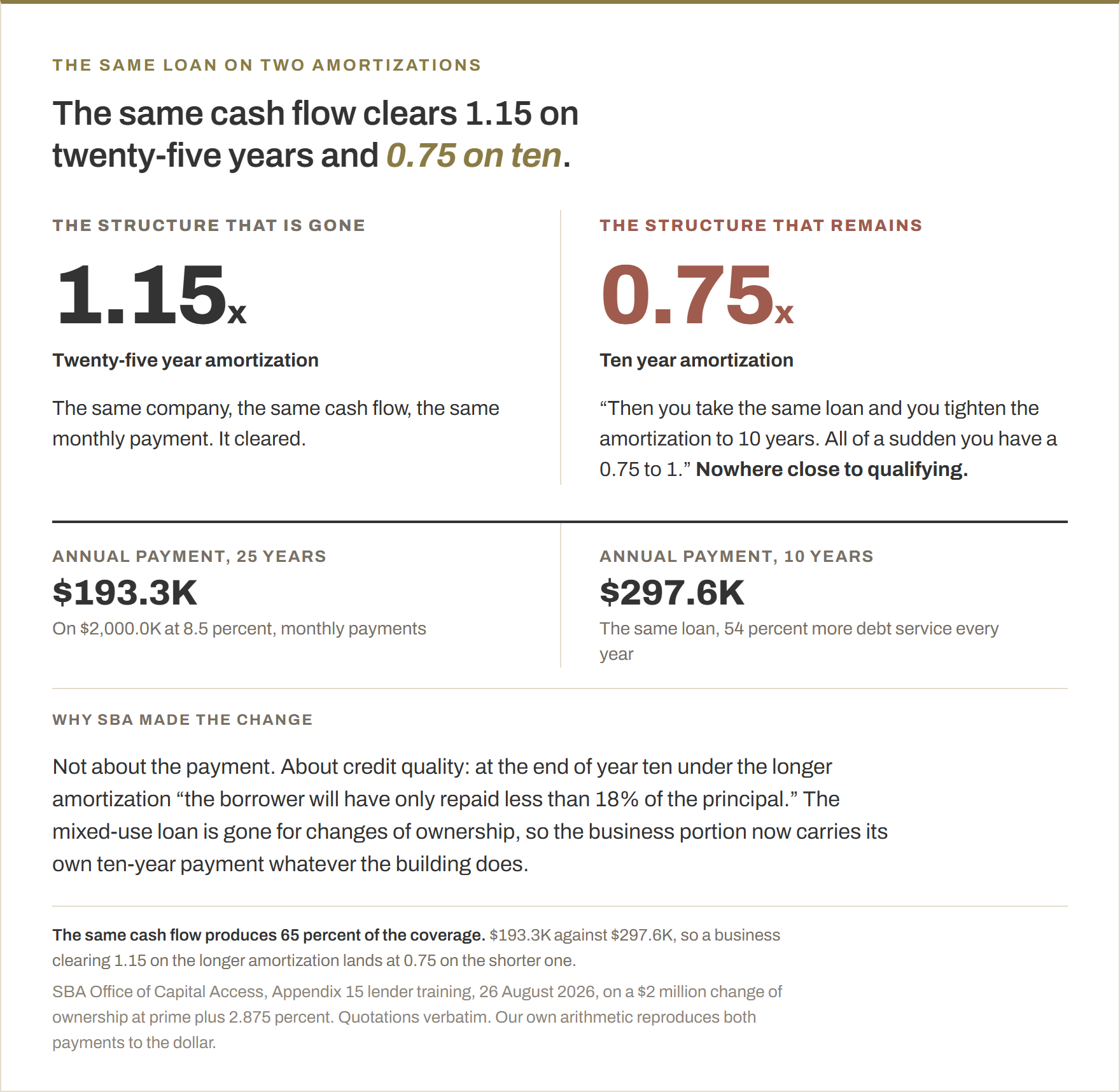
The same cash flow produces 65 percent of the coverage once the amortization tightens to ten years.
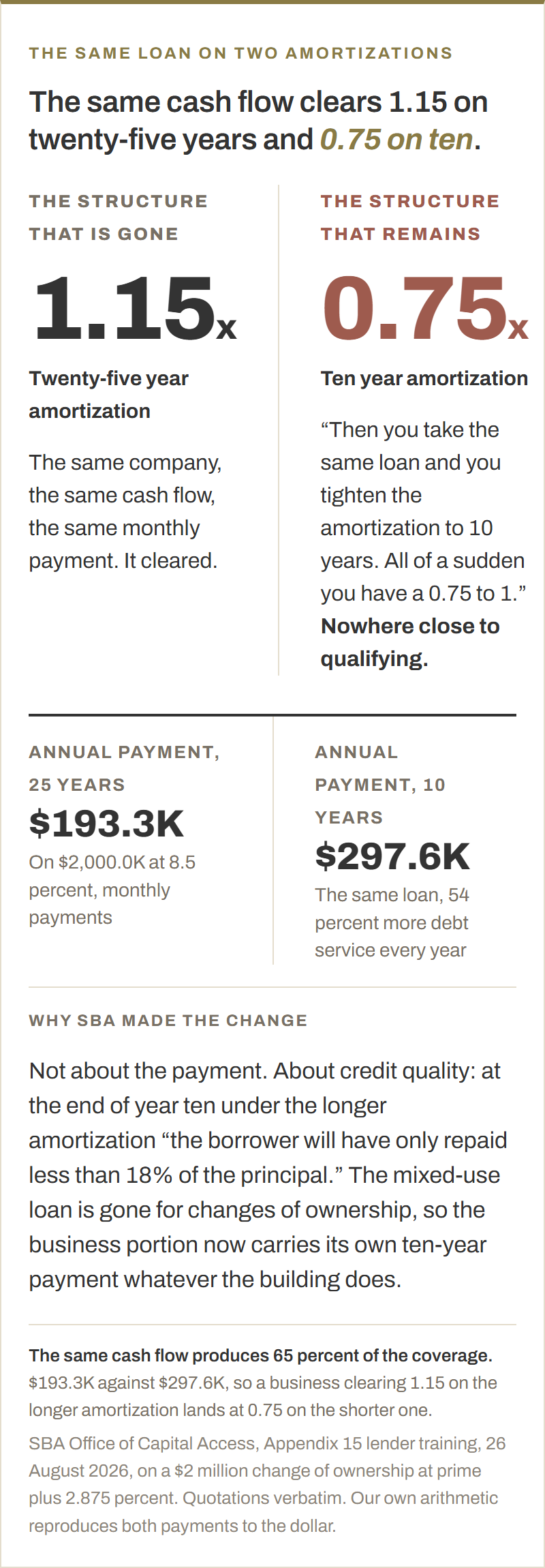
The same cash flow produces 65 percent of the coverage once the amortization tightens to ten years.
What the 7(a) maximum costs, and the earnings it needs
The table below is the arithmetic at each loan size, on a ten-year amortization with monthly payments, at two rates. Rate matters more than buyers expect. SBA caps it on a loan above $350,000 at the base rate plus three percent, so substitute prime plus three for today’s answer.
| 7(a) term loan | Annual debt service at 8.5% | At 10.0% | Adjusted EBITDA needed at 1.25x |
|---|---|---|---|
| $2,000.0K | $297.6K | $317.2K | $372.0K to $396.5K |
| $3,000.0K | $446.3K | $475.7K | $557.9K to $594.7K |
| $4,000.0K | $595.1K | $634.3K | $743.9K to $792.9K |
| $5,000.0K, the maximum | $743.9K | $792.9K | $929.9K to $991.1K |
$ in thousands. Coverage floors from SBA SOP 50 10 8.1 Appendix 15 Para. C.2. Payment arithmetic is ours and reproduces to the dollar.
Two readings of that table are worth having. On a business at the top of the band the program cap binds before the coverage floor does. Our worked example carries the $5.0M maximum at 1.68x coverage at 8.5 percent and 1.57x at ten, so the constraint is the cap and not the earnings. Move down one band and it reverses. A business at $900K of adjusted earnings is $91K short of the maximum loan at ten percent, and on that deal the three add-backs a lender strikes decide whether there is a deal at all. Which is why the two arguments are now one.
The amortization change, and why it costs more than it looks
The mixed-use loan is gone for changes of ownership, and with it the twenty-five year amortization on the business portion where real estate came along. Two structures remain for most deals. The exception, added on 25 September, is an owner-occupied special purpose property such as a hotel or storage facility that cannot be separated from the business, which may carry one loan of up to 25 years where 85 percent or more of project costs are real estate. Two separate loans, ten years on the business and up to twenty-five on the real estate, where the business portion carries its own ten-year payment whatever the building does. Or one blended maturity on a weighted average of the two uses, rounded to the nearest year and taken before any equity is applied, so you cannot pay down one leg to lengthen the other.
SBA put the consequence in its own numbers. On the lender training call, on a $2 million change of ownership at prime plus 2.875 percent:
“When you need 25 years to stretch that business acquisition further out, it’s the same company, it’s the same cash flow, it’s a weaker credit overall is what it allows for.” And then: “Then you take the same loan and you tighten the amortization to 10 years. All of a sudden you have a 0.75 to 1.” Nowhere close to qualifying.
Our own arithmetic reproduces it. The annual payment on $2,000.0K at 8.5 percent is $193.3K over twenty-five years and $297.6K over ten, so the same cash flow produces 65 percent of the coverage. A business clearing 1.15 on the longer amortization lands at 0.75 on the shorter one. Same company. Same cash flow. SBA’s stated reason is worth knowing, because it is about credit quality rather than payment size. At the end of year ten under the longer amortization “the borrower will have only repaid less than 18% of the principal.”
The equity injection, as it now reads
Appendix 15 is unusually plain here. The minimum injection is ten percent of the total project cost, which the update defines as all costs required to become operational, whatever the source of funds, except lines of credit and 504 loans. And: “For Initial Acquisitions, the required equity injection cannot be reduced or eliminated.” Business expansions and owner buyouts can have theirs reduced or removed where the lender is satisfied on liquidity. An initial acquisition cannot. Where the money comes from is governed as tightly as how much there is.
| The rule | The number | How it works |
|---|---|---|
| Minimum injection | 10% | Of the total project cost, including any fees financed into the loan, at any size |
| From the principals | 5% | “We need the principals bringing in a minimum 5% of the equity.” The other half can come from elsewhere, within the cap below |
| Cap on limited sources | 50% | Seller debt on full standby and non-controlling minority equity, individually or together, may supply no more than half the requirement. The cap now applies across both categories, where the prior SOP was silent |
| Seller note, to count as equity | Full standby | No principal and no interest for the whole term of the 7(a) loan. Interest may accrue and be paid after the 7(a) loan is gone. Refinanceable after 36 months of being in place and current |
| Where the price runs ahead of the value | Standby | Where the sales price exceeds what the valuation and the quality of earnings support, the difference comes in as additional equity, and any limited source that funds it, such as more seller debt, must be on full standby |
SBA SOP 50 10 8.1, Appendix 15 Para. C.2, and the Office of Capital Access lender training of 26 August 2026 for the quoted five percent. Effective 1 October 2026.
That last row is the mechanism by which a tested earnings figure reaches your bank balance. Agree a price the valuation and the review will not support and the gap stays out of the loan. It comes out of your pocket, or from a limited source such as more seller debt, which then sits on standby, earning nothing, for as long as the 7(a) loan runs, which can be ten years.
Three levers on the coverage ratio
Coverage is arithmetic, so there are only a few places to push. Two of these are SBA’s own and the third is a cost most buyers never model.
Move permanent working capital off the term loan and onto a line
This is SBA’s worked example, offered on its own training call as a route for deals that do not quite clear. On a $4.2M initial acquisition, replacing $200,000 of permanent working capital in the term loan with a $1M line, and moving $300,000 of day-one availability across, took coverage from 1.34x to 1.52x. Liens on receivables and inventory are now required, and a lender may move that collateral to a line for no less than 20 and no more than 50 percent of day-one availability. Worth knowing before you ask. If the business carries customer concentration, those invoices can leave the eligible borrowing base, which cuts the availability this lever depends on. Ask early.
Check whether the deal is an expansion rather than an acquisition
A business expansion carries a 1.15 floor instead of 1.25 and the injection can be reduced. It needs two full fiscal years under current ownership, not twenty-four months, and a four-digit NAICS match rather than six. SBA said the delegated team can support an exception. Worth one email. The category is an entry in the SBA Loan System and it has to be justified in the credit memorandum, so there is a right answer and somebody has to write it down.
Quote the insurance before it quotes you
In the deal Yale recounts, diligence found a premium rising by $170,000 a year against an EBITDA that had already come down $150,000, and it nearly ended the deal. Insurance is the cost nobody models. Ask for it in week two and it lands in week two. Quote it on the real entity and the real loss history rather than on the seller’s current premium, which was priced for a different owner with a different claims record.
Two standards we publish and hold to
Reliance is a named, priced liability and never an informal courtesy. If your lender wants to rely on a report you commissioned, that extension is negotiated, documented and paid for, and on an SBA loan the SOP also requires one of the lender’s approved vendors to review the report. A provider who waves it through without changing the engagement letter has not understood what he signed. You find that out at the worst possible moment. Settle it before the work starts.
One firm should not write both the valuation and the review on the same deal. The appendix asks the report to be independent and prepared for the lender’s benefit. SBA went further out loud on its 26 August training call, and the spoken standard is harder than the written one: the preparer “cannot be affiliated in any way with any advisory firm on either buy side or sell side or any agent involved,” and a wall between divisions is not an answer.
How this was built, and where it stops
Every rule above is quoted from SOP 50 10 8.1, Appendix 15, or transcribed from the Office of Capital Access lender training of 26 August 2026, which we hold in full. Every payment, coverage ratio and required-earnings figure was recomputed from first principles rather than carried over from a model. Each one reproduces to the dollar. The worked example, Hoosier Supply Co., is a fictional composite used across our published samples; every figure attached to it is illustrative and we express no conclusion of value.
Two limits. SBA published a technical update to the appendix on 25 September, and this page was updated on 27 September 2026 to match it. And this page offers no legal or tax advice and no recommendation about which lender to use. Several of the questions below sit at the edge of what the SOP answers, and where it does not answer them we say so rather than guessing.
Questions we hear
What are market terms for a seller note on an SBA deal?
For a note that counts toward the equity injection, the terms are not market at all. They are prescribed. Full standby for the whole term of the 7(a) loan, which means no principal and no interest paid. Interest may accrue and be paid once the 7(a) loan is gone. Refinanceable after 36 months in place and current. Seller debt on standby and non-controlling minority equity together may supply no more than half the injection requirement, and that cap now applies across both categories where the prior SOP was silent on the point. A note that is not on full standby can still exist in the deal. It just does not count as equity, and it competes with the bank for the same cash flow. That is where it shows up in your coverage.
Can I use a HELOC as the SBA down payment?
The principle the SOP applies is that borrowed funds count as an injection only where you can show repayment from a source other than the cash flow of the business you are buying. A home equity line serviced out of your salary is a different case from one serviced out of the company’s distributions. Lenders treat them differently. We are stating the principle rather than quoting a paragraph at you, because the documentation a lender wants varies by lender and the call belongs to them. Ask in writing before you draw anything.
If I draw the line in May and sign a letter of intent in August, how would SBA know it came from a borrowed source?
Because the file shows it. A lender verifies the source and seasoning of injection funds, and the trail through your accounts is the evidence. Timing is not the variable. What decides it is whether the repayment comes from somewhere other than the business, and whether you can document that. We are not going to tell you how many months of seasoning satisfies a particular lender, because the SOP does not set that number and we would be inventing it.
Can a spouse or partner be the guarantor instead of me?
Guarantees follow ownership rather than preference, and the lender will want them from the people who own the company. Beyond that principle this is a question for your lender and your counsel, and the answer turns on the ownership structure you are proposing rather than on anything we can source for you here.
Can the personal guarantee be removed over time?
Not as a program feature. The guarantee is the structure of the loan rather than a condition that lapses, which is the single most important difference between what you are signing and what a fund signs. Plan on carrying it for the life of the loan. The price you reach for is the price you stay personally behind, which is the real reason the sequence in this guide is worth respecting.
Does SBA allow personal guarantee insurance?
Products exist commercially and we are not the right people to advise on them. What we can tell you is that buying cover does not change the guarantee, the coverage test, or the arithmetic on this page. If you are reaching for insurance to make a deal feel survivable, the finding is the deal. Take the question to a broker and to your counsel, and price it as a cost.