
SBA carries two different concentration thresholds in the same rulebook
Jared Luegers, CFA · 12 September 2026 · 11 min read
LIMESTONE Strategic Partners reads revenue quality and customer concentration as part of its operational due diligence for buyers, with an operator and a CPA on every engagement, from Carmel, Indiana.
Concentration is a direction as much as a level. We read the top twenty customers by share, tenure and churn, split revenue into contracted, repeat and one-time against the invoices, and run customer reference calls under five rules, so a buyer knows whether next year’s revenue is already spoken for or has to be won again.
SBA sets no concentration threshold when it tests the earnings and a 20 percent default on outstanding receivables when it lends against the invoice on an SBA working capital line. So the same account can be a paragraph in one document and a hole in the collateral in the other, and almost nobody joins the two up.
Part one of this method asks whether the earnings are accurate. This part asks whether they are transferable, which is a different question with different procedures and no overlap at all, and a business can be thoroughly profitable while being only lightly transferable. The financial work will never tell you which one you are buying.
Ask four people what concentration is too much and you get four numbers
Which is why we publish the dispersion rather than pick one. The regulator that just mandated the report supplies two of the three by itself, depending on which document you read.
| Who holds the line | The number | Where it comes from, and what it does to your deal |
|---|---|---|
| SBA, testing the earnings | None | Appendix 15 requires the report to assess “customer concentration risk, contract continuity, and the likelihood that existing revenue and margins will be maintained post-sale,” and sets no number. Mandatory assessment, lender’s conclusion |
| SBA, lending against the receivable | 20% | On a working capital line, “accounts from any one customer that constitute more than 20% of the total outstanding receivables should not be included in the eligible borrowing base” unless one of five narrow conditions is met |
| LIMESTONE, in the work | 15 to 20% | Where we flag an account and test it rather than describe it: the reference call, the contract status, pricing history, and who the customer calls when something breaks |
| Where this deal lands | 24% | The largest account on our worked example, with 70% in the top ten across twenty-one customers. Not one of the contracted accounts, and it buys on open purchase orders, so there is nothing to assign |
Quoted from SOP 50 10 8.1: Appendix 15 Para. C.1 for the earnings test, the Working Capital CAPLine requirements for the borrowing base. Hoosier Supply Co. (illustrative), trailing twelve months.
The consequence nobody joins up
A 24 percent account is a paragraph in the earnings report and a hole in the collateral. If the concentration carries through to receivables and the line is an SBA working capital line, those invoices can leave the eligible borrowing base, which cuts the day-one availability on the line of credit. And that line is the lever a lender reaches for when coverage does not quite clear: SBA’s own worked example moves coverage from 1.34x to 1.52x by shifting permanent working capital onto one. So a concentration finding can quietly remove the fix for a different problem, two documents away.
A level tells you nothing about a direction
Concentration is a trajectory as well as a number. An eleven percent account becomes a thirty percent account in four years if it grows faster than everything else, and the figure on the page today says nothing about which way it is heading. Ask for the top ten by revenue in each of the last three years and read how the ranking moved. That is one request and it costs the seller ten minutes.
The reference calls, and the five rules that govern them
A curated list of happy customers tells you nothing you could not have guessed. Ask the seller for the whole account list, select against the frame below, and give him one pick of his own. Five rules govern the calls before you dial any of them.
| The rule | How it works |
|---|---|
| Buy-side only | On a live sell-side deal we never contact a seller’s customers, including for an informal call |
| Written consent, through the seller | He introduces us, or he approves the list and the outreach in writing. Never a cold call |
| Never disclose the transaction | If a customer works it out and asks directly, deflect once and move on |
| Six calls | A seventh is a change order, priced and approved before it happens |
| No recording | Without explicit verbal consent captured at the top of the call |
Selecting the six
| The pick | Why it is on the list |
|---|---|
| Two of the top five | By revenue. Concentration is the point of the exercise, so the largest relationships are not optional |
| One long-tenured | Five years or more. Tests what the relationship is built on, and whether the answer is a person |
| One recent win | Inside eighteen months. Tests whether the business can still win work without the owner in the room |
| One at-risk account | Where the data shows one. This is the call that earns the fee, and the seller will resist it |
| One free pick, his | Give him one. It buys cooperation and it occasionally surprises you |
LIMESTONE operational diligence method, buy-side only.
The refusal is the finding. If a seller will not let you speak to the at-risk account, that refusal goes in the report as a finding in its own right. It is the one item on the list that produces a result whether the call happens or not, which is also why the at-risk name is requested in week two rather than week six.
Thirteen questions, and the third one is what the call is for
Fifteen minutes, and candid is more useful than polite. Four of the thirteen carry the read: dependency, failure recovery, pricing power and switching cost. Question three produces relationship-based dependency out of the customer’s own mouth rather than the owner’s, and if the answer is a first name you have found something the financial work cannot see.
Relationship and origin. How long have you worked with them, and how did that start? Who do you deal with day to day? Who do you call when something goes wrong?
Performance. What do they do well? Where do they let you down? Have you had a service failure, and what happened next?
Durability, which is what the buyer is paying for. Is there a contract, or is it a rolling relationship? When did you last look at alternatives, and what happened? If they raised prices five percent, what would you do? What would have to happen for you to move your business? Do you expect your volume to go up, down or stay flat, and why?
The open close. If you were advising someone about working with them, what would you say? Anything I should have asked and did not?
LIMESTONE customer reference-call guide, buy-side only. The four in italic carry the read. Nothing is attributed by name without consent, and six calls is a small sample the report has to acknowledge.
What a write-up looks like
A reference-call section reads like this, from our own standard: “Six customers representing roughly forty percent of trailing revenue were interviewed. Four described the relationship as tied to a specific individual rather than to the business. None had a written contract beyond a purchase order.” It gives the count, the share of revenue and what the customers actually said, which is three pieces of evidence a reader can weigh rather than a sentiment a reader has to take on trust. A line like “customers love working with the company” is not a finding.
Revenue character, tested against what management said
Management described about ninety percent of revenue on our worked example as repeating, and tested against the data the claim holds at eighty-nine. The total was right. The composition is what matters, because only the first band carries anything in writing.
| Character | Share of revenue | What it rests on |
|---|---|---|
| Contracted | 49% | Annual pricing letters and supply agreements. The largest account is not among them |
| Repeat, evidenced | 40% | Accounts that also purchased in each prior fiscal year, with nothing in writing |
| One-time | 11% | Re-won order by order, every order |
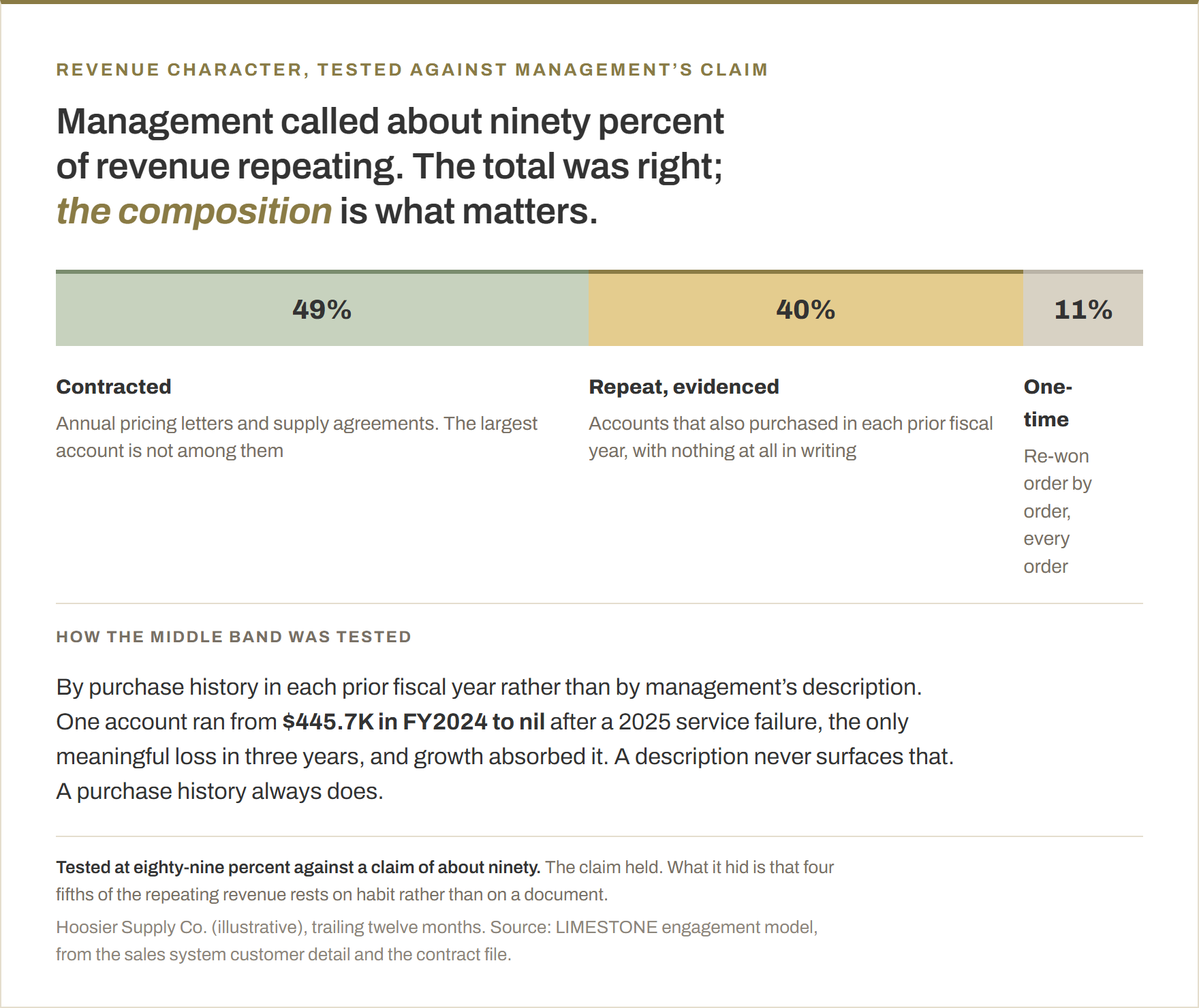
Management called about ninety percent of revenue repeating and the test puts it at eighty-nine; the finding is the mix inside that figure.
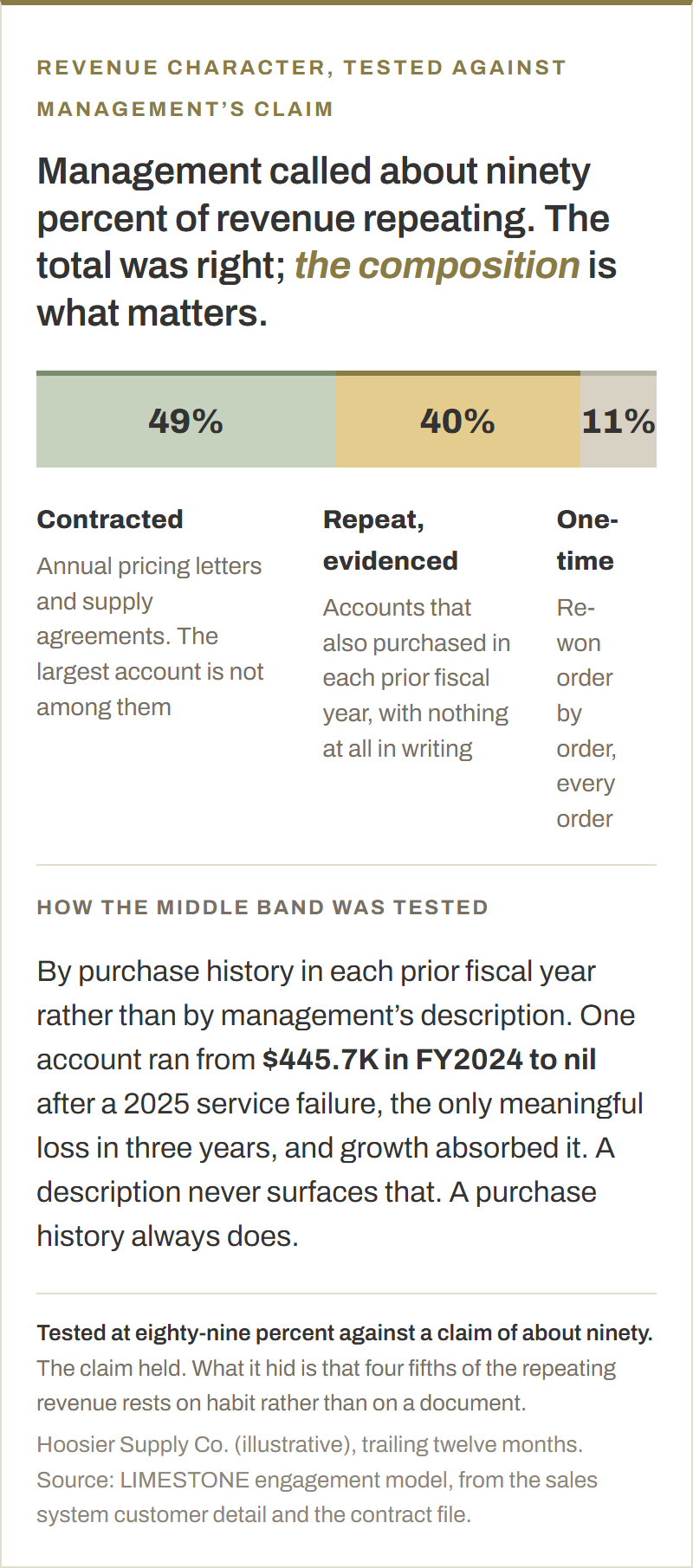
Management called about ninety percent of revenue repeating and the test puts it at eighty-nine; the finding is the mix inside that figure.
The middle band is the one to test, and by purchase history in each prior fiscal year rather than by management’s description. One account on this business ran from $445.7K in FY2024 to nil after a 2025 service failure, the only meaningful loss in three years, and growth absorbed it. That is the kind of thing a description never surfaces and a purchase history always does.
Three tests on durability
| The test | What it asks |
|---|---|
| Cohort retention | Take the accounts live three years ago and ask how many still buy, and at what volume |
| Pricing power | Find the last price increase, when it went out, and who pushed back on it |
| Backlog as evidence | Signed orders with dates are evidence. A weighted pipeline is a forecast |
Change of control, and the consents nobody sequences
This part is mechanical and it is where the legal work meets the durability question. Every item below is a consent, an assignment or a license that somebody outside the deal controls, and each one is a place where a signed purchase agreement does not finish the job.
| What it is | What to read, and what it does |
|---|---|
| Customer contracts Assignment and change of control | Read the assignment clause on every contract worth more than a rounding error. An anti-assignment clause turns an asset purchase into a consent exercise, and a change-of-control clause reaches a stock purchase too. On our worked example the top account has no contract at all |
| Supplier and dealer agreements Territory, rebate, exclusivity | Distribution rights and buying-group membership frequently do not survive a change of ownership, and the rebate program behind a chunk of gross margin can be one of them |
| The real property lease Consent, term, renewal | Where the building belongs to the seller the lease must be re-struck at market before closing, and the add-back for above-market rent rests on it |
| Licenses and permits Transferable, or reapplied for | Some transfer, some do not, and some need a new application with a processing time nobody built into the ninety days |
LIMESTONE operational diligence method, from the contract file review.
Worth knowing what the searches will not tell you. Lien, UCC and judgment searches find recorded interests and nothing at all in a contract file, so a consent problem is found by reading the agreements or it is not found.
How this was built, and where it stops
Both SBA thresholds are quoted from SOP 50 10 8.1, the earnings test from Appendix 15 Para. C.1 and the borrowing-base line from the Working Capital CAPLine requirements. The selection frame, the five call rules, the thirteen questions and the three durability tests are our own operational diligence method, applied buy-side only. Hoosier Supply Co. is a fictional composite used across our published samples, and the whole method is in the field guide so one set of figures can be tested in public, and every figure attached to it is illustrative.
Three limits. Six calls is a small sample and the report says so rather than implying a survey. No customer is named without consent. And a concentration number is a measurement rather than a verdict: what it does to your deal depends on the contract status, the switching cost and who the customer calls, which is why we test an account instead of describing it.
Questions we hear
How much customer concentration is too much?
There is no single number and anyone who gives you one is describing their own risk tolerance. What we can give you is the dispersion. SBA sets none when it tests the earnings and 20 percent of outstanding receivables when it lends against the invoice. We flag and test at 15 to 20 percent of revenue. Above roughly 30 percent in one account, the question stops being about diligence and becomes a question about whether you want to own a business with that shape, because no amount of testing changes the shape.
What are the maximum acceptable thresholds for customer concentration?
Acceptable to whom is the question underneath this one, and the answer differs by party. An SBA working capital line has a threshold for the borrowing base, and the earnings test has none at all, while a buyer has one set by how much personal guarantee he is willing to carry against a single relationship he did not build. We hold ours at 15 to 20 percent as a trigger to test rather than as a limit to refuse. Get all three numbers on the table early, because they are not the same number and only one of them is written down.
Is it ever okay to buy a business with high concentration?
Yes, and the things that make it survivable are testable before you sign. A contract with a real term and no change-of-control clause, a switching cost the customer would actually pay rather than merely acknowledge, and more than one person inside the account. Then a price that reflects the risk instead of ignoring it. Where those are present, concentration is a feature of the industry. Where they are all absent and the relationship sits with the man who is leaving, you are buying the relationship rather than the business.
Is under 60 percent in the top three acceptable?
It depends on what those three look like under testing, and the framing of the question hides the thing that matters. Sixty percent across three contracted accounts with switching costs and named account managers is a different business from sixty percent across three handshake relationships the owner holds personally. Run the reference calls on all three before you decide. The number is the beginning of the analysis.
What would you have spent more time on during due diligence?
The reference calls, which is also the answer the forums keep giving, because they are simultaneously the cheapest procedure available, the highest-yielding one, and the only part of the work the financial procedures structurally cannot do for you. They are also the first thing a buyer cuts when the ninety days get tight. They also have to be arranged in week two to happen in week five, because they need the seller’s consent and his introduction. Cut them and you have bought the earnings without testing whether they travel.
