
Three of the five seats are owner-held, and none of the three has a successor
Jared Luegers, CFA · 12 September 2026 · 11 min read
LIMESTONE Strategic Partners reads the operation as well as the numbers: an operator and a CPA on every diligence engagement, from Carmel, Indiana.
The test of transferability is which of the five critical seats the owner holds (revenue and key accounts, pricing and estimating, purchasing and vendors, office and operations, books and close) and whether anyone is named behind each one. We map the seats, interview the bench and write the transition taper function by function, so a buyer knows what breaks in the first month and a lender knows who will run it.
A business can be profitable without being transferable. The test is which of the five critical seats the seller holds and whether anyone is named behind him, and on the worked example in the field guide three of the five are owner-held with no successor named for any of the three.
The first four parts of this method test the business. This part tests the handover, and it is the only part where the finding is about a person who has already agreed to leave. What walks out of the building with the seller is value you paid for and did not receive, and it is measurable before closing rather than discoverable after.
Transferability, not owner dependence
The word matters more than it looks like it should. Owner dependence sounds like a criticism of the seller, so it gets argued about across a table by two people who both feel insulted. Transferability is a property of the business, so it gets tested. Same finding, and one framing produces evidence while the other produces a row.
| Where the value sits | What that means |
|---|---|
| Belongs to the company Documented, held by a seat | A contract, a price file, a procedure, a system, or a named person other than the owner who does the work today |
| Belongs to the person Undocumented, held in a head | The relationship the customer trusts, the pricing judgment nobody wrote down, the vendor who answers because of who is calling |
| The honest middle Transferable with work | Most of it. The question is how long the work takes and who is doing it in the meantime |
LIMESTONE operational diligence method.
The five critical seats, defined by what each one owns
This is an accountability map rather than an organization chart. A seat is defined by the outcome it owns and not by a title, and a seat the owner holds in addition to his own role is a finding rather than a footnote.
| Seat | What it owns | Who holds it | Successor |
|---|---|---|---|
| Revenue and key accounts | The buying relationship: who the customer calls, and who is at the table on price | Owner-held. Dale Ratliff, 28 years | None. No account manager of record on the three owner-held accounts |
| Pricing and estimating | The price file, the quote, the discount call and vendor pass-through | Owner-held, split. Dale Ratliff and the estimator | None. The estimator, 5 years, holds quoted pricing with no framework and no review |
| Office and operations | Fill rate, counter service, delivery, inventory accuracy and staffing | Held by the business. Office manager, 6 years | None. The warehouse lead covers a week of execution and does not hold the seat |
| Purchasing and vendor programs | Replenishment, the buying-group position and the dealer agreements | Owner-held. Dale Ratliff, 28 years | None. Purchasing has no documented procedure of any kind |
| Books and close | The close, the reporting package, cash and the lender relationship | Held thinly. Bookkeeper, 9 years, 20 hours a week | The outside accountant can backfill reporting. No internal successor |
Hoosier Supply Co. (illustrative), a fictional composite; names are fictional. Source: management interviews with all five seat-holders, the representative-of-record report, the owner’s trailing ninety-day calendar and the employment file review.
Three of five owner-held, and none of the three with a named successor. Which is a number you can negotiate against rather than a worry you carry into closing, and the three conditions below are what we would ask for.
The three conditions worth making conditions
Transfer the top-account relationship on a written schedule, with the seller’s economics released against the transfer and not against a calendar date. Retention agreements for the office manager and the estimator, signed as a condition of closing, because nothing holds either of them today. Pricing authority into a named seat with a written framework inside 100 days, which is the seat that decides your gross margin and currently exists only in one man’s judgment.
Relationship ownership, tested against four sources
Asked directly, the owner on our worked example said the business runs without him and offered a two-week fishing trip in 2025 as proof. That is fair evidence and it deserved testing rather than either accepting or dismissing it. Four sources, and none of them an opinion.
| The source | What it showed |
|---|---|
| The calendar Trailing ninety days | 61 percent of scheduled time in customer, pricing or vendor meetings. Eleven of fourteen recurring approvals route to him, including every discount above 8 percent and every purchase order above $25K |
| The absence Two weeks, 2025 | Shipping and counter service ran normally. Two project quotes were held for his return, one vendor rebate deadline was missed, and the top account called his mobile twice |
| The managers, separately Interviewed without him | The office manager described her own decision rights as “anything that doesn’t touch price or a vendor.” The owner had described the same seat as running the place. That gap is the finding |
| The customers Six reference calls | Four of six named a specific individual rather than the business when asked who they call when something goes wrong |
Hoosier Supply Co. (illustrative). Relationship ownership is measured as the share of trailing revenue in accounts where the owner is the relationship of record, from the sales system representative-of-record report cross-checked against the reference calls. Source: LIMESTONE operational diligence file.
Forty-two percent of revenue sits in relationships the owner holds personally. The earnings behind that revenue are real, cash-backed and tested. Whether they travel to a new owner is a separate question, and the fishing trip answered a narrower one than the seller thought it did. Shipping ran without him for two weeks, and pricing and vendor decisions did not.
The management interviews, as a procedure
This is a procedure with a written guide rather than a courtesy call, and it runs after the model is built rather than before. A general conversation produces general answers. Once the model exists you can ask why gross margin moved 140 basis points in the second quarter, and the person who knows will tell you, which also tells you who knows.
| Step | What it asks |
|---|---|
| Who is in the room And who is not | The people who hold or would receive a critical seat, one at a time, without the owner |
| The decision-rights question The one that does the work | What can you decide on your own, and what has to go to him? Then ask for the last three examples. Compare the answer to how the owner described the same seat, because the gap between the two is the transition risk in one sentence |
| The accountability chart Seats and outcomes | Draw the five seats and ask each person which they hold. An organization chart shows boxes and titles; this shows who owns a result, which is what you are buying |
| What they have been told And what they suspect | Most will have guessed already. Find out what they think is happening, and what they intend to do about it, before you are their employer |
| What is missing, in writing Agreements, not intentions | On our worked example: no employment agreements for the two seats a buyer must keep, and a capable office manager who has never set a price, negotiated a vendor program or held a profit-and-loss statement |
LIMESTONE management interview guide, operational diligence.
Thirty to forty-five minutes each, with the owner’s written agreement, and nobody is asked to keep a confidence from the person who employs them today. The way a manager responds to being asked is itself information.
The transition taper, function by function
SBA doubled the consulting window from twelve months to twenty-four. The seller may not stay on as an officer, director, stockholder or employee, and the business may engage him as a consultant “for a period not to exceed 24 months (in aggregate, including any extensions),” where “a transitional period is needed to assist the business.” That window is the whole instrument, so write down what happens inside it before the ink dries.
| Window | The shape | What it means in practice |
|---|---|---|
| Month 0 to 3 | He leads, you shadow | Introductions to the top ten accounts and every vendor program, with you in the room and him doing the talking |
| Month 4 to 9 | You lead, he is available | You take the calls and the quotes. He answers the phone when you ring. Pricing decisions route through your seat under the framework |
| Month 10 to 18 | Scheduled, not on call | A day a month, on the calendar. Two full cooling seasons is what actually tests whether a distribution relationship survived the change |
| Month 19 to 24 | On request only | A retainer against named questions. If you still need him weekly at month twenty, the transition did not happen |
LIMESTONE method. The twenty-four-month consulting window is SBA SOP 50 10 8.1, Appendix 15.
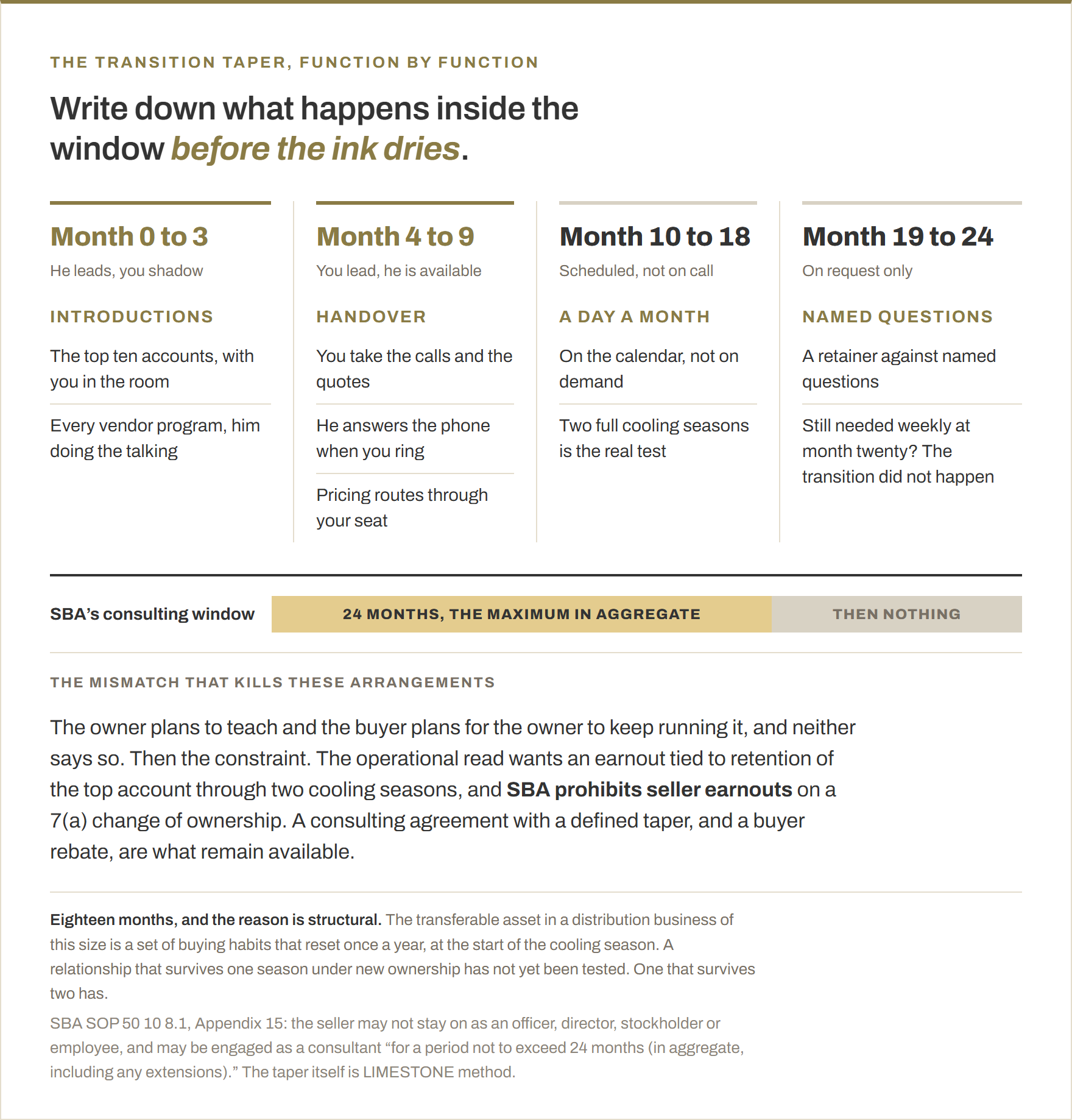
SBA prohibits seller earnouts on a 7(a) change of ownership, so a defined taper and a buyer rebate are what remain available.
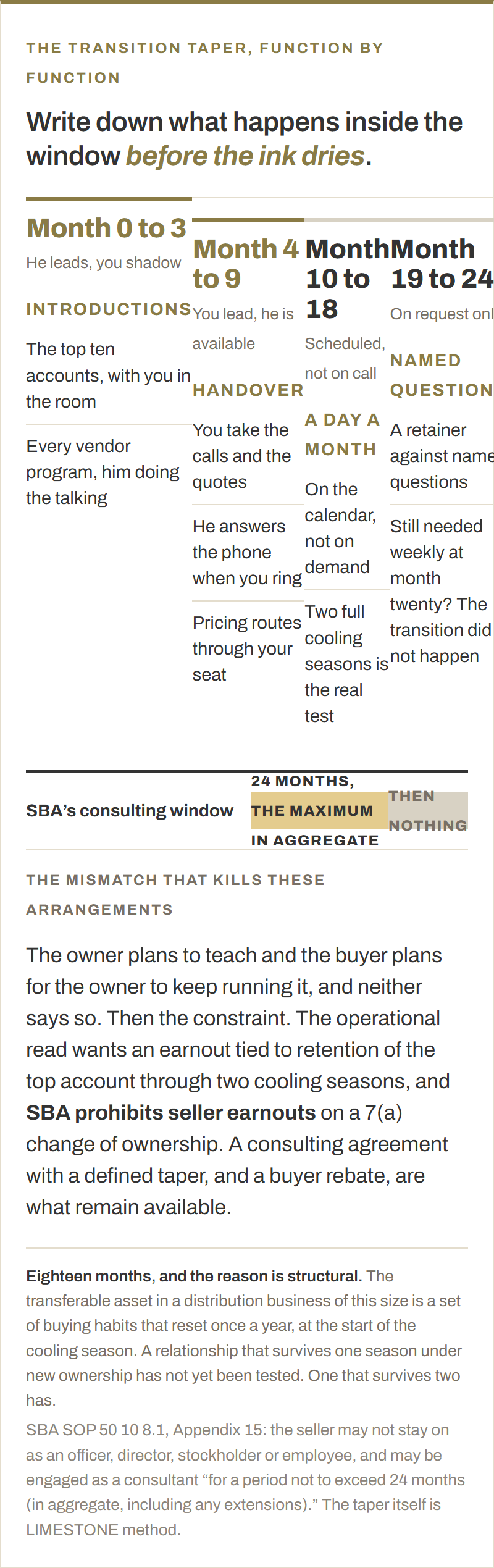
SBA prohibits seller earnouts on a 7(a) change of ownership, so a defined taper and a buyer rebate are what remain available.
Eighteen months, and the reason is structural
The transferable asset in a distribution business of this size is a set of buying habits that reset once a year, at the start of the cooling season. A relationship that survives one season under new ownership has not yet been tested. One that survives two has. That is the arithmetic behind eighteen months, and it is why a twelve-month agreement measured on the calendar proves nothing.
The mismatch that kills these arrangements
The owner plans to teach and the buyer plans for the owner to keep running it, and neither says so. Write the taper down function by function, with the month each one moves, and have both parties sign the same page. Then read the constraint. The operational read here wants an earnout tied to retention of the top account through two cooling seasons, and SBA prohibits seller earnouts on a 7(a) change of ownership. A consulting agreement with a defined taper and a buyer rebate are what remain available.
What arrives in the first quarter after closing
Diligence stops at closing and the first hundred days are their own guide. Four things arrive often enough that they belong at the end of this one, and all four are cheaper to plan for in week two of exclusivity than in week two of ownership.
| What arrives | Why |
|---|---|
| Payroll comes in higher Than the model says | Sellers give raises during diligence, out of guilt or out of retention anxiety, and they are rarely in the numbers you were given. Ask for the payroll register again, dated the week before closing, and compare it to the one you modeled |
| You have no credit For one to three years | A new entity has no trade history. Suppliers who gave the seller thirty days will ask you for a deposit or a personal guarantee, and the working capital effect of that is immediate and usually unmodeled |
| Working capital runs to roughly double What you modeled | The peg plus the credit wall plus the seasonal trough, which on this business is January rather than the June you closed in |
| Your own seat is unfilled You are three people now | Three of the five seats were owner-held and you are holding them. The honest question for the first hundred days is which one you give away first, and to whom |
Observed by LIMESTONE across its own engagements.
How this was built, and where it stops
The twenty-four-month consulting window, the officer and employee restriction and the earnout prohibition are quoted from SOP 50 10 8.1, Appendix 15. The five-seat map, the four sources, the interview guide and the taper are our own operational diligence method. Hoosier Supply Co. is a fictional composite used across our published samples so one set of findings can be tested in public; every name and figure attached to it is illustrative.
Two limits. This is not employment law advice, and a retention agreement is drafted by counsel rather than by us. And the seats framework is ours rather than a standard. It is how we have found the risk, and a different firm would cut it differently, which is worth knowing when you compare two scopes.
Questions we hear
Who checks whether a business runs without the owner?
Nobody, unless you buy it, and that’s the honest answer. A quality of earnings tests whether the earnings are accurate, and the SBA version must also judge whether revenue and margins are likely to hold after the sale, but neither it nor the business valuation tests the handover seat by seat. On an Initial Acquisition or Business Expansion at a $3 million business purchase price your lender requires both, and it requires nothing about owner dependence. So the work is operational diligence, and it is a separate engagement that runs alongside any quality of earnings scope. If you are not buying it, the two procedures that carry most of the value on your own are the reference calls and the owner’s calendar for the trailing ninety days.
Any tips for the first face-to-face meeting with a potential seller?
Ask him what he does on a Tuesday. Not what his role is, what he actually did last Tuesday, hour by hour. It’s a friendly question and it produces the calendar finding six weeks before you could get the calendar. Then ask who decides a price when he is away, and listen for whether the answer is a name or a shrug. Three things not to do: do not open on price, do not bring a list, and do not tell him what you plan to change. You are there to find out how the business runs and to be somebody he would sell to, and those are the same visit.
Is anyone using AI for due diligence?
We use it, and we’ll tell you exactly where. It collects and organizes documents, summarizes long files, and checks our own arithmetic. It does not make the calls, read the room in a management interview, or decide whether a cost recurs. The work on this page is judgment about people, and the part a buyer is paying for is somebody willing to put their name against that judgment in front of a credit committee. A report nobody will defend out loud is not worth what it costs to produce, however it was produced.
Does anyone have any good quality of earnings stories?
The one that stays with us is not a fraud. An owner told us the business ran without him and offered a two-week holiday as proof, and he believed it. His calendar showed 61 percent of his scheduled time in customer, pricing and vendor meetings, and eleven of fourteen recurring approvals routing through him. During the two weeks he was away, shipping and counter service ran fine, which is what he remembered. Two project quotes waited for him, a vendor rebate deadline was missed, and the top account called his mobile twice, which is what he did not. Owners under-report this one consistently and they are not being dishonest about it. A man who has answered the phone for twenty-eight years genuinely does not notice that he is the phone. The calendar notices.
